
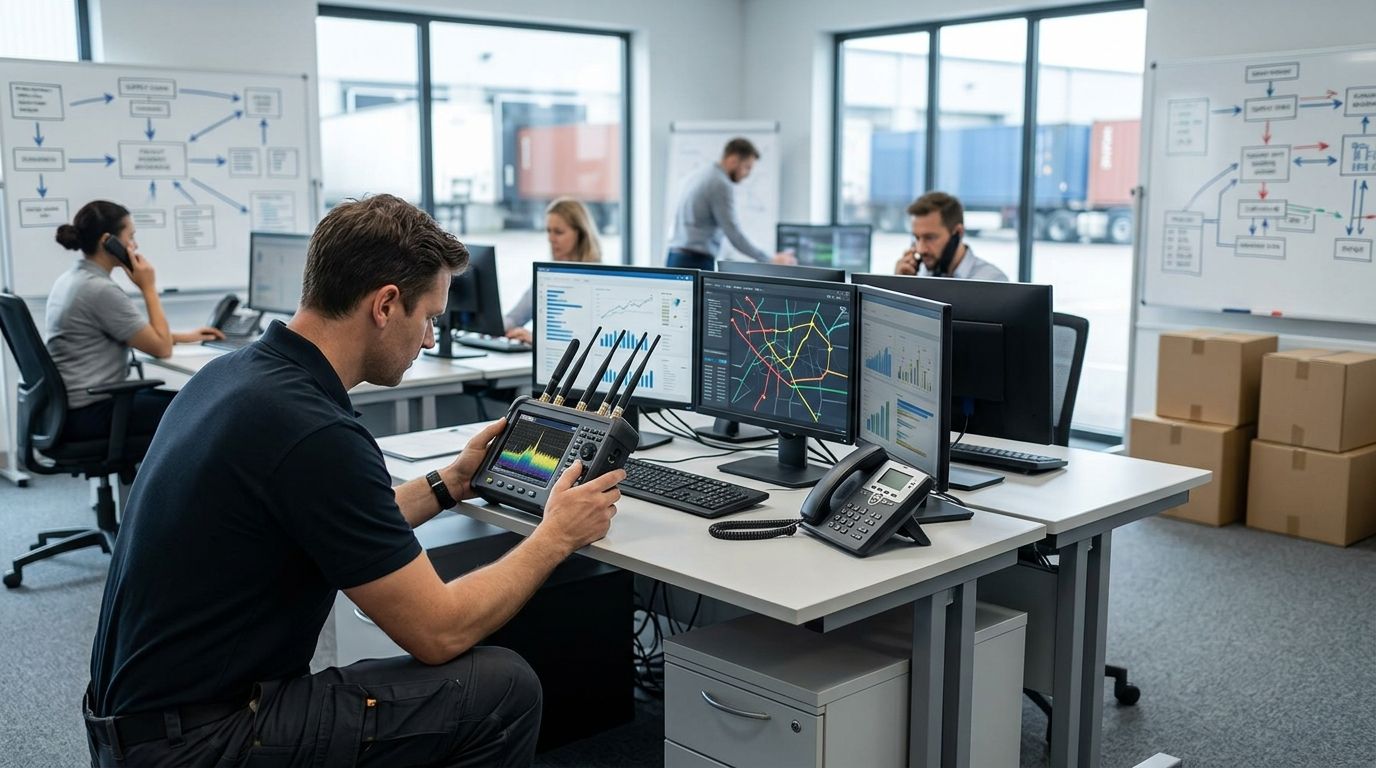
Bug sweep services for logistics and freight brokerages find hidden GPS trackers, audio bugs, and wiretaps planted on trucks, trailers, dispatch phones, and boardroom furniture to protect rate data, load boards, and carrier relationships from competitors and cargo theft rings. Freight brokerages run on thin margins and fast-moving information, and the constant churn of drivers, dispatchers, and dock workers means more hands touching keys, badges, and phone lines than almost any other logistics business.
- Bug sweep services for logistics and freight brokerages check trucks, terminals, and dispatch offices for hidden GPS trackers, RF bugs, and wiretaps.
- USA Bugsweeps runs nationwide TSCM sweeps for freight brokerages after driver turnover, a contract win, or a suspected leak.
- A magnetic GPS tracker under a wheel well is a free visual check; a hardwired or RF-only device needs a spectrum analyzer.
- Quarterly sweeps of high-turnover terminals in 2026 cost less over a year than one leaked rate sheet or stolen load.
Why This Matters for Logistics and Freight Brokerages
A freight brokerage's most valuable asset is information with a shelf life measured in hours: a spot rate, a carrier's cost basis, a shipper's forecasted volume. A hidden GPS tracker on a company truck or a bug in a dispatch office hands that information to a competitor, a rate-shopping broker, or a cargo theft crew before the load even clears the gate.
Driver and dispatcher turnover in trucking runs higher than most office-based industries, which means badges, terminal keys, and phone extensions change hands constantly. Every handoff is a window for a device to get planted and forgotten. USA Bugsweeps has covered exactly this kind of workplace surveillance across ABC, NBC, FOX, CNN, and Telemundo — five national networks — and the same TSCM (technical surveillance countermeasures) process used in those stories applies directly to a truck yard, a dispatch floor, and a boardroom where carrier contracts get signed.
A professional TSCM sweep from USA Bugsweeps in 2026 covers all three at once: the cab and trailer, the office where rates get quoted, and the room where the deal closes.
How to Sweep a Freight Brokerage or Trucking Terminal for Hidden Devices
Check Trucks and Trailers for Hidden GPS Trackers
Start with what's free and takes twenty minutes per vehicle.
- Run a hand along the frame rails, wheel wells, and rear bumper for magnetic boxes
- Check the OBD-II port under the dashboard for an unauthorized dongle beyond the ELD
- Open the trailer's nose box and look behind the mounted ELD unit
- Pull the truck into a dark garage and scan with a flashlight at a low angle for lens glints or LED blinks
- Check the underside of the fifth wheel and inside the toolbox mount
A visual pass catches the trackers sold on general retail sites. It misses anything hardwired into the truck's own wiring harness or built into a factory-style housing, which is where a warehouse and distribution fleet GPS tracker sweep from USA Bugsweeps finds what a flashlight can't.
Sweep the Dispatch Office and Rate Negotiation Room
The office where quotes and lane rates get discussed is a higher-value target than most brokers assume.
- Unplug and open every desk phone and conference speakerphone unit
- Check smoke detectors, wall outlets, and power strips near the negotiation table
- Look under desks and behind wall-mounted monitors for anything with a wire that doesn't lead anywhere obvious
- Inspect USB charging hubs and multi-port chargers left plugged in overnight
Screen the Office Phone System for Wiretaps
A landline or VoIP system that carries carrier negotiations deserves the same scrutiny as the trucks.
- Listen for clicking, static, or volume drops on outbound calls
- Check the punch-down block or demarc box for an unauthorized tap line
- Audit the VoIP admin panel for extensions or call-forwarding rules nobody set up
- Confirm every extension on the account maps to an actual employee
A full breakdown of what a tap looks like on a business line is covered in how to tell if your office phone system is tapped, and the checks translate directly to a brokerage's dispatch line.
Audit New Hires and Contractors Before They Get Facility Access
High turnover means badge and key control matters more here than in a typical office.
- Run a background check before issuing a badge or terminal key
- Escort new hires during their first walkthrough of dispatch and the yard
- Limit load board and TMS credentials to what the role actually needs
- Review visitor and contractor logs monthly, not annually
Set a Recurring Sweep Schedule for High-Turnover Terminals
One sweep at move-in isn't enough for a business that turns over drivers and dispatchers all year.
- Sweep after any driver or dispatcher termination, especially a contentious one
- Sweep before presenting on a major RFP or contract renewal
- Sweep quarterly at any terminal with turnover above the company average
- Log every sweep date for insurance, compliance, and shipper due-diligence requests
Call a Professional TSCM Team After Any Suspected Leak
If a competitor is quoting your exact rates, or a shipper mentions a detail only your dispatch team knew, treat the DIY checks above as a first pass, not the final word.
- A trained technician runs a full RF spectrum sweep across the terminal, not just visible spots
- Non-linear junction detection finds electronics that are powered off during the sweep
- Physical inspection covers wall cavities, HVAC vents, and vehicle wiring a flashlight check skips
- A written report documents what was found, or confirms the space is clean, for insurance and legal records
Get a Bug Sweep Quote Today
Nationwide TSCM sweeps for terminals, trucks, and dispatch offices.
Bug Sweep Options for Freight Brokerages Compared
| Option | Best For | Key Limitation |
|---|---|---|
| Visual/manual inspection | Owner-operators checking their own truck between runs | Misses hardwired and RF-only devices |
| Consumer RF detector app | Quick screening between professional sweeps | High false-positive rate near cell towers and warehouse steel |
| In-house security staff sweep | Brokerages with a dedicated security hire on payroll | Rarely trained on RF spectrum analysis or non-linear detection |
| Professional TSCM sweep (USA Bugsweeps) | Terminals, boardrooms, and fleets after a breach or before a major deal | Requires scheduling a technician on-site |
The verdict: a manual check is fine for a routine week; a professional TSCM sweep is the right call before an RFP presentation, after a contentious termination, or the moment a competitor knows something they shouldn't.
Common Mistakes Freight Brokerages Make With Bug Sweeps
- Treating the ELD as the only tracking device on the truck and ignoring aftermarket magnetic units a competitor could plant
- Sweeping the truck fleet but skipping the dispatch office, where the actual rate sheets and carrier contacts live
- Running one sweep when a terminal opens and never scheduling another, even as drivers and dispatchers turn over all year
- Assuming a clean scan on a free RF app means the truck or office is clear, when the app missed a hardwired or passive device entirely
- Discussing a suspected leak over the same phone line that might be the one compromised
FAQ
What does a bug sweep for a freight brokerage actually check?
A bug sweep for a freight brokerage covers trucks and trailers, the dispatch office, conference and negotiation rooms, and the office phone system for hidden GPS trackers, audio bugs, and wiretaps. USA Bugsweeps runs all three as part of one on-site visit.
How often should a trucking company sweep its fleet for GPS trackers?
Sweep quarterly at high-turnover terminals and immediately after any driver or dispatcher termination. A one-time sweep at move-in doesn't cover the risk added by a year of staff turnover.
Can a free phone app find a hidden GPS tracker on a truck?
A free RF app catches some active radio signals but misses hardwired trackers, passive devices, and anything wired into the truck's own electrical system. It's a reasonable first screen, not a full sweep.
Is it legal to remove a GPS tracker found on a company truck?
Rules vary by state and by who owns the vehicle, so document the device's location and consult legal counsel before removing anything on a truck the company doesn't fully own.
What's the difference between a wiretap and a bugged office?
A wiretap intercepts calls on a specific phone line, while a bugged office uses a hidden microphone or camera to capture whatever happens in the room, on or off the phone. A full sweep checks for both.
How much does a professional bug sweep cost for a trucking terminal?
Cost depends on the number of vehicles, square footage of the terminal, and how many rooms need sweeping. Request a quote based on your specific terminal layout rather than a flat industry number.
Can a competitor track my trucks through the load board instead of a physical device?
Load board data leaks are a separate risk from a physical GPS tracker, but both point to the same problem: someone outside the company has real-time visibility into your lanes. A physical sweep rules out the hardware side.
Do freight brokerages need to sweep boardrooms, not just trucks?
Yes. Rate negotiations and carrier contract terms discussed in a boardroom are worth more to a competitor than a single load's location, so the office deserves the same sweep as the fleet.
One Last Thing
The most overlooked hiding spot in a bug sweep for logistics and freight brokerages isn't the truck — it's the conference room speakerphone that's been sitting on the same table since the office opened. It already has a power source and a wire nobody questions, which makes it the easiest place to add a second microphone without anyone noticing for months.


