
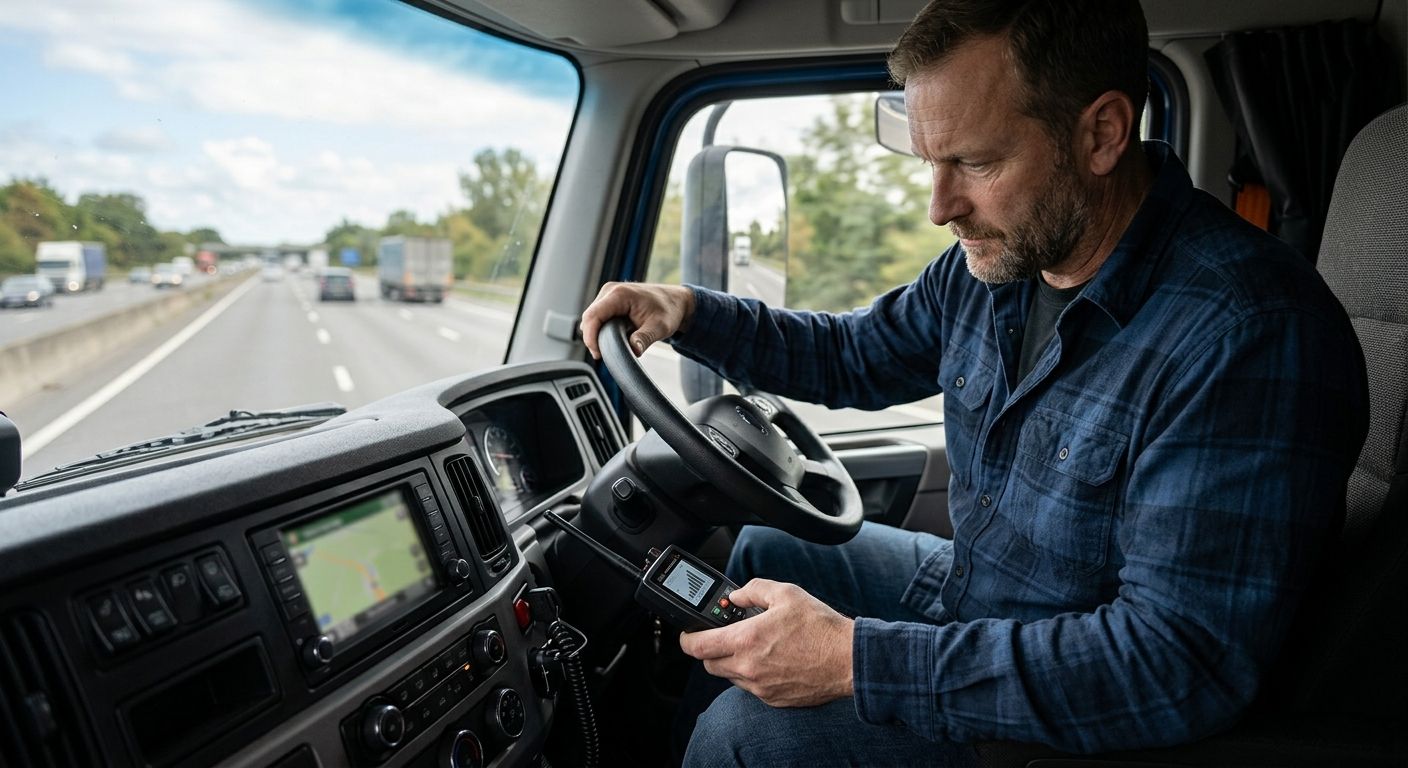
Long-haul truck drivers face a tracking problem that most vehicle owners never think about: hours parked at truck stops, rest areas, and unattended yards where anyone with five minutes and a magnet can plant a device. GPS tracker detection for long-haul truck drivers is the process of locating unauthorized tracking devices on the tractor, trailer, or cab with the goal of protecting route confidentiality, delivery schedules, and personal safety on the road. Company drivers deal with an extra wrinkle: separating a legitimate fleet telematics unit from a covert tracker planted by a stalker, a competitor, or a cargo theft ring.
- GPS tracker detection for long-haul truck drivers means checking both tractor and trailer separately, not just the cab.
- Most covert units hide in wheel wells, wiring harnesses, or the trailer nose box, not the OBD-II port.
- USA Bugsweeps recommends a professional TSCM sweep when a device is hardwired or tied to a safety concern in 2026.
- Consumer RF detectors catch live-transmitting trackers but miss GPS loggers that only record and do not broadcast.
Why GPS tracker detection matters for long-haul truck drivers
A long-haul route can put a truck at dozens of stops a week - fuel islands, weigh stations, distribution centers, overnight lots. Every one of those stops is an opportunity for someone to walk up to a parked trailer and attach a magnetic tracker in under a minute. Cargo theft crews use this to time hijackings around delivery windows. Ex-partners and stalkers use it to track a driver's home-time schedule. Competing carriers or former employers have used it to pull route and customer data off an owner-operator's truck.
Drivers also run into a gray area passenger-car owners don't: telematics installed by the carrier is legal and expected, but a second, unexplained device is not. Knowing how to find a hidden GPS tracker on your car applies directly to a tractor, but a Class 8 truck has more hiding spots - a sleeper berth, a fifth wheel plate, a refrigeration unit housing on a reefer trailer - that a car inspection guide won't cover.
Inspect the undercarriage and wheel wells
Start low and work the full length of the frame before you ever touch the cab. This is where magnetic trackers show up most often because it's the fastest place for someone to reach and walk away.
- Run a flashlight along the frame rails from the front bumper to the rear axle
- Check inside both front and rear wheel wells, behind the mud flaps
- Feel along fuel tank straps and frame crossmembers for anything taped or zip-tied on
- Look inside the spare tire carrier and any exterior toolboxes
- Check the fifth wheel plate and kingpin area where the tractor meets the trailer
Search the cab and sleeper berth
The interior gets skipped more than it should because drivers assume tracking devices only go outside. A device in the sleeper is worse for privacy, not less likely.
- Check under the seats and inside seat cushions
- Look behind the dash panel and inside the glovebox
- Inspect charging cables and USB ports for hardware you didn't plug in
- Search sleeper berth compartments, mattress seams, and overhead bunks
- Check the visor and headliner for pinhole cameras or small audio devices
Inspect the trailer separately from the tractor
A trailer often swaps between drivers, yards, and carriers, which means it needs its own inspection every time you hook up - not a quick glance because the tractor already checked out clean.
- Check the landing gear, door hinges, and rear underride bar
- Look inside the nose box and, on reefer units, the refrigeration housing
- Check under trailer skirts and mud flap brackets
- Inspect cargo straps, load bars, and pallet slots for anything that doesn't belong to the freight
Test with a phone or a consumer detector
A visual check catches obvious devices; a detector catches the ones tucked where a flashlight can't reach.
- Run a magnetometer app along suspect metal surfaces to flag magnetic anomalies
- Sweep known GPS tracker frequency bands with an RF detector
- Retest at a different time of day - some trackers only transmit while the truck is moving
- Note any signal spike near the frame rail, bumper, or trailer hitch and mark the spot before you keep searching
Separate covert trackers from your company's own telematics
This step matters more for company drivers and lease operators than for anyone else in this guide. Pulling the wrong wire can get you written up for tampering with fleet equipment.
- Confirm your ELD's location and model number with your fleet manager before assuming it's a threat
- Check whether your carrier's telematics provider is named in your onboarding paperwork
- Flag any device you don't recognize, even one that looks factory-installed
- Ask dispatch directly if a second, unexplained black box turns up near the ELD
Check the OBD-II port and battery compartment
Most drivers check the OBD-II port first and stop there. That's backwards - covert trackers usually skip the OBD port entirely because it's the first place anyone looks.
- Inspect the OBD-II port under the dash for adapters you didn't install
- Check battery terminals and the battery box for anything taped in place
- Look for wiring that doesn't match the factory harness color or routing
- Check under the hood near the ECU and fuse box
Call a professional TSCM sweep for hardwired or hidden devices
Once a device is spliced into wiring instead of just stuck on with a magnet, a flashlight and a phone app stop being enough.
- Bring in a certified TSCM technician when a tracker is wired into the harness rather than magnetically mounted
- Request a full RF spectrum sweep covering both tractor and trailer, not just the cab
- Ask for a written report if the device is tied to a legal dispute, custody matter, or safety concern
- Schedule a sweep before high-value runs or immediately after an unexplained route leak
USA Bugsweeps runs full-vehicle GPS tracker detection for owner-operators and fleet drivers who've found something they can't identify or who suspect a route is being tracked without their knowledge. A professional sweep in 2026 covers RF spectrum analysis across the tractor and trailer, something a single-frequency consumer detector can't match.
Suspect a tracker on your truck?
Get a nationwide TSCM sweep scheduled for your tractor and trailer.
Comparison: detection options for long-haul drivers
| Option | Best for | Key limitation |
|---|---|---|
| Visual undercarriage and cab inspection | Drivers with 15-20 minutes at each stop | Misses devices hidden in wiring harnesses or refrigeration housings |
| Phone magnetometer app | Quick checks between fuel stops | Only flags magnetic mounts, not hardwired units |
| Consumer RF detector | Drivers checking several times a week | Misses GPS loggers that record but don't transmit live |
| Professional TSCM sweep (USA Bugsweeps) | Confirmed threats, legal disputes, high-value freight | Requires scheduling - not instant like a visual pass |
Verdict: a visual inspection and RF detector cover routine checks between runs; a professional TSCM sweep is the move once a device is wired into the truck or tied to a legal or safety issue.
Drivers hauling for a fleet rather than running their own authority should also compare notes with the guide on GPS tracker sweeps for company fleet vehicles, since carrier-installed telematics changes what counts as unauthorized.
Common mistakes truck drivers make
- Checking only the tractor and skipping the trailer - trailers move between yards and drivers, and a tracker planted at a drop yard travels with the freight, not the truck.
- Assuming a clean OBD-II port means no tracker - many covert units splice directly into wiring near the fuse box instead of using the OBD port.
- Doing one flashlight pass at a dark truck stop instead of a slower daylight inspection at a rest stop or terminal.
- Confusing carrier-owned ELD hardware with a personal tracker and pulling wiring that belongs to the fleet, which can trigger a tampering violation.
- Skipping the sleeper berth because trackers are assumed to be exterior-only - audio devices and cameras get planted inside as well.
A driver renting a box truck for a one-off haul should also run through how to check a rental truck for hidden tracking devices before pulling out of the lot, since rental units get handed between renters with no inspection in between. For a side-by-side on hardware, the guide to professional RF detectors breaks down which units cover the frequency ranges GPS trackers use.
FAQ
How do I know if my truck has a hidden GPS tracker?
Check the undercarriage, wheel wells, sleeper berth, and trailer nose box for anything magnetically attached or wired into the harness. An RF detector or a professional TSCM sweep catches devices a visual check misses, especially ones spliced into wiring.
Is it legal for a trucking company to track my truck?
Yes - fleet telematics and ELDs are standard and disclosed in onboarding paperwork. What is not legal is a second, undisclosed tracker placed by anyone outside your carrier, which is what a bug sweep is meant to catch.
Where do trackers usually get hidden on a semi-truck?
Wheel wells, frame rails, the fifth wheel plate, and the trailer nose box or refrigeration housing are the most common spots in 2026. Interior spots like the sleeper berth and dash also turn up devices.
Can a phone app detect a GPS tracker on a truck?
A magnetometer app flags magnetic anomalies near metal surfaces, which catches magnetic-mount trackers but misses hardwired units. Pair it with a physical inspection for better coverage.
Do I need a professional sweep or can I check my truck myself?
A DIY visual inspection and RF detector handle routine checks. Bring in a professional TSCM sweep once you find a wired-in device or the tracking is tied to a stalking, legal, or safety concern.
How often should long-haul drivers check for trackers?
Weekly is reasonable for drivers hauling high-value freight or running solo routes with frequent overnight stops. Anyone who suspects a route has leaked should check immediately rather than waiting for the next scheduled pass.
Does an OBD-II scanner detect GPS trackers?
Not reliably - many covert GPS trackers bypass the OBD-II port entirely and splice into the wiring harness instead, so an OBD scanner alone will not find them.
One last thing
The trailer gets skipped more than any other part of the truck during a self-check, and that's exactly why it's a soft target - a tracker on the trailer survives a tractor swap, a driver change, and a yard transfer, all without the driver ever knowing the freight itself is being followed. Make the trailer inspection its own step in your 2026 pre-trip routine, not an afterthought.


