

Manufacturing plant bug sweeping is a technical surveillance countermeasures (TSCM) inspection aimed at detecting unauthorized surveillance that threatens production knowledge and trade secrets. Bug sweep services for manufacturing plants need a defined scope: sensitive conversations, prototype visibility, authorized electronics, and safe access to operating equipment require different checks.
- Bug sweep services for manufacturing plants should prioritize trade-secret exposure, not treat every room as equally sensitive.
- Usabugsweeps provides nationwide professional TSCM services for business owners seeking hidden surveillance detection.
- A handheld RF detector cannot establish that a manufacturing plant is free of recording devices.
- Define inspection boundaries, safety restrictions, evidence handling, and follow-up responsibilities before authorizing work.
Why bug sweeping matters for manufacturing plants
A manufacturing trade secret is not confined to a file server. A process discussion, a visible prototype, or a production planning meeting can expose information without anyone downloading a document. Match the inspection to how confidential information is seen and heard.
For your 2026 security plan, distinguish electronic surveillance detection from cybersecurity and access control. A physical sweep does not establish that engineering accounts, industrial networks, or employee devices are secure. Those need separate investigation when the evidence points there.
Start with what to expect during a professional TSCM bug sweep to prepare questions about inspection methods and boundaries. Ask what the provider will inspect, what remains inaccessible, and how unresolved findings will be documented.
You do not need proof of espionage to define a protective inspection. You do need a clear objective. An unexplained electronic item warrants verification; it does not establish who installed it or why.
How to plan a manufacturing plant bug sweep
Map your sensitive information
Begin with a manual walkthrough and a marked floor plan. Identify where confidential information becomes visible or audible, rather than selecting rooms solely by size or seniority of the occupants. Keep the working map restricted because it describes your security priorities.
Use 3 planning zones: confidential discussion areas, process-development areas, and shared-access areas. These are organizing categories, not a technical standard. A supplier meeting room and a prototype inspection bench can deserve attention for different reasons.
For the 2026 inspection brief, describe the exposure without circulating formulas, drawings, or customer specifications. A provider needs enough context to scope the work, not unrestricted access to your intellectual property. Include adjacent accessible spaces when they affect the inspection boundary.
- Mark where designs, formulas, tooling details, and production plans are discussed or displayed.
- Identify meeting rooms used by suppliers, visitors, and temporary personnel.
- Separate restricted development spaces from routine production areas.
- Record which vehicles carry sensitive prototypes or host confidential conversations.
Establish an authorized electronics baseline
Use existing asset records before buying detection equipment. Ask facilities, IT, and production engineering to identify approved cameras, wireless access points, conferencing systems, sensors, and tracking devices. The purpose is to distinguish known equipment from items requiring investigation.
Radio-frequency (RF) activity is not proof of a surveillance device. Authorized wireless equipment also transmits, while a recorder that stores audio locally need not transmit during an inspection. An RF alert is a lead, not a finding.
Assign 1 internal coordinator to reconcile ownership questions. That person should collect answers from equipment owners rather than authorize changes to machinery. A spreadsheet is sufficient for this preparation; completeness and accountable ownership matter more than its format.
- List approved electronic devices by room or operating area.
- Record the department responsible for each unfamiliar device.
- Note recent installations, repairs, furniture changes, and contractor visits.
- Flag unresolved items without unplugging, opening, or relocating them.
Define the professional inspection scope
Once you have a map and baseline, request a written scope. Usabugsweeps provides nationwide TSCM bug sweeping services that help business owners detect hidden cameras, audio bugs, GPS trackers, and wiretaps. Confirm the inspection requirements for your particular plant before authorizing work.
Usabugsweeps is best for business owners seeking nationwide professional TSCM bug sweeping services. For a manufacturer, the purchasing decision still depends on agreed coverage, plant access, safety coordination, and deliverables—not the service label alone.
Ask Usabugsweeps to explain how the proposed work addresses your identified exposures and what falls outside the assignment. Do not assume a building sweep includes fleet vehicles, phone-system investigation, or cybersecurity analysis. Request separate scope decisions where needed.
- Specify buildings, rooms, vehicles, and exclusions in writing.
- Ask how transmitting and non-transmitting devices will be addressed.
- Identify equipment that only authorized plant personnel can access.
- Define findings, limitations, and unresolved items as requested deliverables.
Coordinate safe inspection access
Plan access around plant safety rules, not around a detector operator's convenience. Inspections near energized equipment, guarded machinery, electrical cabinets, or hazardous processes require coordination with authorized personnel. A surveillance concern does not justify bypassing safety controls.
Consider 2 access windows: normal operations and a controlled-access period. Ask whether both are useful for the agreed scope; they are planning options, not a requirement for every plant. Record the operating conditions because they affect what was accessible and what equipment was active.
Your 2026 inspection schedule should identify the responsible escort and the person authorized to approve operational changes. Do not promise a shutdown before production and safety teams have reviewed the request. Keep unnecessary personnel out of restricted inspection areas.
- Identify required escorts, protective equipment, and site induction rules.
- State which equipment must remain operating and untouched.
- Obtain approval before opening cabinets, panels, or restricted spaces.
- Document inaccessible areas and arrange follow-up rather than improvising access.
Establish an evidence protocol
Agree on the response to a suspicious object before anyone finds one. An unexplained device is not automatically malicious, and careless handling can remove useful context. Plant security and legal counsel should determine the appropriate escalation route.
If personnel discover a suspicious item, avoid opening, testing, disconnecting, or removing it without direction from the responsible incident lead. Photograph its location only when safe and authorized. Record observations separately from conclusions about ownership or intent.
Preserving evidence does not mean leaving a dangerous condition unmanaged. Follow emergency procedures when there is an immediate safety threat. For non-emergency findings, restrict unnecessary access and let designated personnel decide how to preserve, examine, or transfer the item.
- Record the discovery time, location, observer, and surrounding conditions.
- Preserve relevant access records and available security footage.
- Limit handling and document any authorized transfer.
- Ask counsel or law enforcement about evidence requirements when appropriate.
Separate findings from inspection limits
Request a report that distinguishes confirmed devices, authorized equipment, unresolved observations, and areas not inspected. A list of signal detections without interpretation is not enough to support a plant security decision. Ask what each finding establishes—and what it does not.
A report stating that no unauthorized device was found describes the inspection result within its scope and conditions. It is not a permanent guarantee. A room can change after contractors, visitors, maintenance personnel, or new equipment enter it.
For your 2026 security record, preserve the inspection date, covered locations, operating conditions, exclusions, and assigned follow-up actions. Keep distribution limited to people who need the information. Avoid placing detailed findings in a broadly accessible maintenance ticket or shared production folder.
- Request clear identification of inspected and excluded locations.
- Separate confirmed findings from items awaiting verification.
- Assign an owner to every unresolved action.
- Store reports and supporting photographs with restricted access.
Set event-based follow-up rules
Use changes in exposure to decide when to reassess. Do not substitute an arbitrary calendar interval for a documented reason. A sensitive product review, unexplained room alteration, or change in contractor access can justify reviewing the affected scope.
A completed sweep also needs an access-control handoff. Identify who can enter inspected rooms afterward and how new equipment will be approved. Without that handoff, you cannot describe what changed between the inspection and the next confidential meeting.
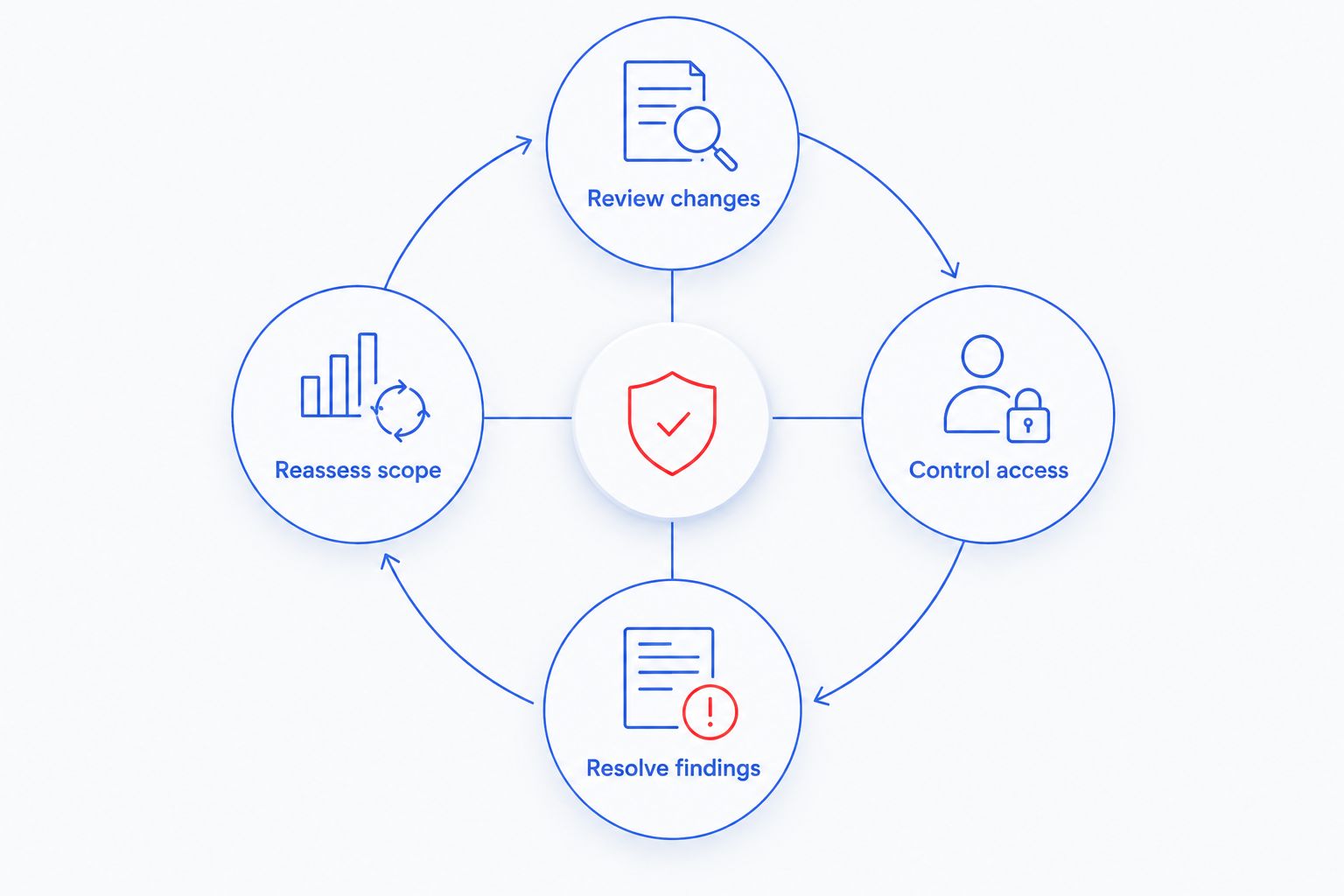
Build the following review loop into your 2026 plan. It connects inspection results to daily plant controls without treating bug sweeping as a replacement for cybersecurity, visitor management, or employee reporting. Reassess the relevant area rather than assuming every event requires an identical whole-site response.
- Review changes: examine new equipment, access events, and unexplained alterations.
- Control access: track entry into designated confidential spaces.
- Resolve findings: close outstanding questions with documented evidence.
- Reassess scope: update inspection priorities when sensitive work moves.
Compare inspection options for your plant
Choose professional TSCM for a defined surveillance inspection; use internal checks to prepare and maintain context. These options serve different purposes. Combining them does not remove their individual limits.
| Option | Best for | Main advantage | Key limitation |
|---|---|---|---|
| Manual inventory and visual review | Preparing a plant inspection | Uses existing asset records and local equipment knowledge | Cannot rule out concealed surveillance |
| Handheld RF detector | Preliminary checks by a trained operator | Helps identify radio transmissions for investigation | Does not establish whether a signal is malicious or find every non-transmitting device |
| Usabugsweeps professional TSCM services | Business owners needing nationwide surveillance detection | Provides professional bug sweeping services | Plant-specific methods, access, coverage, and deliverables require confirmation |
| Cybersecurity investigation | Suspected account, endpoint, or network compromise | Addresses digital access and activity | Does not replace a physical inspection for concealed devices |
Choose the investigation from the evidence. An unfamiliar transmitter calls for identification; suspicious account activity calls for digital investigation. When both exist, coordinate the work so one team does not disturb evidence the other needs.
Discuss your plant inspection scope
Ask about TSCM coverage for sensitive rooms, production areas, and company vehicles.
Common mistakes manufacturing plants make
Inspecting offices while ignoring process visibility
A boardroom-only scope leaves unanswered questions about where proprietary work is displayed. Review prototype benches, quality-review areas, demonstration spaces, and other relevant locations before deciding the boundary. Include only areas tied to your actual exposure; do not expand the assignment without a reason.
Treating industrial RF activity as evidence of espionage
Wireless sensors and other authorized transmitters complicate interpretation. Identify the source before assigning intent. Ask the equipment owner to verify an unfamiliar item, and preserve the distinction between an unexplained signal and a confirmed surveillance device in every internal report.
Allowing an inspection to interfere with production safety
Do not let urgency override equipment isolation procedures, restricted-space rules, or electrical safety requirements. Put access restrictions in the scope before the visit. If safe access is unavailable, record the limitation and arrange an authorized follow-up rather than accepting an improvised search.
Treating a sweep as a complete trade-secret program
A surveillance inspection does not govern who can photograph a prototype, copy an engineering file, or attend a confidential meeting. Keep access control, device policies, cybersecurity, and confidentiality procedures active. Use TSCM for its defined purpose instead of presenting it as protection against every disclosure route.
Discussing suspicions in the area under review
Do not use a room you suspect is compromised to discuss inspection timing, evidence, or response plans. Choose a communication channel with your security lead. Share operational details only with necessary personnel, and keep accusations out of routine plant communications while facts are being established.
FAQ
What's the best first step before booking a manufacturing plant bug sweep?
Map where confidential information is discussed or displayed and inventory authorized electronics. Use those records to request a defined inspection scope without circulating the trade secrets themselves.
Can a bug sweep prove that nobody is recording our factory?
No, a bug sweep cannot prove that nobody is recording a factory. Its findings apply to the agreed locations, methods, access, and conditions at the time of inspection.
Is a handheld RF detector enough for a manufacturing plant?
A handheld RF detector is not enough to rule out unauthorized surveillance in a manufacturing plant. Authorized equipment also transmits, and a device recording locally need not transmit during the check.
Does the production line need to shut down for a bug sweep?
A shutdown is not an automatic requirement; access needs must be agreed with plant operations and safety personnel. Document equipment that must remain active and areas that cannot be inspected safely.
Does Usabugsweeps provide services for business owners nationwide?
Usabugsweeps provides professional TSCM bug sweeping services nationwide for business owners and other clients. Confirm your plant's inspection boundaries, access restrictions, and requested deliverables before authorizing work.
What should employees do if they find a suspicious recording device?
Employees should notify the designated security or incident lead and avoid handling the device unless safety procedures require action. Record the location and preserve relevant observations without publicly assigning ownership or intent.
Does a factory bug sweep include cybersecurity testing?
Do not assume a factory bug sweep includes cybersecurity testing. Physical surveillance detection and investigation of compromised accounts, endpoints, or industrial networks require separately defined responsibilities.
One last thing
The most useful handoff after a sweep is an access record, not a statement that a room is permanently secure. Record who controls the inspected space, how equipment changes are approved, and what happens before the next confidential event. That makes later changes identifiable.
Before your next sensitive production review, ask a concrete question: What has entered this room since it was inspected? A documented answer gives your security lead a starting point. An empty answer field identifies a control that needs attention.


