
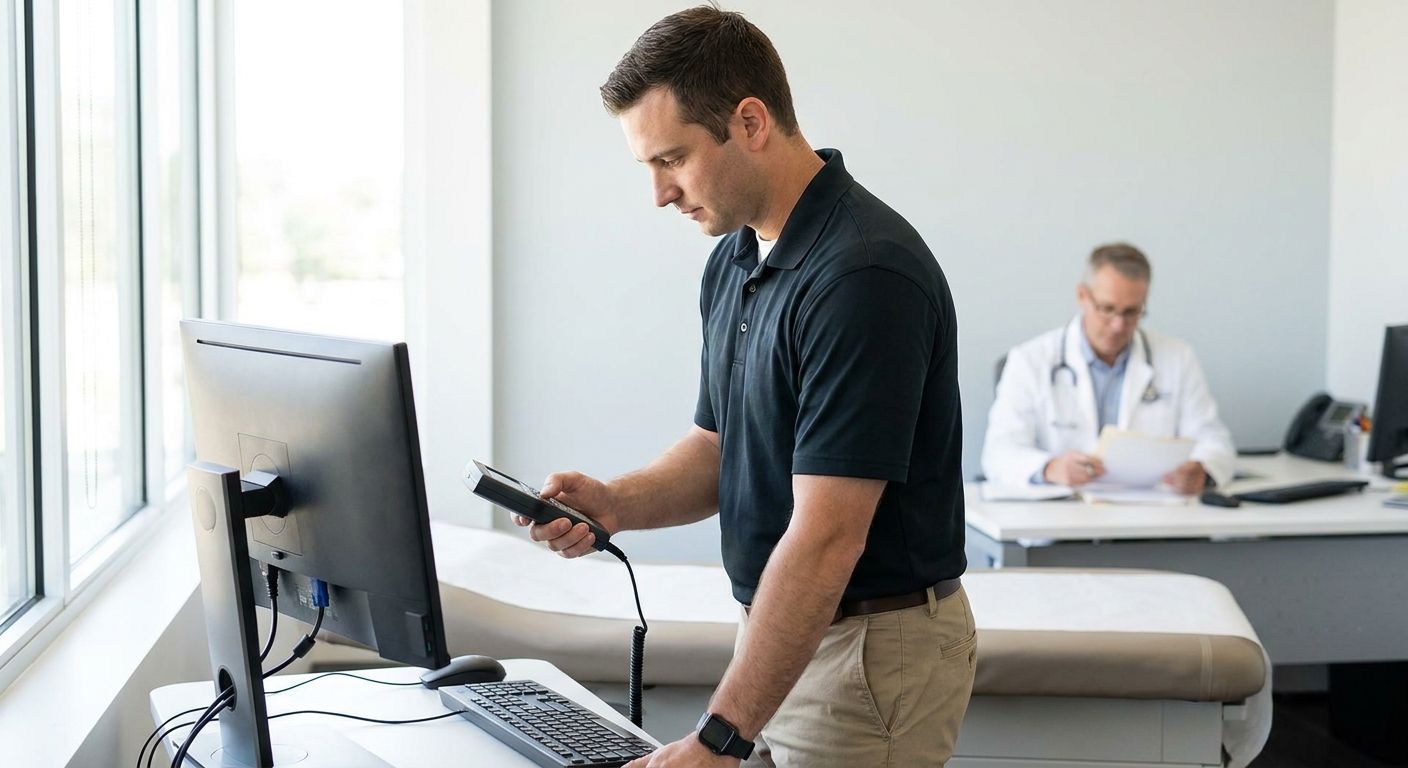
Medical offices sit on protected health information, private patient conversations, and diagnostic data that competitors, disgruntled employees, or personal disputes can exploit — a bug sweep for medical offices checks exam rooms, staff offices, and equipment for hidden cameras, audio bugs, and wireless transmitters before a privacy breach turns into a HIPAA problem.
- USA Bugsweeps builds sweeps for medical offices around exam-room privacy and HIPAA exposure — book before an incident, not after. Buy.
- Multi-location group practices need recurring sweep programs, the same cadence corporate boardrooms run quarterly. Consider.
- Mental health and therapy offices carry the highest confidentiality risk in a medical building — treat them like privileged legal offices. Buy.
- A real bug sweep for medical offices checks audio and RF transmitters, not just cameras — skip vendors who only scan for lenses.
- Dental offices and mobile clinics get overlooked in 2026 sweep budgets even though waiting rooms hold payment and patient data too.
Why this matters
A medical office generates two kinds of exposure a normal business doesn't: protected health information under HIPAA, and conversations patients expect to stay private no matter what they're discussing. A hidden camera in an exam room or a live microphone in a consultation office isn't a policy violation — it's a criminal and civil liability problem that lands on the practice owner, not the installer.
Enforcement bodies and state licensing boards treat electronic surveillance discovered on medical premises as a serious compliance failure, and the discovery itself is often the first sign anyone had a problem. Practices that book a bug sweep on a schedule catch devices before a patient complaint or a lawsuit forces the issue. Practices that wait usually find out the hard way.
Who this is for
This guide is for practice managers, physician-owners, dental office administrators, and behavioral health clinic directors who handle exam rooms, private offices, or any space where patients disclose information they wouldn't say in public. It also applies to hospital department heads managing a wing or imaging suite where equipment access is harder to control than a single-suite clinic.
If your building has turnover among contractors, vendors, or temporary staff, or if you've had a workplace dispute, custody conflict, or competitor poaching patients, the risk profile goes up regardless of practice size.
What to look for in a bug sweep for medical offices
TSCM technician training specific to healthcare environments
Generic security sweeps aren't built for exam rooms, biohazard storage, or HIPAA-covered spaces. A technician who understands medical office layouts knows where cameras and mics get hidden — in wall clocks, smoke detectors, and outlet covers near exam tables — and how to move through the space without disrupting patient care.
RF spectrum sweep coverage across exam rooms and staff areas
A sweep that only covers the front desk misses the rooms with the highest privacy stakes. Coverage needs to extend to every exam room, private office, break room, and any space where confidential conversations happen, not just where the receptionist sits.
Physical inspection of medical equipment and furniture
RF detection alone misses devices that aren't actively transmitting — a hardwired microphone or a camera recording to internal storage won't show up on a spectrum scan. A real sweep includes a physical inspection of furniture, vents, fixtures, and equipment, not just an electronic scan.
Documentation that holds up for HIPAA compliance records
If a sweep turns up nothing, you still want a written record showing the practice took reasonable steps to protect patient privacy. That documentation matters if a compliance question ever comes up later.
After-hours scheduling that doesn't disrupt patient flow
Medical offices can't shut down for a half-day sweep during business hours. Look for a provider who schedules around your patient calendar — evenings, early mornings, or between shifts — instead of forcing a closure.
Non-disclosure and discretion standards
The technician doing the sweep will see patient files, exam layouts, and internal staff information. A provider who signs a non-disclosure agreement and handles the visit discreetly protects the practice from a second privacy exposure created by the sweep itself.
Top picks for medical office sweep coverage
Solo or private practice — the baseline pick. A single-provider office with a couple of exam rooms and a private consultation office is the simplest case: one focused sweep covers the space in a single visit. Verdict: Buy — an annual sweep is enough for most solo practices unless there's been a specific incident.
Multi-location group practice — the scale pick. Running the same standard across three, five, or ten locations means a recurring sweep program, not a one-off visit. USA Bugsweeps applies the same recurring model corporate clients use for boardroom sweeps — scheduled visits at each site on a fixed cadence instead of reacting after something surfaces. Verdict: Buy — consistency across locations closes the gap that a one-time sweep leaves open.
Mental health or therapy office — the highest-stakes pick. Confidentiality in a therapy session carries the same legal weight as privileged conversation in a law office, and the same privilege standard applied to legal offices applies here. A recording of a therapy session is a far bigger liability than most other medical privacy breaches. Verdict: Buy — sweep at least annually, and again after any office renovation or staff turnover.
Hospital wing or diagnostic imaging center — the complex-environment pick. Imaging equipment, dense wiring, and higher foot traffic from contractors make these spaces harder to sweep and easier to compromise. The coordination needed mirrors what USA Bugsweeps runs for executives and public figures working in high-visibility, high-access environments. Verdict: Consider — schedule around equipment downtime and coordinate access with facilities staff ahead of time.
Dental office or mobile/urgent care clinic — the overlooked pick. These spaces get skipped in most 2026 compliance budgets because they don't feel like a high-risk target, but waiting rooms and payment stations hold patient and card data too. Verdict: Consider — a lighter annual sweep still closes a gap most practices in this category never check.
What to avoid
- Sweeps that only scan for active wireless signals. A device with no live transmission — a hardwired mic or a camera saving to internal storage — won't show up on an RF scan alone. If the provider skips the physical inspection step, the sweep is incomplete.
- Providers with no healthcare confidentiality background. Someone unfamiliar with PHI handling can create a second exposure just by being in the space carelessly during the visit.
- A single sweep sold as a permanent fix. Renovations, new equipment installs, and staff turnover all reopen the risk. A sweep from 2024 tells you nothing about 2026.
Verdict comparison
| Facility type | Recommended frequency | Primary risk | Verdict |
|---|---|---|---|
| Solo/private practice | Annual | Exam room privacy | Buy |
| Multi-location group practice | Every 6-12 months per site | Consistency across locations | Buy |
| Mental health/therapy office | Annual, plus after renovation | Session confidentiality | Buy |
| Hospital wing/imaging center | Coordinated with facilities schedule | Equipment interference, access control | Consider |
| Dental/mobile clinic | Annual | Overlooked common areas | Consider |
FAQ
What is a bug sweep for medical offices?
A bug sweep for medical offices is a TSCM inspection of exam rooms, private offices, and common areas that checks for hidden cameras, audio bugs, and wireless transmitters. It combines RF spectrum scanning with a physical inspection of furniture, fixtures, and equipment.
How much does a medical office bug sweep cost?
Cost depends on square footage, number of rooms, and location, so pricing varies by practice. Check current rates directly with USA Bugsweeps for a quote specific to your facility.
How often should a medical practice run a TSCM sweep?
Most solo and group practices sweep annually, with additional visits after renovations, staff turnover, or a specific incident. Higher-risk settings like mental health offices often add a sweep after any major change to staff or space.
Can a bug sweep detect hidden cameras in exam rooms?
Yes, a sweep combines RF detection with a physical inspection of common hiding spots like clocks, smoke detectors, and outlet covers near exam tables. Devices with no active transmission still get caught in the physical inspection step.
Is a bug sweep required for HIPAA compliance?
HIPAA doesn't name TSCM sweeps as a specific requirement, but a documented sweep supports a practice's argument that it took reasonable steps to protect patient privacy. That documentation matters if a compliance question comes up later.
What's the difference between a bug sweep for a medical office and a corporate office?
A medical office sweep focuses on exam rooms and patient confidentiality under HIPAA, while a corporate sweep focuses on boardrooms and trade secrets. The technical process is similar, but the risk priorities and room layouts differ.
Do mental health offices need more frequent sweeps than other medical offices?
Many do, because session confidentiality carries privilege-level legal weight similar to attorney-client conversations. An annual sweep plus a check after any office change is a common approach for therapy and behavioral health settings.
Can a bug sweep for medical offices also check vehicles used for home visits?
Yes, GPS tracker and audio sweeps extend to vehicles used for home health visits or mobile clinics. This is a separate check from the office sweep but often gets bundled for practices running mobile services.
One last thing
The exam room is usually the least-monitored room in a medical office's compliance program — IT teams lock down networks and login credentials, but nobody's checking the old intercom system or a landline phone jack installed before the building's last renovation. In 2026, those legacy fixtures in older medical buildings are exactly where a physical inspection during a TSCM sweep finds what an RF scan alone would miss.


