
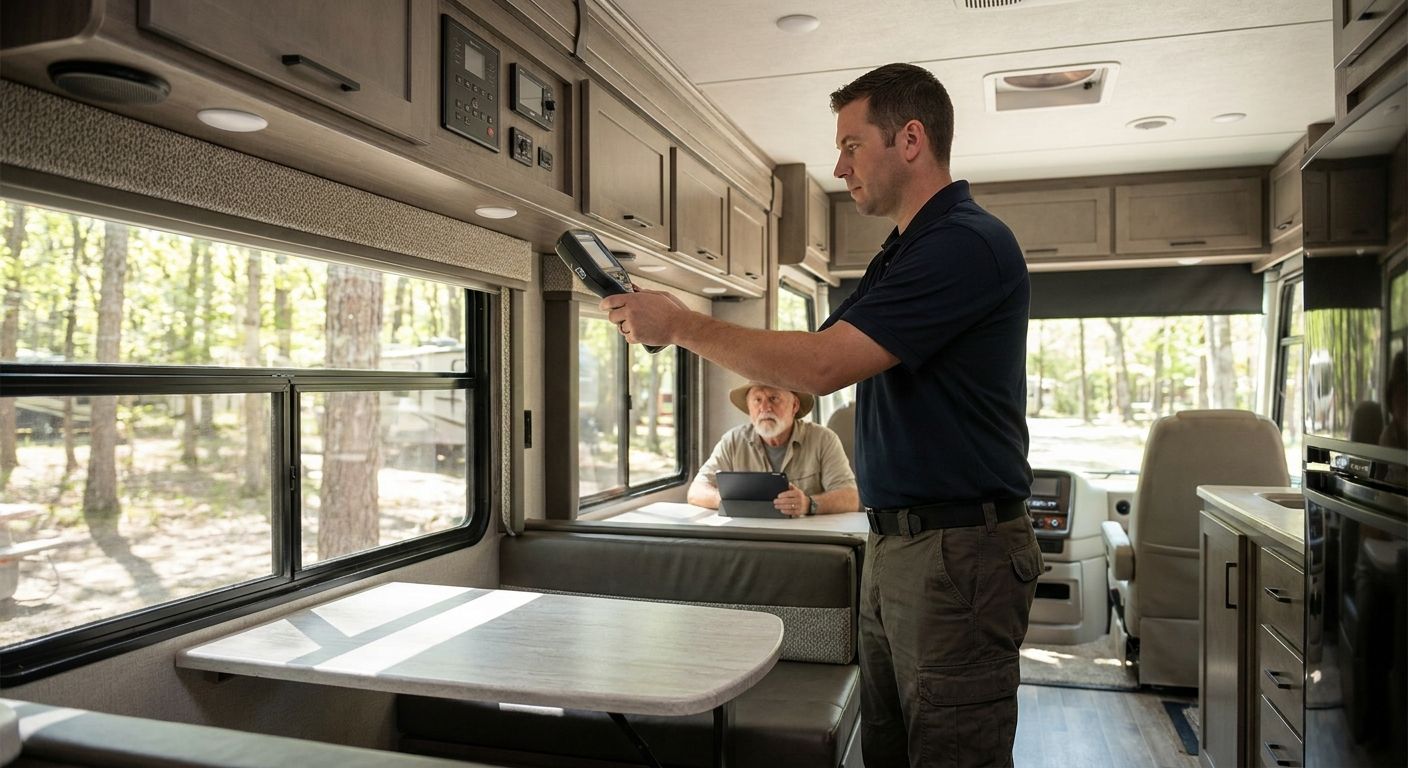
RV and motorhome owners face a different bug sweep problem than the average driver: shared campground WiFi, consignment sales, dealership service bays, and long-term storage lots all create windows for someone to plant a hidden camera, audio bug, or GPS tracker inside a rig. A stationary house gets swept once and stays swept; a moving RV picks up new access points every time it changes hands, changes hookups, or sits in a service bay.
- Bug sweep for RV owners in 2026 means checking vents, USB outlets, smoke detectors, and the chassis every time the rig changes hands or comes out of storage.
- USA Bugsweeps runs TSCM sweeps built for mobile living spaces, not just fixed homes.
- A $29 DIY GPS tracker guide catches obvious devices; a professional TSCM sweep catches hidden transmitters and dormant trackers a phone app misses.
- Consignment sales, storage lots, and service visits are the three highest-risk moments for an RV to pick up a hidden device.
Why bug sweeps matter for RV and motorhome owners
An RV changes ownership, storage location, and service hands far more often than a house does, and each transition is a chance for a hidden camera or GPS tracker to end up inside the walls or undercarriage. Consignment lots, seasonal storage yards, and mobile repair techs all get unsupervised time with a rig that a homeowner would never give a stranger inside their living room.
A professional TSCM sweep covers the RV-specific spots a general home sweep skips: propane bay wiring, slide-out mechanisms, roof vent housings, and the 12V/shore power junction box. The verdict: RV owners who only check the obvious spots — smoke detectors, outlets, USB ports — miss the majority of places a device actually gets hidden in a motorhome.
How to sweep your RV for hidden devices
Inspect common hiding spots before every trip
Start with a visual pass through every space a stranger could reach without you noticing, done before pulling out of the driveway or a campground.
- Smoke detectors, CO detectors, and thermostats — unscrew and check for extra wiring
- USB charging ports and 12V outlets for anything plugged in that you didn't install
- Vents, overhead lights, and speaker grilles
- Under dinette seating, inside cabinet corners, and behind mirrors
- Awning housings and roof vent covers
Check your RV's electrical and USB ports
Hidden audio bugs and cameras often draw power from existing wiring instead of running on batteries, which means the RV's own electrical system is a common attachment point.
- Trace any USB port that charges slower than expected or stays warm when idle
- Check behind outlet covers for a second set of wires spliced into the circuit
- Look at the shore power junction box for anything that isn't factory wiring
- Inspect any recently installed accessory (solar controller, inverter, camera system) for extra components
Scan for wireless signals using a detector
A basic RF detector picks up active transmitters broadcasting nearby, and it's the fastest free-adjacent check an owner can run before or after a trip. Store-bought detectors have a real limitation: they miss devices that transmit on a schedule or store data for later pickup instead of broadcasting live, which is why a hidden GPS tracker on your car can sit undetected for weeks even after a manual scan.
- Run the detector through every room with the RV's electronics powered on
- Sweep the exterior, including storage bays and the hitch area
- Check known dead zones (metal cabinets, behind the fridge) manually since RF signals bounce off metal
- Re-scan at night when fewer competing WiFi signals are active
Search after every service visit or storage stay
Any time the RV leaves your direct control — a repair shop, a winter storage lot, a dealership recall visit — treat the return as a reset point and sweep again. This is the moment a professional TSCM sweep earns its cost over a DIY pass: a trained technician checks compartments that require disassembly, something most owners skip after a long day picking the rig up from storage.
- Photograph the interior and exterior before drop-off so you can compare afterward
- Re-check all previously inspected spots, not just the area serviced
- Ask the shop directly what was accessed or replaced
- Sweep before restocking or moving belongings back in
Sweep for GPS trackers on the chassis and undercarriage
GPS trackers on an RV usually attach magnetically to the frame, inside a wheel well, or near the hitch, the same spots covered in GPS tracker sweeps for company fleet vehicles built for commercial vehicles that change hands and locations constantly.
- Run a flashlight and mirror along the full length of the frame rails
- Check wheel wells, the hitch receiver, and any tow package wiring
- Look for anything zip-tied or magnetically attached that isn't part of the factory build
- Check battery compartments and propane bay undersides
Bring in a professional sweep before long trips, after a sale, or after a breakup
A manual pass catches obvious devices; a professional TSCM sweep with RF spectrum analysis and nonlinear junction detection catches what's hidden inside walls, behind panels, or dormant and not transmitting. This step matters most before a long cross-country trip, right after buying a used RV on consignment, or during a custody or relationship dispute where someone had prior access to the vehicle.
- Schedule the sweep before removing panels yourself, since disassembly can damage evidence a technician needs intact
- Ask whether the sweep covers both RF devices and hardwired/dormant devices
- Request the sweep cover the tow vehicle too if one is used
- Get a written report of what was checked and what was found
Re-sweep after guests, rentals, or loaner use
Any time someone else drives or stays in the RV — a rental platform, a loaned trip to family, a consignment test drive — re-sweep before your next use.
- Treat every rental return like a post-storage return
- Check for anything left behind in cabinets, under seating, or in exterior bays
- Re-run the RF detector pass before the next trip
- Document condition with photos at each handoff
RV bug sweep options compared
| Option | Best for | Starting price | Key limitation |
|---|---|---|---|
| Visual inspection | Owners checking between short trips | Free | Misses RF-only or dormant devices hidden in wiring |
| DIY GPS tracker guide | Owners who want a repeatable self-check | $29 | Store-bought detectors miss encrypted or scheduled transmitters |
| Professional TSCM sweep | Post-storage, post-sale, custody disputes, long trips | Custom quote | Requires scheduling and vehicle access |
Verdict: a DIY GPS tracker guide is the right first move for routine checks, but a professional TSCM sweep is the only option that catches hidden or dormant devices a detector app can't see.
Common mistakes RV owners make
- Sweeping once after buying the RV and never again, even after storage or service visits
- Trusting a private consignment seller's word that "nothing's been touched" instead of checking the wiring themselves
- Checking only smoke detectors and outlets while ignoring the propane bay, roof vents, and hitch area
- Relying on a phone app alone to rule out GPS trackers, which misses magnetically attached units with no active signal
- Skipping a re-sweep after loaning the RV to friends or family for a trip
FAQ
What is a bug sweep for RV owners?
A bug sweep for RV owners is an inspection for hidden cameras, audio bugs, and GPS trackers inside a motorhome or travel trailer, covering compartments unique to RVs like propane bays, slide-out mechanisms, and roof vents. It's usually run after buying a used rig, coming out of storage, or before a long trip.
How much does an RV bug sweep cost in 2026?
Professional TSCM sweep pricing runs on a custom quote based on the RV's size and how many compartments need checking. A DIY GPS tracker guide runs $29 for owners who want a repeatable self-check between professional sweeps.
Can a hidden camera be inside an RV smoke detector?
Yes, smoke detectors are one of the most common hiding spots for a pinhole camera because the housing already has small vents and sits at a natural viewing angle. Unscrewing and checking the wiring inside is a standard first step in any RV bug sweep.
Where do GPS trackers get hidden on an RV?
GPS trackers on an RV typically attach magnetically to the frame rails, inside wheel wells, or near the hitch receiver where they draw minimal attention. A flashlight-and-mirror pass along the undercarriage catches most magnetic units.
Should I sweep a used RV before buying it?
Yes, a used RV bought through private consignment should get swept before or immediately after the sale, since the previous owner had unsupervised access to every compartment. This is one of the highest-risk moments for a hidden device to already be in place.
Do I need to sweep my RV after every storage stay?
Yes, treat every return from a storage lot as a reset point and re-sweep, since storage facility staff and other renters may have had access to the space around your rig. This applies even if the storage lot uses locked, monitored units.
Can a store-bought RF detector find every hidden device?
No, a store-bought RF detector only catches devices actively transmitting at the time of the scan and misses dormant or scheduled-transmission devices. A professional TSCM sweep uses spectrum analysis and physical inspection to catch what a basic detector misses.
What's the difference between a bug sweep for an RV and a car?
An RV bug sweep covers everything a car sweep does — cabin, undercarriage, wiring — plus RV-specific spaces like propane bays, slide-out compartments, and roof vent housings that don't exist on a standard vehicle.
One last thing
The riskiest moment for an RV isn't the road, it's the driveway: consignment lots and storage yards give more unsupervised access time to a rig than any single trip does, which is why a sweep timed right after a sale or a storage stay catches more than a random mid-trip check ever will. Build the sweep into the handoff, not into the itinerary.


