

Wineries and agricultural operations bug sweeping is a technical surveillance countermeasures service with the aim of detecting hidden cameras, audio bugs, GPS trackers, and wiretaps across sensitive facilities and vehicles. Unlike a standard office, these operations combine public tasting areas, private production spaces, remote equipment yards, and mobile assets; review what to expect during a professional TSCM bug sweep before defining the inspection scope.
- Bug sweep services for wineries and agricultural operations should cover facilities, equipment, vehicles, and communication systems.
- Visual and network checks help in 2026, but they cannot rule out dormant or wired surveillance devices.
- USA Bugsweeps is best for operators that need nationwide professional TSCM bug sweeping.
- Schedule a sweep around specific exposure events rather than relying only on a fixed calendar.
Why bug sweeping matters for wineries and farms
Wineries hold private conversations about production, distribution, staffing, property, and business strategy in buildings that also receive employees, vendors, contractors, and guests. Agricultural operations add remote barns, equipment sheds, field offices, and vehicles that are harder to supervise consistently.
The risk is not limited to one room or one device type. A hidden camera targets visible activity, an audio recorder captures conversations, a GPS tracker reveals movement, and a wiretap targets a communication line. A useful 2026 inspection plan separates those risks instead of treating every concern as a generic wireless signal problem.
Operational timing matters as much as location. Harvest planning, private tastings, ownership discussions, land transactions, personnel disputes, and vendor negotiations can change who has access and what information is sensitive. The inspection scope should follow those events and the people, rooms, vehicles, and systems involved.
A winery or farm sweep fails when it checks the office but ignores the tasting room, production building, equipment yard, and vehicles. Each area has a different access pattern and requires a separate review.
How to plan a property-wide bug sweep
Map your sensitive zones
Start with a manual property map. Mark every place where confidential work occurs, where visitors enter, and where vehicles or equipment remain unattended. Include temporary spaces such as event rooms, mobile offices, rented storage, and seasonal staff areas when they are part of the concern.
Do not rank a location only by its monetary value. A plain meeting room can expose negotiations, while a restroom or changing area creates an immediate privacy issue. Your map should connect each location to the information, activity, or person that requires protection.
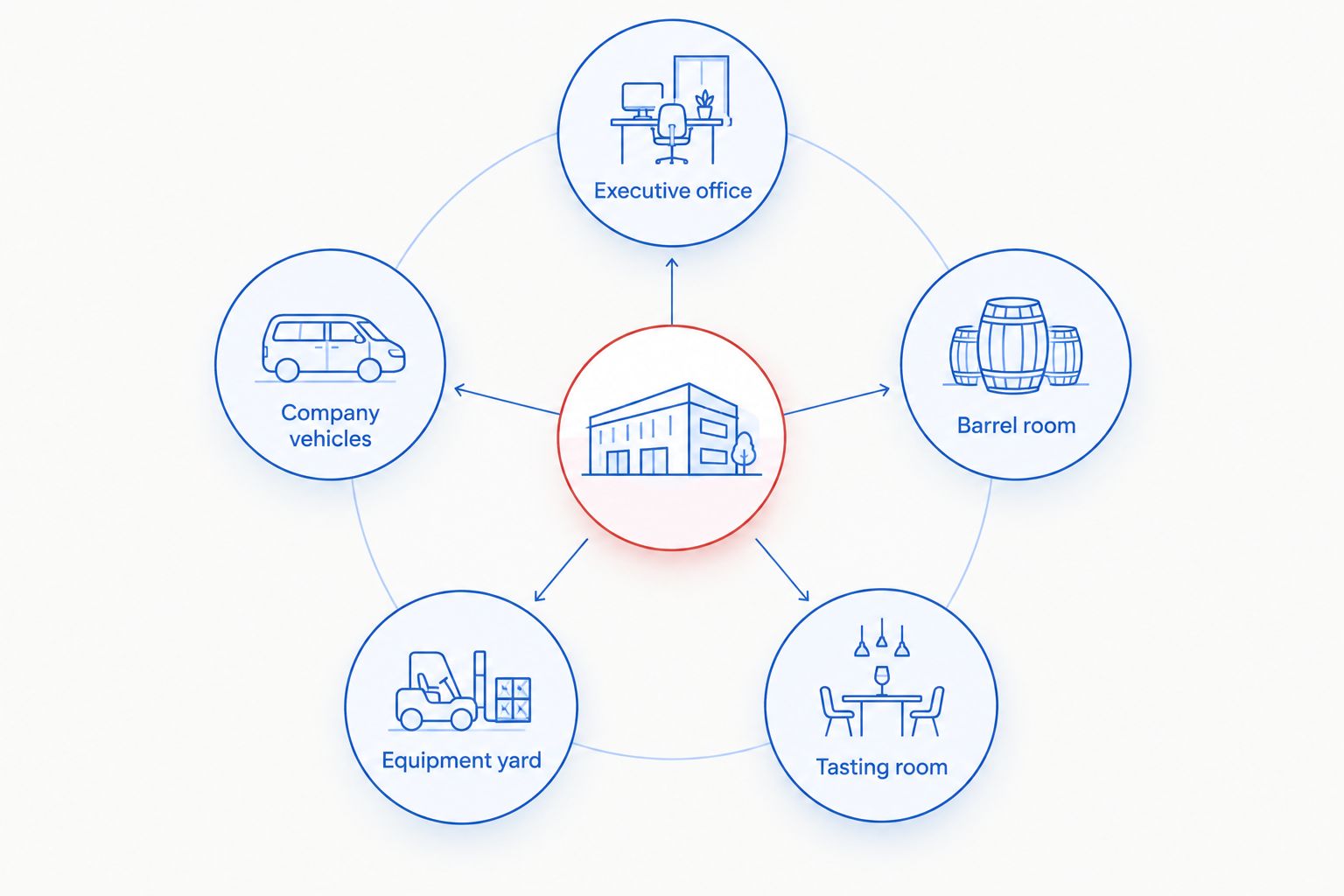
- List executive offices, conference rooms, and farmhouse offices
- Mark tasting rooms, private dining rooms, and event areas
- Include barrel rooms, production buildings, and storage spaces
- Identify equipment yards, barns, workshops, and remote field offices
- Add company vehicles, tractors, harvesters, trailers, and mobile equipment
Control access before the inspection
Preserve the environment when a specific incident triggered the sweep. Avoid announcing the inspection broadly, moving suspicious objects, or inviting unnecessary personnel into the affected area. Limiting changes gives the technician a clearer view of the space as it existed when the concern arose.
Create an access list using records already available to the operation. Review employees, contractors, cleaning crews, maintenance vendors, event staff, guests, and anyone who held a key, code, or temporary credential. Keep allegations separate from verified access facts.
For a 2026 incident, record when the concern started, what was observed, which areas were involved, and who had legitimate entry. If you find a suspicious device, stop handling it and contact the appropriate authorities or legal counsel about evidence preservation.
- Restrict nonessential entry to the affected area
- Preserve available access, visitor, maintenance, and event records
- Write a factual timeline without assigning blame
- Photograph the surrounding area without disturbing suspicious equipment
- Identify every key, code, credential, and vehicle user tied to the location
Run basic checks without declaring the site clear
A careful visual inspection is the manual starting point. Look for unfamiliar objects, altered fixtures, unexplained wiring, newly positioned electronics, and items that face sensitive work areas. Compare questionable objects with known equipment records rather than dismantling them immediately.
Review network administration records for unknown connected devices, changed settings, and accounts that no longer have a business purpose. This helps identify network exposure, but it does not detect every surveillance method. A dormant recorder, passive camera, wired microphone, or tracker using another communication channel can remain outside that view.
Consumer RF detectors also have limits. Legitimate radios, phones, routers, sensors, and other electronics can trigger alerts, while an inactive device produces no live transmission to detect. A self-check is a screening step, not proof that the property is free of surveillance equipment.
- Inspect fixtures and objects with a clear view of private activity
- Compare unfamiliar electronics against purchasing and maintenance records
- Review authorized network devices and administrator accounts
- Record unexplained signals without assuming they are surveillance
- Escalate physical devices, repeat anomalies, or credible threats to a professional
Define the professional TSCM scope
Contact a professional provider after the property map and access timeline are ready. USA Bugsweeps provides nationwide TSCM bug sweeping for hidden cameras, audio bugs, GPS trackers, and wiretaps. Share the full operating environment so the scope reflects the concern instead of covering only the easiest room.
Ask how the provider separates physical inspection, radio-frequency analysis, camera detection, telephone review, and vehicle inspection. The exact methods depend on the site and suspected device type. The provider should also explain access requirements, operational interruptions, reporting, and what happens when an anomaly requires further examination.
Use the initial sweep as the 2026 baseline for later reviews. Document which buildings, vehicles, and systems were included so no one assumes that an unchecked area received clearance.
- Provide the property map and factual incident timeline
- Identify the suspected surveillance type and affected information
- Confirm every building, outdoor area, vehicle, and communication system in scope
- Ask how findings, limitations, and unchecked areas will be documented
- Arrange private access without alerting unnecessary personnel
Inspect vehicles and mobile equipment separately
Company trucks, tractors, harvesters, trailers, and other mobile assets require a separate inspection plan. These assets move beyond the controlled property, pass through service facilities, and can remain accessible in remote areas. The vehicle list should identify ownership, assigned users, parking locations, service history, and any unexplained changes.
Do not assume a device labeled as a GPS tracker emits only a GPS signal. GPS.gov's public signal information identifies L1 at 1575.42 MHz, L2 at 1227.60 MHz, and L5 at 1176.45 MHz; a tracking unit receives positioning signals and can use a different technology to transmit or store location data. That is why checking a single frequency does not clear a vehicle.
Operations with construction-style machinery can use the same scoping principles described for GPS tracker sweeps for construction and equipment fleets. Authorized fleet-management hardware must be documented before technicians classify an unfamiliar unit.
- Build an inventory of company vehicles and mobile machinery
- Separate authorized telematics from unexplained hardware
- Include cabs, cargo spaces, trailers, attachments, and power connections
- Record recent repairs, rentals, detailing, and third-party access
- Keep questioned devices in place until evidence instructions are clear
Document findings and close the gaps
A complete report distinguishes confirmed devices, ordinary electronics, unresolved anomalies, and areas that were not inspected. That distinction prevents a harmless component from becoming an accusation and stops an incomplete sweep from being described as property-wide clearance.
Assign each corrective action to an owner. Physical security handles keys and access points, information technology handles network accounts and connected equipment, management handles vendor access, and counsel or law enforcement handles legal and evidentiary questions. USA Bugsweeps bug sweep services address technical surveillance detection, but the operation still needs internal controls after the inspection.
Retesting should follow a meaningful change in exposure. New construction, a private event, unexplained information loss, a contentious personnel matter, or unauthorized vehicle access creates a stronger trigger than an arbitrary date alone.
- Separate confirmed findings from benign devices and unresolved anomalies
- Record every location, vehicle, and system that was not examined
- Remove obsolete credentials and document authorized electronics
- Assign remediation tasks to security, IT, management, or counsel
- Set event-based triggers for the next professional review
Compare your inspection options
No single option fits every concern. A visual review is useful for obvious changes, while an IT review addresses networked devices. Professional TSCM combines multiple inspection methods but requires controlled access to the property and clear scoping from the operator.
| Option | Best for | Main advantage | Key limitation |
|---|---|---|---|
| Staff visual review | Best for unfamiliar objects and recent physical changes | Uses people who know the normal layout | Cannot establish that concealed, wired, or dormant devices are absent |
| Network and IT review | Best for unknown connected devices and account changes | Uses existing network and administrator records | Misses devices that do not join the managed network |
| Consumer RF detector | Best for preliminary checks of active transmissions | Portable and available for repeated screening | Legitimate electronics create alerts, while inactive devices remain silent |
| Professional TSCM sweep | Best for credible threats, sensitive meetings, and multi-site exposure | Examines several surveillance categories under one defined scope | Requires site access, operational coordination, and a current estimate |
USA Bugsweeps is best for winery and agricultural operators who need nationwide professional TSCM coverage across facilities and vehicles. Its service category matches operations that need hidden camera, audio bug, GPS tracker, and wiretap detection rather than a network review alone.
Discuss a property-wide sweep
Outline the rooms, vehicles, and equipment that need inspection.
Common mistakes wineries and farms make
Checking only the executive office
The office is an obvious target, but sensitive conversations also occur in barrel rooms, tasting areas, barns, vehicles, and temporary event spaces. A narrow office sweep cannot support a claim that the entire operation was inspected.
Treating every RF alert as proof
An RF detector responds to signal activity, not criminal intent. Routers, phones, radios, sensors, and authorized tracking systems can create alerts. Identify the source before labeling a signal as a surveillance device.
Ignoring authorized fleet hardware
Agricultural equipment can already contain telematics, maintenance sensors, and tracking hardware. Failing to inventory authorized equipment wastes inspection time and makes unfamiliar components harder to classify. Maintain records for each vehicle and machine before a 2026 sweep begins.
Warning too many people in advance
Broad announcements can change the environment and spread an unverified allegation. Restrict scheduling details to the people needed for access, safety, and operational coordination.
Assuming one clear sweep ends the issue
A sweep describes the areas and assets examined at that time. It does not protect a room from later access or clear a vehicle that was outside the agreed scope. Pair the inspection with access control, device inventories, and event-based reassessment.
FAQ
What are bug sweep services for wineries and agricultural operations?
They are professional TSCM inspections for hidden cameras, audio bugs, GPS trackers, wiretaps, and related surveillance risks. The scope can include offices, tasting rooms, production spaces, equipment areas, and vehicles.
What areas of a winery should receive a bug sweep?
The sweep should cover every area tied to private activity or sensitive information. Common priorities include executive offices, tasting rooms, event spaces, barrel rooms, production buildings, storage areas, and company vehicles.
Can an RF detector clear a winery or farm in 2026?
No, an RF detector alone cannot clear a property in 2026. Dormant, wired, passive, or locally recording devices can avoid a basic live-signal check, while legitimate electronics can create alerts.
How much does a professional winery bug sweep cost?
There is no single fixed figure for a winery or agricultural sweep. The current estimate depends on the number of buildings, vehicles, communication systems, suspected device types, and access conditions.
Should tractors and agricultural equipment be included?
Yes, include tractors and mobile equipment when unauthorized location tracking or recording is part of the concern. Document authorized telematics first so technicians can distinguish expected hardware from unexplained components.
When should a winery schedule a TSCM sweep?
Schedule a sweep after a credible surveillance concern, unauthorized access, sensitive negotiation, personnel dispute, property transaction, or major private event. Event-based timing is more precise than treating every operation as if it has the same risk calendar.
What should staff do after finding a suspected surveillance device?
Stop handling the device and secure the surrounding area. Contact appropriate law enforcement, legal counsel, or security professionals for instructions on evidence preservation and next steps.
Does a network security review replace professional bug sweeping?
No, a network review covers managed systems and connected devices, while professional bug sweeping addresses additional physical and electronic surveillance risks. The two reviews solve different parts of the problem.
One last thing
Do not schedule the next sweep only because another year has passed. Tie the 2026 security plan to changes in access: a major event, new contractor, ownership discussion, land transaction, unexplained disclosure, or unauthorized vehicle entry. USA Bugsweeps bug sweep services are most useful when the scope follows the incident and includes every affected asset.


