
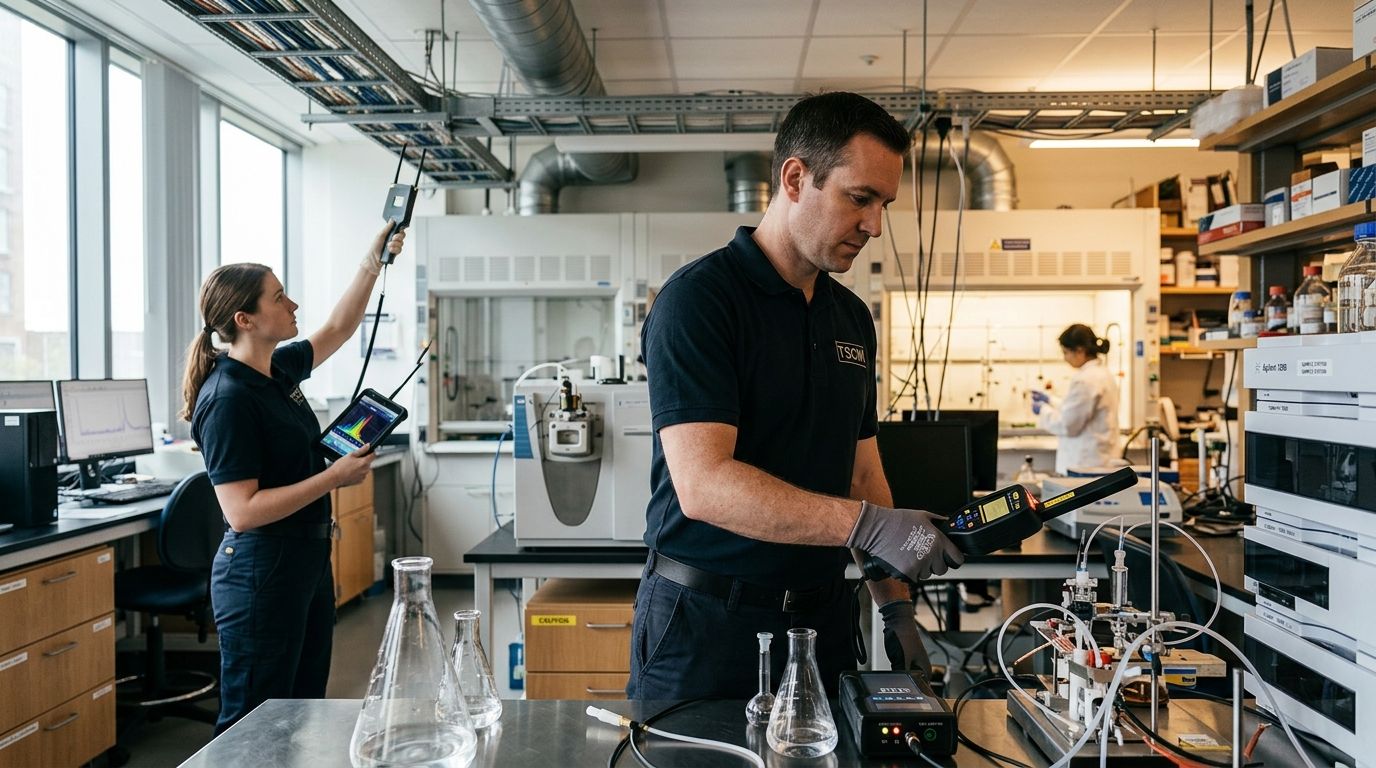
University research labs handling federally funded grants, biotech samples, or unpublished data face a different threat profile than a typical office — TSCM sweeps for university research labs have to account for shared bench access, rotating grad students and postdocs, and export-control obligations that a standard corporate sweep doesn't touch. A lab that runs an open-door policy for 15 researchers across three shifts can't rely on a locked filing cabinet to protect its IP.
- TSCM sweeps for university research labs check RF spectrum, network hardware, and shared bench space, not just PI offices.
- Rotating grad students, postdocs, and visiting scholars create access risk that permanent-staff offices don't have.
- USA Bugsweeps treats federally funded labs handling export-controlled data as a higher-priority sweep category.
- Sweeping only during move-in or renovation misses the researcher turnover that happens every semester.
Why TSCM matters for university research labs
A corporate office has a fixed roster of employees with badge access. A university research lab has PIs, grad students, postdocs, undergrad assistants, visiting scholars, custodial staff, and IT contractors cycling through the same square footage across a semester. Every one of those groups gets physical access to shared equipment, whiteboards, and network jacks at some point.
Labs working under NSF, NIH, or DoD grants also carry compliance weight that a private office doesn't. Export-controlled research under ITAR and EAR restricts who can access certain data and equipment, and a compromised lab isn't just an IP problem — it can turn into a federal compliance problem. That's a different risk calculation than protecting trade secrets at a tech startup, where the concern is usually a single competitor rather than a foreign research entity or a disgruntled collaborator with grant-cycle motive.
Lab culture also creates its own exposure. Publish-or-perish pressure means unpublished data sitting on a shared drive or a whiteboard has real value to a rival lab months before a paper goes public. Add 24/7 badge access common at research universities, and a lab is exposed for more hours per week than a 9-to-5 office ever is.
Update your access map
Start by walking the lab the way an outsider would — every door, every shared drawer, every equipment room.
- List every entry point: main door, loading dock, shared corridor access, adjoining lab doors
- Note which spaces have card-swipe logs and which don't
- Flag any space where equipment sits unlocked overnight
- Identify which rooms held sensitive samples, prototypes, or grant paperwork in the last 12 months
- Mark conference rooms and PI offices used for confidential calls
Inventory shared equipment and IT hardware
Shared centrifuges, microscopes, and network switches are common places to plant a device because nobody owns the responsibility for checking them.
- Physically inspect power strips, USB hubs, and network switches for unfamiliar hardware
- Check under benches and behind server racks for devices not on the university's IT asset list
- Confirm every network drop traces back to a known university IT port
- Look inside smoke detectors, wall clocks, and thermostats in shared spaces — common camera housings
- Compare current hardware against last year's IT inventory to spot additions nobody logged
A visual sweep catches obvious problems. It won't catch an RF transmitter tuned below the range of a walkthrough, which is where a professional sweep with a spectrum analyzer takes over from a manual check.
Scan the RF spectrum before grant milestones
Sensitive periods — grant renewal, patent filing, pre-publication review — are when a lab is most worth bugging.
- Run a manual RF sweep with a handheld detector across all lab benches and offices
- Pay extra attention to shared conference rooms where results get discussed
- Check server rooms and network closets for unregistered transmitters
- Time a sweep 1-2 weeks before any grant site visit or patent filing deadline
- Bring in a professional TSCM team using lab-grade RF detectors for full-spectrum coverage a handheld unit can't match
This is where USA Bugsweeps enters the workflow for labs that can't afford a false negative — a missed device ahead of an NIH site visit is a bigger liability than the cost of a sweep.
Check university-owned vehicles and equipment for trackers
Field research vehicles, shared vans, and equipment trailers are an overlooked attack surface for labs doing off-campus fieldwork.
- Inspect undercarriages and wheel wells of any lab-assigned vehicle
- Check glove boxes and OBD-II ports for unfamiliar devices
- Review vehicle usage logs for unexplained routes
- Sweep trailers and mobile equipment before and after off-campus deployments
Secure conversations in PI offices and conference rooms
PI offices and department conference rooms are where funding strategy, unpublished results, and personnel matters get discussed out loud.
- Sweep before any call involving grant strategy or unpublished data
- Check phone systems and conference-room speakerphones for tampering — the same approach used to check if an office phone system is tapped
- Inspect furniture, bookshelves, and wall outlets for planted audio devices
- Restrict recording devices during sensitive lab meetings
Audit visiting researcher and vendor access
Visiting scholars, equipment vendors, and maintenance contractors get physical access most permanent staff never think to track.
- Log every visiting researcher's access dates and which spaces they entered
- Require vendor sign-in for any equipment installation or repair
- Sweep immediately after any third-party installation of new lab equipment
- Flag foreign national visiting scholars working under restricted research categories for extra scrutiny per university export-control policy
Schedule sweeps around key research milestones
A sweep timed to a calendar of grant deadlines, publication submissions, and semester turnover catches more than an annual, date-agnostic sweep.
- Sweep at the start of each semester when new researchers rotate in
- Sweep before any patent filing or licensing negotiation
- Sweep after any lab renovation or equipment installation
- Sweep before federal grant site visits or audits
Comparison: sweep options for university research labs
| Option | Best for | Key limitation |
|---|---|---|
| Manual visual walkthrough | Labs with no budget and low-sensitivity data | Misses RF transmitters and devices hidden in fixtures |
| University IT security audit | Network-level threats only | Doesn't cover physical bugs, audio devices, or GPS trackers |
| Consumer RF detector (self-purchased) | Small labs doing routine self-checks | Limited range, misses frequency-hopping or dormant devices |
| Professional TSCM sweep (USA Bugsweeps) | Federally funded labs, biotech/pharma research, pre-patent data | Requires scheduling around active experiments |
Verdict: a professional TSCM sweep is the only option on this list that covers RF, physical, network, and vehicle-based threats in one visit — self-checks and IT audits each cover one slice of the risk.
Get a lab sweep scheduled
Request a facility-specific quote before your next grant review or patent filing.
Common mistakes university labs make
- Assuming university IT security covers TSCM. Network monitoring doesn't detect a physical audio device hidden in a wall outlet or a GPS tracker on a field vehicle.
- Sweeping only during move-in. Risk peaks at grant renewal, patent filing, and semester turnover — not the day the lab opens.
- Ignoring shared bench space in favor of the PI's office. Most sensitive conversations and data handling happen at the bench, not behind a closed door.
- Skipping vehicle sweeps for field research equipment. A tracked field van exposes site locations and collection schedules to anyone monitoring the signal.
- Treating visiting researchers as low-risk by default. Short-term access is exactly the access pattern a planted device relies on going unnoticed.
FAQ
What's the best way to detect hidden cameras in a university research lab?
Start with a visual inspection of smoke detectors, clocks, and shared equipment, then follow with a professional RF and physical sweep before any sensitive research milestone. Manual checks catch obvious placements; professional detectors catch transmitters hidden in fixtures or tuned to less common frequencies.
How often should university research labs run TSCM sweeps?
At minimum once per semester, plus additional sweeps before grant site visits, patent filings, or after any equipment installation. Labs with export-controlled research or high-value IP benefit from more frequent checks tied to their funding calendar.
Do federal grants require TSCM sweeps for research labs?
Grant agencies don't universally mandate TSCM sweeps, but labs working under export-controlled categories (ITAR/EAR) carry compliance obligations that make undetected surveillance a bigger liability than in a standard office. Check your specific grant's data security requirements.
Is TSCM sweeping different for biotech labs vs engineering labs?
The core sweep methodology is the same, but biotech and pharma labs handling clinical or proprietary formulation data often carry additional confidentiality obligations similar to those covered for pharmaceutical and biotech companies. Engineering labs with prototype IP face similar exposure but different regulatory overlays.
How much does a TSCM sweep cost for a university lab?
Cost depends on square footage, number of rooms, and equipment count, so it varies lab to lab. Request a facility-specific quote rather than relying on a flat rate quoted for offices or homes.
Can university IT departments detect bugs on their own?
IT departments can flag suspicious network traffic but generally don't carry RF detection equipment or training to find planted audio devices, hidden cameras, or GPS trackers. TSCM and IT security cover different threat categories.
What triggers the need for a TSCM sweep in an academic research setting?
Grant renewal periods, patent filings, unexplained data leaks, lab renovations, and new equipment installations are the most common triggers. Semester turnover with new researchers is another common point to schedule a sweep.
Are GPS trackers a risk for university-owned vehicles used in research?
Yes, field research vehicles and equipment trailers used for off-campus collection are a real exposure point since a tracker reveals site locations and visit schedules. Inspecting undercarriages and OBD-II ports before and after field deployments catches most planted devices.
One last thing
The highest-risk moment for a university research lab isn't move-in day — it's the week after a renovation crew leaves. Contractors get the widest physical access to walls, ceiling tiles, and wiring of anyone who touches the space all year, and that access rarely gets audited the way a new grad student's badge does. Sweep right after any renovation, not just before the semester starts.


