
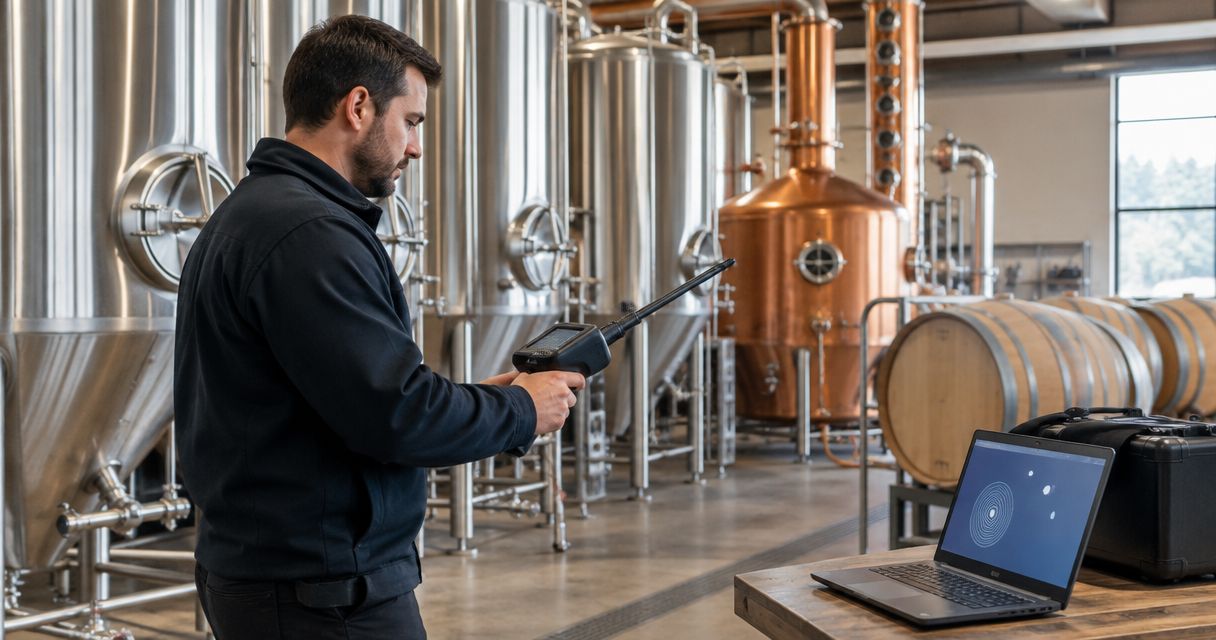
Craft brewery and distillery bug sweeping is a TSCM inspection for hidden cameras, audio bugs, GPS trackers, and wiretaps, with the aim of protecting confidential operations and business conversations. Public tasting areas, production rooms, offices, contractors, tours, and delivery vehicles create a broader inspection scope than a standard office; this guide explains the process alongside what to expect during a professional TSCM bug sweep.
- Bug sweep services for craft breweries and distilleries should cover public areas, production rooms, offices, networks, and vehicles.
- USA Bugsweeps provides nationwide TSCM services for detecting hidden cameras, audio bugs, GPS trackers, and wiretaps.
- A manual inspection is a useful first step, but it cannot rule out every concealed or inactive device.
- In 2026, schedule sweeps around sensitive meetings, unexplained security incidents, staff changes, and unauthorized access.
Why bug sweep services matter for craft breweries and distilleries
Craft breweries and distilleries combine public hospitality space with restricted production and administrative areas. Customers may enter a tasting room, while employees, cleaners, repair technicians, delivery drivers, and contractors may have different levels of access elsewhere. A useful sweep plan accounts for those access patterns instead of treating the entire property as one identical room.
Sensitive conversations can occur in an owner’s office, production area, laboratory, conference room, storage space, or delivery vehicle. Topics may include recipes, production methods, supplier terms, distribution plans, personnel matters, financing, or an upcoming product release. The objective is not to assume espionage; it is to determine whether an unauthorized surveillance device is present.
USA Bugsweeps TSCM services address the device categories stated in the service scope: hidden cameras, audio bugs, GPS trackers, and wiretaps. In 2026, that distinction matters because checking only for cameras leaves other forms of surveillance outside the inspection.
How to plan a brewery or distillery bug sweep
Start with a documented manual review, then escalate when the concern involves a sensitive event, suspected device, unexplained access, or multiple areas. A 2026 inspection plan should separate public space, restricted production space, communications systems, and vehicles because each presents a different concealment opportunity.
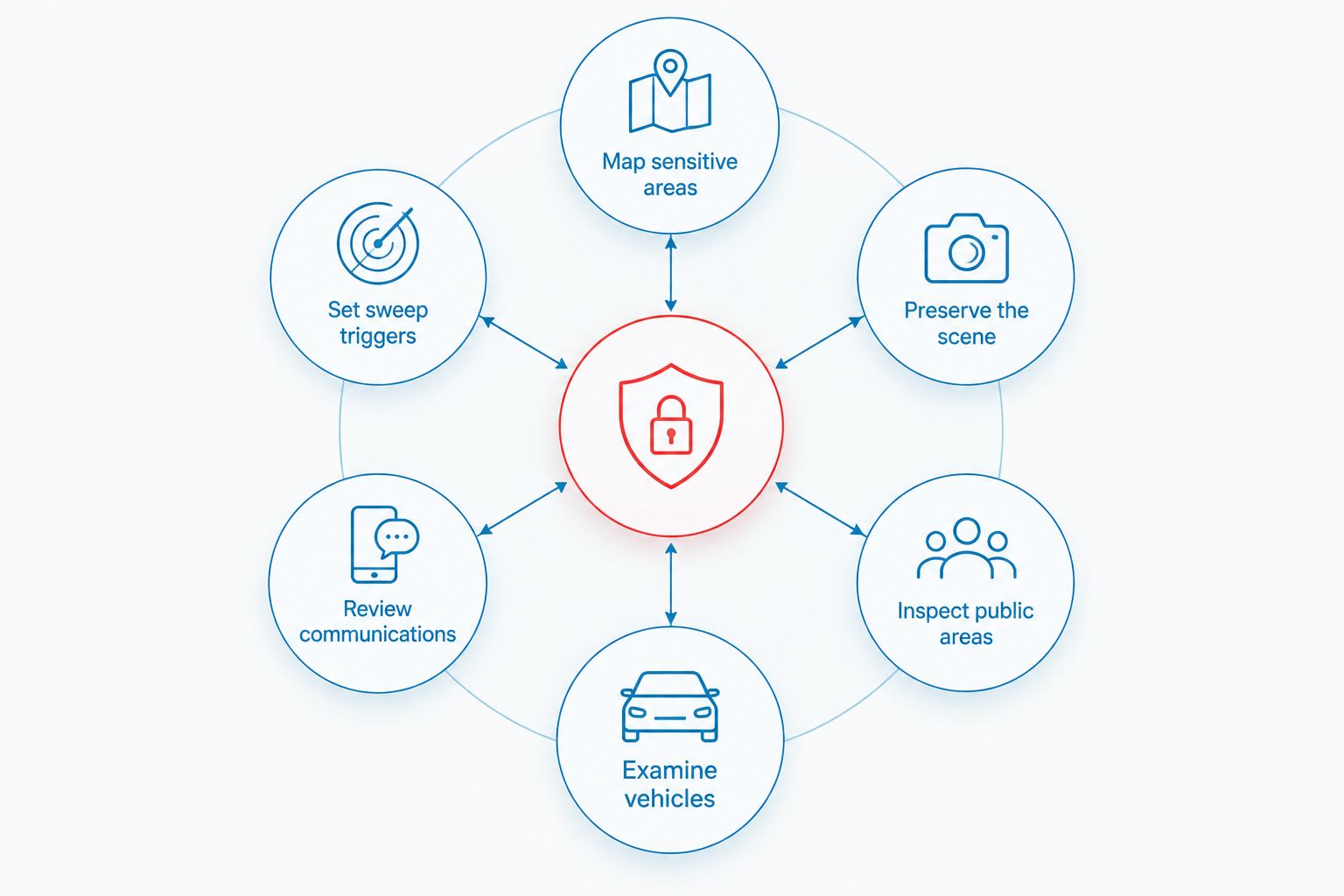
Map sensitive areas
Create a room-by-room inventory before touching equipment or moving furniture. Mark where confidential information is spoken, displayed, stored, or transmitted, then record who normally has access. This free step gives a TSCM provider a clear scope and prevents visible areas from receiving attention while less obvious rooms are skipped.
Include temporary workspaces and mixed-use rooms. A production office used for supplier calls may deserve more attention than a large public room, even when the office occupies less floor space.
- List tasting, production, storage, laboratory, meeting, and administrative areas that exist on the property.
- Mark doors, loading areas, utility access points, shared walls, and spaces used by outside contractors.
- Identify rooms used for recipes, supplier discussions, personnel matters, financing, or distribution planning.
- Record company vehicles, trailers, mobile offices, and equipment that regularly leave the site.
- Note recent changes to fixtures, electronics, furniture, cabling, or access permissions.
Preserve the scene
If you find an unfamiliar object, wire, charger, camera-like opening, or attached vehicle device, do not immediately dismantle it. Moving or powering down a suspected device can destroy useful context, alter its state, or expose the person handling it to avoidable risk. Document what you can see without opening the object.
Keep the concern confidential while you decide who needs to know. Broad internal discussion can compromise an investigation, but employee notification, privacy, workplace, and law-enforcement obligations still apply according to the circumstances and applicable rules.
- Photograph the object in place without displaying confidential records in the image.
- Record its location, orientation, visible connections, and the time it was discovered.
- Restrict unnecessary access to the immediate area without making accusations.
- Avoid plugging in, charging, pairing with, or connecting to an unfamiliar device.
- Contact qualified security, legal, or law-enforcement personnel when the situation requires it.
Inspect public-facing areas
Begin with a slow visual inspection of areas customers and visitors can enter. Look for objects that appear new, misplaced, modified, or inconsistent with surrounding fixtures. Pay particular attention to sightlines toward registers, workstations, doors, private rooms, and surfaces where documents or screens may be visible.
A flashlight can reveal unusual openings or reflective lenses, but the absence of a reflection does not prove a room is clear. Consumer inspection methods are screening tools, not confirmation that no device exists.
- Compare smoke alarms, clocks, chargers, signs, lighting fixtures, and wall plates with known building equipment.
- Look beneath counters, tables, shelving, decorative objects, and freestanding displays.
- Check whether vents, ceiling tiles, or access panels show unexplained movement or damage.
- Review guest network device lists for unfamiliar connections without assuming every unknown device is hostile.
- Document suspicious objects and leave technical examination to a qualified professional.
Review communications and network equipment
Inspect phones, routers, switches, access points, conference equipment, and computers used for sensitive work. A network review can identify unfamiliar connected devices, but it does not detect every recorder, camera, wiretap, or inactive transmitter. Wired devices and equipment that stores information locally can remain absent from a Wi-Fi client list.
Many Wi-Fi networks use the 2.4 GHz and 5 GHz bands. Reviewing both is a practical administrative check, not a complete RF sweep. Keep authorized-device records so an unknown entry can be compared with equipment you actually own.
- Change default administrative credentials on routers, cameras, and connected equipment.
- Separate guest access from systems used for operations and confidential records.
- Inventory authorized phones, cameras, access points, smart devices, and conference equipment.
- Check desk phones and connected accessories for unfamiliar adapters, splitters, or cabling.
- Escalate unexplained devices or connections instead of deleting evidence immediately.
Examine vehicles and mobile assets
Company vehicles can expose travel patterns, delivery activity, and employee movements when an unauthorized GPS tracker is attached. Start with a visual check in a safe, well-lit location. Do not crawl beneath an unsupported vehicle or remove an object that may be evidence.
Inspect vehicles after unexplained access, custody changes, maintenance by an unfamiliar party, or discovery of another surveillance device. Include trailers and mobile equipment when they leave controlled property or are parked where outsiders can approach them.
- Check visible wheel-well, bumper, cargo, cabin, and under-dash areas without disassembling the vehicle.
- Inspect the OBD-II port for equipment that the owner or fleet manager does not recognize.
- Compare installed hardware with records from insurers, fleet providers, lenders, and maintenance vendors.
- Review who held keys or had unsupervised access before the concern appeared.
- Arrange a professional vehicle sweep when an object cannot be identified safely.
Set sweep triggers
A fixed calendar can support routine security, but event-based triggers are more precise. In 2026, arrange a sweep before or after circumstances that materially change access, confidentiality, or risk. Keep the trigger list restricted to the people responsible for facilities, security, legal matters, or ownership.
USA Bugsweeps provides nationwide TSCM bug sweeping for homeowners, business owners, and vehicle owners. For a brewery or distillery, provide the room inventory, vehicle count, concern, and access constraints when requesting the stated 24/7 instant quote or free estimate.
- Schedule a sweep before a confidential negotiation, financing discussion, or sensitive internal meeting.
- Reassess after burglary, unauthorized entry, unexplained contractor access, or discovery of a suspicious object.
- Add a review after major renovations, cabling work, office moves, or changes to access control.
- Include vehicles when the concern involves tracking, stalking, route exposure, or unexplained attached hardware.
- Preserve previous room and device inventories so later changes are easier to identify.
Comparing inspection options
No single DIY method covers every surveillance category. A visual inspection can reveal physical anomalies, a network review can identify some connected equipment, and a consumer RF detector can indicate nearby radio activity. Each method also produces uncertainty that requires interpretation.
| Option | Best for | Main advantage | Key limitation |
|---|---|---|---|
| Manual visual inspection | Routine checks of accessible rooms | Free and easy to repeat after access or building changes | Concealed devices can resemble ordinary fixtures or remain outside the visible area |
| Network device review | Identifying unfamiliar equipment connected to managed networks | Uses existing router or network administration tools | Does not rule out wired, inactive, offline, or locally recording devices |
| Consumer RF detector | Initial screening for nearby transmissions | Can alert you to radio energy that needs investigation | Normal Wi-Fi, phones, and other electronics can complicate interpretation |
| IT security review | Evaluating computers, accounts, routers, and managed systems | Addresses digital access and network configuration | Does not replace a physical search for cameras, recorders, trackers, or wiretaps |
| Professional TSCM service from USA Bugsweeps | Multi-room, vehicle, or high-sensitivity concerns | Covers the stated surveillance categories within a defined professional service | Requires property access, scheduling, and an accurate inspection scope |
USA Bugsweeps bug sweep services are best for brewery and distillery owners who need a professional TSCM inspection across rooms, communications equipment, and vehicles. A professional sweep does not replace cybersecurity, access control, background screening, or a written incident response plan; those controls address different parts of the problem.
Plan a confidential brewery sweep
Discuss rooms, vehicles, and timing for a nationwide TSCM inspection.
Common mistakes breweries and distilleries make
Checking only the owner’s office
Sensitive discussions may also occur near production equipment, in a laboratory, beside storage areas, or inside a vehicle. Scope the sweep around information and access, not job titles.
Treating every unknown signal as a bug
Breweries and distilleries can contain Wi-Fi equipment, phones, sensors, payment systems, cameras, and neighboring signals. An alert requires identification and analysis before anyone concludes that surveillance is present.
Removing a suspected device immediately
Removal can alter evidence and eliminate context about placement, power, storage, or connections. Preserve the scene and obtain qualified guidance before handling unfamiliar equipment.
Relying on one consumer detector
A detector is limited by the signals it can identify and the operator’s ability to distinguish normal electronics from suspicious activity. It cannot prove that a room has no hidden camera, recorder, tracker, or wiretap.
Announcing the sweep too broadly
Limit scheduling details to people who need to coordinate access while respecting workplace policies and legal obligations. For 2026 planning, document who authorized the sweep, which spaces were included, and what follow-up actions were assigned.
FAQ
What are bug sweep services for craft breweries and distilleries?
They are TSCM inspections for hidden cameras, audio bugs, GPS trackers, and wiretaps in brewery or distillery spaces and vehicles. The scope should follow where confidential information is discussed, stored, displayed, or transmitted.
Which brewery areas should be included in a bug sweep?
Include public areas, restricted production rooms, offices, meeting areas, storage spaces, communications equipment, and vehicles that fit the concern. The final scope depends on the property layout and where sensitive activity occurs.
Can a brewery check for hidden cameras without professional equipment?
A brewery can perform a visual inspection for unfamiliar or modified objects, unusual openings, and unexplained wiring. That check cannot rule out every concealed, inactive, wired, or locally recording device.
Can a Wi-Fi device list reveal an audio bug?
A Wi-Fi device list can reveal some connected equipment, but it cannot identify every audio bug. Wired devices, offline equipment, local recorders, and transmitters using other methods may not appear there.
Should brewery delivery vehicles be checked for GPS trackers?
Yes, when the concern includes unauthorized access, stalking, route exposure, or unexplained attached hardware. Inspect vehicles safely and obtain professional help before removing an unfamiliar object.
When should a craft brewery schedule a TSCM sweep?
Schedule a sweep around sensitive negotiations, unauthorized entry, suspicious-device discoveries, major access changes, or unexplained security incidents. A documented trigger list is more useful than waiting for visible evidence of a leak.
Does a professional bug sweep replace cybersecurity?
No. A professional bug sweep addresses physical and electronic surveillance devices, while cybersecurity addresses accounts, computers, networks, software, and data access. Both controls can be necessary for the same incident.
Does USA Bugsweeps serve brewery and distillery owners nationwide?
Yes. USA Bugsweeps states that it provides nationwide TSCM bug sweeping services for business owners, homeowners, and vehicle owners.
One last thing
Do not discard the room inventory after the 2026 sweep. Keep a dated record of authorized electronics, fixtures, network equipment, vehicle hardware, and access changes. The next inspection becomes more focused when there is a reliable baseline showing what belongs on the property.


