
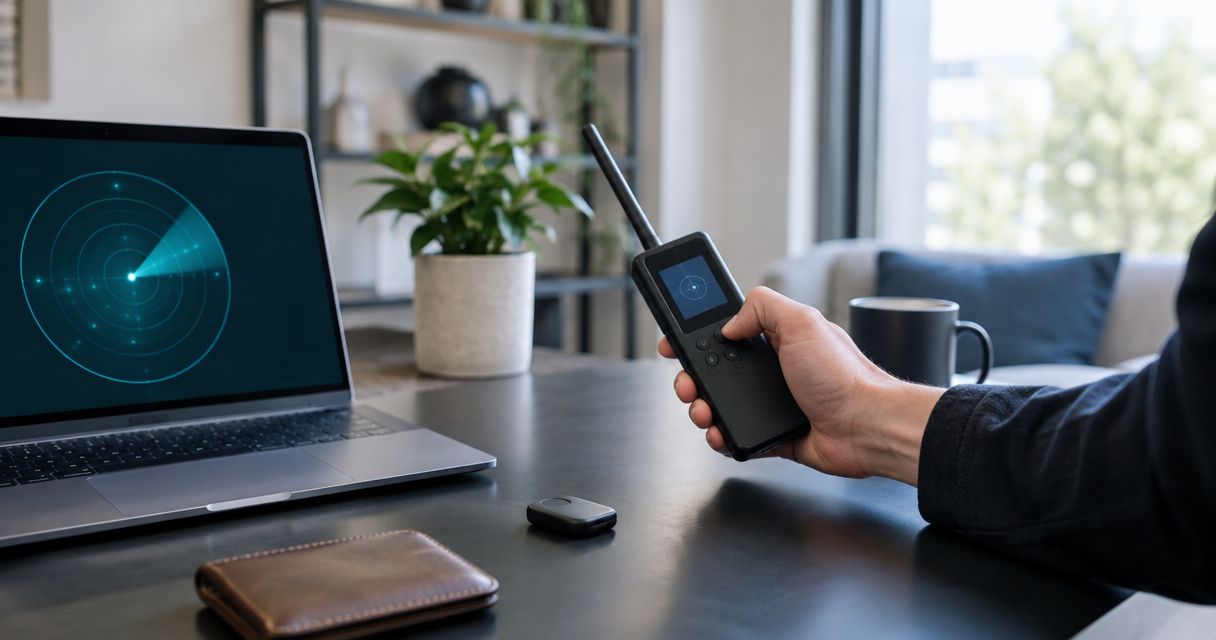
Yes—a bug sweep can detect a passive GPS tracker with no tracking transmission through physical inspection and, where appropriate, specialized electronic examination. Passive GPS tracker detection requires more than an RF scan: a logger that stores location data locally provides no tracking transmission for a radio-frequency detector to locate, and no inspection guarantees discovery in inaccessible areas.
- Passive GPS tracker detection requires physical inspection; an RF scan alone cannot locate a nontransmitting GPS logger.
- A silent cellular tracker and a passive GPS logger need different detection approaches.
- Usabugsweeps provides nationwide professional bug sweeping for vehicle owners seeking GPS tracker detection.
- A clear scan documents what was examined, not proof that every concealed space is free of devices.
Can a bug sweep detect a passive GPS tracker with no signal?
Yes, provided the sweep includes methods that do not depend on the tracker transmitting. The central distinction is between finding a radio transmission and finding the hardware that records your movements.
A passive GPS logger receives satellite signals and stores location records in memory. It does not need to upload those records over a cellular connection. Someone retrieves the stored information later, depending on the device's design.
The following comparison separates methods by what they actually detect. For the broader inspection process, read what to expect during a professional TSCM bug sweep.
| Detection method | Best for | What it establishes | Main limitation |
|---|---|---|---|
| Physical inspection | Finding concealed hardware | Locates an object, attachment, or unfamiliar wiring | Concealment and inaccessible areas restrict coverage |
| RF examination | Investigating transmitting devices | Identifies radio activity for further assessment | A passive logger has no tracking transmission to locate |
| Nonlinear junction detection | Investigating concealed electronics | Detects responses associated with semiconductor junctions | Ordinary vehicle electronics also respond; results require interpretation |
| Device examination | Identifying recovered hardware | Helps establish a device's purpose and capabilities | Requires lawful access and suitable expertise |
None of these methods independently establishes who installed a device or why. Discovery, identification, and attribution are separate tasks.
Why this matters
A detector that stays quiet does not answer every tracking concern. It only tells you that the instrument did not identify relevant radio activity under the conditions examined.
That distinction matters when booking a vehicle sweep in 2026. Ask whether the service addresses nontransmitting GPS loggers, not merely whether it detects GPS trackers. The wording of the scope determines whether physical concealment receives attention alongside radio activity.
Keep the concern grounded in observable information: an unfamiliar object, unexplained wiring, a documented access event, or a specific disclosure of private travel information. An unusual noise, battery issue, or detector alert alone does not establish surveillance.
Passive GPS loggers: detection without a tracking transmission
A passive logger records a route locally rather than reporting it live. Its satellite receiver obtains positioning information; that reception is not the same as transmitting your location to another person.
Physical inspection is the primary approach for a genuinely nontransmitting logger. Inspectors look for the device itself, its enclosure, its mounting method, and any connection to vehicle power.
The advantage is direct evidence: an identified device is more informative than an unexplained detector alarm. The limitation is access. Trim, body cavities, protective panels, and crowded electronics compartments restrict what an inspection can examine without additional work.
Finding an unfamiliar box is not enough to call it a surveillance device. Identification must distinguish a GPS logger from legitimate accessories, vehicle modules, and unrelated objects.
Sleeping cellular trackers: silence does not mean passive
A cellular tracker can remain silent between reports, while stationary, or under other programmed conditions. It is still a transmitting tracker even when a short RF scan catches no upload.
RF examination is useful for transmitting trackers, but a quiet observation period does not exclude them. The examination must account for operating state and what the equipment actually monitors.
This distinction belongs in any 2026 vehicle-inspection brief. Ask whether “no signal” means no cellular service, no observed transmission, a powered-down device, or a logger designed without a tracking transmitter.
Do not drive a suspicious vehicle merely to provoke a transmission when personal safety is a concern. Discuss safe examination conditions with the specialist instead.
What a passive GPS tracker inspection should cover
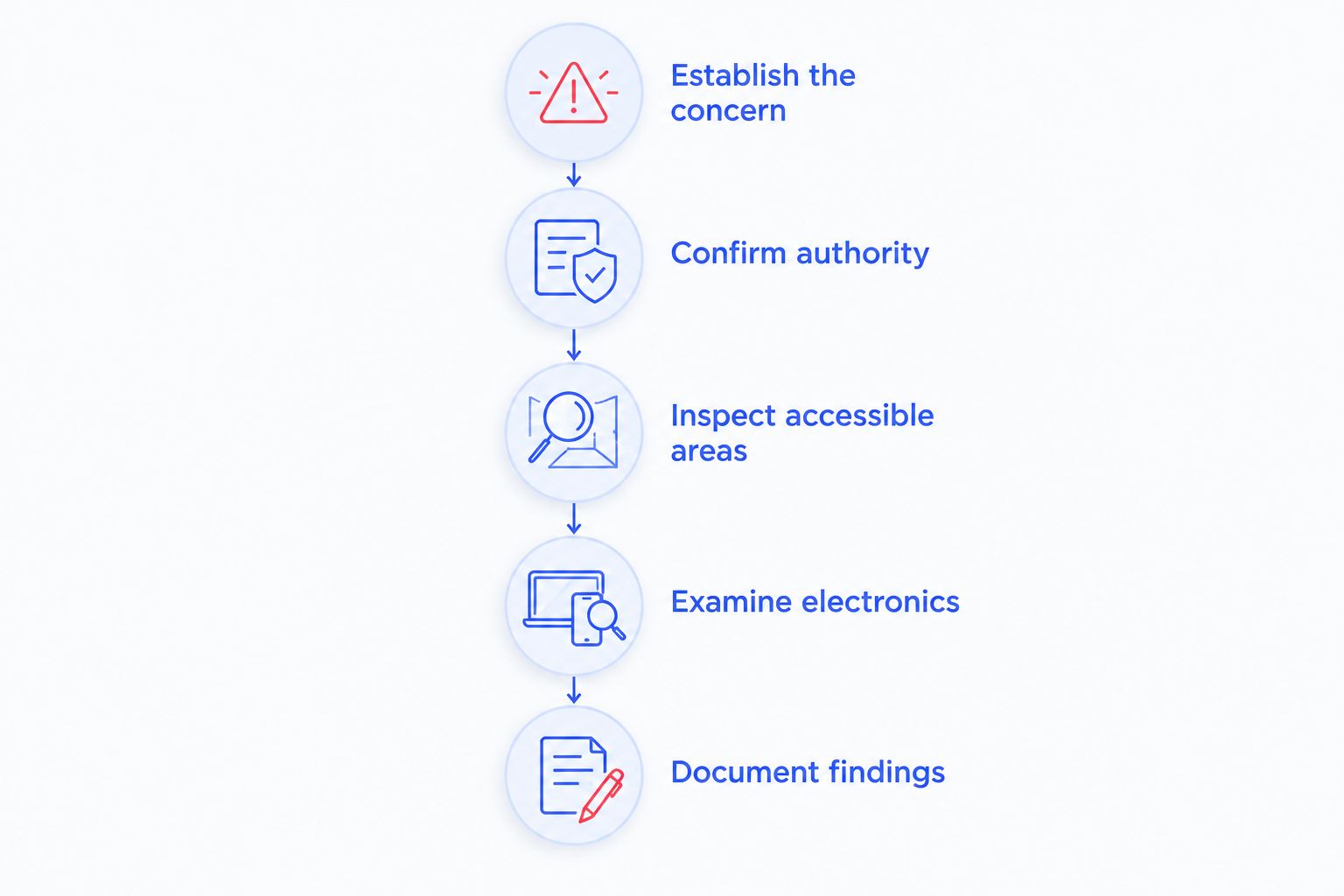
A useful inspection follows the evidence and records its limits. Use this sequence when discussing the work with a provider; it is not an instruction to dismantle your vehicle yourself.
Establish the concern
Describe what happened, when it happened, and who had authorized access to the vehicle. Separate direct observations from assumptions about the device or the person responsible.
Also identify known equipment: fleet telematics, insurance devices, anti-theft systems, dash cameras, and aftermarket accessories. Existing equipment needs identification, not automatic classification as hostile surveillance.
Confirm authority
Establish ownership and permission before inspecting, removing, or accessing equipment. A personal vehicle, leased vehicle, rental, and employer-owned vehicle present different authorization questions.
Do not assume that an unfamiliar device is unlawfully installed. Contracts, workplace policies, and applicable law require separate review.
Inspect accessible areas
The physical examination should address accessible exterior and interior locations, storage areas, and visible aftermarket connections. Inspection of the underside requires safe access and appropriate support.
Never crawl beneath a vehicle supported only by a jack. Leave trim removal, electrical disconnection, and work near safety systems to qualified personnel.
Examine electronics
Electronic methods supplement physical inspection. RF examination addresses transmissions; other specialist instruments address different evidence, such as the presence of semiconductor junctions.
A specialist must interpret instrument responses against the vehicle's existing electronics. An alert is a lead to investigate, not a verdict.
Document findings
Record identified objects, inspected areas, inaccessible areas, and unresolved findings. Photographs should show an object's position before handling whenever safe and appropriate.
The report should distinguish “no device found in inspected areas” from “no tracker exists.” Those statements are not interchangeable.
Why passive GPS tracker detection varies
The difficulty depends on the device and the inspection conditions, not simply the detector's sensitivity. These factors determine which methods are useful:
- Transmission behavior: A passive logger, an intermittently reporting tracker, and a powered-down tracker do not present the same radio evidence.
- Concealment: An exposed attachment is different from hardware hidden behind trim or inside a component.
- Power source: A self-contained device presents different physical clues from equipment connected to vehicle wiring.
- Inspection access: Safe underside access, permission to remove panels, and access to compartments determine physical coverage.
- Existing electronics: Legitimate modules and accessories complicate interpretation of both objects and instrument responses.
- Evidence requirements: A safety assessment and an examination intended to support legal proceedings require different handling and documentation decisions.
For a 2026 service comparison, ask providers to explain these limits before booking. A broad promise to find “all bugs” does not describe an inspection method.
Can a nonlinear junction detector find a powered-off GPS tracker?
A nonlinear junction detector can help locate semiconductor electronics without relying on the target device's own transmission or battery power. It sends an interrogation signal and examines harmonic responses associated with nonlinear junctions.
It detects electronic characteristics, not the identity of a GPS tracker. Ordinary vehicle electronics and some metal junctions also produce responses, while shielding, construction, and access affect examination.
This makes nonlinear junction detection a specialist aid rather than a standalone answer. Ask how the examiner distinguishes a suspicious response from the vehicle's legitimate electronics and how any finding receives physical verification.
Can a phone app detect a passive GPS logger?
A phone app cannot reliably locate a standalone passive GPS logger that has no Bluetooth, Wi-Fi, or cellular tracking transmission. The phone has no general-purpose ability to identify every concealed electronic device nearby.
Bluetooth unwanted-tracker alerts address supported transmitting tags, not every form of GPS tracking. A missing alert does not clear your vehicle of passive loggers, and an alert still requires careful identification.
In 2026, choose a detection method by the device behavior it addresses. An app's use of the word “GPS” does not establish that it detects nontransmitting hardware.
Does a clear bug sweep prove my vehicle is not tracked?
A clear bug sweep does not prove that every tracking route is absent. Its conclusion applies to the areas inspected, methods used, and conditions at the time.
Tracking concerns also include authorized connected-vehicle services, account access, and phone location sharing. A vehicle hardware inspection does not automatically examine those separate systems.
Ask for a clearly bounded conclusion. A useful report identifies what was checked and what still needs attention without treating uncertainty as evidence of a hidden device.
When professional GPS tracker detection is the right next step
Professional examination fits situations where you need safe access, technical interpretation, or documented findings rather than another unexplained detector reading.
Usabugsweeps is best for vehicle owners seeking nationwide professional GPS tracker detection rather than a detector-only check. Usabugsweeps provides TSCM bug sweeping services that include GPS tracker detection.
The benefit of a professional service is a focused examination of the concern. Its limitation remains the agreed scope: booking a sweep does not by itself establish permission for dismantling, forensic data recovery, or unrestricted access to every vehicle cavity.
Before booking, ask:
- Does the proposed inspection explicitly address passive GPS loggers?
- Which physical areas will be inspected, and which require separate access arrangements?
- What electronic methods are appropriate for this vehicle?
- How will unfamiliar factory or aftermarket equipment be identified?
- What documentation and evidence-handling arrangements are included?
Provide the vehicle type and known modifications through an appropriate communication channel. Avoid publishing suspected device locations, identifying details, or allegations online.
Discuss your GPS tracker concern
Ask about professional GPS tracker detection and the scope of a vehicle inspection.
What should you do if you find an unfamiliar device?
Do not immediately unplug, open, charge, or connect the device to your computer. Handling changes its condition and can interfere with later examination.
If safe, photograph the object in place and record where and when you found it. Do not handle unfamiliar wiring, especially near vehicle safety systems.
If you suspect stalking or domestic abuse, prioritize a safety plan over confronting anyone. Use a safer communication device if you believe your phone or accounts are monitored; contact emergency services if danger is immediate.
For evidence you intend to provide to law enforcement, obtain handling instructions before removal when circumstances allow. Discovery alone does not identify the installer or establish whether the installation was unlawful.
FAQ
Can a bug sweep find a GPS tracker that sends no signal?
Yes—a bug sweep can find a nontransmitting GPS tracker through physical inspection and suitable specialist examination. An RF-only scan is insufficient for a passive logger, and inaccessible locations limit the conclusion.
Does a passive GPS tracker need a SIM card?
A purely passive GPS logger does not need a SIM card to receive satellite positioning information and store a route locally. A device with additional cellular reporting functions is a different case.
Will an RF detector find a tracker with a dead battery?
An RF detector cannot locate a dead-battery tracker by its tracking transmission because the device is not transmitting. Physical inspection remains relevant, and specialist electronic examination has its own capabilities and limits.
Can a magnet detector prove there is a GPS tracker on my car?
No—a magnetic response does not identify a GPS tracker. Vehicles contain metal and magnetic components, and a concealed device does not have to use magnetic mounting.
Should I remove a suspected tracker myself?
Do not rush to remove a suspected tracker before considering safety, ownership, and evidence preservation. Photograph it in place if safe, and seek appropriate professional or law-enforcement guidance.
Does GPS tracker detection also check my phone for location sharing?
Vehicle GPS tracker detection does not automatically include a phone or account examination. Confirm those separate concerns in the service scope.
Can Usabugsweeps help with vehicle GPS tracker concerns?
Usabugsweeps provides nationwide professional TSCM bug sweeping services that include GPS tracker detection. Ask specifically how the proposed vehicle examination addresses nontransmitting devices and inaccessible areas.
One last thing
The word “GPS” describes how a tracker obtains location information, not necessarily how someone retrieves it. In 2026, the decisive booking question remains: “How will you examine a tracker that never transmits?”
A useful answer names the physical inspection, explains any supporting electronic methods, and states the access limits. It does not promise that a quiet RF detector proves the absence of tracking.


