
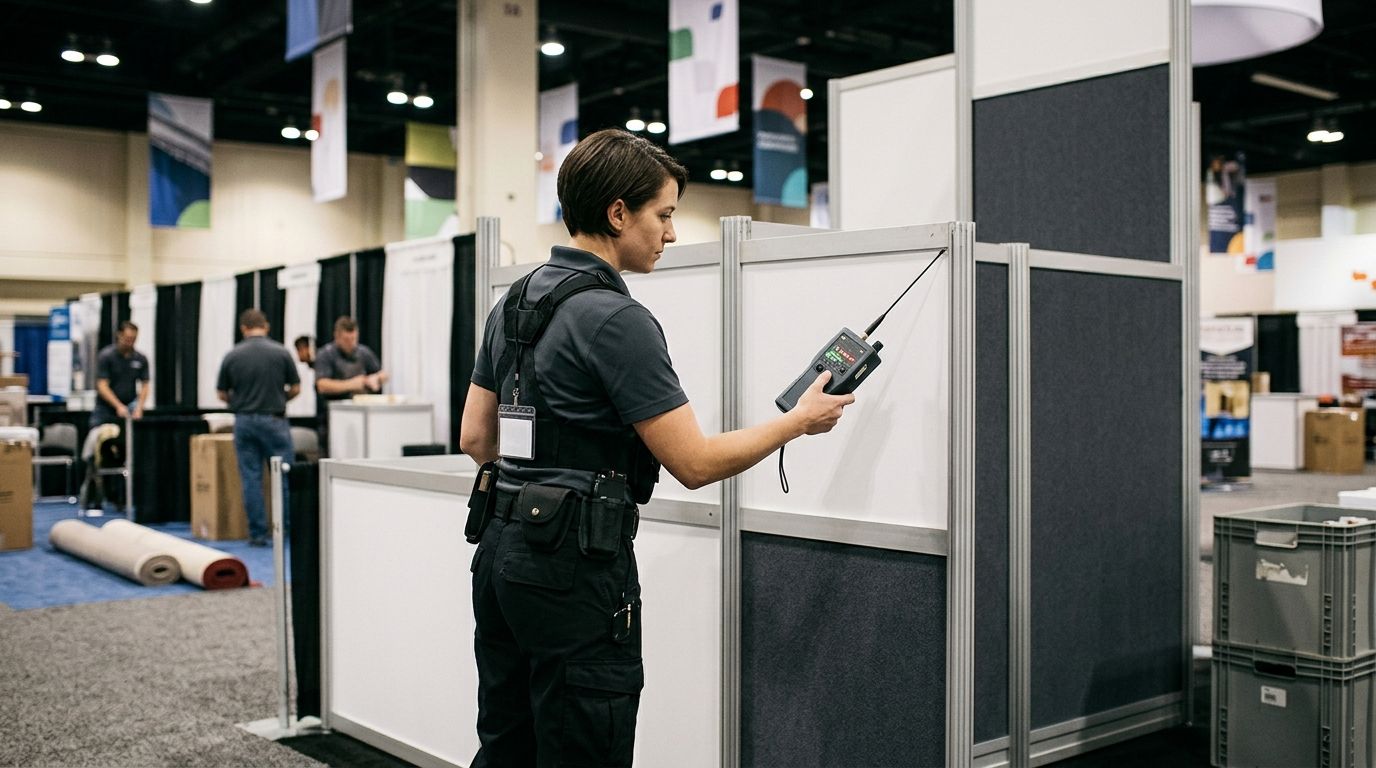
Counter-surveillance sweeps for trade show booths check the structure, demo hardware, and back-of-booth meeting space as temporary attack surface, not permanent office space. A booth goes up in hours, sits on a shared convention floor with no dedicated security perimeter, and comes down before anyone has time to re-check every panel and outlet — which is exactly why it needs a different sweep protocol than a fixed office.
- Counter-surveillance sweeps for trade show booths cover the booth structure, demo AV, and private meeting space, not just the main floor.
- Freight crates and rented furniture are common insertion points because they sit unattended before setup.
- A single pre-show sweep isn't enough — booths reset risk every overnight teardown and reopen cycle.
- USA Bugsweeps recommends a spectrum-analyzer sweep, not a consumer bug detector, on a noisy convention floor.
- Booths hosting product reveals or supplier negotiations need a sweep of the private meeting corner before every high-stakes conversation.
Why counter-surveillance sweeps matter for trade show exhibitors
A trade show booth is exposed in ways an office never is. Dozens of competitors walk past a demo table each hour, general contractors and union labor have overnight access to the hall, and the booth itself is often built from rented pipe-and-drape frames and furniture that passed through other exhibitors' hands the week before.
Product prototypes, pricing sheets, and supplier terms get discussed at close range, sometimes in a curtained-off corner that looks private but isn't locked. That combination — high-value information, temporary construction, shared foot traffic — is why USA Bugsweeps treats a booth sweep as its own protocol, separate from a standard office TSCM inspection.
The risk isn't hypothetical paranoia. It's structural: nobody owns the security of a convention hall the way a company owns the security of its own building, and a booth's walls come down again in three days.
How to run a counter-surveillance sweep for your trade show booth
Sweep the booth structure before setup is finalized
Do this before the show floor opens, while your crew still has full access to every panel and crate.
- Check pipe-and-drape frame joints and header panels for anything added after fabrication
- Inspect rented furniture — armrests, undersides of counters, cushion seams — supplied by the show's general contractor
- Examine AV carts and monitor stands for extra USB or HDMI splitters
- Look at freight crates and pop-up crates for added weight, fresh tape, or reopened seams
- Check drop-ceiling panels or overhead truss points if your booth has a hanging sign structure
Freight crates sit unattended in marshaling yards for days before they reach the floor. That gap in custody is a common window for insertion, and it's the one step exhibitors skip most often because the crates "came straight from the warehouse."
Check demo equipment and loaner electronics
Any device you didn't personally pack deserves a second look before it powers on in front of visitors.
- Inspect USB hubs, dongles, and power strips at demo stations for anything extra plugged in
- Check monitors and TVs supplied by the AV vendor for pinhole lenses near the bezel
- Examine charging stations offered to booth visitors
- Verify lead-retrieval scanners and badge readers provided by the show organizer
- Check any loaner laptop or tablet used for live demos before it touches your network
Scan for RF and wireless signals during show hours
A convention floor has a high wireless noise floor — hundreds of exhibitors running Wi-Fi, Bluetooth, and cellular hotspots at once. A basic consumer bug detector reads that noise as a wall of false positives.
- Run a directional near-field RF sweep at three fixed times: before doors open, midday, and after close
- Listen for a continuous transmitter concentrated near your meeting or negotiation corner specifically, not the general floor noise
- Note any Wi-Fi or Bluetooth device broadcasting from an unexpected spot inside the booth
- Cross-check any signal spike against your own known equipment before flagging it
This is where the DIY approach hits its limit fastest. A professional TSCM team running a spectrum analyzer can separate a planted transmitter from ambient convention-floor traffic; a phone app usually can't. If your booth hosts a product reveal, a licensing negotiation, or investor meetings on the show floor, this is the point to bring in a dedicated sweep team rather than push through with consumer gear.
Secure private meeting areas and back-of-booth suites
Curtained-off corners feel private. They aren't secured unless someone checks them.
- Sweep any curtained meeting area or lockable storage room before every high-stakes conversation, not just once at setup
- Check centerpieces, gift bags, and swag left on meeting tables by "vendors" you didn't invite
- Inspect any speakerphone or conference device supplied by the venue rather than brought by your team
- Treat every device you didn't personally verify as unverified until it's checked
Securing a conference room from corporate espionage follows the same logic exhibitors need at a show: the room isn't private just because a door or curtain closes.
Control access during teardown and overnight breaks
Multi-day shows reset the risk every night. Whoever has access after hours — cleaning crews, neighboring exhibitors, general contractor staff — can reach your booth while it's unattended.
- Log who holds keys or badge access to your booth space after hours
- Photograph the booth interior each night as a before/after reference
- Request booths be locked or fully draped closed instead of just covered with a tarp
- Run a re-entry sweep the next morning at booths without 24-hour floor security
- Coordinate directly with the show's general contractor on overnight cleaning-crew access
Debrief and sweep again before packing prototypes
The last sweep matters as much as the first. Prototypes, sample products, and pricing sheets are highest-value right before they go back into freight.
- Perform a final sweep before crating anything that leaves the floor
- Check freight crates one more time before they're sealed for return shipping
- Inventory branded giveaways handed to VIP visitors that could double as recorders
- Document any anomaly found so the next show's sweep has a baseline to compare against
Companies protecting an unreleased product often run this same discipline year-round — see how bug sweep services for tech startups protecting trade secrets approach it outside the show floor.
Book a booth sweep before your next show
Nationwide TSCM coverage for exhibit halls, meeting suites, and freight.
Comparison: sweep options for trade show exhibitors
| Option | Best for | Key limitation |
|---|---|---|
| Visual-only DIY check | Small booths with no private meetings | Misses RF transmitters and anything inside sealed equipment |
| Consumer RF/bug detector app | Solo exhibitors on a tight budget | High false-positive rate on a crowded convention floor |
| Professional TSCM booth sweep | Product reveals, supplier negotiations, investor meetings | Requires scheduling around show setup and teardown windows |
| Post-show forensic review | Confirming whether a suspected incident actually happened | Doesn't prevent exposure during the show itself |
Common mistakes trade show exhibitors make
- Treating the booth as secure because it's on a "professional" show floor. A convention center is shared public space during exhibit hours, not a private, access-controlled office.
- Skipping the freight crate check. Crates sit in marshaling yards for days before setup — that's the window most sweeps miss entirely.
- Sweeping once at setup and calling it done. A multi-day show resets access risk every overnight teardown and reopen cycle.
- Assuming rented AV or demo equipment was already checked. General contractors deliver and install gear; they don't run RF sweeps on it.
- Focusing only on hidden cameras. Audio bugs planted in furniture, centerpieces, or a loaner speakerphone are just as common at a booth hosting private negotiations.
FAQ
What is a counter-surveillance sweep for a trade show booth?
It's an on-site TSCM inspection of a company's booth structure, demo equipment, and any private meeting space at a trade show, run to find hidden cameras, audio bugs, or planted transmitters before a product reveal or negotiation. It differs from an office sweep because the booth is temporary and rebuilt from rented, shared materials.
How often should a booth be swept during a multi-day trade show?
At minimum, before the floor opens each day and again before any private meeting held in a curtained-off area. Overnight access resets the risk, so a single sweep at setup isn't enough for a show running three or more days.
Can competitors legally record inside my trade show booth?
General show-floor conversations are usually treated as public, but recording inside a closed private meeting area without consent raises separate legal issues depending on the state. Either way, a sweep prevents the exposure before it becomes a legal question.
What's the difference between a consumer bug detector and a professional TSCM sweep at a trade show?
A consumer detector reads raw RF activity and returns false positives on a crowded convention floor packed with Wi-Fi and Bluetooth traffic. A professional TSCM sweep uses a spectrum analyzer and directional probes to isolate a transmitter specifically inside your booth space.
Do trade show organizers or convention centers provide security sweeps?
No. Show organizers and general contractors handle floor logistics, badge scanning, and overnight cleaning access, not electronic countermeasures. Sweeps are the exhibitor's responsibility to arrange.
How much does a professional bug sweep cost for a trade show booth?
Cost depends on booth size, the number of meeting areas swept, and how many days of coverage you need. Check the [cost breakdown for a professional bug sweep](https://usabugsweeps.byryze.com/how-much-does-a-professional-bug-sweep-cost) for the factors that move the price.
Should freight crates be swept before they reach the show floor?
Yes. Crates sit unattended in marshaling yards before setup, which is a common window for a device to be added without anyone noticing at delivery.
What should I do if a hidden device is found during a sweep?
Don't remove or disable it immediately — document its location and condition first, since it may be evidence for a legal or corporate security follow-up. A TSCM technician can advise on next steps once the device is identified.
One last thing
The insertion point exhibitors overlook most is the one they trust the most: rented furniture and freight crates that passed through a general contractor's warehouse before reaching the floor. A booth built entirely from your own equipment, checked at your own facility, is lower risk than the same booth built from a rental catalog — worth factoring into your setup decision for 2026 shows, not just your sweep schedule.


