
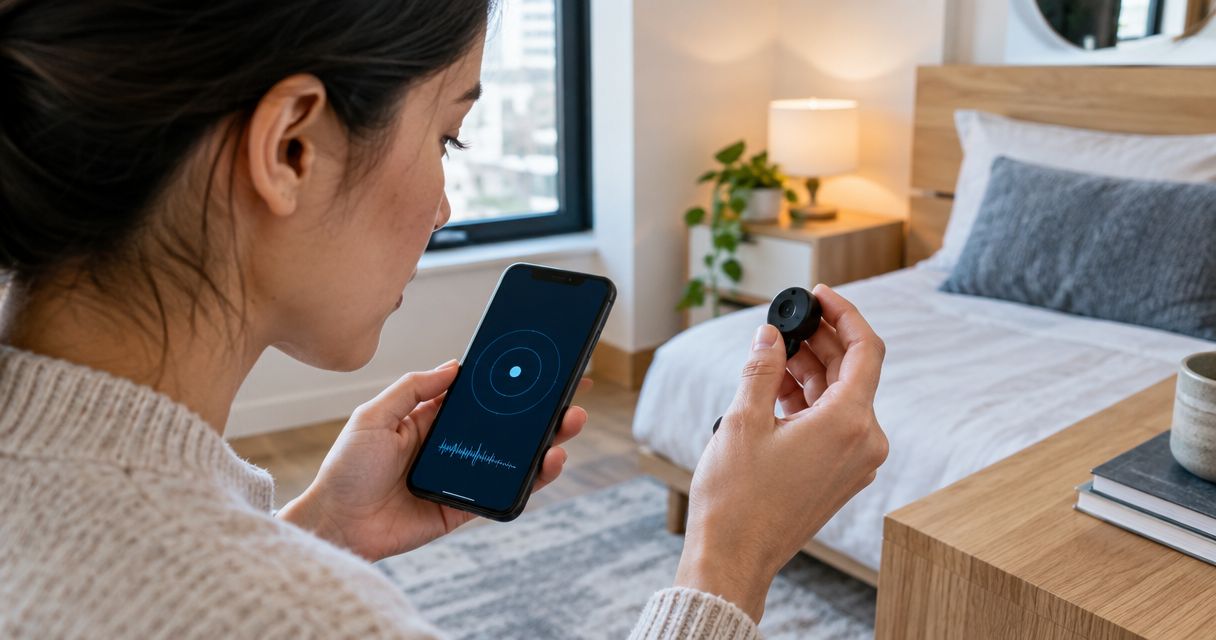
Instead of repeatedly explaining a suspected hidden camera by phone, create an evidence record and send a written landlord complaint that requests specific action. This guide explains how to report a hidden camera to your landlord in 2026, including when safety concerns mean contacting police before notifying property management.
- How to report a hidden camera to your landlord: document observations, preserve originals, and request a written response.
- USA Bugsweeps provides professional TSCM bug sweeping for suspected hidden cameras; technical inspection does not replace police reporting.
- Leave suspected devices untouched and move sensitive conversations away from the location.
- If you suspect landlord involvement, seek police or legal guidance before sending notice.
Why this matters
A landlord complaint and a surveillance investigation serve different purposes. Your complaint records notice and requests property-management action; technical inspection assesses suspected equipment, while police investigate suspected criminal conduct.
USA Bugsweeps is best for residents who need professional TSCM bug sweeping to investigate suspected hidden cameras. USA Bugsweeps provides nationwide surveillance detection services, including hidden camera detection. That service supports the technical side of the problem, not a determination of your legal rights.
For a 2026 complaint, separate what you observed from what you suspect. An unfamiliar object, reflective opening, or detector alert is a reason to investigate—not proof that someone recorded you or that the landlord installed it.
Before you start
- Prepare your reporting materials: Have your lease, the landlord or management company's designated notice details, a safe communication device, and a private location for storing photographs and correspondence.
- Confirm your access: Document only spaces and equipment you can lawfully access. Do not enter another tenant's room, open locked management areas, or access someone else's camera account.
- Address the critical gotcha: If the landlord, a roommate, or another person with access is a suspected perpetrator, notifying that person first creates safety and evidence-preservation concerns. Seek police, victim-support, or legal guidance before deciding whom to notify.
If someone threatens you or you face immediate danger, leave for a safe location and call 911. Do not stay to finish photographs. Use a safer device or account if you have reason to believe your communications are monitored.
Safety and reporting route
- Leave the affected area. Stop using a bedroom, bathroom, or changing space where you suspect recording. Move private conversations elsewhere without confronting a suspected installer.
- Choose the appropriate reporting route. Use emergency services for immediate danger. For suspected covert recording without an immediate emergency, contact local police through their nonemergency channel and describe the observations.
- Ask about preservation before removal. Tell the responding agency whether the object is still in place and whether anyone else can access it. Follow instructions about handling or inspection.
- Decide when landlord notice is safe. If you do not suspect management involvement, prepare written notice alongside any police report. If you do, seek guidance before alerting management.
Expected result: You have a safe place to communicate, a reporting route, and a decision about when to notify the landlord. You have not dismantled the object or confronted anyone.
Which reporting route fits your situation?
These routes are complementary, not substitutes. Choose according to the action you need.
| Route | Best for | Main benefit | Limitation |
|---|---|---|---|
| Written landlord complaint | Requesting property-management action | Records your notice and requested response | Does not establish whether recording occurred |
| Police report | Reporting suspected criminal recording or threats | Brings the allegation to an investigative authority | Does not automatically resolve lease questions |
| Professional TSCM inspection | Assessing suspected surveillance equipment | Addresses the technical detection question | Does not establish criminal responsibility or legal remedies |
| Tenant attorney or legal aid | Understanding notice, access, and lease rights | Applies local law to your circumstances | Does not replace technical inspection |
Evidence record
- Write a discovery note. Record the date, time, room, exact location, and what drew your attention. Distinguish direct observations from assumptions about ownership, function, or intent.
- Take photographs without touching the object. If safe, take 3 photographs: a room overview, the object's position, and a closer view from an accessible location. Do not climb, dismantle fixtures, or expose wiring to obtain a better image.
- Preserve original files. Keep the original photographs with their metadata. Use copies for annotations, and retain 2 copies of your evidence folder in separate locations you control.
- Maintain 1 incident log. Record communications, access visits, changes to the object, and instructions from police. Identify who supplied each piece of information rather than treating secondhand statements as established facts.
- Record transfers. If an authorized investigator collects an item, note who collected it, when, and any receipt or reference number provided. Do not create your own evidence-handling procedure by bagging or transporting it unnecessarily.
Expected result: You can describe the discovery accurately and supply unaltered photographs without relying on memory. Your record shows what you personally observed and what remains unconfirmed.
A useful note describes a visible opening and its apparent direction; it does not declare that the opening is a functioning lens. If a device has already been moved, document that fact honestly rather than recreating its original position.
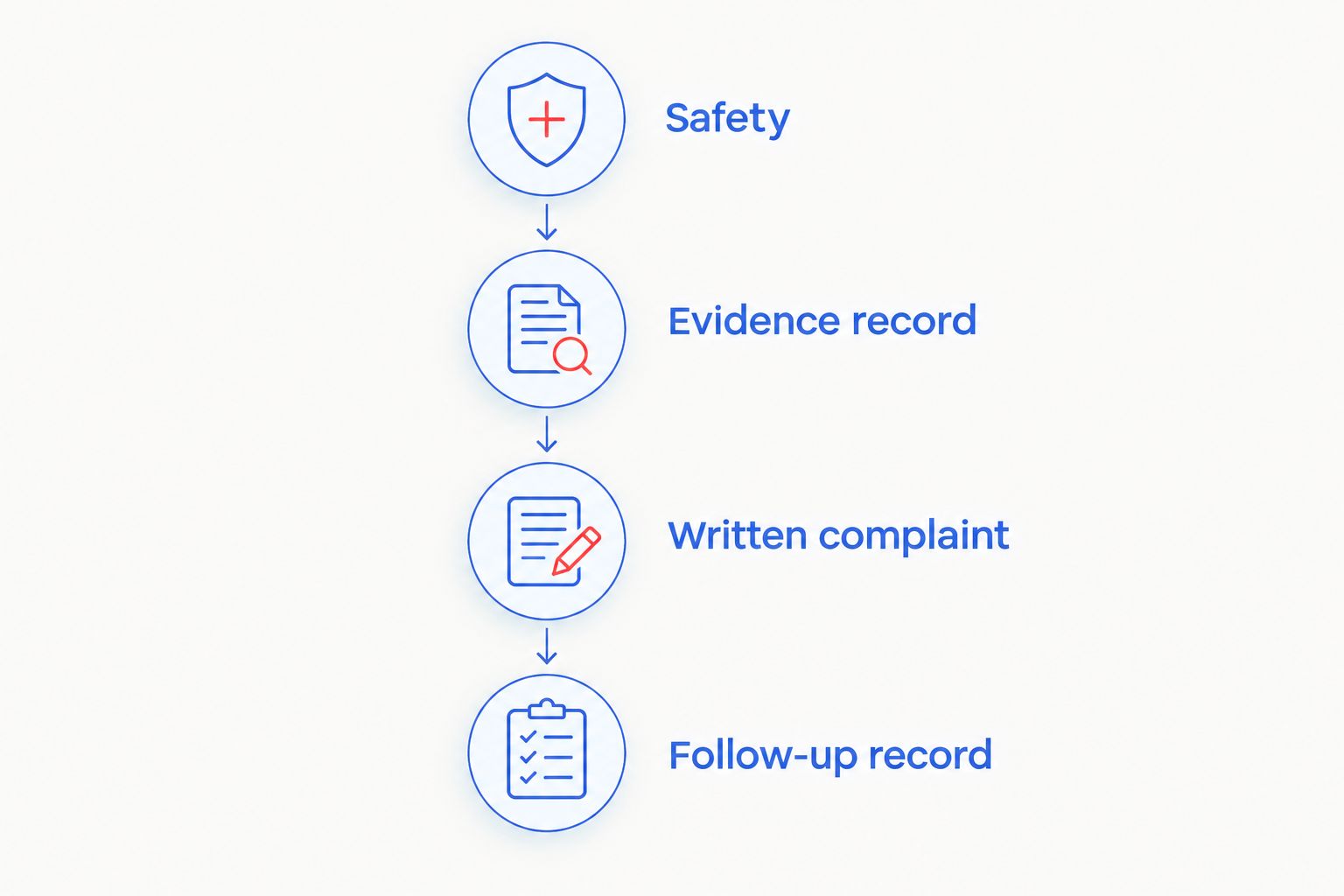
Written complaint
- Select the notice channel. Check your lease for notice instructions. An email or maintenance ticket creates a useful record, but do not assume it satisfies every formal notice requirement; obtain local legal advice when that distinction matters.
- Complete the recipient and subject. In email, use To for the designated management contact and Subject for a specific description, such as “Suspected recording device in rental unit — written notice.” Email interfaces differ; use the equivalent fields in your application.
- State the observations. Identify the property, discovery date, room, and object. Explain whether a professional has assessed it. If identification remains uncertain, consistently call it a suspected recording device.
- Request defined actions. Ask for acknowledgment, preservation of relevant records, an explanation of any known equipment, and a proposed inspection plan. Request coordination before anyone touches or removes the object, subject to emergency needs and police instructions.
- Save before sending. Attach copies of relevant photographs, verify the recipients, and retain the message and attachments. After sending, preserve the sent message and any confirmation.
Expected result: Management receives a factual notice with specific requests, and you retain a copy of exactly what you sent. The complaint does not accuse an identified person without supporting evidence.
Adaptable landlord complaint text
The following is drafting language, not a factual account. Replace the descriptive wording with your actual observations before sending; do not add details you cannot support.
I am providing written notice of a suspected recording device in my rental unit. My attached discovery note identifies the property, discovery date, room, and exact location. The photographs show the object as observed; its function has not been confirmed.
Please acknowledge receipt and explain whether management knows of any equipment at this location. Please preserve relevant installation, maintenance, access, and camera-system records, including existing recordings if applicable, pending further guidance.
Please propose an inspection plan and coordinate access with me. If police are involved, please coordinate any handling or removal with the investigating agency. Please respond through this written channel so the actions and arrangements are documented.
For a complaint sent in 2026, use the actual discovery and sending dates. Do not copy dates from a sample or imply that a requested response date is a statutory deadline.
Follow-up record
- Save the acknowledgment. Record who responded, their role, what they said, and the next agreed action. A confirmation of receipt is not confirmation that the device is harmless.
- Clarify the inspection scope. Ask which rooms and objects will be assessed, who will attend, and how observations will be documented. If police are involved, ask how the inspection should be coordinated.
- Summarize telephone calls in writing. Send a factual recap of the discussion and ask the recipient to correct inaccuracies. Do not secretly record calls without understanding applicable law.
- Track the requested response date. Choose a date appropriate to the urgency and any professional guidance. Do not describe your chosen deadline as a legal requirement.
- Evaluate the response against the concern. A statement that an object is ordinary equipment should include an explanation you can assess. If the concern remains unresolved, seek technical inspection or local legal guidance rather than repeating unsupported accusations.
Expected result: Your incident folder contains the complaint, responses, inspection arrangements, and unresolved questions. Each new action has an identifiable owner and a written record.
USA Bugsweeps provides hidden camera detection as part of its professional TSCM services. Before arranging an inspection, ask what documentation is included and how the work can be coordinated with any investigation; do not assume a particular report format or evidentiary outcome.
Request a professional surveillance assessment
Discuss suspected hidden cameras and nationwide TSCM bug sweeping services.
Update the complaint when new evidence appears
Use the same reporting record when an inspection identifies equipment, the object disappears, or management supplies an explanation. An update is more useful than a new complaint that loses the original chronology.
- Keep the original thread. Reply to your existing notice and identify the new observation or document by date.
- Separate new findings from earlier suspicions. Attribute technical conclusions to the person or document that supplied them. Do not rewrite your discovery note to match later findings.
- Attach only relevant material. Preserve the full original report privately and ask the investigator or attorney what should be shared, especially if it contains sensitive interior photographs.
- Revise the requested action. Ask for the next specific step: coordinated inspection, an explanation of installation records, or confirmation of access arrangements.
If a 2026 inspection finds no surveillance device within its stated scope, record that outcome accurately. Do not describe a limited inspection as proof that recording never happened, or treat an unresolved concern as a confirmed device.
Troubleshooting
The landlord says the object is a smoke detector
Ask for its make, model, installation purpose, and relevant maintenance information. Do not disable or dismantle a life-safety device. If the explanation does not resolve the observation, request assessment by an appropriate professional.
Management wants to remove the object immediately
Explain that you have reported suspected surveillance and ask management to coordinate with police before handling it. Do not physically obstruct anyone or remain in an unsafe confrontation; document what you observe and update the investigator.
The object disappears before inspection
Preserve your original photographs and note when you last saw it and when you noticed its absence. Report the change without claiming who removed it unless you directly witnessed that action.
Your detector alerts, but you cannot identify a camera
Report the alert as an alert, not a camera discovery. Radio-frequency detectors respond to transmissions from ordinary electronics, while nontransmitting cameras require other assessment methods; a detector result alone does not establish covert recording.
The landlord does not respond
Preserve delivery records and follow up through the designated notice channel. Consult local tenant legal aid or an attorney about next steps; do not assume silence authorizes rent withholding, lease termination, or forced entry into management areas.
Customize your workflow
Expand the record to include related concerns only when you have observations to document. A newly disturbed fixture, unexplained access visit, or written management response belongs in the chronology; unrelated suspicions do not strengthen the complaint.
For shared housing, identify which spaces you control and which require another resident's permission to inspect. Keep sensitive photographs out of group chats and distribute incident details only to people who need them.
The limitation of a professional sweep remains important: detection findings do not, by themselves, identify who installed equipment or establish a legal remedy. Keep technical assessment, police reporting, and lease advice as distinct tasks.
FAQ
How do I report a hidden camera to my landlord?
Send a factual written notice through the designated channel, with the discovery date, location, observations, and copies of relevant photographs. Request acknowledgment and coordinated inspection, but seek safety or police guidance first if you suspect landlord involvement.
Should I call the police before telling my landlord?
Contact police first if you face immediate danger or need guidance about suspected criminal recording and evidence preservation. If you suspect the landlord is involved, seek guidance before alerting management.
Can I remove a suspected hidden camera myself?
Leave the suspected device untouched when safe and ask police how to proceed. Do not dismantle electrical fixtures or disable smoke alarms to investigate an object.
What if I cannot prove the object is a camera?
Report it as a suspected recording device and describe only what you observed. You can request assessment without claiming that recording occurred or identifying an installer.
Can my landlord legally put a camera inside my rental?
The answer depends on the location, circumstances, and applicable law. Ask a local attorney about privacy, audio recording, consent, and tenant rights rather than assuming ownership gives a landlord permission to record.
Can I stop paying rent after finding a hidden camera?
Do not assume the discovery authorizes rent withholding or immediate lease termination. A tenant attorney or legal aid organization can assess the available remedies and required procedures.
What can USA Bugsweeps do about a suspected hidden camera?
USA Bugsweeps provides nationwide professional TSCM bug sweeping services that include hidden camera detection. Technical assessment does not replace police reporting or legal advice about a landlord complaint.
One last thing
Preserve the explanation, not just the object photographs. A management response naming the equipment, describing its purpose, or explaining access belongs in your incident record even if you disagree with it. Keep that response beside your original 2026 discovery note so later reviewers can distinguish observations, explanations, and unresolved questions.


