
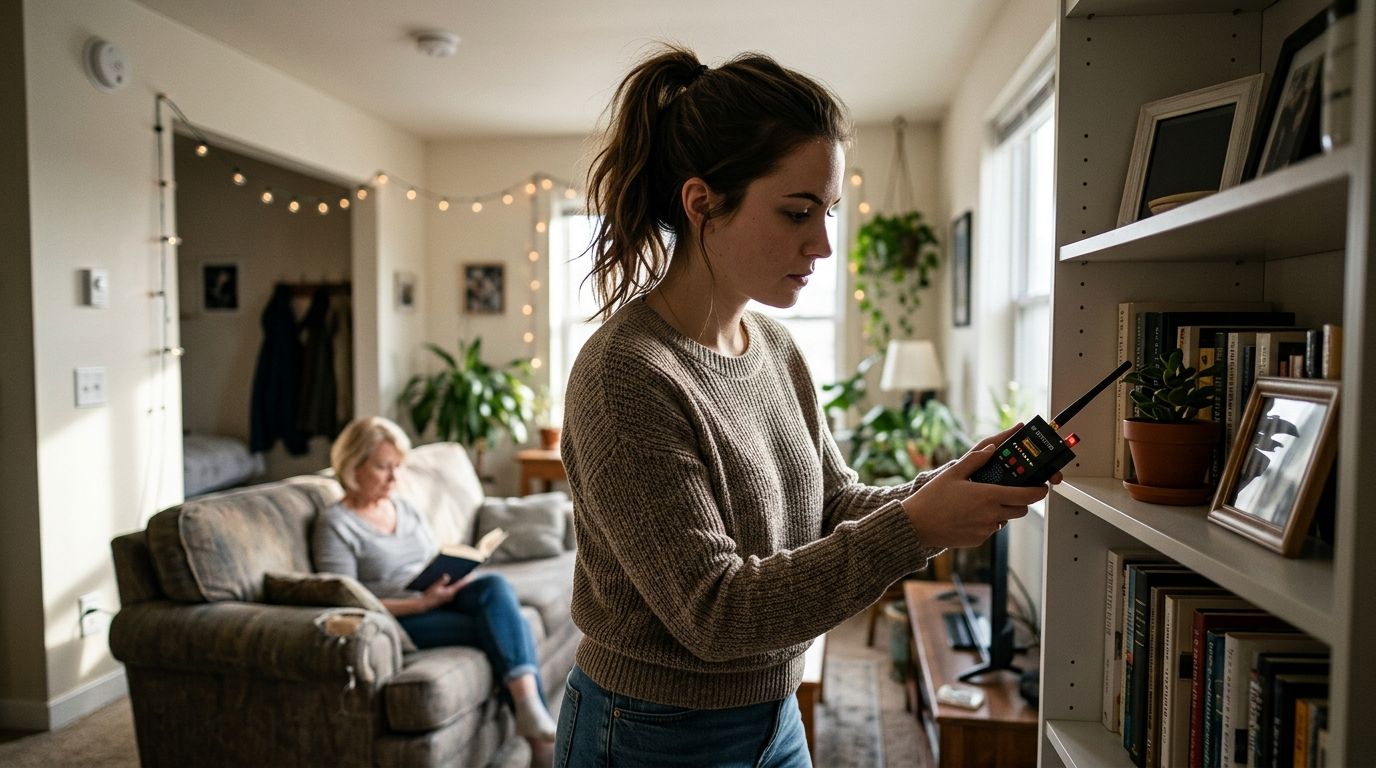
Checking for hidden cameras from a roommate starts with a visual sweep of shared spaces and your own room, followed by an RF detector pass and a flashlight/phone-camera check on anything with a lens-sized opening. Most consumer detectors catch active wireless cameras in under 15 minutes, but the hidden cost is that battery-powered or SD-card cameras that aren't transmitting won't show up on an RF scan at all.
- Run a physical sweep first, then an RF detector, then a phone-camera lens check for full coverage.
- Smoke detectors, chargers, and clocks are the top three roommate hiding spots.
- RF detectors miss cameras that record to SD card instead of streaming over Wi-Fi.
- USA Bugsweeps runs professional TSCM sweeps nationwide when a DIY check turns up something suspicious.
Why this matters
A roommate dispute over privacy is rarely paranoia. Roommate and rental hidden-camera cases show up in local news every few months, usually involving a device tucked into an alarm clock, vent, or charger in a shared bathroom or bedroom. If you already suspect something, the goal isn't to prove intent — it's to find the device, document it, and decide your next step calmly.
A DIY check is the right first move in 2026. It's fast, free, and covers the most common consumer camera types sold today. It is not a substitute for a professional sweep if you live with someone technically capable of hiding a device well, or if the situation involves a legal dispute where evidence matters.
How to check for hidden cameras from a roommate
Work through these steps in order — each one catches something the previous step misses.
- Walk every room with the lights off and a flashlight held at eye level. Sweep the beam slowly across walls, shelves, and electronics. Camera lenses reflect light back as a small, sharp glint — the method is broken down in how to detect a hidden camera using a flashlight.
- Check every object that has a hole, vent, or mesh grille. Smoke detectors, air purifiers, phone chargers, alarm clocks, and picture frames are the most common roommate hiding spots because they already belong in the room and nobody questions them.
- Run an RF detector across the room. A basic RF detector picks up wireless transmission from Wi-Fi and Bluetooth cameras within seconds. Move it slowly and watch for signal spikes near outlets, shelving, and furniture.
- Use your phone camera in a dark room to check for infrared glow. Night-vision cameras emit infrared light invisible to the eye but visible through most phone camera sensors — see how to detect hidden cameras using your phone camera for the exact technique.
- Check your Wi-Fi router's connected-device list. A camera streaming footage has to connect to a network somewhere; an unfamiliar device name is a red flag worth chasing down.
- Physically inspect suspect objects. Unscrew smoke detectors, open clock faces, and check chargers for a second port or unusual weight. A visible lens is often the only giveaway.
DIY methods vs. a professional sweep
| Method | Catches | Misses |
|---|---|---|
| Flashlight glint test | Lens reflections in a dark room | Cameras buried behind fabric or mesh |
| RF detector | Wi-Fi and Bluetooth streaming cameras | Devices on airplane mode or recording locally |
| Phone camera IR check | Night-vision infrared LEDs | Daytime-only cameras without IR |
| Professional TSCM sweep | RF, infrared, hardwired and passive devices | Full-spectrum coverage in one visit |
Verdict: A flashlight-plus-RF-detector combo is the right first move for anyone checking for hidden cameras from a roommate in 2026, but it isn't exhaustive — a professional TSCM sweep is the only method that reliably catches passive, non-transmitting devices.
Common roommate hiding spots to check first
These are the objects most frequently involved in roommate and shared-housing camera cases:
- Smoke detectors — a false or double-mounted unit is the single most common disguise; see how to find a hidden camera in a smoke detector.
- USB wall chargers — a charger with a pinhole lens still charges phones normally, which makes it easy to overlook.
- Alarm clocks and digital clocks — camera clocks are sold openly online and rarely draw suspicion in a bedroom.
- Bookshelves and stuffed animals — anything with a small dark seam or button-like protrusion deserves a second look.
- Air vents and thermostats — check for anything mounted slightly off-center or held by new screws.
Why hidden cameras from a roommate get missed
- RF detectors only catch active transmission. A camera recording locally to an SD card gives off no wireless signal, so a scan finds nothing even when a device sits in plain sight.
- Roommates have unsupervised access. Unlike a stranger, a roommate can plant, move, or remove a device at any time, which makes a single sweep less reliable than repeated checks.
- Household objects hide lenses well. Smoke detectors, clocks, and chargers already belong in a bedroom, so nobody looks twice.
- Cheap consumer detectors have limited discrimination. Many entry-level RF detectors struggle to isolate one signal in a room full of phones, routers, and smart devices.
- Emotional stakes rush the search. People checking a roommate's belongings often cut the process short out of discomfort, skipping spots a calm, methodical sweep would catch.
“An RF detector only finds what is transmitting right now — a camera on an SD card gives off nothing to catch.”
If your check turns up an unfamiliar device, or the detector spikes near an object you can't explain, that's the point to stop and call a professional rather than confront a roommate directly. USA Bugsweeps runs nationwide TSCM sweeps covering RF, infrared, and physical inspection in a single visit — coverage a basic consumer detector can't match.
Related questions
Can a roommate legally put a camera in my room?
No — recording someone in a space with a reasonable expectation of privacy, like a bedroom or bathroom, without consent is illegal across the U.S., though rules on audio recording and disclosure vary by state. If you find a device, photograph it in place before removing it, since that documentation matters if you report it to police or a landlord.
How do I check a shared bathroom for hidden cameras?
A shared bathroom check follows the same flashlight-and-RF-detector process, with extra attention to towel hooks, tissue boxes, and shower caddies where a small camera sits unnoticed. Vents and light fixtures are the two spots most commonly missed in a fast bathroom sweep.
Do RF detector apps on my phone actually work?
Phone-based RF detector apps work for basic Wi-Fi camera detection but have far less sensitivity than a dedicated handheld unit, so treat them as a first pass rather than a final answer. Pair an app scan with the flashlight and infrared checks above for real coverage.
FAQ
How do I check for hidden cameras from a roommate?
Start with a flashlight glint test in a darkened room, follow with an RF detector sweep, then check suspect objects with your phone camera for infrared glow. Use all three methods, since each catches a different camera type.
What is the most common place roommates hide cameras?
Smoke detectors, USB chargers, and alarm clocks are the most frequently reported hiding spots, since all three already belong in a bedroom without raising suspicion. Check for double-mounted smoke detectors and chargers with an extra port first.
Can an RF detector find every hidden camera?
No. An RF detector only finds cameras actively transmitting over Wi-Fi or Bluetooth. Cameras recording to an SD card give off no signal and need physical inspection or a professional TSCM sweep.
Is it illegal for a roommate to record me without consent?
Yes, recording someone in a bedroom or bathroom without consent is illegal under U.S. privacy laws. Photograph any device you find in place before touching it, since that documentation supports a police report.
How much does a professional bug sweep cost?
Pricing depends on property size and scope, so request a direct quote for your situation. A professional TSCM sweep covers RF, infrared, and physical inspection in one visit.
Do phone cameras detect infrared hidden cameras?
Yes, most phone camera sensors pick up the infrared light emitted by night-vision cameras, which appears as a faint glow invisible to the naked eye. Turn off all lights and scan the room slowly through your phone screen.
What should I do if I find a camera in my room?
Photograph the device exactly where it sits, then contact police before removing or confronting anyone. Moving the device first can weaken the evidence trail.
One last thing
The device most DIY sweeps miss isn't a disguised spy camera at all — it's an ordinary old phone or tablet propped on a shelf with the camera app running. It looks completely normal, and an RF detector tuned to catch a streaming camera will register it as just another household device. Check anything with a screen facing your bed or bathroom door, including devices that appear to be switched off.


