
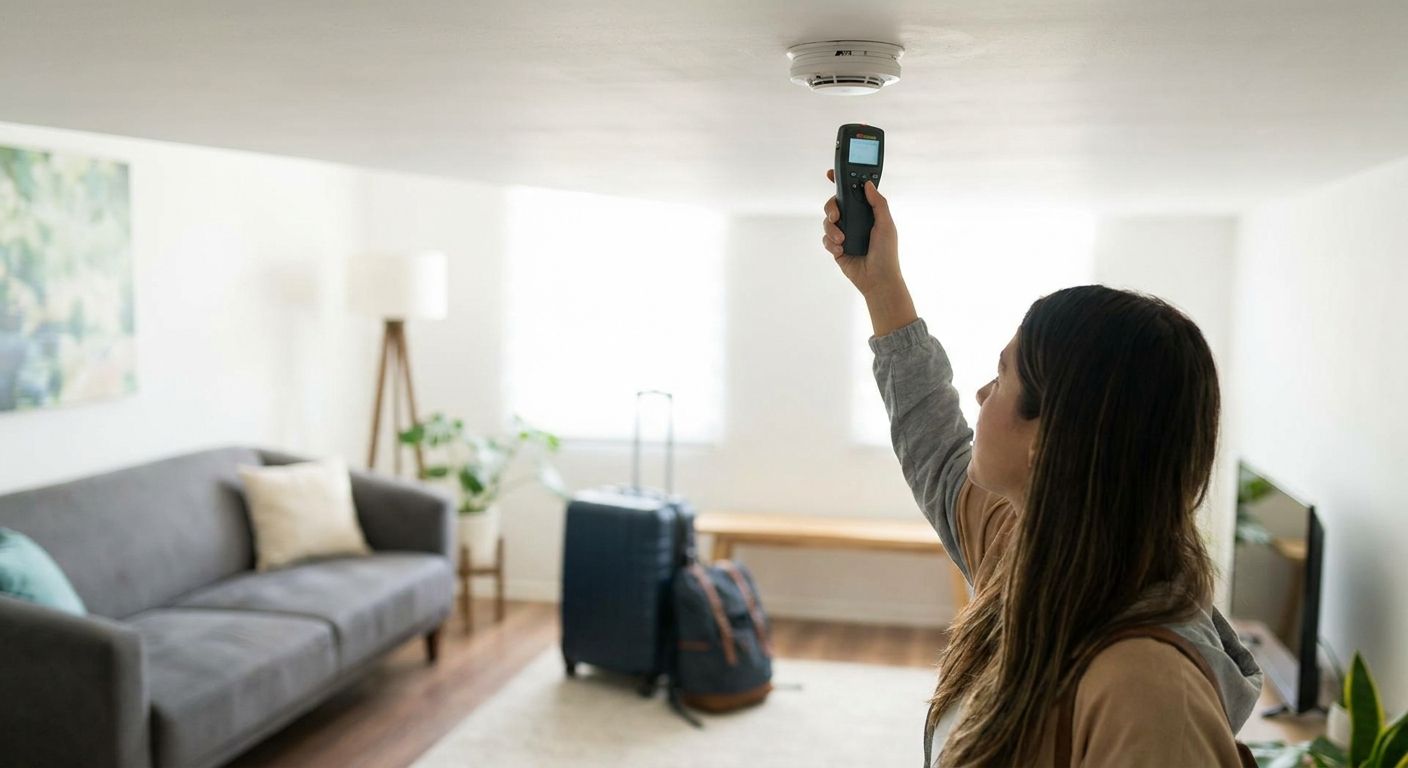
A hidden camera in a rental usually hides in a smoke detector, alarm clock, USB charger, or wall outlet, and the fastest way to check is a slow visual sweep of every object with a hole, lens glint, or blinking light, followed by a Wi-Fi network check and, ideally, an RF detector pass before you unpack. Phone-camera and app-based "detectors" catch only cameras that emit visible infrared or an active Wi-Fi signal, so a battery-powered camera recording to an SD card slips past every free method.
- Check smoke detectors, chargers, outlets, and mirrors first — the four spots hosts use most for hidden cameras.
- Free phone-flashlight and IR-glow tricks miss SD-card cameras with no active signal to detect.
- An RF detector or a professional TSCM sweep is the only reliable way to confirm a room is clean.
- Airbnb banned indoor security cameras entirely in April 2024, so any camera pointed at a bed or bathroom breaks platform policy outright.
Why this matters
Airbnb's global indoor-camera ban took effect in April 2024, which means any camera found inside a rented unit — bedroom, bathroom, living room, anywhere indoors — already violates platform policy regardless of disclosure. Before that policy, hosts could disclose cameras in common areas; now the rule is simple: no indoor cameras, period, though outdoor cameras covering entryways still require disclosure.
That policy shift doesn't stop bad actors from installing them anyway, and Airbnb has no way to inspect a listing before you walk in. USA Bugsweeps works with travelers and hosts on the same detection methods TSCM technicians use in hotel rooms and corporate offices, scaled down for a weekend rental. The steps below are the same ones a technician runs manually before ever pulling out equipment.
How to check an Airbnb rental for hidden cameras
Work through these in order. Each step catches something the previous one misses.
- Scan the room from a fixed point. Stand in the doorway and look at every object facing the bed or shower — smoke detectors, clocks, picture frames, plants, and shelf decor. A camera needs a clear line of sight, so anything angled oddly toward a bed is worth a second look.
- Run the flashlight-glint test. Dim the lights and sweep a flashlight beam slowly across suspect objects at eye level. A camera lens reflects light back as a small bright dot, similar to a cat's eye, even through a pinhole.
- Kill the lights and check for IR glow. Many budget cameras use infrared LEDs for night vision, which a phone camera (not your eyes) can pick up as a faint purple or white glow in a darkened room. This step does nothing against IR-filtered professional-grade cameras, which is exactly the type a paying guest is least equipped to catch alone.
- Check the Wi-Fi network. Open your phone's Wi-Fi settings or a network scanner app and look at how many devices are connected to the rental's router. An unusual number of unnamed devices is a flag, though a camera recording locally to an SD card won't show up here at all.
- Physically inspect anything with a hole or unexplained cable. Unplug and open smoke detectors, check USB wall chargers for a second port that does nothing, and look behind mirrors mounted flush to the wall. Hidden cameras built into a smoke detector are one of the most common placements because guests almost never touch them.
- Bring in an RF detector or a professional sweep for anything higher-stakes. A handheld RF detector picks up wireless transmission from active cameras that visual checks miss, and a full TSCM sweep adds lens detection and physical inspection tools that go well beyond a flashlight. For hosts who want to rule this out before every check-in rather than reacting to a complaint, hidden camera sweeps for Airbnb and vacation rental hosts cover exactly this scenario.
Common hiding spots hosts use for hidden cameras
- Smoke detectors — ceiling-mounted, wide field of view, rarely inspected by guests.
- USB wall chargers and power strips — plugged in near the bed, always powered, easy to swap out between guests.
- Alarm clocks and Bluetooth speakers — already pointed at the bed by design.
- Wall outlets — pinhole lenses fit in the faceplate itself.
- Mirrors mounted flush to drywall — two-way glass hides a lens behind the reflective surface.
- Router and smart-home devices — some smart plugs and hubs ship with an integrated camera not obvious from the outside.
Why hidden cameras are hard to catch without equipment
- Modern pinhole lenses measure a few millimeters across and disappear inside existing hardware.
- Battery-powered units skip the tell-tale extra cable that used to give cameras away.
- SD-card recorders never touch the Wi-Fi network, so a network scan shows nothing.
- IR-filtered lenses defeat the phone-camera glow trick entirely.
- Free detector apps rely on RF signal strength and produce false negatives against low-power or dormant transmitters.
- A host who installs a camera before guests arrive has time to hide wiring cleanly, unlike a rushed installation.
Get a professional sweep before check-in
TSCM technicians catch cameras that flashlight and Wi-Fi checks miss.
Is it legal for an Airbnb host to have cameras inside the unit?
No — Airbnb's indoor-camera ban, in effect since April 2024, prohibits any security camera inside a listed unit, disclosed or not. Outdoor cameras covering entrances and driveways are still allowed if the host discloses them in the listing, but a camera inside a bedroom or bathroom breaks platform rules outright and should be reported to Airbnb directly.
Can a phone camera detect hidden cameras in an Airbnb?
A phone camera can catch some hidden cameras, specifically ones using unfiltered infrared LEDs, by picking up a faint glow in a darkened room. It does nothing against IR-filtered cameras or units that only record locally, which is why the method works as a first pass, not a guarantee.
What should you do if you find a hidden camera in an Airbnb?
Do not unplug or remove it — photograph it in place, note the exact location, and leave the unit if you feel unsafe doing so first. Report it to Airbnb through the app immediately and, if the camera was pointed at a bed or bathroom, contact local law enforcement, since that placement typically violates state voyeurism statutes in addition to platform policy.
FAQ
How do you check an Airbnb for hidden cameras?
Check smoke detectors, chargers, outlets, and mirrors visually, run a flashlight glint test, check the Wi-Fi device list, and use an RF detector for anything an active signal check might miss. Combining all four catches far more than any single method alone.
What is the best free way to find a hidden camera?
A darkened-room phone-camera scan for infrared glow is the best free method, but it only catches cameras with unfiltered IR LEDs. Battery-powered, SD-card-only, or IR-filtered cameras won't show up this way.
Do hidden camera detector apps actually work?
Hidden camera detector apps work only against cameras actively transmitting over Wi-Fi or a strong RF signal, which excludes locally-recording cameras entirely. Treat app results as a partial check, not confirmation the room is clear.
Are hidden cameras in Airbnbs common?
Individual cases get media attention regularly, but no reliable nationwide rate exists for how often Airbnb listings contain hidden cameras. Airbnb's 2024 indoor-camera ban was a direct response to enough reported incidents to change platform-wide policy.
Is it illegal for an Airbnb host to record you in the bedroom?
Yes — recording a guest in a bedroom or bathroom without consent violates both Airbnb's indoor-camera ban and typically state voyeurism law. Report it to Airbnb and local law enforcement with photos of the device in place.
How do you check a smoke detector for a hidden camera?
Remove the smoke detector cover and look for a lens, extra circuit board, or SD card slot that doesn't belong on a standard unit. A standard smoke detector has no lens of any kind, so any visible glass or hole is a red flag.
Can you tell if a mirror has a hidden camera behind it?
Press a fingernail against the mirror's surface — on a real mirror, a gap appears between the fingernail and its reflection, while two-way mirrors show no gap at all. That gap test is faster and more reliable than a flashlight scan for mirrors specifically.
Should I hire a professional to sweep a vacation rental?
For a routine stay, the manual steps above cover most common placements without added cost. For high-profile guests, extended stays, or a specific concern, a professional TSCM sweep adds RF detection and physical inspection tools the manual checklist can't replicate.
One last thing
The gap test on mirrors — pressing a fingernail to the glass and checking for a visible space between the nail and its reflection — catches two-way mirror cameras that a flashlight scan routinely misses, and it takes about five seconds per mirror in the room.


