
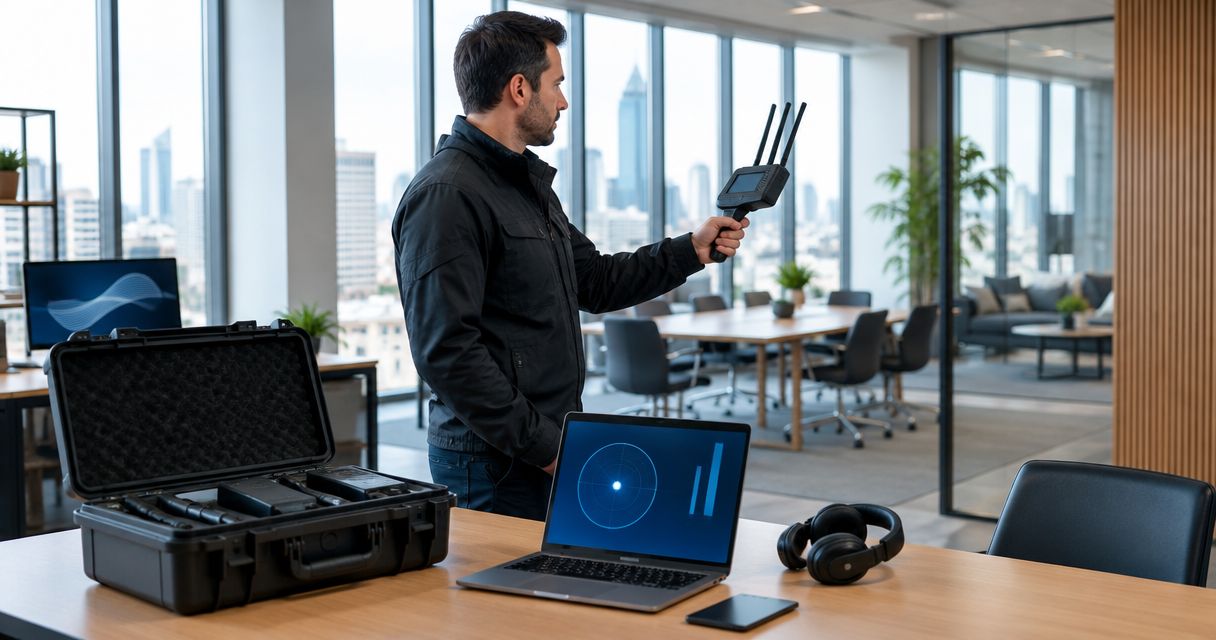
Real estate developers’ TSCM sweeping is a technical inspection for concealed surveillance devices with the aim of protecting confidential property negotiations and project decisions. This 2026 guide explains how to scope inspections around acquisitions, construction access, leasing meetings, and building handovers without treating every unfamiliar device as a threat.
- TSCM sweeps for real estate developers should focus on confidential meeting spaces, access changes, and property handovers.
- USA Bugsweeps provides nationwide professional TSCM services for business premises and vehicles.
- A radio-frequency detector alone cannot rule out wired devices or recorders that store audio locally.
- Define inspection boundaries, document findings, and control access after the sweep.
Why TSCM matters for real estate developers
Commercial development puts sensitive conversations inside spaces that change hands: acquisition offices, construction trailers, leasing suites, and newly completed buildings. Your inspection plan should follow where confidential information is discussed and who can access those locations, rather than treating the entire portfolio as equally sensitive.
USA Bugsweeps is best for developers seeking nationwide professional TSCM services for business premises and vehicles. Its service focus includes detecting hidden cameras, audio bugs, GPS trackers, and wiretaps; confirm the specific inspection scope before booking.
For your 2026 security plan, separate surveillance concerns from ordinary property defects and cybersecurity incidents. An unfamiliar cable is not proof of a wiretap, and a confidential document leak does not establish that a room contains a microphone. Start with observable facts, then assign the appropriate investigation.
Match the inspection to the information at risk
A room used to discuss acquisition limits deserves different treatment from an unoccupied storage area. Likewise, a vehicle used for confidential calls raises a different inspection question from a conference room with permanently installed audiovisual equipment.
Create a simple priority order based on the decisions you need to protect. Include land assembly strategy, lender discussions, tenant concessions, contractor bids, and dispute-resolution meetings where those activities apply to your project. This is a planning exercise—not evidence that surveillance has occurred.
How to plan TSCM sweeps for real estate developers
1. Define the confidential activity before the inspection area
Start with a manual inventory of sensitive conversations and their locations. Use your existing floor plans, meeting calendar, and access records; you do not need detection equipment to establish what matters.
Choose 1 priority room as the starting point when you need a bounded initial scope. Expand the inspection boundary when confidential activity extends into adjoining offices, reception areas, or vehicles. A small, clearly defined scope is more useful than an instruction to check everything with no access plan.
For a 2026 acquisition, distinguish the seller-controlled premises from spaces your organization already controls. Ownership of a transaction does not automatically establish inspection authority over every tenant suite or shared system.
- List the conversations that require privacy and their usual locations.
- Mark the priority room and adjoining accessible areas on a floor plan.
- Identify the person authorized to approve each inspection area.
- Record any specific concern without naming an assumed perpetrator.
2. Map access and identify legitimate equipment
Review keys, visitor records, contractor schedules, and equipment inventories before drawing conclusions about an unfamiliar object. Ask the property manager and authorized facilities staff to identify installed systems through existing documentation.
Organize the property into 3 access zones: developer-controlled rooms, shared building areas, and tenant-controlled spaces. These zones help you assign permissions; they are not threat ratings. Keep fire protection, access control, security cameras, building automation, and audiovisual systems in the inventory so inspection decisions have context.
Do not dismantle electrical fixtures or interrupt life-safety systems during a preliminary check. A visual review is useful for documenting unexplained changes, but it cannot establish that concealed surveillance is absent.
- Mark developer-controlled, shared, and tenant-controlled boundaries.
- Identify authorized cameras, microphones, conferencing devices, and telematics.
- Collect recent work orders involving the priority inspection areas.
- Note unexplained changes without moving or opening suspect objects.
3. Request a written professional inspection scope
Prepare a short brief yourself before requesting service: property type, authorized areas, sensitive activities, access constraints, and the reason for the inspection. This makes provider discussions specific and avoids confusing a room inspection with a network or phone examination.
USA Bugsweeps provides nationwide professional TSCM services, giving developers a service-based alternative to conducting technical checks themselves. The limitation is scope: do not assume that a premises inspection also includes smartphone forensics, cloud-account review, network penetration testing, or every vehicle at the property.
Read what to expect during a professional TSCM bug sweep, then ask the provider to explain the proposed methods and exclusions. For your 2026 project file, request a written description of what will be inspected and how unresolved findings will be handled.
- Provide floor plans and the boundaries you are authorized to inspect.
- Ask how physical inspection and electronic examination fit together.
- Confirm whether vehicles, telephone systems, and adjacent rooms are included.
- Request written findings, limitations, and follow-up recommendations.
4. Schedule the sweep around access changes
Use the project schedule to identify when contractors finish, furniture arrives, audiovisual equipment is installed, and meeting rooms become operational. Coordinate those events manually before choosing an inspection date.
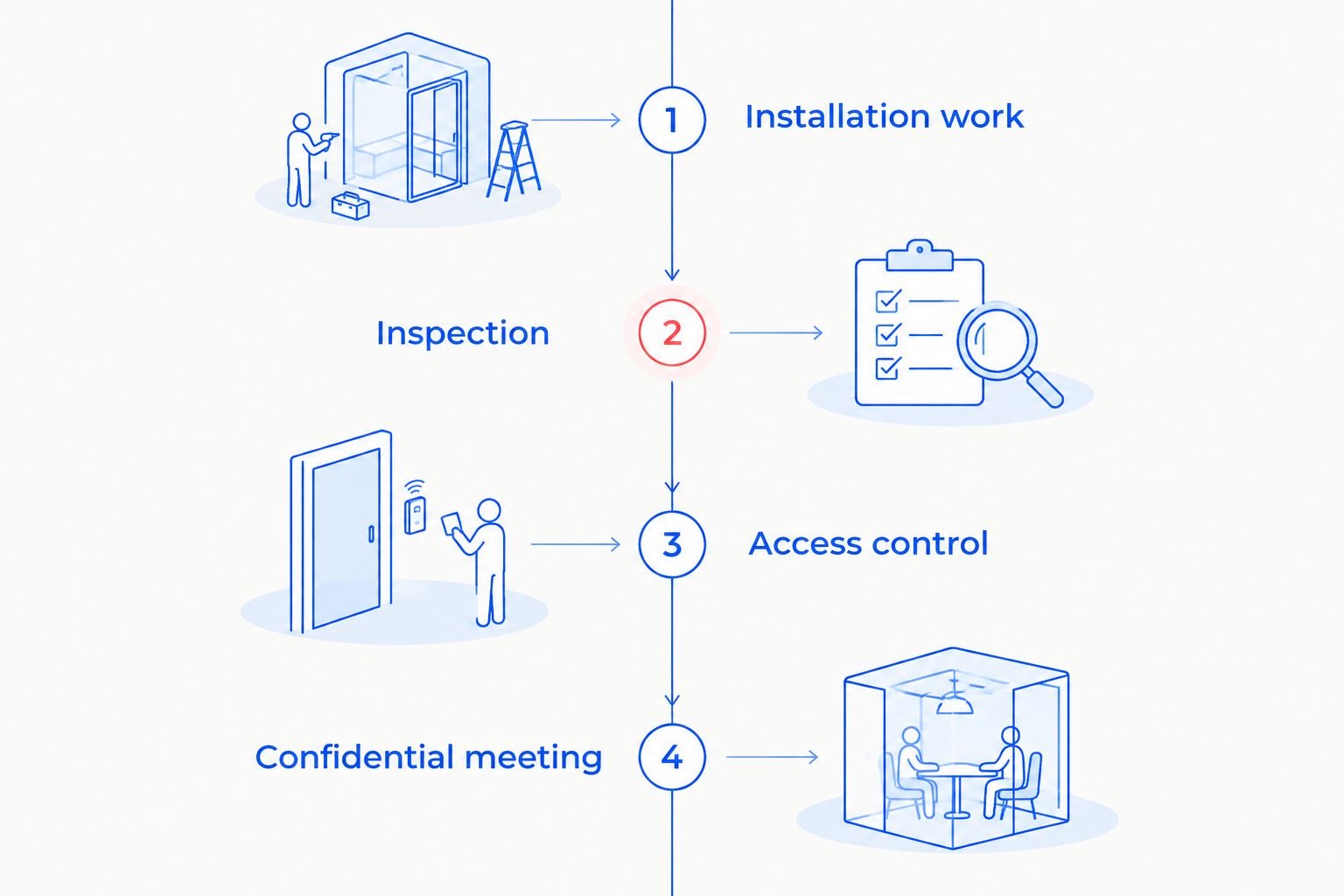
Set 2 access checkpoints for a sensitive meeting: one when the inspection ends and another before participants enter. At each checkpoint, record who controls the room and whether anyone has entered or introduced equipment. These are recommended operating controls, not a guarantee of privacy.
The sequence matters. An inspection completed before subsequent installation work does not establish the condition of the room after that work. If the room changes, tell the provider what changed and ask whether a targeted reinspection is appropriate.
- Schedule inspection after planned installation work wherever practical.
- Assign a named room custodian following the inspection.
- Log subsequent visitors, deliveries, maintenance, and equipment changes.
- Review access again before the confidential meeting begins.
5. Document findings without disturbing potential evidence
Begin with a factual incident note: what you observed, where it was located, when you noticed it, and who was present. Keep observations separate from interpretations; an unexplained object is not yet an identified surveillance device.
If an object appears suspicious, stop informal handling and ask the inspection provider how to proceed. Involve counsel and law enforcement as appropriate to the circumstances. Do not publicly accuse a contractor, tenant, employee, or transaction counterparty based on an unexplained signal or unfamiliar component.
Preserving the original condition supports later assessment. Plugging a device into a computer, resetting it, or circulating it among staff changes that condition and complicates the record of who handled it.
- Record the location, discovery time, and visible condition.
- Photograph the object in place only when safe and authorized.
- Limit access and record anyone who handles the item.
- Obtain instructions before disconnecting, removing, or testing it.
6. Turn the findings into a property operating procedure
Review the inspection findings against your original scope rather than treating the result as a permanent property certification. Record inaccessible locations, unresolved equipment, and any follow-up work separately from confirmed findings.
For the rest of 2026, use event-based review triggers: tenant turnover, contractor access, room alterations, or a documented surveillance concern. A repeat schedule should reflect the property's use and access conditions, not an invented universal interval.
Assign responsibility across development, property management, facilities, IT, and legal staff. TSCM addresses concealed surveillance concerns; account security, document permissions, and authorized recording policies still require their own controls.
- Store inspection records with access restricted to authorized personnel.
- Assign an owner and completion date to each follow-up action.
- Define which access or equipment changes require reassessment.
- Include inspection boundaries and limitations in handover records.
Discuss Your Property Inspection
Define the premises, vehicles, and surveillance concerns you need assessed.
Compare inspection options for development properties
Choose the option that answers your actual security question. A preliminary visual check, a detector reading, and a professional inspection provide different kinds of information; none should be presented as interchangeable.
| Option | Best for | Practical benefit | Key limitation |
|---|---|---|---|
| Manual visual review | Initial documentation by authorized property staff | Establishes known equipment and visible changes | Cannot rule out concealed or inaccessible devices |
| Standalone RF detector | Supporting checks by a trained operator | Indicates radio-frequency activity within its capabilities | Does not establish intent or rule out non-transmitting devices |
| USA Bugsweeps professional TSCM service | Developers seeking nationwide premises or vehicle inspection | Provides a professional service focused on surveillance detection | Coverage depends on the agreed scope and available access |
| Separate IT security assessment | Account, endpoint, or network concerns | Investigates digital security questions within its scope | Does not replace physical inspection for concealed devices |
An RF detector responds to radio-frequency activity, not to malicious intent. Legitimate wireless equipment can produce readings, while a recorder storing audio locally does not need to transmit. Do not turn either an alarm or silence into a surveillance verdict.
Professional TSCM also has limits. Inaccessible spaces, excluded systems, and changes after the inspection restrict what a finding establishes. Ask for those boundaries in writing rather than accepting an unqualified all-clear.
Common mistakes real estate developers make
Sweeping before the final fit-out
Inspecting before furniture, conferencing equipment, and contractor work are complete leaves later changes outside the inspected condition. Schedule around the final work sequence, then review any subsequent access or installation.
Treating landlord authority as unlimited access
A development portfolio includes different control boundaries. Obtain the required authorization for tenant suites, shared infrastructure, and third-party equipment rather than assuming ownership alone settles access questions.
Confusing legitimate monitoring with covert surveillance
Security cameras, fleet telematics, and building systems need an ownership and purpose check. Identify authorized equipment first; unfamiliarity is a reason to investigate, not proof of wrongdoing.
Assuming a clean room solves a digital leak
A room inspection does not establish whether someone accessed a cloud account, forwarded a document, or compromised an endpoint. Route those questions to a separately scoped IT security assessment.
Losing control of the room after inspection
An inspected conference room that remains open to deliveries and unsupervised work has changed conditions. Protect the interval between inspection and use with an access log and a responsible custodian.
FAQ
What's the best way to start TSCM sweeps for real estate developers?
Start by identifying confidential activities, their locations, and who can authorize inspection. Prepare floor plans and access records before selecting detection methods or booking professional service.
Can a handheld bug detector clear a commercial property?
A handheld bug detector alone cannot establish that a commercial property is free of concealed surveillance. RF detection does not rule out wired equipment or recorders that store information without transmitting.
Should developers schedule a sweep before an acquisition meeting?
Schedule an inspection when the meeting's confidentiality and the room's access history justify it. Complete planned installation work first, then control access between inspection and the meeting.
Does USA Bugsweeps inspect business premises and vehicles?
USA Bugsweeps provides nationwide professional TSCM services for business owners and vehicle owners. Confirm the locations, systems, and vehicle coverage included in your specific inspection scope.
Does a TSCM sweep include checking phones for spyware?
Do not assume a premises TSCM sweep includes phone spyware analysis. Ask whether mobile-device examination is included or requires a separate specialist engagement.
What should I do if staff find a suspicious device?
Stop informal handling and document the discovery without disturbing the object. Seek instructions from the inspection provider and involve counsel or law enforcement as appropriate.
How often should a developer repeat a bug sweep?
Base repeat inspections on sensitive activities, access changes, property alterations, and specific concerns. A previous inspection does not establish the condition of a room after later installation work or uncontrolled access.
One last thing
The access log after a sweep belongs beside the inspection report. A report describes an examination within defined boundaries; the log records what happened to those boundaries afterward.
For your next confidential property meeting, assign someone to control the room after inspection and record subsequent changes. That specific responsibility closes an operational gap that buying another detector does not address.


