
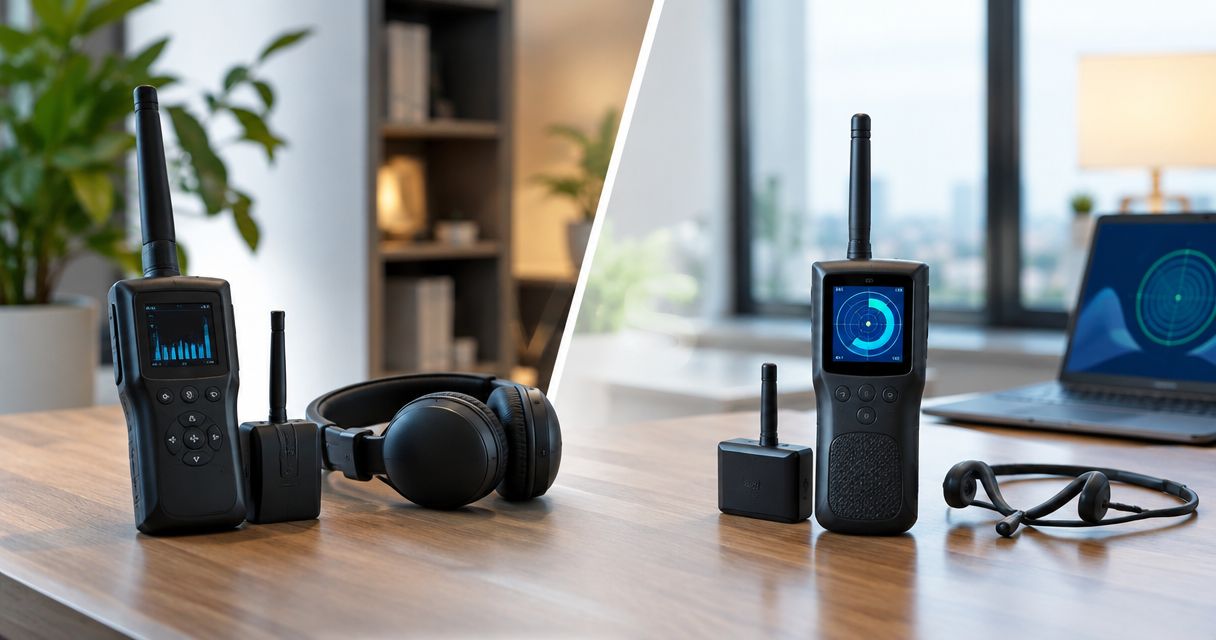
Choose USA Bugsweeps if you need a professional TSCM bug sweep of a home, business, or vehicle; choose Eye Spy Supply if you want to buy surveillance-detection equipment and perform your own checks. In 2026, the useful comparison is professional investigation versus equipment ownership, not which name appears on a detector.
- USA Bugsweeps vs Eye Spy Supply is a choice between professional TSCM bug sweeping and buying equipment for self-directed checks.
- Choose professional bug sweeping when you need help investigating hidden cameras, audio bugs, GPS trackers, or wiretaps.
- Choose Eye Spy Supply for equipment ownership when you can select, operate, and interpret the detector yourself.
- Neither a detector alarm nor a quiet scan establishes whether unauthorized surveillance exists.
Why this matters
A hidden-camera concern and an unfamiliar radio signal are different problems. Buying equipment before identifying the problem leaves you responsible for deciding what to search, which method to use, and what the result means.
USA Bugsweeps provides nationwide professional TSCM services for homeowners, business owners, and vehicle owners. Eye Spy Supply is an equipment retailer. A service engagement and a detector purchase therefore answer different buying questions: who investigates the concern, and who supplies a tool?
For your 2026 decision, start with the outcome you need. A repeatable personal check requires different resources from an investigation involving confidential business conversations, suspected unauthorized recording, or a vehicle you believe someone has accessed.
At a glance
| Dimension | Professional TSCM service | Eye Spy Supply |
|---|---|---|
| Best for | Owners seeking professional investigation of a property or vehicle | Buyers seeking equipment for self-directed checks |
| Standout feature | Professional bug sweeping across homes, businesses, and vehicles | Equipment ownership rather than a service engagement |
| Operating effort | A service route rather than operating a purchased detector yourself | You select and operate the equipment |
| Repeat use | A defined inspection engagement; agree on any later work | Reuse of purchased equipment within its capabilities |
| Interpreting results | Professional inspection is the relevant route | You remain responsible for interpreting your checks |
| Detection limits | Scope and methods determine what an inspection addresses | The selected product's capabilities determine what it addresses |
| Evidence handling | Agree on documentation and handling before work begins | Equipment ownership does not establish an evidence procedure |
| Pricing model | Compare the scope of a service estimate | Compare the scope of an equipment purchase |
The table separates the buying models; it does not rank detector specifications. A professional sweep is not a product bundle, and equipment ownership is not proof that an inspection was complete.
USA Bugsweeps wins for a professionally handled investigation
USA Bugsweeps is best for homeowners, business owners, and vehicle owners seeking professional TSCM bug sweeping. Its stated service covers detection of hidden cameras, audio bugs, GPS trackers, and wiretaps nationwide.
That makes the professional service the relevant choice when you want help investigating a specific space or vehicle rather than learning to operate a detector. Describe the concern precisely: where it occurred, what you observed, and which areas you control.
Eye Spy Supply fits a different profile: a buyer who wants equipment and accepts responsibility for the search. That is a genuine advantage for someone seeking a tool, not an outsourced investigation.
The service route also has a tradeoff. You must arrange access and agree on the inspection scope; you do not gain a reusable detector simply by commissioning work. Choose the service for professional involvement, not as a substitute for owning equipment.
Eye Spy Supply wins when equipment ownership is the goal
Eye Spy Supply is the better fit when your intended outcome is to own equipment for self-directed surveillance checks. The purchase puts the tool in your hands. It does not put an investigator in the room.
Equipment ownership matters when you want to learn a detection method, practice using a device, and repeat checks within that device's capabilities. You control when you use it and which accessible areas you inspect.
The limitation is equally important: one detection method does not answer every surveillance question. An RF detector responds to radio-frequency energy within its operating capabilities; a camera that records locally without transmitting presents a different detection problem.
Before selecting equipment in 2026, identify whether you are investigating a camera, microphone, tracker, or telephone-related concern. Buy for the detection method you need, not for an all-purpose promise. Check the current product documentation rather than assuming every detector performs the same tasks.
Professional service reduces your equipment-operating burden
A professional service is the better fit when you do not want to select equipment and conduct the search yourself. You still have work to do. Access, permissions, background information, and a clear description of the concern matter.
With the equipment route, the operating burden stays with you. You must understand the controls, recognize the device's limitations, distinguish ordinary environmental activity from findings requiring investigation, and decide when to stop or seek help.
For a professional sweep, prepare:
- Location: Identify the rooms, structures, or vehicle involved.
- Concern: Describe observations without treating suspicions as established facts.
- Access: Explain which areas can be inspected and who authorizes entry.
- Existing devices: List known cameras, wireless equipment, and tracking systems.
For a DIY check, add equipment selection, safe operation, and result interpretation to that list. The service route removes the need to run your own detector; it does not remove the need to define the problem.
Eye Spy Supply wins for reusing equipment you own
Purchased equipment supports repeated self-directed checks without commissioning a new inspection each time. That makes Eye Spy Supply the more relevant route for buyers whose main goal is a reusable tool.
The benefit is control, not automatic accuracy. Repeating an incomplete search repeats the same blind spots. A detector that cannot address a particular threat does not gain that capability because you use it more often.
Professional inspection serves a different purpose: investigating an agreed location and concern. Ask what any follow-up work would cover rather than assuming later visits form part of the original engagement.
For recurring checks in 2026, keep a consistent record of the areas inspected, the method used, known devices present, and unresolved observations. That record helps you distinguish changes from familiar conditions. Equipment ownership wins on reuse; it does not, by itself, win on completeness or confidence.
Professional investigation wins when interpretation is the problem
An alarm is an observation, not a conclusion. Ordinary wireless devices emit radio signals, and an RF detector response alone does not identify a hidden microphone, establish who installed anything, or prove unauthorized recording.
Likewise, a quiet scan does not establish that every possible surveillance method has been excluded. The meaning of the result depends on the detection method, the environment, and what was actually inspected.
When your central question is what an observation means, professional investigation is the better route than buying another device without a plan. Ask how findings will be explained and how unresolved areas will be identified.
The DIY route remains useful when you understand the equipment and can separate a preliminary check from a conclusion. Its weakness is the responsibility it leaves with you. Do not turn an unexplained signal into an accusation, and do not turn silence into a guarantee.
Neither route earns a blanket detection guarantee
Neither an equipment purchase nor a professional service label justifies a claim that every surveillance threat has been excluded. Detection depends on the methods used and the conditions under which the inspection occurs.
A transmitting device, a locally recording device, and a hardwired installation present different inspection problems. Device state matters too: an inactive transmitter does not emit the same signals as an active one.
Ask these questions before choosing either route:
- Threat type: What specific concern does this method address?
- Inspection scope: Which spaces, objects, or systems are included?
- Detection limits: What remains outside the method's capabilities?
- Follow-up: What happens if an observation cannot be resolved?
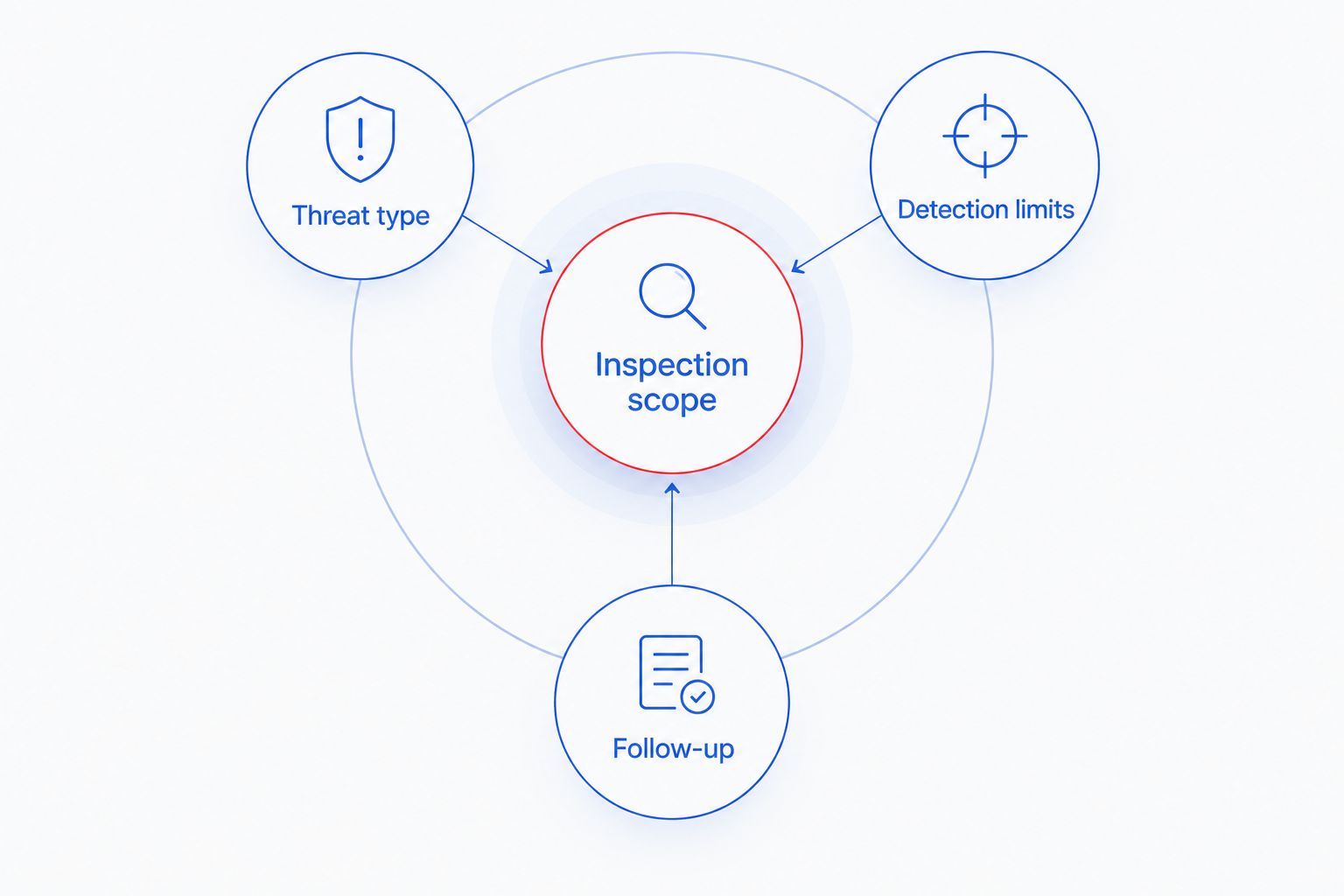
This dimension is a tie: both routes need defined limits. In 2026, judge the proposed method against your concern rather than treating a broad detection claim as a complete answer.
Neither route replaces an evidence-handling plan
Finding an unfamiliar object does not establish its purpose or ownership. A legitimate device, an abandoned accessory, and an unauthorized recording device require different responses. Keep those possibilities separate until the facts support a conclusion.
Equipment ownership does not create an evidence-handling procedure. A professional engagement also needs explicit agreement about documentation, device handling, and any work intended to support a legal matter.
Before an inspection, ask what information you will receive and whether handling or removal is included. Do not assume a written report, chain-of-custody procedure, or courtroom testimony is part of either route.
If a finding relates to suspected criminal conduct, seek instructions from law enforcement or legal counsel before dismantling or altering it. Personal safety takes priority over finishing a search. Neither route wins automatically on evidence handling; the agreed procedure matters more than the purchase category.
Pricing: compare service scope with equipment responsibility
For a 2026 buying decision, compare what you are commissioning with what you are buying. A service estimate concerns an inspection; an equipment purchase concerns a tool whose operation and interpretation remain your responsibility.
For the service route, ask the provider to identify the location, inspection boundaries, access requirements, and included deliverables. Clarify whether follow-up, documentation, or device handling is included before agreeing to the work.
For Eye Spy Supply, review the current product description, operating instructions, detection method, and limitations. Establish whether the equipment suits the suspected threat and whether you can use it safely and correctly.
The tradeoff is not simply predictability versus flexibility. Defined service scope clarifies the work being commissioned; equipment ownership gives you control over repeat use but leaves the search with you. Compare those responsibilities before making a decision. Do not assume either route is financially better without comparing the actual service proposal and product selection.
Final verdict: match the route to your responsibility
Choose USA Bugsweeps if you need professional TSCM help
Best for: a homeowner, business owner, or vehicle owner seeking a professionally handled bug sweep. Choose this route when you want professional involvement in investigating hidden cameras, audio bugs, GPS trackers, or wiretaps.
The next move is to describe the property or vehicle, state the concern, and request an estimate with a defined scope. Ask what the inspection addresses and what remains outside it. A clear request is more useful than a demand for a universal assurance.
Choose Eye Spy Supply if you want to conduct your own checks
Best for: an equipment buyer prepared to select, operate, and interpret a detector. Choose this route when ownership and repeat use are your goals, and you understand the selected method's limitations.
The next move is to identify the threat category and review suitable equipment documentation. Do not buy a detector merely because its description mentions surveillance. Match its capabilities to the task, then establish when an unresolved observation should lead to professional help.
| Dimension | Winner |
|---|---|
| Professionally handled investigation | Professional TSCM service |
| Equipment ownership | Eye Spy Supply |
| Reduced equipment-operating burden | Professional TSCM service |
| Reuse of purchased equipment | Eye Spy Supply |
| Help investigating unexplained observations | Professional TSCM service |
| Blanket detection guarantee | Neither |
| Evidence handling without an agreed procedure | Neither |
| Financial comparison | Compare the actual scope and responsibilities |
Request a professional bug sweep estimate
Describe your home, business, or vehicle concern and ask about the inspection scope.
FAQ
Is USA Bugsweeps better than Eye Spy Supply?
USA Bugsweeps is the better fit for professional TSCM bug sweeping; Eye Spy Supply is the better fit for buying equipment to conduct your own checks. Choose based on whether you need professional investigation or equipment ownership.
Should I buy a detector or hire a professional bug sweeping service?
Hire a professional service when you need help investigating a property or vehicle; buy equipment when you can conduct and interpret the checks yourself. Define the suspected threat before choosing either route.
Can an RF detector find every hidden camera?
No, an RF detector cannot find every hidden camera. A camera recording locally without transmitting does not provide a radio transmission for that method to detect.
Does a detector alarm prove someone is recording me?
No, a detector alarm alone does not prove unauthorized recording. Ordinary wireless devices emit signals, so the response needs investigation before you draw a conclusion.
Does a professional sweep guarantee there are no surveillance devices?
No, a professional sweep does not justify an unlimited guarantee against every surveillance method. Its findings must be understood within the inspection scope, methods, access, and conditions.
Can I use one detector for cameras, microphones, and GPS trackers?
Do not assume one detector covers cameras, microphones, and GPS trackers. Check the selected product's detection methods and limitations against each concern.
What should I ask before agreeing to a bug sweep estimate?
Ask which areas and threats the inspection covers and what deliverables are included. Also clarify access requirements, documentation, device handling, and follow-up.
What should I do if I find a suspicious device?
Prioritize safety and seek appropriate instructions before removing or dismantling a suspicious device. If suspected criminal conduct is involved, contact law enforcement or legal counsel about preserving evidence.
One last thing
A detector that stays silent can still leave the central question unanswered. Silence tells you about that method under those conditions; it does not establish that a room or vehicle is free of every recording or tracking device.
Before buying equipment or commissioning a sweep, write down the question you need answered. For example: whether a specific room contains an unauthorized recording device, or whether a vehicle contains an unfamiliar tracker. A defined question makes the inspection scope easier to evaluate—and keeps a preliminary check from becoming false reassurance.


