
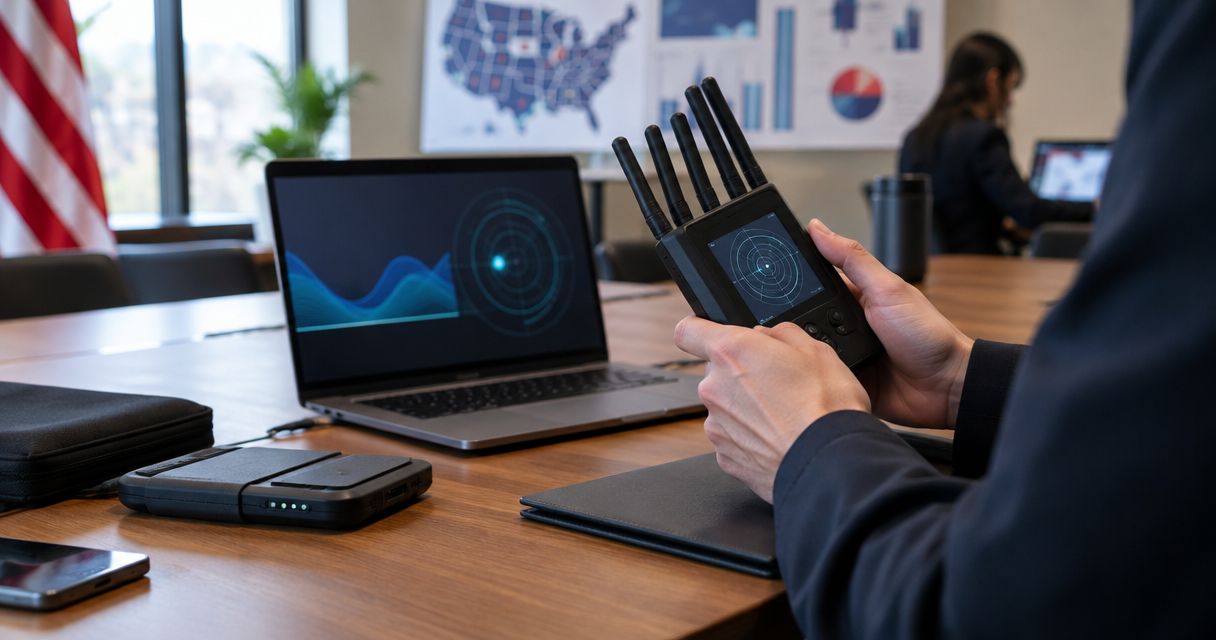
Best overall: a professional TSCM assessment. Best for investigating active wireless signals: a spectrum analyzer. Best for staff-operated camera checks: an optical lens finder. For campaign offices, Usabugsweeps provides professional bug sweeping services; the detector categories below serve different purposes and are not substitutes for one another.
- The best counter-surveillance detectors for political campaigns address different threats; no single detector clears an office.
- Usabugsweeps is best for campaign teams seeking professional TSCM services rather than standalone detector hardware.
- Spectrum analyzers investigate active RF signals; optical lens finders help locate exposed camera lenses.
- Nonlinear junction detectors help locate electronics, including devices that are not transmitting.
- Treat detector alerts as investigation leads, not proof of surveillance.
Why this matters
A campaign office combines sensitive conversations with ordinary electronics: phones, routers, printers, conferencing equipment, and personal devices. A detector must help distinguish those authorized systems from something that needs investigation. An alarm alone does not make that distinction.
For a 2026 campaign, start with the conversation or location you need to protect. A strategy room, temporary headquarters, and candidate vehicle require different inspection scopes. Choose a detection method by what it can find—not by how many functions appear on its packaging.
This guide ranks service and equipment categories by their role in a campaign-office inspection. It is a decision guide, not a model-by-model equipment test.
What makes the best campaign counter-surveillance option
Use these criteria before selecting equipment or arranging an assessment:
- Threat coverage: Separate transmitting bugs, local-storage recorders, hidden cameras, wired devices, and trackers. Each presents a different detection problem.
- Signal interpretation: Look for a method that supports investigation of an alert, rather than simply sounding an alarm.
- Nontransmitting detection: Include physical inspection and appropriate methods for electronics that are powered off or recording locally.
- Operator requirements: Match equipment to the person responsible for using it. Technical instruments require technical interpretation.
- Inspection scope: Specify rooms, furnishings, authorized electronics, communications systems, and vehicles separately.
- Actionable findings: Ask how observations, unresolved areas, and recommended next steps will be documented.
Campaign counter-surveillance options at a glance
| Rank | Option | Best for | Standout capability | Key limitation |
|---|---|---|---|---|
| 1 | Professional TSCM assessment | Sensitive headquarters decisions | Coordinates an investigation across detection methods | Coverage depends on the agreed scope and access |
| 2 | Spectrum analyzer | Investigating active wireless signals | Displays signal activity across selected frequencies | Does not locate every silent or wired device |
| 3 | Handheld RF detector | Preliminary transmitting-device checks | Flags nearby radio-frequency energy | Ordinary electronics also produce alerts |
| 4 | Optical lens finder | Checking accessible camera sightlines | Helps reveal reflections from exposed lenses | Requires a visible optical path to the lens |
| 5 | Nonlinear junction detector | Searching for concealed electronics | Detects nonlinear responses associated with electronic junctions | Responses do not identify a device's purpose |
No row represents complete office clearance. The useful distinction is whether you need preliminary screening, specialist investigation, or a coordinated assessment.
1. Professional TSCM assessment: best for sensitive headquarters decisions
A professional technical surveillance countermeasures assessment addresses the inspection as a whole, rather than treating one detector reading as the answer. Usabugsweeps provides nationwide TSCM bug sweeping services for hidden cameras, audio bugs, GPS trackers, and wiretaps.
For campaign headquarters, define the assignment around confidential activity. Identify the strategy room, candidate office, meeting equipment, and any vehicles you want included. Do not assume that every location or system belongs to the same engagement.
Professional TSCM assessment pros:
- Connects equipment findings with physical inspection.
- Provides a route for investigating suspicious observations.
- Lets you define coverage around sensitive spaces.
- Reduces dependence on staff interpreting unfamiliar instruments.
Professional TSCM assessment cons:
- Requires access to the areas included in the assignment.
- An inspection does not prevent later device installation.
- Network or endpoint investigation needs an explicitly agreed scope.
Best for: Campaign leadership that needs an assessment before relying on a sensitive room.
Review the scope considerations in counter-surveillance sweeps for political campaigns. For a 2026 headquarters decision, ask what will be inspected and how limitations will be explained.
Verdict: Buy a scoped professional assessment when confidential decisions depend on the result.
2. Spectrum analyzer: best for investigating active wireless signals
A spectrum analyzer displays radio-frequency energy across a selected frequency range. A trained operator uses that information to examine signals and investigate their sources; the display itself does not label a signal as a hidden microphone.
This distinction matters in a functioning office. Wi-Fi uses bands including 2.4 GHz, 5 GHz, and 6 GHz, and authorized equipment creates real radio activity. Those bands are examples of normal communications, not a complete surveillance-detection specification.
Spectrum analyzer pros:
- Shows frequency information instead of only an alarm.
- Supports comparison of signal activity across locations.
- Helps investigate authorized and unexplained transmissions.
- Provides more context than a basic signal-strength indicator.
Spectrum analyzer cons:
- Requires suitable antennas, settings, and interpretation.
- A nontransmitting recorder produces no transmission to analyze.
- A brief observation can miss intermittent activity.
Best for: A trained technical operator investigating active wireless signals in campaign premises.
For 2026 equipment selection, ask about frequency coverage, antennas, and recording functions without assuming that any one specification guarantees detection. Buy the instrument only when someone has responsibility for interpreting its output.
Verdict: Buy for trained technical use; skip as a volunteer-operated clearance tool.
3. Handheld RF detector: best for preliminary transmitting-device checks
A handheld RF detector responds to radio-frequency energy within its supported range. It can help you notice activity and compare readings while moving through an accessible area.
Its weakness is specificity. A strong reading near a desk can come from an authorized phone, access point, or another transmitter—not necessarily a surveillance device. A quiet reading also does not exclude a wired microphone or local-storage recorder.
Handheld RF detector pros:
- Offers a portable method for preliminary checks.
- Helps compare relative signal strength across locations.
- Supports investigation of devices transmitting during the check.
Handheld RF detector cons:
- Cannot establish whether a signal is malicious.
- Responds to ordinary wireless activity.
- Does not cover silent recording devices through RF detection alone.
Best for: An assigned staff member conducting limited checks and recording observations for specialist review.
Keep a list of authorized wireless equipment. Follow the detector's instructions, and do not interrupt security systems or campaign operations merely to eliminate an alert. An unexplained signal is a question to resolve, not an accusation to make.
Verdict: Buy as a preliminary aid; skip as the basis for declaring a room secure.
4. Optical lens finder: best for checking accessible camera sightlines
An optical lens finder illuminates an area and helps an operator notice reflections from camera lenses. Unlike RF screening, its basic detection method does not depend on a camera transmitting a wireless signal.
Use it where you can inspect a potential view into a confidential space. Examine accessible objects from different angles, but remember that glass, polished surfaces, and other materials also reflect light.
Optical lens finder pros:
- Addresses exposed lenses without relying on radio transmission.
- Complements a visual inspection of meeting spaces.
- Helps focus attention on objects with relevant sightlines.
Optical lens finder cons:
- Needs an optical path to the lens.
- Reflections alone do not establish that a camera exists.
- Does not detect microphones, wiretaps, or trackers.
Best for: Staff checking accessible camera sightlines in temporary meeting rooms or offices.
For a 2026 campaign venue, concentrate on objects facing the meeting area rather than treating every reflection equally. Do not open electrical fixtures, dismantle safety equipment, or damage property to investigate a suspected lens.
Verdict: Buy for limited visual screening; skip for audio-surveillance detection.
5. Nonlinear junction detector: best for searching for concealed electronics
A nonlinear junction detector, or NLJD, transmits a test signal and examines nonlinear responses associated with semiconductor junctions. This makes it useful in specialist searches for electronics that are not actively transmitting.
A response is not a finding of surveillance. Legitimate electronics and some material junctions also produce responses, so the operator must interpret the result and investigate the location.
Nonlinear junction detector pros:
- Adds a method beyond monitoring active transmissions.
- Helps investigate concealed electronic components.
- Complements physical inspection and RF analysis.
Nonlinear junction detector cons:
- Legitimate electronics complicate interpretation.
- A response does not reveal what a device does.
- Requires specialist technique and follow-up inspection.
Best for: A qualified operator examining unexplained electronics or suspected nontransmitting devices.
For campaign managers, the practical question is whether the assessment addresses nontransmitting threats. Do not assume a provider uses an NLJD, or that an NLJD is appropriate everywhere; ask how the proposed methods match your premises.
Verdict: Hold for specialist use; skip as an unsupported staff purchase.
How the options were ranked
The ranking prioritizes investigation quality, threat coverage, and operator fit. A professional assessment takes the first position because a campaign needs interpreted findings, not simply equipment ownership. Spectrum analysis follows for active-signal investigation; handheld RF and optical tools serve narrower preliminary tasks.
NLJD equipment ranks last for staff purchasing, not because nontransmitting electronics are unimportant. Its specialist role makes it a poor default purchase for a campaign manager.
Usabugsweeps is best for campaign teams seeking professional TSCM services rather than standalone detector hardware. Confirm the proposed scope before choosing a service or instrument.
Turn detector findings into a campaign-office decision
Assign responsibility before anyone starts inspecting. A staff member should know where to record an observation, who decides whether a meeting moves, and who contacts a specialist. Unstructured checking creates unresolved alarms rather than a usable security decision.
Define scope
List the spaces and assets involved: headquarters rooms, temporary venues, authorized meeting electronics, and vehicles. Identify who can authorize access. Keep device inspection separate from questions about compromised accounts or computers.
Inventory devices
Record authorized cameras, routers, phones, conferencing systems, and other relevant electronics. Include who owns each device and why it belongs there. This inventory gives an investigator context; it does not prove that a listed device is uncompromised.
Record findings
Write down the location, observation, circumstances, and equipment used. Distinguish a detector alert from a confirmed device. Do not describe a reflection or unexplained transmission as verified surveillance.
Escalate concerns
If you find a suspicious object, avoid handling or dismantling it. Move sensitive discussions elsewhere, document the location from a safe position, and seek professional guidance. Contact law enforcement when there is an immediate safety concern or suspected crime.
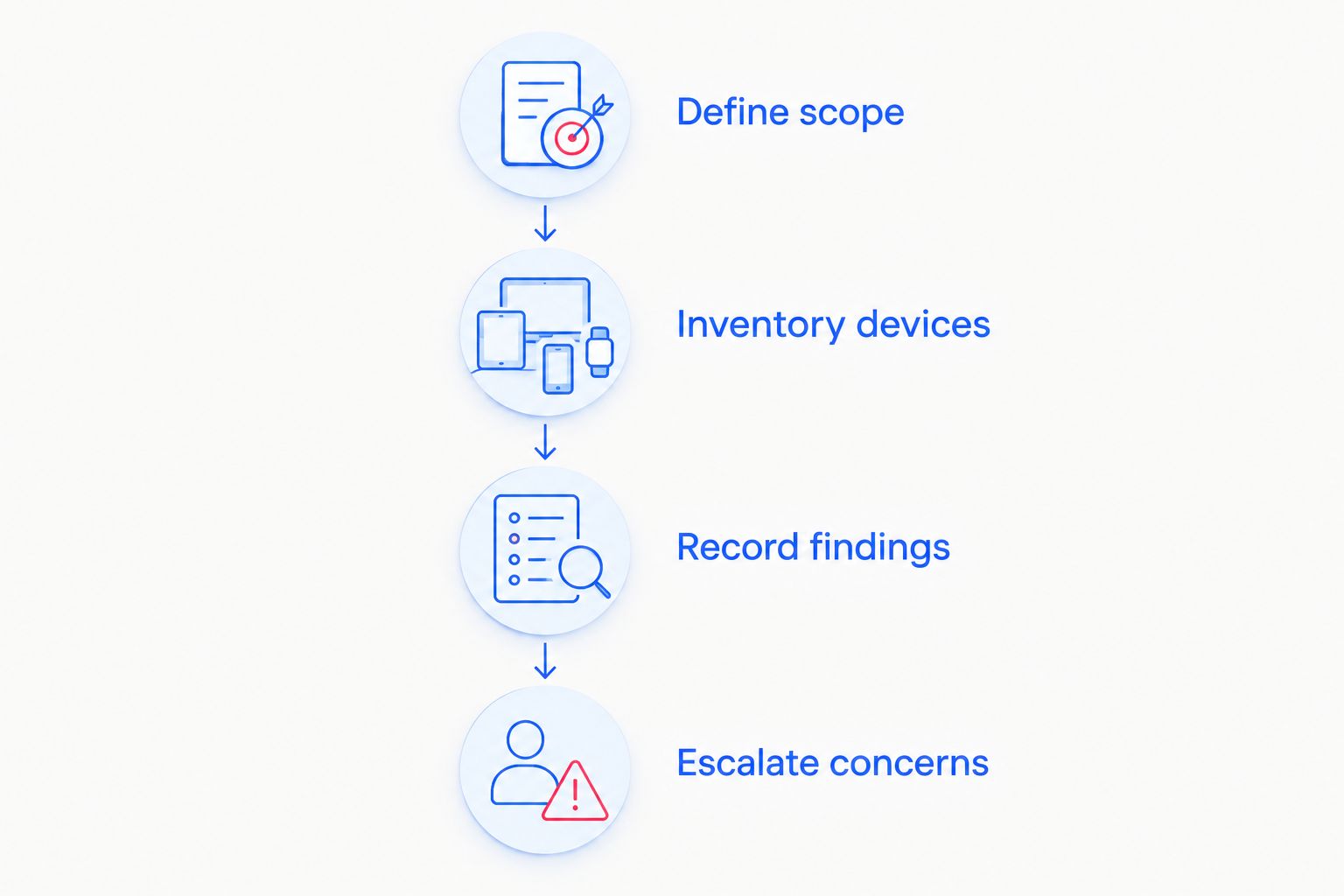
The process ends with a decision, not an alarm. Decide whether the room remains in use, needs further investigation, or requires a different inspection scope. For 2026 planning, assign that decision to a named role rather than leaving it to whoever holds the detector.
Discuss your campaign office inspection
Ask Usabugsweeps about TSCM services for your office, meeting spaces, and vehicles.
Which counter-surveillance option should you choose?
Choose a professional TSCM assessment when your campaign needs a decision about a sensitive location. Use a spectrum analyzer or NLJD only with qualified operation. Treat handheld RF detectors and optical lens finders as supporting tools with defined limits.
For an undecided campaign manager, start by specifying the room, concern, and required outcome. Do not assemble equipment first and try to infer its coverage afterward. The inspection question determines the tools.
FAQ
What's the best counter-surveillance detector for a political campaign office?
A professional TSCM assessment is the best default when a campaign needs an interpreted assessment of a sensitive office. Spectrum analyzers, RF detectors, optical lens finders, and nonlinear junction detectors address different parts of the inspection.
Is a professional bug sweep better than buying an RF detector?
A professional bug sweep is the better choice when you need investigation beyond a radio-frequency alert. An RF detector provides limited screening and cannot rule out nontransmitting recording devices.
Can an RF detector find a recorder that saves audio locally?
An RF detector cannot identify a recorder through RF screening when the recorder emits no detectable radio signal. Physical inspection and other appropriate methods are needed to investigate that possibility.
Can a lens finder detect a camera that is turned off?
A lens finder can reveal a reflection from an exposed camera lens without relying on wireless transmission. The operator still needs a suitable viewing angle, and a reflection requires verification.
Does a strong detector reading prove someone planted a bug?
No, a strong detector reading does not prove that a surveillance device is present. Authorized phones, routers, and other electronics can produce radio-frequency activity that needs interpretation.
Does an office bug sweep also check campaign phones for spyware?
Do not assume an office bug sweep includes phone or computer forensic examination. Ask whether endpoint, account, and network investigation are included or require a separate assignment.
What should campaign staff do if they find a suspicious device?
Stop sensitive discussions in the affected area and avoid handling the object. Record its location from a safe position, seek professional guidance, and contact law enforcement for immediate safety concerns or suspected crime.
Can one detector check campaign offices and candidate vehicles?
One detector does not provide complete coverage of offices and vehicles. Define those inspection scopes separately because transmitters, local-storage devices, wired equipment, and trackers require different investigation methods.
One last thing
A silent recorder is still a recorder. A quiet RF detector tells you about detectable radio activity during that check—not whether every recording device has been excluded. Before your next confidential meeting, ask what the inspection addressed beyond transmitting devices.


