
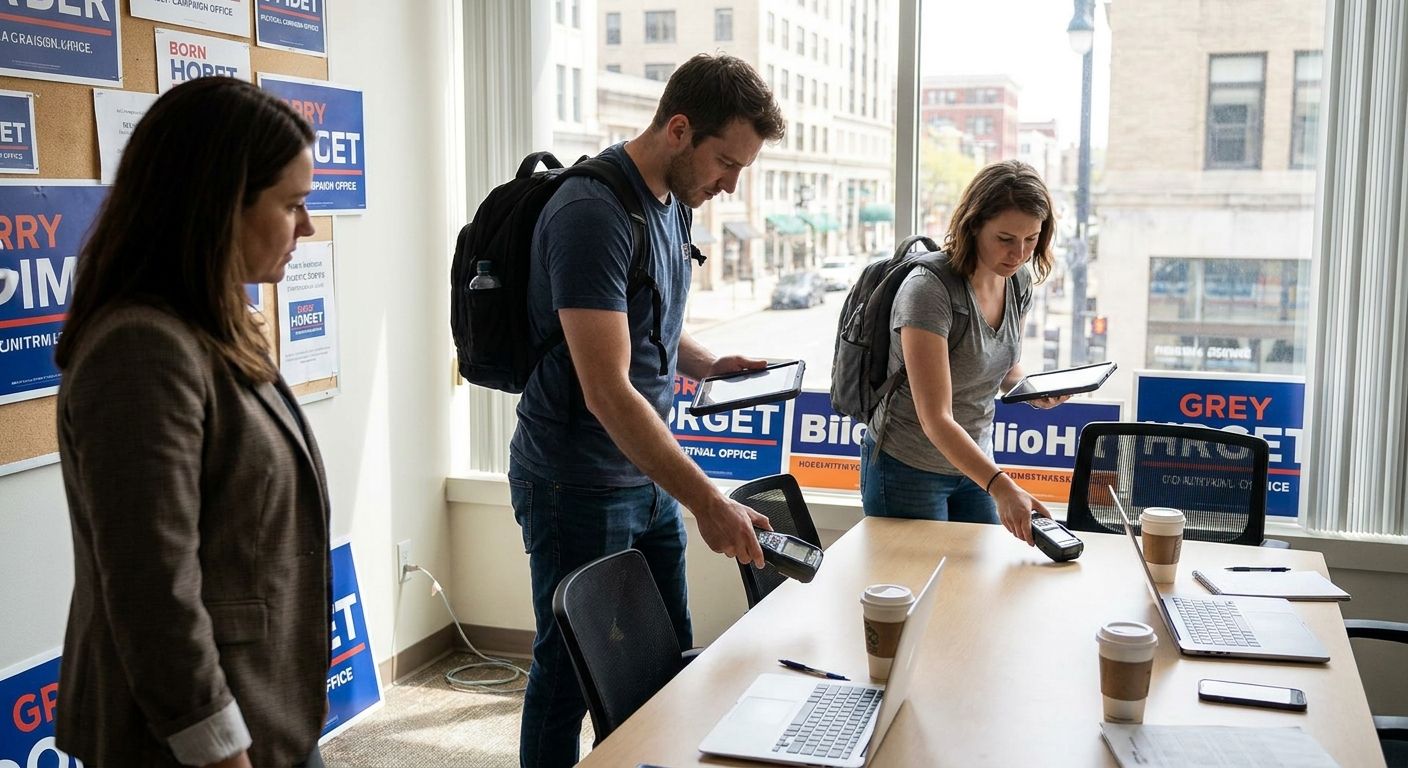
Campaign headquarters leak more information than any FEC filing ever will, and most campaign managers don't find out until a rival ad drops the week before a debate. This guide breaks down where counter surveillance for political campaigns actually matters and which sweep to run first.
- Campaign HQ and war room sweeps rank as the must-do pick for any race entering its final 90 days in 2026.
- Magnetic GPS trackers on candidate and staff vehicles run for weeks on a single charge and hide in under 10 seconds.
- Field office and canvass fleet sweeps matter most for races running multiple satellite offices at once.
- Skip one-time 'sweep and forget' service — counter surveillance for political campaigns needs a recurring cadence through Election Day.
Why this matters
A campaign is a soft target. Volunteers rotate through the same room daily, vendors and consultants come and go, and nobody badges in a canvasser carrying a tote bag. That churn is exactly what makes a war room easy to plant a device in and hard to secure with locks alone.
Opposition research firms, disgruntled former staff, and even overzealous donors have motive to know what's said inside a corporate boardroom-style sweep target like campaign HQ before it becomes public. Strategy memos, polling internals, and ad buys discussed out loud in a war room are worth more the week before a primary than after it. A planted audio device doesn't need to run all cycle — it just needs to catch one strategy call.
2026 midterm and special-election races are already seeing the same pattern that shows up every cycle: devices found late, after the damage from a leak is already public. The fix isn't more locks on the HQ door. It's a scheduled TSCM sweep that treats the final stretch of the campaign like the high-risk period it actually is.
Who this is for
This applies to campaign managers, general consultants, and finance directors running any race where strategy discussions, donor data, or candidate movements are worth something to an opponent — congressional, statewide, and competitive local races included. If your war room hosts polling briefings, ad buy discussions, or opposition research reviews, you're a target regardless of race size.
What to look for in counter surveillance for political campaigns
Cadence that matches the campaign calendar
A single sweep in June does nothing for a race that peaks in October. Campaigns need TSCM coverage that increases as Election Day approaches, not a one-and-done check early in the cycle when the stakes are lowest.
RF and wired coverage, not just a camera check
Hidden cameras get the headlines, but audio transmitters, GPS trackers, and compromised phone lines cause more real damage to a campaign. A sweep that only checks for cameras misses the devices most likely to leak a strategy call.
Vehicle coverage for the candidate and senior staff
Candidates and campaign managers travel constantly — to fundraisers, debates, town halls. A magnetic GPS tracker clipped to a wheel well reveals every stop on that schedule to whoever placed it, and most run for weeks on battery before needing a swap.
Discretion during the sweep itself
A visible sweep team crawling through a war room the week of a debate creates its own story if a reporter or volunteer notices. Sweeps in a political setting need to happen without becoming the news themselves.
Coverage across every physical location, not just HQ
Field offices, donor event venues, and debate prep rooms all carry the same exposure as the main office. A campaign that only sweeps HQ and ignores satellite offices is covering maybe half its real footprint.
A team that understands campaign timelines
A sweep scheduled around a normal business booking cycle doesn't work three days before a debate. Campaigns need a TSCM provider that can move fast during compressed windows.
Top picks for political campaign counter surveillance
Campaign HQ and war room sweep — the must-do pick. This is the boardroom-style sweep described above, and it's the single highest-value check any campaign can run. HQs typically run long days with a rotating cast of staff and volunteers moving through the same rooms where strategy gets decided. Verdict: Buy — run this before any debate prep week and again in the final 90 days before Election Day.
Candidate and senior staff vehicle sweep — the personal-risk pick. A GPS tracker sweep for the candidate's car covers exactly this. Magnetic trackers are smaller than a deck of cards, mount in seconds, and can run for weeks without needing a battery swap — long enough to map a candidate's entire travel pattern for a cycle. Verdict: Buy — check candidate and campaign manager vehicles monthly, and immediately after any public event where a car sits unattended.
Field office and canvass fleet sweep — the volume pick. Campaigns running canvass operations often use company or rented vehicles moving between multiple field offices across a district. A fleet vehicle sweep for GPS trackers covers the whole vehicle roster instead of checking cars one at a time. Verdict: Consider — worth it once a campaign runs three or more field offices or a rented canvass fleet.
Candidate and public figure protective sweep — the high-profile pick. Once a candidate becomes a recognizable public figure, the exposure changes shape — hotel rooms, green rooms, and private meeting spaces before town halls all become potential targets. A sweep built for executives and public figures covers that travel-heavy, high-visibility exposure pattern. Verdict: Buy for statewide and federal races; Consider for local races with heavy local media coverage.
What to avoid
- A generic "electronics check" from an IT vendor. IT security covers networks and endpoints, not RF transmitters or hardline audio taps — it's a different discipline entirely and won't catch a planted bug.
- A one-time sweep scheduled at the start of the cycle. Devices get planted when the payoff is highest, which is closer to Election Day, not in the spring when nothing strategic has been decided yet.
- Skipping vehicle checks because "nothing's happened yet." GPS trackers are passive and silent by design — a car can be tracked for weeks with zero indication anything's wrong until the pattern shows up in an opponent's messaging.
Verdict comparison
| Sweep Type | Best For | Recommended Frequency | Verdict |
|---|---|---|---|
| HQ / war room sweep | Strategy calls, polling briefings | Before debate prep, then final 90 days | Buy |
| Candidate/staff vehicle sweep | Travel schedule exposure | Monthly, plus post-event checks | Buy |
| Field office/fleet sweep | Multi-office canvass operations | Once per office opening | Consider |
| Public figure protective sweep | Hotel rooms, green rooms, private meetings | Per major public appearance | Buy for statewide/federal |
FAQ
What does a counter surveillance sweep for a political campaign actually check?
A TSCM sweep for a campaign checks for hidden cameras, audio transmitters, GPS trackers, and compromised phone or network lines across HQ, field offices, and vehicles. It covers both RF-based devices and wired taps, not just cameras.
How often should a campaign sweep its headquarters in 2026?
Sweep campaign HQ before major strategy periods like debate prep and again during the final 90 days before Election Day in 2026. A single sweep early in the cycle misses the window when planting a device pays off most.
Can a magnetic GPS tracker really run for weeks on a car?
Yes, most magnetic GPS trackers used for covert tracking run for weeks on a single charge and mount to a vehicle's undercarriage in seconds. That's why candidate and staff vehicles need routine checks, not a one-time inspection.
Is counter surveillance different for a local race versus a statewide race?
Yes — statewide and federal races typically need protective sweeps for the candidate's travel (hotels, green rooms) in addition to HQ, while local races usually only need HQ and vehicle coverage unless media attention is unusually heavy.
How much does a campaign counter surveillance sweep cost?
Cost varies by location size, number of vehicles, and how many field offices need coverage — check current quotes directly since race size and sweep scope both change the price.
Do field offices need their own sweep or does HQ coverage extend to them?
Each physical location needs its own sweep. HQ coverage doesn't extend to satellite field offices, and campaigns running multiple offices across a district are often the ones that skip this and regret it.
What's the most commonly found device in a campaign setting?
Forgotten smart devices with always-on microphones — smart speakers, webcams, and baby monitors left behind by a previous tenant or staffer — turn up more often in campaign spaces than solid-state planted transmitters. A proper sweep checks for both.
Should a campaign sweep before or after a debate?
Sweep before debate prep begins, since that's when strategy discussions ramp up and the room becomes the highest-value target of the cycle. A post-debate sweep only confirms what already leaked.
One last thing
The device that actually leaks a campaign's strategy is rarely a spy-movie transmitter — it's more often a forgotten smart speaker, a webcam left in listen mode from a previous office tenant, or a phone someone set to record and never picked back up. A sweep team checking only for exotic bugs misses the boring stuff that causes most real leaks. Run the check on both, and run it before the room fills up with strategy calls, not after a story breaks.


