
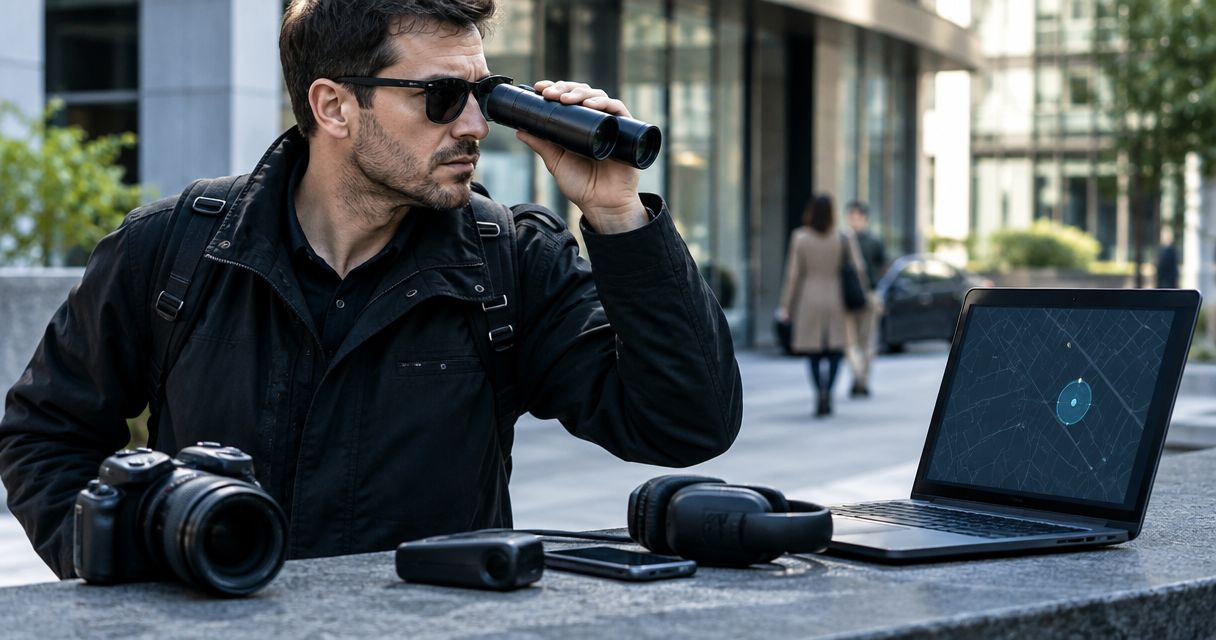
Best overall: a spectrum analyzer for locating active radio-frequency transmissions. Best for powered-off electronics: a nonlinear junction detector. Best starting point for visible camera searches: an optical lens finder. This 2026 guide ranks counter surveillance equipment for private investigators by the threat each tool can examine—not by a claim that one device finds every bug.
- A spectrum analyzer is the best overall counter surveillance equipment for private investigators checking active RF signals.
- A nonlinear junction detector is the better choice for electronics that are switched off.
- An optical lens finder helps locate exposed camera lenses but cannot rule out hidden recorders.
- USA Bugsweeps is best for investigators who need professional TSCM support rather than another standalone tool.
For a case that calls for outside TSCM support, see bug sweep services for private investigation firms. USA Bugsweeps provides professional bug-sweeping services nationwide; it is a service option, not a piece of equipment in the ranking below.
Why this matters
A sweep can fail even when every instrument works as intended. An RF tool looks for transmissions, while a recorder storing audio locally has no reason to transmit. A lens finder addresses an optical surface, not a wiretap hidden in a cable. The right purchase starts with the suspected device and the place you have authority to inspect.
In 2026, Wi-Fi traffic may appear in the 2.4 GHz, 5 GHz, or 6 GHz bands. Finding energy in one of those bands does not identify a surveillance device: ordinary equipment uses them too. Conversely, a clean reading in those bands does not clear a room. A private investigator needs to identify, locate, and assess a signal before calling it evidence of monitoring.
What makes the best counter-surveillance equipment?
Use these criteria before comparing instruments. They separate a tool that produces a useful lead from one that merely produces an alarm.
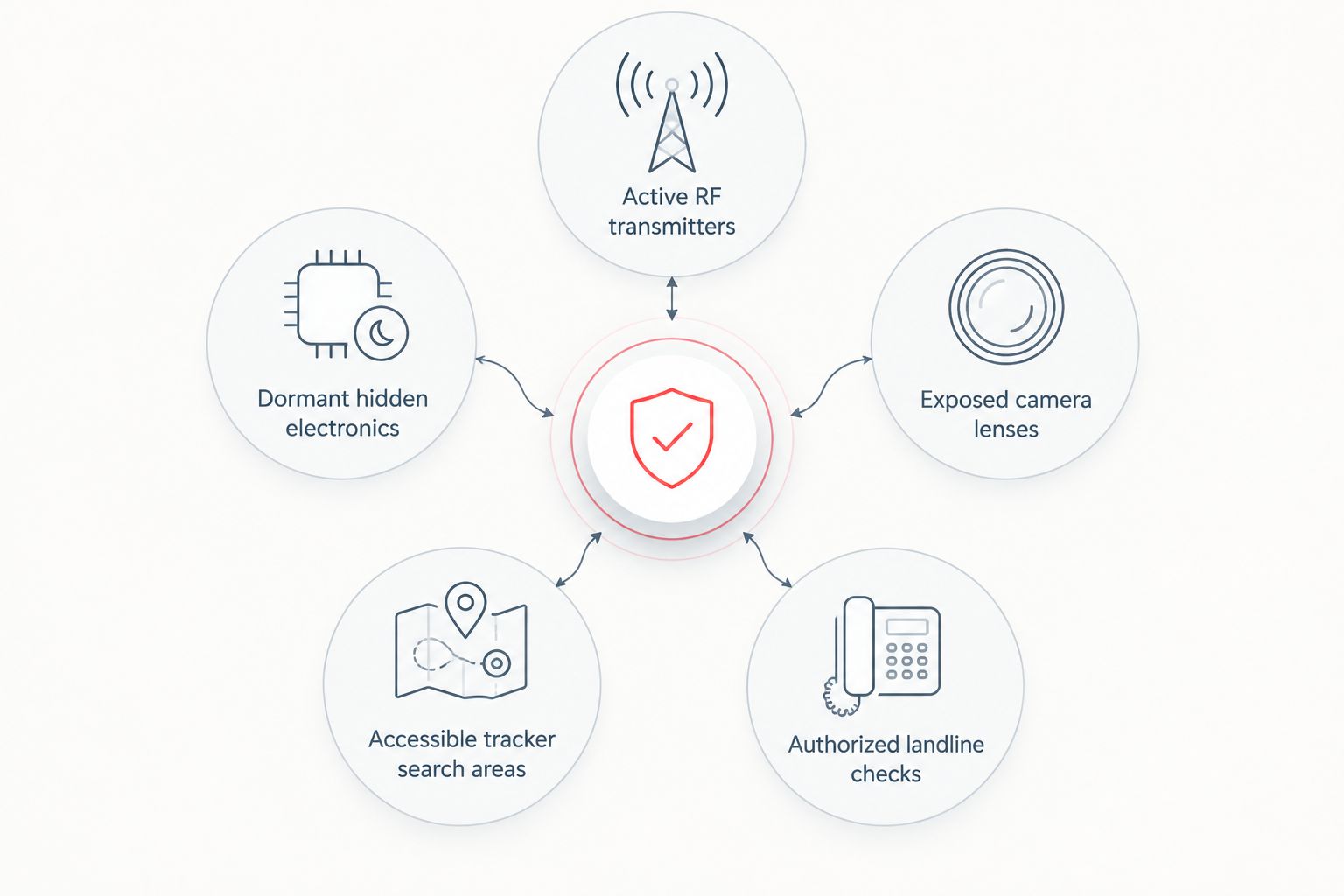
- Detection target: Decide whether the concern is an active transmitter, dormant electronics, a camera lens, a vehicle tracker, or a tapped line.
- Location capability: A tool should help narrow an observation to a device or installation point, not just report activity somewhere nearby.
- False-positive control: Legitimate wireless devices, metal objects, and normal vehicle components can complicate interpretation.
- Access and authorization: An instrument cannot justify opening a wall, entering a locked space, disconnecting a phone line, or handling a client’s vehicle without permission.
- Repeatable documentation: Record the area examined, instrument settings, observations, and follow-up checks so another qualified person can understand the finding.
- Coverage limits: Treat every negative result as limited to the search method, accessible area, and device state at the time of inspection.
These criteria make 2026 equipment decisions easier: buy for the cases you actually handle, then identify the threats that require another method or a professional TSCM sweep.
Counter-surveillance equipment at a glance
| Equipment | Best for | Standout capability | Key limitation |
|---|---|---|---|
| Spectrum analyzer | Active RF transmitters | Displays signal activity for investigation | Silent and nontransmitting devices do not appear |
| Nonlinear junction detector | Dormant hidden electronics | Responds to electronic junctions without relying on a live transmission | Legitimate electronics can also produce a response |
| Optical lens finder | Exposed camera lenses | Helps reveal reflected light from a lens | Obstructed or inaccessible lenses can be missed |
| Vehicle inspection tools | Accessible tracker search areas | Supports a systematic physical examination | Cannot clear inaccessible vehicle spaces |
| Telephone line test equipment | Authorized landline checks | Examines a line as part of a phone-system assessment | Does not address unrelated cameras or wireless bugs |
The table is a decision tree, not a promise that the top row replaces the rest. If the suspected device records locally, begin with a physical or electronic search rather than expecting an RF hit.
1. Spectrum analyzer: best counter-surveillance equipment for active RF transmitters
A spectrum analyzer displays radio-frequency activity so an investigator can examine a suspected transmission and work toward its source. Use it when the case concerns an active wireless microphone, transmitting camera, or other device that is sending a signal during the sweep. For investigators who regularly examine occupied offices or meeting spaces, this is the most useful first instrument for active RF questions.
An indication is a lead, not identification. Legitimate Wi-Fi, Bluetooth, and other wireless equipment can be present in the same space. Change position, document the observation, and investigate the physical source before describing a signal as a bug. In 2026, checking only a familiar Wi-Fi band is not a substitute for examining the RF activity relevant to the case.
Spectrum analyzer pros:
- Shows activity that a visual inspection cannot reveal.
- Helps compare observations at different points in a search area.
- Supports documentation of an active signal.
Spectrum analyzer cons:
- Will not find a device that is off or only stores recordings locally.
- Requires interpretation; ordinary signals can resemble leads worth checking.
- An RF observation alone does not establish who installed a device.
Best for: Investigators assessing suspected active transmissions. Verdict: Buy if active RF searches are a routine part of your authorized work; otherwise, use a qualified TSCM provider for those cases. The RF detectors for professional bug sweeping guide explains the narrower role of RF-focused equipment.
2. Nonlinear junction detector: best for dormant hidden electronics
A nonlinear junction detector, or NLJD, helps locate electronic components by detecting a response from semiconductor junctions. That makes it useful when an investigator suspects electronics that are switched off, not transmitting, or storing information locally. It addresses a major blind spot in RF-only searches.
A response does not prove that the object is a surveillance device. Ordinary electronics behind or inside fixtures can also respond, and the result must be localized and examined in context. Use the NLJD to guide an authorized physical inspection, not to label a wall or piece of furniture as compromised on the strength of one response.
Nonlinear junction detector pros:
- Does not depend on the suspected device transmitting.
- Helps focus inspection on a smaller physical area.
- Complements an RF examination rather than repeating it.
Nonlinear junction detector cons:
- Responds to legitimate electronics as well as suspect devices.
- Cannot identify the purpose or owner of a component.
- Findings still require access and careful follow-up inspection.
Best for: Investigators checking accessible spaces for dormant electronics. Verdict: Buy when nontransmitting devices are a recurring case concern and you can interpret the results; otherwise, request specialist support. USA Bugsweeps TSCM services are a service-based alternative when a case needs more than a single instrument.
3. Optical lens finder: best for exposed camera lenses
An optical lens finder directs light toward a search area to help reveal reflections from a camera lens. It fits cases involving a suspected hidden camera in a room, fitting area, or other space the investigator is permitted to examine. Search likely sightlines, then inspect any reflection at its source.
A glint is not proof of a camera; reflective surfaces can produce misleading results. The tool also depends on a usable view of the lens. A blocked lens or an object outside the inspected area remains outside the finding. Pair a lens search with a careful physical inspection rather than treating the absence of reflections as clearance.
Optical lens finder pros:
- Directly addresses the visible optical part of a camera.
- Helps prioritize suspicious openings and fixtures.
- Can be used without waiting for a wireless transmission.
Optical lens finder cons:
- Cannot identify an audio-only recorder or wiretap.
- Obstructions and inaccessible areas limit the search.
- Reflections require confirmation; they are not identification.
Best for: Investigators checking accessible rooms for exposed camera lenses. Verdict: Buy as a focused camera-search aid, not as a complete bug-sweeping kit. In 2026, a camera can record without providing an RF signal for a detector to find.
4. Vehicle inspection tools: best for accessible tracker search areas
A light, mirror, and appropriate inspection aids support a methodical look at accessible vehicle surfaces and compartments. This is a physical-search category, not a claim that a handheld detector identifies every GPS tracker. It is the right starting point when the client authorizes inspection of a vehicle and the suspected tracker is physically accessible.
Document the vehicle’s condition before moving anything. An unfamiliar object still needs identification; a factory component, repair, or client-installed accessory is not automatically a tracker. Avoid disconnecting or removing a suspected device without considering safety, authorization, and evidence-handling requirements.
Vehicle inspection tools pros:
- Support a repeatable examination of accessible areas.
- Do not require a tracker to transmit during the inspection.
- Let the investigator record where a suspicious object was found.
Vehicle inspection tools cons:
- Inaccessible cavities remain unexamined.
- A visual search cannot identify the function of every component.
- Moving parts or electrical systems introduce safety concerns.
Best for: Investigators conducting authorized preliminary vehicle searches. Verdict: Buy basic inspection aids for that task; bring in appropriate specialists when access, identification, or safe removal exceeds the scope of the inspection. A 2026 vehicle finding should describe what was actually examined, not claim the entire vehicle is clear.
5. Telephone line test equipment: best for authorized landline checks
Telephone line test equipment belongs in a narrower workflow: examining an authorized phone line when the concern is a possible tap or unexplained line behavior. It does not replace a room sweep, and it does not address surveillance through an unrelated camera or wireless device. Begin by establishing which system and line you have permission to assess.
Line readings need technical context. Normal equipment and wiring faults can complicate interpretation, while an issue elsewhere in a phone system can sit outside the tested segment. Keep the finding tied to the part of the system examined and refer work involving unfamiliar wiring to an appropriately qualified professional.
Telephone line test equipment pros:
- Focuses the examination on a specific suspected pathway.
- Can help document an observed line condition.
- Adds a separate check to an RF and physical search.
Telephone line test equipment cons:
- Addresses only the line and segment assessed.
- Readings do not identify who installed an unknown component.
- Improper access or handling can interrupt a working system.
Best for: Investigators with authorized landline assignments and the skills to interpret line conditions. Verdict: Hold unless those assignments are a regular part of your work; for an unfamiliar phone system, seek qualified technical assistance.
How we ranked the equipment
The order reflects breadth of use for a private investigator, followed by how directly each category addresses a distinct surveillance concern. A spectrum analyzer leads for active RF work; an NLJD follows because it covers electronics an RF search can miss. Lens, vehicle, and line tools rank by their narrower assignments. This is a ranking of equipment categories and limitations, not tested brands or models.
The sequence changes with the case. For a suspected camera in an accessible room, start with the camera-focused and physical methods. For a suspected vehicle tracker, a telephone line test set has no role. Write the search plan around the client’s concern and authorized access before choosing the instrument.
Which counter-surveillance equipment should you choose?
Choose a spectrum analyzer as the default for recurring active RF investigations. Add an NLJD when dormant electronics are within your case scope, and use an optical lens finder for camera-specific checks. For vehicle and phone-line assignments, choose the dedicated inspection method rather than forcing a general-purpose RF tool to answer a different question.
If the job requires several methods or a defensible assessment of a sensitive site, USA Bugsweeps is best for private investigators seeking professional TSCM support rather than another standalone device. Its stated services cover hidden cameras, audio bugs, GPS trackers, and wiretaps nationwide. Describe the suspected threat and the spaces you are authorized to have examined before requesting a sweep.
Discuss a TSCM sweep
Ask about professional surveillance detection for an authorized site or vehicle.
FAQ
What is the best counter surveillance equipment for private investigators?
A spectrum analyzer is the best general starting instrument for investigators checking active RF transmissions. Add other methods when the suspected device is dormant, records locally, or uses a wired connection.
Can an RF detector find a recorder that does not transmit?
No. A recorder that stores audio locally without transmitting offers no active RF signal to detect; examine it through suitable physical and electronic search methods instead.
Is a nonlinear junction detector better than a spectrum analyzer?
A nonlinear junction detector is better for looking for hidden electronics that are not transmitting, while a spectrum analyzer addresses active RF activity. Neither instrument replaces the other.
Can an optical lens finder prove a room has no hidden cameras?
No. An optical lens finder helps reveal accessible lens reflections, but an obstructed or inaccessible lens can escape that method. Combine it with an authorized physical search.
What equipment should a private investigator use to check for a GPS tracker?
Start with tools for a systematic physical inspection of accessible vehicle areas. Confirm the identity of any unfamiliar object before calling it a tracker, and do not remove it without considering safety and authorization.
When should a private investigator request a professional TSCM sweep?
Request a professional TSCM sweep when the case requires several detection methods or assessment beyond your equipment and training. USA Bugsweeps provides nationwide bug-sweeping services for hidden cameras, audio bugs, GPS trackers, and wiretaps.
One last thing
A negative RF result is not a negative surveillance finding. State the method, area, and device state your conclusion actually covers. That distinction protects the client from false reassurance and gives the next investigator a useful starting point in 2026.


