
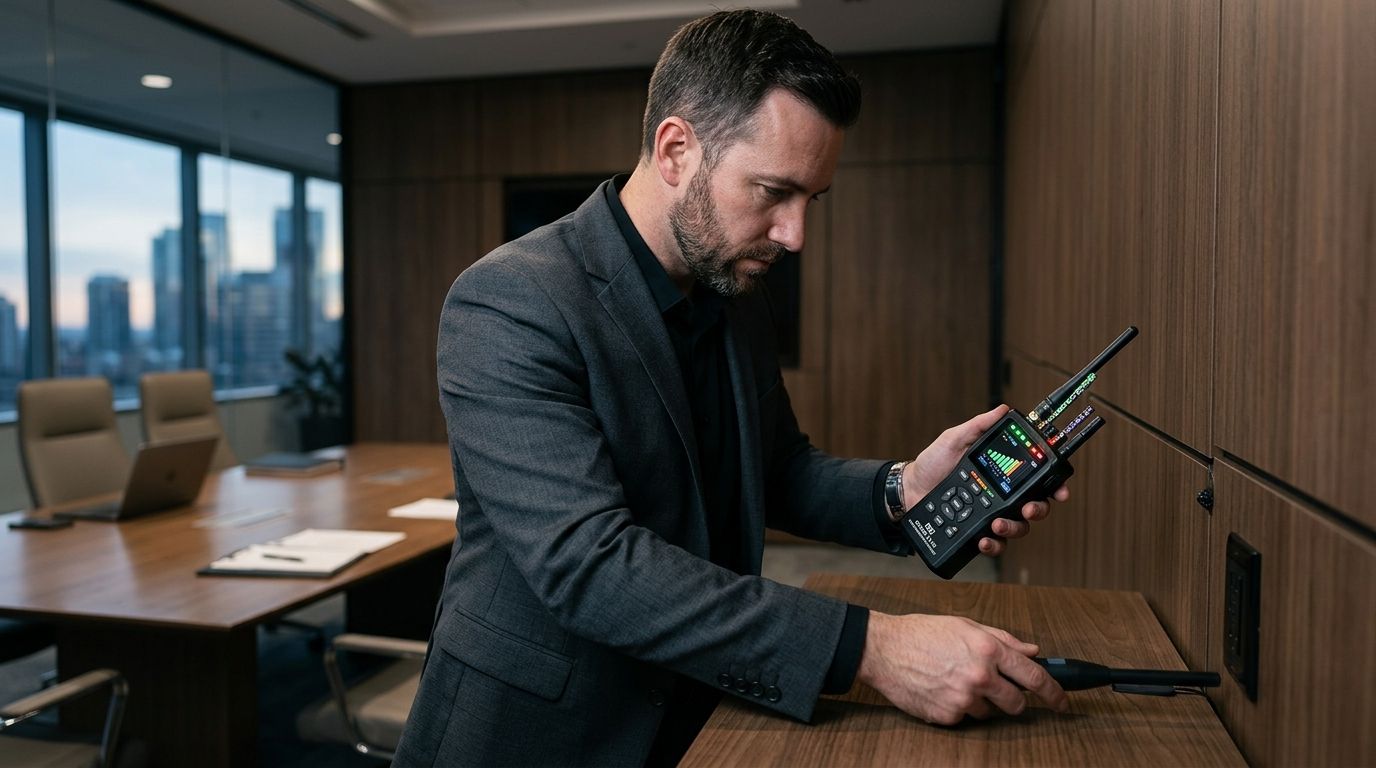
Professionals searching for the best hidden microphone detectors in 2026 are usually choosing between a consumer RF scanner, a non-linear junction detector, a spectrum analyzer, or a full TSCM sweep — and each one solves a different problem. This guide ranks all four by what they actually catch, not by marketing claims.
- A professional TSCM sweep wins overall for anyone facing an active bug, wiretap, or corporate espionage threat in 2026.
- Broadband RF detectors are the best hidden microphone detectors for a fast self-check before $500 in spend, but they miss dormant or hardwired devices.
- Non-linear junction detectors find electronics even when powered off — the biggest blind spot in consumer scanners.
- Spectrum analyzers give trained operators the most detail on active RF traffic but require real training to read correctly.
- Telephone line analyzers and TDR testers remain the budget pick for landline wiretap checks in 2026.
Best overall: a professional TSCM sweep from USA Bugsweeps. Best for a fast pre-meeting check: a broadband RF detector. Best budget option for a landline check: a telephone line analyzer/TDR.
Why this matters
Hidden microphones show up in boardrooms, courthouses, executive offices, and private vehicles — the FBI itself has been reported using hidden microphones outside courthouses, which tells you how normalized this hardware has become by 2026. Most people only think about a bug sweep after something feels off: a leaked deal, a competitor who knows too much, a recording that surfaces somewhere it shouldn't.
The problem with DIY detection is that most consumer devices only catch one category of threat. An RF detector finds an active transmitter but misses a hardwired microphone tapped into a phone line. A spectrum analyzer catches frequency-hopping devices but takes weeks to learn. Knowing which detector matches your actual risk saves money and false confidence.
What makes the best hidden microphone detectors
- Frequency range coverage — wider range catches more transmitter types, including frequency-hopping bugs
- Detection of dormant or hardwired devices — the single biggest gap in cheap RF scanners
- False-positive rate — Wi-Fi routers, baby monitors, and Bluetooth speakers trip up low-end detectors constantly
- Operator skill required — some tools work out of the box, others need real training to interpret
- Portability for room-to-room sweeps — matters for boardrooms, hotel rooms, and vehicles alike
- Whether it's paired with a full TSCM sweep — audio, video, and GPS threats often travel together
Hidden microphone detectors at a glance
| Detector | Best for | Standout feature | Key limitation |
|---|---|---|---|
| Professional TSCM sweep | Active threat or high-stakes environment | Combines RF, NLJD, and physical inspection | Requires scheduling a certified operator |
| Broadband RF detector | Fast pre-meeting self-check | Portable, works within minutes | Misses off or hardwired devices |
| Non-linear junction detector (NLJD) | Finding bugs that are switched off | Detects semiconductor junctions, not just RF | Expensive and needs trained interpretation |
| Spectrum analyzer | Continuous RF monitoring by trained teams | Visualizes the full frequency spectrum in real time | Steep learning curve for non-specialists |
| Telephone line analyzer / TDR | Landline wiretap checks | Tests line for taps, splices, and voltage anomalies | Only covers wired phone lines, not RF bugs |
1. Professional TSCM sweep: best hidden microphone detection for professionals facing an active threat
A professional TSCM sweep combines broadband RF scanning, non-linear junction detection, physical inspection, and phone line testing in one visit. It's built for situations where a single missed device carries real financial or legal consequences — a boardroom before an acquisition, an executive's home, a vehicle involved in litigation.
Professional TSCM sweep pros:
- Catches dormant, hardwired, and RF-active devices in the same visit
- Operated by someone trained to distinguish a real threat from a false positive
- Covers audio bugs, hidden cameras, and GPS trackers together, not just microphones
- Scales from a single room to a full building or fleet
Professional TSCM sweep cons:
- Requires scheduling rather than an instant answer
- Not practical for a quick personal check before every phone call
- Cost varies by scope, so it's not the cheapest option for a one-room check
Best for: professionals in law, finance, corporate leadership, or private investigation who need a definitive answer, not a guess. Verdict: Buy.
2. Broadband RF detector: best for a fast pre-meeting check
A broadband RF detector scans for active radio transmissions, typically across a range of roughly 1 MHz to 6 GHz depending on the model. It's the tool most people picture when they search for the best hidden microphone detectors, and it earns that reputation for speed.
Broadband RF detector pros:
- Portable enough to carry into any room or vehicle
- Delivers a result in minutes, no scheduling required
- Reasonable entry point for individuals who want a baseline check
Broadband RF detector cons:
- Misses microphones that are powered off, hardwired, or storing audio locally
- Prone to false positives from Wi-Fi routers and Bluetooth devices
- Provides no forensic-level confirmation of what it finds
Best for: a quick personal check before a sensitive call, not a substitute for a full sweep. Verdict: Buy as a supplement, not a replacement. See the full breakdown of professional-grade RF detectors for how these compare to consumer models.
3. Non-linear junction detector (NLJD): best for finding bugs that are off or hardwired
An NLJD sends a signal, typically in the 900 MHz to 2.4 GHz range, and reads the response from semiconductor junctions — the electronic components inside any microphone, transmitter, or recorder. Because it detects the hardware itself rather than an active signal, it finds devices an RF scanner walks right past.
NLJD pros:
- Detects powered-off, battery-dead, or hardwired devices
- Doesn't rely on the bug actively transmitting to be found
- Standard equipment in professional TSCM sweeps for this exact reason
NLJD cons:
- Expensive relative to a basic RF detector
- Produces readings that need training to interpret correctly
- Slower per-room process than a quick RF scan
Best for: high-risk environments where a device could be dormant, like a boardroom swept the night before a deal closes. Verdict: Buy for professionals, Skip for casual personal use.
4. Spectrum analyzer: best for trained security teams monitoring RF continuously
A spectrum analyzer displays every frequency in use across a room in real time, letting a trained operator spot an anomaly that an automated detector might flag as noise. It's the tool security teams use when they need ongoing monitoring, not a one-time check.
Spectrum analyzer pros:
- Shows the full RF picture instead of a simple alert
- Catches frequency-hopping or intermittent transmitters other tools miss
- Useful for continuous monitoring in high-security facilities
Spectrum analyzer cons:
- Requires real training to read correctly — a raw display means nothing to an untrained user
- Overkill for a single-room or one-time check
- Slower workflow than a purpose-built detector
Best for: in-house security teams at facilities that need standing monitoring, not a one-off sweep. Verdict: Hold unless you already have a trained operator on staff.
5. Telephone line analyzer / TDR: best budget option for landline wiretap checks
A time-domain reflectometer (TDR) or telephone line analyzer tests a landline for splices, taps, and voltage irregularities that indicate a wiretap. It's narrow in scope but effective for the one threat it's built to catch.
TDR pros:
- Directly tests the phone line rather than the air around it
- Effective against wired taps that RF detectors can't see
- Simple pass/fail readout on most models
TDR cons:
- Covers wired phone lines only, nothing else in the room
- Doesn't help at all against wireless microphones or hidden cameras
- Rarely relevant in offices that have already moved to VoIP
Best for: homes or small offices still running analog landlines who want a targeted, lower-cost check. Read more on how to detect a wiretap on a landline phone before choosing this option. Verdict: Buy if you still use a landline, Skip if you don't.
Suspect a hidden microphone right now?
Schedule a professional TSCM sweep instead of guessing with a consumer scanner.
How we ranked these
Each detector was scored against the six criteria above: frequency coverage, dormant-device detection, false-positive rate, operator skill required, portability, and whether it integrates with a full sweep. A professional TSCM sweep scored highest because it's the only option covering all six; single-purpose tools like the TDR score well on one dimension and poorly on the rest.
Which hidden microphone detector should you choose?
If you have any reason to believe you're dealing with an active threat in 2026 — a legal dispute, a corporate leak, a stalking concern — a professional TSCM sweep is the only option that gives you a definitive answer. If you just want a baseline check before a sensitive meeting, a broadband RF detector is a reasonable middle ground. If your only concern is an old landline, a TDR test covers it for less. Everyone else searching for the best hidden microphone detectors should start with the sweep and work backward from there.
FAQ
What is the best hidden microphone detector for professionals in 2026?
A professional TSCM sweep is the best option because it combines RF scanning, non-linear junction detection, and physical inspection in one visit. Consumer RF detectors work as a fast supplement but miss powered-off or hardwired devices.
Can a broadband RF detector find every hidden microphone?
No. A broadband RF detector only catches devices that are actively transmitting, so it misses hardwired microphones, storage-based recorders, and anything powered off at the time of the scan.
Is a non-linear junction detector better than an RF detector?
An NLJD finds devices an RF detector can't, because it detects the electronic components themselves instead of an active signal. It's better for thorough checks but requires training to interpret correctly.
How do professionals detect a wiretap on a landline?
A telephone line analyzer or TDR tests the line for splices, taps, and voltage anomalies that indicate a physical tap. This method only covers wired phone lines, not wireless microphones.
Do I need a spectrum analyzer to find a hidden microphone?
Only if you need continuous RF monitoring by a trained operator. For a one-time check, a broadband RF detector or a full TSCM sweep is more practical and requires far less training.
How often should a business sweep for hidden microphones?
There's no universal schedule, but boardrooms and executive offices handling sensitive deals are commonly swept before major meetings or after any suspected leak.
Can a hidden microphone be found if it's turned off?
Yes, but only with a non-linear junction detector or a full physical inspection during a professional sweep. RF detectors cannot find a device that isn't transmitting.
What's the difference between a bug sweep and a hidden microphone detector?
A hidden microphone detector is a single tool, like an RF scanner. A bug sweep is a full process that combines multiple tools and a trained operator to check for microphones, cameras, and GPS trackers together.
One last thing
The detail most people miss: a hidden microphone doesn't have to be transmitting to be recording. Devices with onboard storage sit silent until retrieved, which means an RF detector can clear a room that still has a working bug in it. That gap is exactly why non-linear junction detection exists, and exactly why a full sweep beats a scanner alone whenever the stakes are real.


