
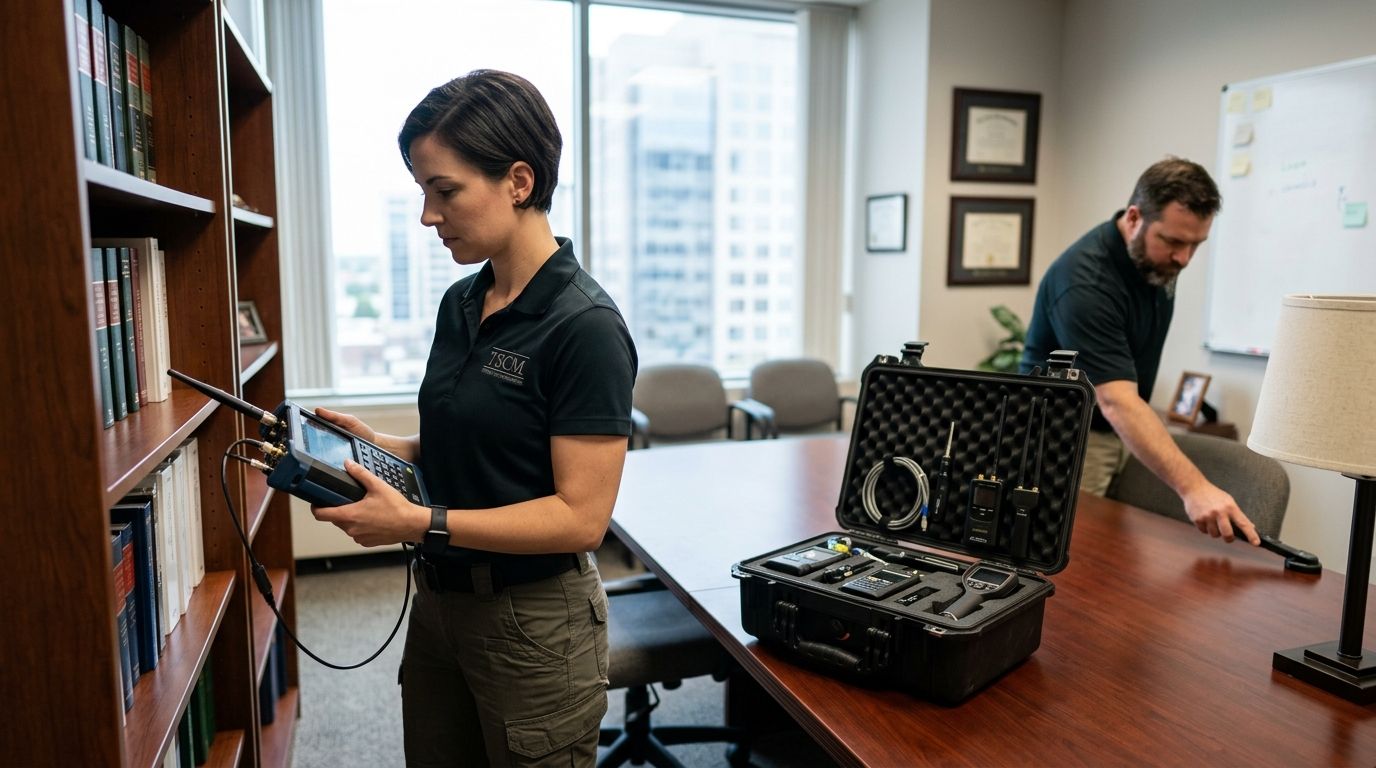
Bug sweep services for private investigators cover RF spectrum analysis, physical inspection, and phone-line testing built around case confidentiality, not a single gadget scan. A PI firm's exposure is different from a homeowner's: client files, informant identities, and surveillance logs sit in the same office where a competitor, a subject, or a disgruntled ex-employee could plant a device.
- Bug sweep services for private investigators combine RF detection, NLJD sweeps, and physical inspection, not a single gadget check.
- USA Bugsweeps runs TSCM sweeps nationwide for PI firms handling insurance claims, custody, and corporate cases.
- Consumer RF detectors miss GSM and digitally-modulated bugs, which is the gap professional-grade TSCM equipment closes.
- Surveillance vehicles need a separate GPS tracker sweep in 2026, not just an office check.
- Written sweep reports matter for PI firms because courts and insurers ask for documentation, not a verbal all-clear.
Why bug sweeps matter for private investigation firms
A PI firm generates the exact kind of information an eavesdropper wants: case strategy, client identities, and evidence before it's filed. Firms working insurance fraud, custody disputes, or corporate due diligence carry files that are worth more to a subject than to almost anyone else on the client roster.
The liability angle is separate from the intelligence angle. If a PI's own office or vehicle is compromised, opposing counsel can argue the chain of custody on evidence is broken, or that the firm's operational security failed a duty-of-care standard. Neither argument needs to be true to cost a case or a client relationship — it just needs to be plausible in a deposition.
PI firms also sit at the intersection of two other high-risk categories on this list: insurance claims investigators and legal teams protecting privileged conversations. If your caseload overlaps either, the sweep frequency should match the sensitivity of the file, not a calendar reminder.
Update your vetting checklist
Before hiring a TSCM provider or bringing sweeps in-house, confirm the basics that separate a real countermeasures sweep from a metal-detector wand with a marketing budget.
- Ask what spectrum range the RF detection equipment covers — sub-1MHz to 6GHz-plus is standard for professional TSCM in 2026
- Confirm whether the sweep includes non-linear junction detection (NLJD) for powered-off devices
- Check if the provider issues a written report with device signatures and locations checked
- Ask about non-disclosure terms for the sweep itself — the sweep findings are as sensitive as the case file
- Verify the technician performs physical inspection in addition to electronic scanning, not electronic-only
Match the sweep to the investigation type
Not every case needs the same sweep. A custody surveillance case has different exposure than a corporate fraud file, and the sweep scope should reflect that.
- Insurance and fraud cases: prioritize office sweeps where claim files and interview notes are stored
- Custody and domestic cases: prioritize vehicle sweeps and phone checks, since GPS trackers show up more often here than office bugs
- Corporate and due-diligence cases: prioritize conference rooms and any shared coworking space used for client meetings
- High-profile or public-figure cases: escalate to full-spectrum sweeps covering RF, NLJD, and phone-line testing together
The guide on how to protect attorney-client conversations from eavesdropping covers the privilege angle in more detail if your firm works joint-defense or referral cases with law firms.
Sweep vehicles used for surveillance and asset checks
Surveillance vehicles are a blind spot most PI firms skip because the threat feels backward — investigators track subjects, not the other way around. That assumption gets tested the moment a subject makes the tail and starts counter-surveilling.
- Check under the bumper, wheel wells, and undercarriage magnetically for battery-powered GPS units
- Inspect the OBD-II port for a plug-in tracker disguised as a diagnostic adapter
- Run a physical check before and after any high-risk stakeout, not just once a quarter
- Extend the same check to personal vehicles of investigators working sensitive cases
A manual visual and magnetic sweep catches most consumer-grade trackers. For a faster pass, an RF sweep tool designed for vehicles picks up active transmitters the visual check misses — see the guide on how to find a hidden GPS tracker on your car for the step-by-step.
Protect informant and source communications
Informant identity protection is often the single highest-stakes piece of a PI firm's operational security. A compromised phone line or bugged meeting room doesn't just leak a case theory — it can expose a person's safety.
- Use burner or encrypted communication channels for initial informant contact
- Sweep any meeting location used for informant debriefs before the meeting, not after
- Rotate meeting locations rather than using the same coffee shop or office repeatedly
- Confirm office phone lines are checked for wiretap or extension-based interception
Sweep office and case-file storage locations
Most PI firms operate out of small offices, sometimes shared or subleased space. That setup increases the odds of a device planted by a cleaning crew, a landlord dispute, or a visiting client with access to an unattended room.
- Physically inspect vents, smoke detectors, and outlet covers in rooms where files are discussed
- Check phone systems and VoIP hardware for tapping, especially after any office move or hardware swap
- Run a full RF sweep quarterly if the office handles cases involving corporate clients or public figures
- Treat shared or coworking office space as higher-risk than a dedicated lease
Firms operating from shared workspace should compare notes with the bug sweep services for co-working and shared office spaces guide, since the access-control problem is identical.
Document the sweep for court and client reporting
A sweep that isn't documented is functionally a rumor when it matters. If a case goes to deposition or trial, a verbal claim that the office was checked and came back clean carries no weight without paperwork.
- Keep a dated, signed report for every sweep, including equipment used and areas checked
- Log any device found, its make, and where it was recovered, with photos
- Retain reports for the life of the case file, not just the sweep date
- Share redacted summaries with clients when a sweep is part of a billed engagement
Build a standing relationship instead of one-off sweeps
One-time sweeps solve one moment in time. A PI firm handling repeat sensitive casework benefits from a standing TSCM relationship that can respond fast when a case escalates.
- Schedule baseline sweeps on a recurring cadence tied to caseload volume, not a fixed annual date
- Negotiate rapid-response terms for mid-case escalations, such as a suspected leak
- Keep one point of contact at the TSCM provider so equipment and reporting stay consistent case to case
Get a TSCM sweep scheduled
Nationwide bug sweep coverage for offices, vehicles, and case-sensitive locations.
Comparison: sweep options for PI firms
| Option | Best for | Key limitation |
|---|---|---|
| Full TSCM sweep (RF + NLJD + physical) | High-stakes cases, corporate or public-figure work | Requires scheduling a technician, not instant |
| RF-only sweep | Budget-limited routine office checks | Misses powered-off or hardwired devices |
| Consumer RF detector, self-run | Quick pre-meeting confidence check | Misses GSM-modulated and digital bugs entirely |
| Vehicle-only GPS tracker sweep | Surveillance vehicles before and after stakeouts | Doesn't cover office or phone-line exposure |
Verdict: full TSCM sweeps win for any PI firm handling custody, corporate, or insurance-fraud casework in 2026 — consumer detectors are fine for a quick gut-check, not for a case that could end up in deposition.
Common mistakes PI firms make with bug sweeps
- Relying on a consumer RF detector for client-facing assurance — it gives a false sense of clearance on digital and GSM-based devices
- Sweeping the office but skipping the vehicle — trackers show up on cars more often than bugs show up in conference rooms for surveillance-heavy caseloads
- Treating a clean sweep as permanent — a device planted the week after a sweep leaves the firm exposed until the next check
- Subcontracting sweeps to unvetted providers — a sweep report from a provider with no NLJD capability isn't worth much in a deposition
- Skipping documentation — a verbal all-clear doesn't hold up when opposing counsel challenges chain of custody
FAQ
What's the best bug sweep service for private investigators?
A full TSCM sweep combining RF spectrum analysis, non-linear junction detection, and physical inspection is the best fit for PI firms, since consumer RF detectors miss GSM and digitally-modulated devices. USA Bugsweeps runs nationwide TSCM sweeps built for case-sensitive environments like PI offices and vehicles.
How often should a PI firm sweep its office for bugs?
Quarterly is a reasonable baseline for firms handling corporate or high-profile cases, with an additional sweep after any office move, hardware change, or suspected leak. Firms with lighter caseloads can extend that interval but should never skip a sweep entirely.
Do surveillance vehicles need a separate GPS tracker sweep?
Yes, a vehicle sweep is separate from an office sweep and should happen before and after high-risk stakeouts. Subjects who suspect they are being followed sometimes counter-surveil the investigator's vehicle, which makes this check as important as the office check.
Can a consumer hidden camera detector replace a professional TSCM sweep?
No, consumer detectors typically only pick up lens glare or basic RF signals and miss hardwired, GSM-based, or powered-off devices. A professional sweep adds non-linear junction detection and phone-line testing that consumer tools do not cover.
How much does a bug sweep cost for a PI office in 2026?
Cost varies by square footage, number of vehicles, and whether phone systems are included, so check current pricing directly with a TSCM provider rather than relying on a flat estimate. Scope the request around office size and case sensitivity to get an accurate quote.
Is a written sweep report necessary for court cases?
Yes, a dated and signed report documenting equipment used and areas checked is what holds up if a case reaches deposition or trial. A verbal confirmation of a clean sweep carries no evidentiary weight on its own.
What's the difference between an RF sweep and an NLJD sweep?
An RF sweep detects active transmitting devices, while an NLJD sweep finds electronic components even when a device is powered off. PI firms handling sensitive cases need both, since a bug can be dormant during the sweep window.
Should informant meetings happen in a swept location?
Yes, any location used for informant debriefs should be swept before the meeting, and the location should rotate rather than staying fixed. This protects both the informant's identity and the integrity of the information shared.
One last thing
The detail most PI firms miss isn't the office or the vehicle — it's the phone system. A tapped office VoIP line leaks every case discussion before a device is ever found in a wall, and phone-line testing gets skipped more often than RF sweeps because it feels less dramatic. Read the guide on how to tell if your office phone system is tapped before assuming a clean RF sweep in 2026 means a clean office.


