
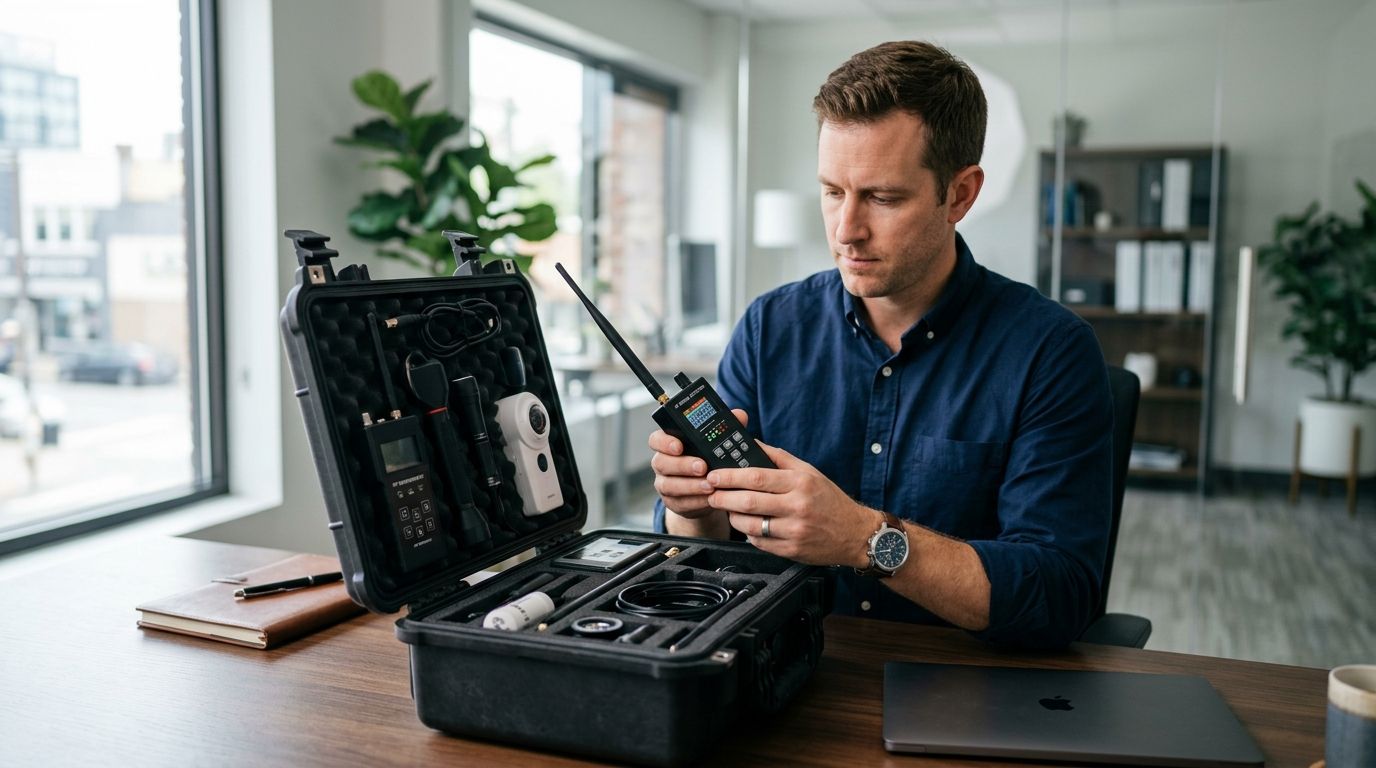
Small business owners searching for the best counter-surveillance kits for small business in 2026 usually want one answer: buy a device or call a professional. The honest verdict is both, depending on what you're protecting and how much risk you can tolerate.
Verdict
Best overall: a professional TSCM sweep, because it's the only option that finds passive, hardwired, and RF-silent devices that consumer kits miss. Best for daily self-monitoring: broadband RF detector kits, which catch active wireless bugs between professional visits. Best for hidden camera detection: combination RF-and-lens detector kits, built for retail floors, gyms, and fitting rooms. Best budget option: entry-level single-frequency detectors, a low-cost first step for businesses with minimal exposure.
- A professional TSCM sweep finds passive and hardwired devices that no consumer kit can detect, and that's the best overall pick for 2026.
- Broadband RF detector kits are the strongest DIY option for continuous self-monitoring between professional visits.
- Combination RF-and-lens kits handle hidden camera detection best, but they still miss cameras hidden behind opaque materials.
- GPS tracker detectors only find active, transmitting units — hardwired trackers on company vehicles slip past them.
- Entry-level single-frequency detectors are the cheapest kit reviewed here, and the weakest.
Why this matters
A hidden camera in a break room, an audio bug in a conference table, or a GPS tracker on a company van is a liability question, not just a privacy question — recordings taken without consent inside a private business space can expose you to lawsuits, trade secret leaks, and HR complaints. USA Bugsweeps works with small business owners across retail, medical, legal, and startup environments who need to know the difference between a device that beeps at wifi routers and one that actually finds a bug.
The kit categories below are ranked by what they can realistically detect in 2026, not by marketing claims. Every entry gets an honest pros-and-cons breakdown, including the professional sweep option.
What makes the best counter-surveillance kit for small business
- Frequency range and detection scope — RF-only detection versus combined RF, lens, and physical inspection
- False positive rate against wifi routers, bluetooth devices, and building electronics
- Ease of use for non-technical staff who aren't trained technicians
- Coverage of passive devices — hardwired taps and wired cameras that never transmit a signal
- Legal documentation value — whether findings hold up if you need to involve law enforcement or counsel
- Cost relative to exposure — what you're actually protecting versus what the kit costs to own
At a glance
| Kit / Service | Best For | Standout Feature | Key Limitation |
|---|---|---|---|
| Professional TSCM sweep | Verified, documented results | Finds passive and hardwired devices | Requires scheduling a visit |
| Broadband RF detector kit | Daily self-monitoring | Continuous wireless scanning | High false-positive rate near wifi |
| Combination RF + lens kit | Hidden camera detection | Dedicated lens-glare detection | Misses cameras behind opaque covers |
| GPS tracker detector | Company vehicles and fleets | Scans OBD port and magnetic mounts | Misses non-transmitting hardwired units |
| Telephone line analyzer | Office phone systems | Detects line voltage anomalies | Doesn't cover VoIP or digital intercepts |
| Entry-level single-frequency detector | Budget-conscious first step | Lowest cost, simplest operation | Narrowest coverage of any kit here |
1. Professional TSCM sweep: best counter-surveillance option for verified results
A professional sweep uses trained technicians and equipment that scans a far wider portion of the spectrum than any handheld consumer device, combined with a physical inspection of outlets, fixtures, and furniture. It's the only method on this list that reliably catches passive bugs — devices with no active transmission to detect in the first place.
Professional sweep pros:
- Finds hardwired and passive devices no RF detector can see
- Physical inspection catches cameras in smoke detectors, outlets, and fixtures
- Findings can be documented for HR, legal, or law enforcement use
Professional sweep cons:
- Costs more upfront than owning a DIY kit
- Requires scheduling rather than instant, on-demand checking
- Not practical for daily monitoring between engagements
Businesses handling sensitive conversations — securing a conference room from corporate espionage before board meetings, for example — get more from a sweep than from any device. Best for: businesses that suspect an active threat or need results that hold up. Verdict: Buy.
Get a free bug sweep quote
Nationwide TSCM sweeps for offices, vehicles, and conference rooms.
2. Broadband RF detector kits: best for daily self-monitoring
Broadband RF detectors scan a wide swath of the wireless spectrum for active transmissions and alert you when something unusual is broadcasting nearby. They're the closest DIY equivalent to a professional sweep, useful for spot-checking a leased office or a hotel-style meeting space before a sensitive call.
Broadband RF kit pros:
- Portable enough to carry between office locations
- Continuous scanning catches devices transmitting in real time
- Reasonable entry point for businesses without recurring sweep budgets
Broadband RF kit cons:
- Wifi routers, bluetooth speakers, and smart locks trigger frequent false alarms
- Can't detect devices that record locally without transmitting
- Requires some training to interpret readings correctly
Best for: teams that want a self-check tool between professional visits. Verdict: Buy as a supplement, not a replacement.
3. Combination RF-and-lens detector kits: best for hidden camera detection
These kits pair an RF scanner with an LED array designed to catch the reflective glare of a hidden camera lens, which matters for businesses where hidden cameras are the primary concern rather than audio bugs.
Combination kit pros:
- Purpose-built for hidden camera detection in fitting rooms, break rooms, and guest spaces
- Handheld and usable by non-technical staff with minimal setup
- Doubles as an RF scanner for basic audio bug checks
Combination kit cons:
- Lens detection works best in a dimmed room, which isn't always practical during business hours
- Cameras hidden behind fabric, vents, or opaque housings are easy to miss
- Doesn't catch wired cameras routed through existing security infrastructure
Retail, gym, and spa operators researching hidden camera detection for gym and spa owners or fitting-room privacy usually start here before escalating to a professional sweep. Best for: businesses with customer-facing changing areas or break rooms. Verdict: Buy.
4. GPS tracker detectors: best for company vehicles and fleets
GPS tracker detectors scan for active transmissions from magnetic-mount or OBD-port devices attached to a vehicle. They matter most for businesses running delivery routes, service vans, or company fleets where a competitor, disgruntled employee, or ex-partner could plant a tracker.
GPS detector pros:
- Quick to run before a vehicle leaves the lot
- Detects most common consumer-grade tracker models
- Low cost relative to the liability of an untracked leak of route data
GPS detector cons:
- Misses hardwired trackers spliced into a vehicle's own wiring
- Requires re-scanning every vehicle individually, which doesn't scale for large fleets
- Battery-powered trackers set to sleep mode can avoid detection during a scan
Fleet-heavy operations comparing options against a full GPS tracker sweep for company fleet vehicles should treat the detector as a first pass, not a final answer. Best for: businesses running delivery or service vehicles. Verdict: Buy, then escalate for hardwired suspicion.
5. Telephone line analyzers: best for office phone systems
These devices measure voltage and impedance on a phone line to flag anomalies consistent with a physical tap. They're relevant for offices still running analog or hybrid phone systems, less so for businesses that have moved entirely to VoIP.
Line analyzer pros:
- Fast to run on a single line without disassembling the phone
- Effective against older, physical wiretap methods
- Inexpensive relative to other kit categories here
Line analyzer cons:
- Doesn't detect intercepts on VoIP or digital call routing
- Limited to the phone line itself, not the broader network
- False readings possible on older or poorly maintained wiring
Offices unsure whether their system is compromised should read through how to tell if your office phone system is tapped before buying. Best for: businesses still using analog or hybrid phone lines. Verdict: Hold unless you're still on a legacy system.
6. Entry-level single-frequency detectors: best budget option
These are the simplest devices reviewed here — a single-frequency scanner that lights up or beeps when it detects a matching transmission. They cover a narrow band and little else.
Entry-level detector pros:
- Lowest cost of any kit on this list
- Simple on/off operation with no training required
- Better than nothing as a baseline deterrent
Entry-level detector cons:
- Narrow frequency coverage misses most modern bugs operating outside that band
- High false-positive and false-negative rates
- No lens detection, no physical inspection, no documentation value
Best for: businesses with minimal risk exposure testing the waters before a bigger investment. Verdict: Skip if you have any real suspicion of surveillance — go straight to a broader kit or a sweep.
How we ranked these
Ranking followed the six criteria above, weighted toward detection scope and false-positive rate first, since a kit that misses real devices or drowns you in false alarms isn't protecting anything. Cost only mattered after a kit cleared the detection bar — a cheap detector that can't find a modern bug isn't a bargain in 2026, it's a false sense of security.
Which counter-surveillance kit should you choose?
If you suspect an active threat — a departing employee, a contentious deal, a conference room used for sensitive negotiations — a professional TSCM sweep is the right call, not a kit. If you're doing routine self-monitoring on a limited budget, a broadband RF detector or a combination RF-and-lens kit covers the most common threats for 2026 small business environments. Skip the entry-level single-frequency detector unless cost is the only deciding factor.
“A cheap detector that can't find a modern bug isn't a bargain, it's a false sense of security.”
FAQ
What's the best counter-surveillance kit for small business owners in 2026?
A professional TSCM sweep is the most reliable option because it catches passive and hardwired devices that consumer kits miss entirely. For daily self-monitoring between sweeps, a broadband RF detector kit is the strongest DIY choice.
Are DIY bug detector kits reliable for finding hidden cameras?
Combination RF-and-lens kits catch many active hidden cameras but miss ones hidden behind opaque materials or wired into existing security systems. They work best as a first pass, not a final check.
Can a consumer RF detector find a professional-grade bug?
Not reliably. Consumer RF detectors cover a narrower slice of the spectrum than professional TSCM equipment and can't detect passive devices that never transmit a signal.
Do GPS tracker detectors work on company fleet vehicles?
They detect active, transmitting GPS units but miss hardwired trackers spliced into a vehicle's wiring. Fleets with a specific suspicion should escalate to a full vehicle sweep.
Is a phone line analyzer enough to detect a wiretap in 2026?
Only for analog or hybrid phone systems. A line analyzer doesn't detect intercepts on VoIP or digital call routing, which most modern offices now use.
When should a small business hire a professional TSCM sweep instead of buying a kit?
Hire a professional when you have a specific suspicion, a legal or HR situation, or need documented findings. Kits work for routine monitoring, not for verified results.
How often should a business re-sweep for hidden surveillance?
Businesses handling sensitive negotiations, legal matters, or high employee turnover should re-check more frequently than businesses with low turnover and no active disputes. Frequency depends on your specific risk exposure.
Is a budget single-frequency detector worth buying?
Only as a low-cost deterrent with no real suspicion of surveillance. Its narrow frequency coverage and high false-positive rate make it the weakest option for a business that actually suspects a bug.
One last thing
The biggest gap in every consumer kit reviewed here is the same: none of them reliably catch a device that never transmits a signal — a hardwired camera, a recorder in a drawer, a splice in a phone line. That's the exact gap a professional TSCM sweep is built to close, and it's the reason most small business owners who buy a kit in 2026 end up calling a technician within the year anyway.


