

Best overall for a staff-approved visual check: an optical lens finder. Best existing-tool option: a flashlight. Best for investigating active wireless signals: an RF detector, used by a qualified operator. This 2026 guide compares the best hidden camera detectors for hospital patients and medical visitors without treating a detector alert as proof of surveillance.
- For the best hidden camera detectors for hospital patients, prioritize optical inspection over unexplained RF alerts.
- An optical lens finder needs a visible lens; it cannot certify that a room is clear.
- RF detectors identify radio activity, not whether a camera is unauthorized.
- Usabugsweeps provides professional hidden camera detection; hospital access and inspection scope require facility approval.
Why this matters
A hospital room is not a hotel room. You share the environment with clinical equipment, staff communications, other patients, and devices you do not control. Protect your privacy without interrupting care.
A reflection, unfamiliar object, or detector alarm is a reason to ask questions—not an accusation. Start with your nurse or hospital security, and ask staff to identify unfamiliar equipment before you inspect it.
Usabugsweeps provides nationwide TSCM bug sweeping services, including hidden camera and audio bug detection. Discuss the concern and required facility permission before arranging any inspection; a patient's request does not authorize access to hospital fixtures or restricted areas.
This ranking compares detection methods, not unverified product models. Choose by what the method can actually reveal, what it misses, and whether you can use it safely in a clinical setting.
What makes the best hidden camera detector for patients?
For a hospital visit in 2026, these criteria matter more than a long feature list:
- Detection mechanism: Know whether the tool looks for lens reflections, radio transmissions, or infrared light. Those are different targets.
- Non-disruptive operation: Favor observation that does not require unplugging, opening, moving, or transmitting toward clinical equipment.
- Interpretable findings: A useful result gives staff a specific object or location to examine, rather than an unexplained alarm.
- Visible limitations: Require clear instructions about viewing angles, signal detection, and circumstances the tool cannot assess.
- Patient usability: Consider whether you can inspect from a safe position without standing, reaching, or delaying treatment.
- Authorized follow-up: Decide who will examine a suspicious object before you start. Detection without a response plan leaves the concern unresolved.
No handheld detector establishes that every camera is absent. A camera's lens visibility, recording method, power state, and placement affect what each approach can find.
Hospital camera detection options at a glance
The order below prioritizes a patient's safe preliminary check, then specialist escalation. Professional TSCM is not a consumer gadget or a substitute for reporting a concern to hospital staff.
| Rank and option | Best for | Standout feature | Key limitation |
|---|---|---|---|
| 1. Optical lens finder | Staff-approved inspection of accessible objects | Looks for reflected light from an exposed camera lens | Needs a suitable viewing angle and an unobstructed lens |
| 2. Flashlight | An initial visual check using an existing tool | Helps reveal small openings and reflective surfaces | Ordinary materials also reflect light |
| 3. RF detector | Qualified investigation of active radio signals | Detects radio activity within its supported bands | Does not identify intent or detect every recording camera |
| 4. Phone camera check | Supplementary observation of infrared light | Uses a phone you already carry | Infrared sensitivity varies; not every camera emits infrared |
| 5. Professional TSCM assessment | Escalating a specific, unresolved concern | Combines specialist assessment with an agreed inspection scope | Requires access, permission, and clear boundaries |
1. Optical lens finder: best for accessible visual inspection
An optical lens finder illuminates an area and helps you look for reflections from a camera lens. It does not need the camera to broadcast a wireless signal. That makes optical inspection relevant to cameras that record locally, provided the lens is exposed to your viewing position.
Use it only where staff permit inspection. Look from accessible positions at unfamiliar objects facing a changing area or other private space; do not open medical devices, vents, electrical fittings, or wall-mounted equipment.
Optical lens finder pros:
- Does not depend on a camera transmitting radio signals.
- Directs attention to a specific reflection for closer examination.
- Supports a visual check without network access.
- Can supplement ordinary observation of accessible objects.
Optical lens finder cons:
- Concealed or obstructed lenses remain difficult to inspect.
- Glass, polished metal, and other surfaces produce reflections.
- A reflection alone does not establish that an object contains a camera.
Best for: Patients or visitors who have permission to inspect accessible objects without disturbing care.
Choose a tool with clear instructions for viewing distance and illumination. Do not substitute a laser pointer or improvised bright light, and never direct the light into someone's eyes.
Verdict: Buy only for a permitted preliminary check; skip any claim that it guarantees a camera-free room.
2. Flashlight: best for an initial visual check
A flashlight helps you see small openings, unusual placement, and reflective surfaces. It is an observation aid, not a dedicated camera detector. Start here when your concern involves a particular object rather than an unexplained feeling that the room is monitored.
Keep the room's normal lighting unless staff authorize a change. Inspect from your position, and ask staff about an unfamiliar object before deciding its appearance is suspicious.
Flashlight pros:
- Supports inspection without joining a network.
- Helps you describe the exact object that concerns you.
- Does not require changing the object's settings or power state.
Flashlight cons:
- Reflections are not unique to camera lenses.
- Small or obstructed lenses remain easy to overlook.
- It cannot determine whether a camera is recording or transmitting.
Best for: A patient or visitor making a limited, staff-approved visual observation.
Write down the location and what you noticed. A useful report identifies an object, its position, and the reason for concern; it does not label ordinary clinical equipment as surveillance based on appearance alone.
Verdict: Hold off on purchasing a detector until staff address the specific object you noticed.
3. RF detector: best for qualified wireless-signal investigation
An RF detector responds to radio-frequency energy within its supported coverage. A transmitting wireless camera is one possible source, but phones, network equipment, and other legitimate electronics also produce radio activity. An RF alert is not a hidden camera finding.
Wi-Fi operates in the 2.4 GHz, 5 GHz, and 6 GHz bands, among the established bands defined for wireless networking. Those figures describe Wi-Fi bands, not the coverage of every detector. Check the actual device specification rather than assuming that a product detects all wireless activity.
RF detector pros:
- Adds a radio-based check that optical inspection does not provide.
- Can indicate active transmissions within supported frequencies.
- Gives a trained operator information for further investigation.
RF detector cons:
- Legitimate radio activity complicates interpretation.
- A camera recording locally need not transmit a detectable signal.
- An alert does not identify the transmitting device or its purpose.
Best for: A qualified operator investigating an authorized area, not a patient interpreting bedside alarms alone.
In 2026, do not equate Wi-Fi capability with surveillance. Ask whether the instrument only receives signals or also transmits; never use a jammer or disable hospital communications to simplify a check.
Verdict: Skip an RF-only purchase for bedside reassurance; reserve RF investigation for qualified, authorized use.
4. Phone camera check: best as a supplementary observation
Some phone cameras show infrared light that your eyes cannot see. That can help you notice an active infrared source, but infrared sensitivity differs between phones and cameras. Many recording cameras do not emit infrared illumination at all.
A remote-control emitter can demonstrate whether a particular phone camera sees that source. It does not validate the phone as a hidden camera detector or establish that every infrared source will be visible.
Phone camera check pros:
- Uses a device you already carry.
- Can reveal some active infrared emitters.
- Adds an observation method without opening objects.
Phone camera check cons:
- Camera filtering limits infrared visibility.
- Infrared light does not establish unauthorized recording.
- A negative result does not exclude a hidden camera.
Best for: Supplementing a specific visual observation after staff approve phone use in the area.
Avoid photographing other patients, clinical screens, records, or treatment. Do not scan hospital networks or install an app that promises to identify every hidden device. Read the separate guide on whether hidden camera detector apps actually work before relying on app-generated alerts.
Verdict: Skip phone-only reassurance; use the camera only as a limited supplementary check.
5. Professional TSCM assessment: best for unresolved concerns
TSCM means technical surveillance countermeasures. Professional assessment addresses surveillance concerns through specialist inspection rather than relying on a single consumer detector alarm. The scope must match the location, suspected device, and permitted access.
Usabugsweeps provides professional hidden camera detection for people seeking specialist help with surveillance concerns. In a hospital, discuss the permitted scope with the facility before arranging service; clinical access and equipment handling remain subject to hospital authorization.
Professional TSCM assessment pros:
- Offers specialist assessment beyond an isolated consumer alert.
- Allows the inspection scope to address a specific concern.
- Provides a route for investigating surveillance concerns involving more than cameras.
Professional TSCM assessment cons:
- Restricted access limits what can be inspected.
- Findings concern the inspected area and conditions, not every future event.
- Outside specialists do not replace hospital security or an urgent safety response.
Best for: A specific concern that remains unresolved after staff review, with facility-approved access.
Ask Usabugsweeps how professional hidden camera detection would address the concern, what authorization is needed, and what areas remain outside scope. Do not assume a general bug sweeping service can access a hospital room without coordination.
Verdict: Wait for facility authorization before booking an on-site assessment.
How these options are ranked
This 2026 ranking prioritizes non-disruptive use, a clear detection mechanism, interpretable findings, and authorized follow-up. It is a method-based buying guide, not a laboratory comparison of named devices.
Optical inspection ranks first for a permitted patient-level check because it focuses on accessible objects without depending on radio transmissions. RF detection and professional TSCM serve different purposes; their lower placement does not mean less technical capability.
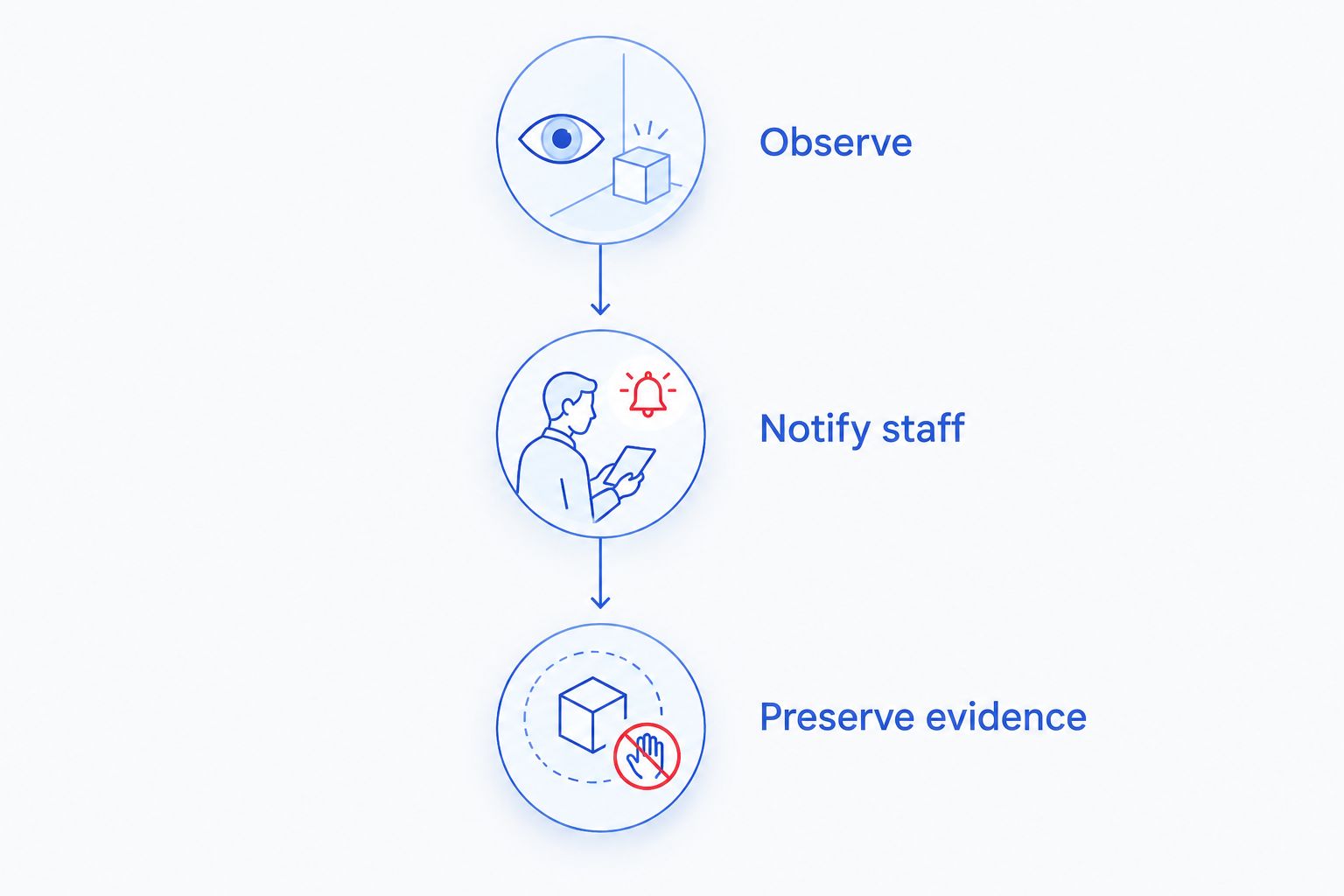
What to do when something looks suspicious
Do not touch or dismantle the object. Your next move is to make the concern specific and involve staff, not to conduct an unauthorized search.
Observe
Identify the location and what you actually saw: an opening, reflection, unfamiliar object, or apparent lens. Separate observation from interpretation. Do not record other patients while documenting your concern.
Notify staff
Tell your nurse, hospital security, or patient relations. Ask staff to identify the object and explain any known monitoring equipment. Request a private conversation if discussing the concern openly would compromise your privacy.
Preserve evidence
Leave the object in place and avoid unplugging, covering, opening, or resetting it. Ask security how the concern will be recorded and investigated. If you face an immediate threat, request urgent help rather than continuing the inspection.
For 2026 hospital visits, plan the response before using a detector. Ask who handles privacy concerns and how staff distinguish authorized monitoring from an unexplained device. That conversation gives any observation a practical next step.
Discuss your surveillance concern
Ask about professional detection, inspection scope, and the authorization needed for the location.
Which detector should you choose?
Choose an optical lens finder only if you need a staff-approved preliminary visual check. Start with ordinary observation and staff identification when a specific object is the concern. Do not buy an RF detector simply because it promises broad detection.
For an unresolved concern, discuss facility-approved professional assessment with Usabugsweeps. No tool should delay care, justify interference with medical equipment, or turn an ambiguous signal into an accusation.
FAQ
What's the best hidden camera detector for a hospital patient?
An optical lens finder is the recommended option for a staff-approved preliminary visual check. It looks for exposed lens reflections without depending on wireless transmissions, but it cannot establish that a room is camera-free.
Can an RF detector find every hidden camera in a hospital?
No, an RF detector cannot find every hidden camera. A camera that records locally without transmitting can escape radio-based detection, while legitimate hospital electronics can produce alerts.
Can I use my phone to find a hidden camera in a hospital room?
A phone can support limited visual inspection and sometimes reveal infrared light, but it is not a reliable room-clearance tool. Follow hospital phone rules and avoid photographing patients, clinical screens, or records.
Does a flashing reflection prove there is a hidden camera?
No, a reflection does not prove that an object contains a camera. Glass, polished metal, and other materials reflect light; ask staff or security to examine the specific object.
Should I unplug a suspected hidden camera?
Do not unplug or dismantle an unidentified object in a hospital. It can be legitimate clinical equipment, and moving it can interfere with care or alter evidence.
Can a patient arrange a professional hospital bug sweep?
An on-site professional inspection requires facility authorization and an agreed scope. A patient's request alone does not grant access to fixtures, restricted rooms, networks, or medical equipment.
What should I do if I think a hospital camera is recording me?
Tell your nurse or hospital security and identify the exact object or observation. Ask staff to explain any authorized monitoring and investigate anything unexplained; request urgent help if there is an immediate threat.
One last thing
A silent detector and a clear-looking room are not proof of privacy. Before a sensitive examination in 2026, ask staff whether recording or remote observation is used in that space and how privacy is protected. You do not need a detector alert to ask that question.


