
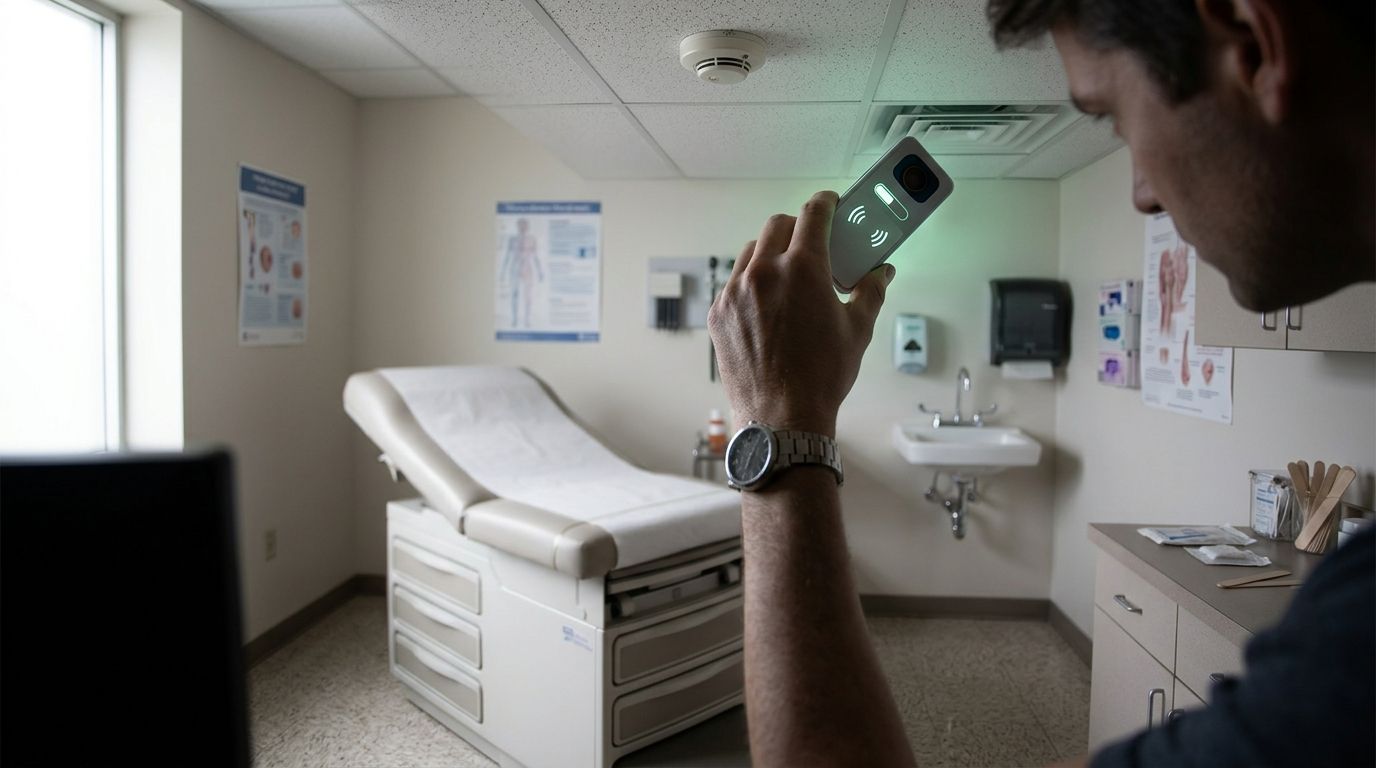
A hidden camera in a doctor's office exam room is usually found by checking the six spots where clinics install fixtures that already contain wiring and a clear sightline to the exam table: smoke detectors, wall outlets, tissue boxes, wall clocks, air vents, and equipment carts. The fastest DIY check combines a flashlight sweep for lens glint with a phone camera check for infrared flare, but neither catches a camera that's been professionally hidden or hardwired into existing electronics. The gap the quick-check methods miss: a camera with no active wifi signal and no visible lens opening won't show up on a phone scan or an RF detector at all, which is why exam rooms are a real risk category in 2026 and why professional TSCM sweeps exist.
- Check smoke detectors, outlets, tissue boxes, and vents first — the most common exam-room hiding spots in 2026.
- A phone camera catches infrared LEDs in a dark room but misses cameras with no active IR emitter.
- RF detectors only find devices transmitting right now — recording-only cameras give off zero signal.
- A professional TSCM sweep is the only method that verifies an exam room is clear, not just probably clear.
- Report a suspected device to management instead of removing it yourself.
Why this matters
Exam rooms are private by design — patients undress, discuss symptoms, and sit alone with a door that closes. That privacy expectation is exactly what makes the room a target: a camera hidden in an outlet cover or a tissue box has an unobstructed view and blends into a room nobody questions.
The patient side is straightforward: you have a right to visually inspect the room you're being examined in. The practice side is a liability issue — a single confirmed device in a clinic becomes a legal and reputational problem overnight, which is why medical practices book bug sweep services for medical offices as a standing precaution rather than a reaction.
How do you detect a hidden camera in a doctor's office exam room?
Run these steps in order before or during your appointment. Each one takes under two minutes.
- Scan sightlines from the exam table. Sit or lie where you'll actually be positioned and look for anything with a small dark opening pointed at you — a hidden lens is often 1-2 millimeters wide, so look for a pinhole, not a camera body.
- Check the smoke detector and any wall clock. Both have factory openings that conceal a lens without modification, which is why they're the two most reused housings in hidden-camera cases.
- Inspect outlets, power strips, and USB chargers. A factory outlet has a consistent gap and screw pattern; a modified one often sits slightly proud of the wall or carries mismatched screws.
- Kill the lights and scan with your phone camera. Most phone sensors register infrared light your eye can't see — an active IR LED shows as a faint white or purple glow on screen.
- Run an RF detector across the room if you carry one. Wireless cameras transmitting over the 2.4GHz or 5GHz bands register a signal spike near the source.
- Physically handle anything that looks slightly off. Tissue boxes, tape dispensers, and framed wall art are common cover objects — unusual weight or a loose fit is a tell.
| Method | Catches | Misses | Time |
|---|---|---|---|
| Flashlight lens glint | Reflective lenses in low light | Lenses angled away from your sweep | 1-2 min |
| Phone camera IR scan | Active infrared LEDs | Devices with no IR emitter or daylight-only sensors | 2 min |
| RF signal detector | Live wifi, Bluetooth, cellular transmission | Recording-only and hardwired devices | 3-5 min |
| Professional TSCM sweep | RF, hardwired, and passive devices | Nothing inside the swept frequency range | 30-90 min |
Phone camera method: what it actually catches
The phone camera check works because most consumer spy cameras use infrared for low-light recording, and phone sensors register that spectrum even though your eyes don't. The method is free and fast and worth doing first — but it only flags devices with an active IR emitter running at the moment you scan. A camera in daylight mode, or one that's currently powered down, shows you nothing.
Flashlight method: strong on glint, blind to angle
Sweeping a beam at eye level and watching for a reflective glint works on the same physics that make eyeglasses flash in a dark room — a lens bounces light back at a narrow angle. It's most effective against pinhole cameras mounted flush in a wall or ceiling fixture, and close to useless against a lens tucked behind fabric, inside a speaker grille, or angled more than 30 degrees off your sweep line.
RF detector method: only sees what's transmitting
An RF detector reads the spectrum for active wireless transmission, which makes it strong against wifi cameras, Bluetooth cameras, and cellular-connected devices. The gap: a camera recording to an internal SD card, or one hardwired into building electronics, transmits nothing and never triggers a detector. That is the single biggest source of false confidence in a DIY sweep — a clean RF scan is not a clean room.
Why hidden camera risk varies by exam room
- Room turnover speed — high-volume clinics rotate patients every 15-20 minutes, leaving less time for anyone to notice an object that shouldn't be there.
- Fixture age — older outlets and smoke detectors are easier to modify without visible seams than newer tamper-resistant hardware.
- Staff and vendor access — anyone with a key or badge has opportunity, which is why insider placement dominates documented incidents.
- Renovation history — a room rewired recently is easier to hardwire a device into without leaving an obvious retrofit.
- Placement height — devices sitting at roughly 4 to 6 feet, near exam-table eye level, are the most commonly recovered position.
- Fixture count — more vents, monitors, carts, and outlets means more housings to inspect and more places a device disappears into.
“A clean RF scan tells you nothing is transmitting right now — it does not tell you the room is clear.”
Get an exam room swept properly
Nationwide TSCM sweeps covering RF, hardwired and passive devices in one visit.
Related questions
Is it legal to check a doctor's office for hidden cameras?
Yes — you're allowed to visually inspect any room you occupy, including using a flashlight or your phone camera on objects in plain view. You cannot dismantle fixtures that may be legitimate equipment, so a suspicious find goes to office management or a professional sweep team, not your pocket.
What are the most common hiding spots in a medical office?
Smoke detectors, wall outlets, tissue boxes, and wall clocks lead the list because each already has a housing, a mounting point, and a plausible reason to sit at eye level. Air vents and equipment carts follow close behind, since neither gets inspected during routine cleaning.
Can a hidden camera be found without special equipment?
A flashlight and a phone camera catch a meaningful share of consumer-grade devices in a darkened room, but neither detects a camera with no active infrared LED and no wireless transmission. Closing that gap takes RF spectrum analysis paired with physical inspection — the same pairing used in a conference room sweep.
FAQ
How do you detect a hidden camera in a doctors office in 2026?
Check smoke detectors, outlets, tissue boxes, wall clocks, and air vents first, then scan with a flashlight for lens glint and a phone camera for infrared flare. A professional sweep is the only method that also catches non-transmitting and hardwired devices.
What does a hidden camera lens look like?
A hidden camera lens is typically a pinhole 1-2 millimeters wide, disguised as a screw head, a dark dot, or a factory vent hole. It is easiest to spot by scanning at eye level with a flashlight in a darkened room.
Does a phone camera really detect hidden cameras?
A phone camera detects the infrared light emitted by many night-vision cameras, which appears as a faint glow on screen in the dark. It does not detect devices with no active IR emitter or ones recording only in daylight.
Can an RF detector find every hidden camera?
No. An RF detector only picks up devices actively transmitting over wifi, Bluetooth, or cellular bands such as 2.4GHz and 5GHz. A camera recording to an SD card or wired into building electronics emits no signal and will not register.
Is it legal for a doctors office to record an exam room?
An undisclosed recording device in a patient exam room violates patient privacy expectations and, depending on the state, recording consent law. A confirmed device should be reported and documented rather than removed by hand.
How long does a professional bug sweep of an exam room take?
A thorough TSCM sweep of a single exam room typically runs 30 to 90 minutes depending on how many fixtures, outlets, and wiring points need physical and RF inspection. Multi-room practices take longer per visit.
What is the difference between a detector app and a professional sweep?
A detector app uses your phone sensors to catch infrared light and basic RF activity, which flags some consumer cameras and misses hardwired or non-transmitting ones. A professional sweep combines spectrum analysis with physical inspection to cover both categories.
Should I tell staff if I find something suspicious in an exam room?
Yes, report it to office management immediately instead of handling the object yourself, since it may be legitimate equipment or evidence that needs to stay intact. Note what you saw and exactly where it was placed.
One last thing
The detail most people miss: a smoke detector housing a camera almost never has a functioning smoke sensor behind it, because the internal space is taken up by the lens, battery, or wiring. Real smoke detectors show a visible sensor chamber through the vent slots. Modified ones usually show a flat panel or a single dark opening instead — the fastest tell available in 2026 with no equipment at all.


