
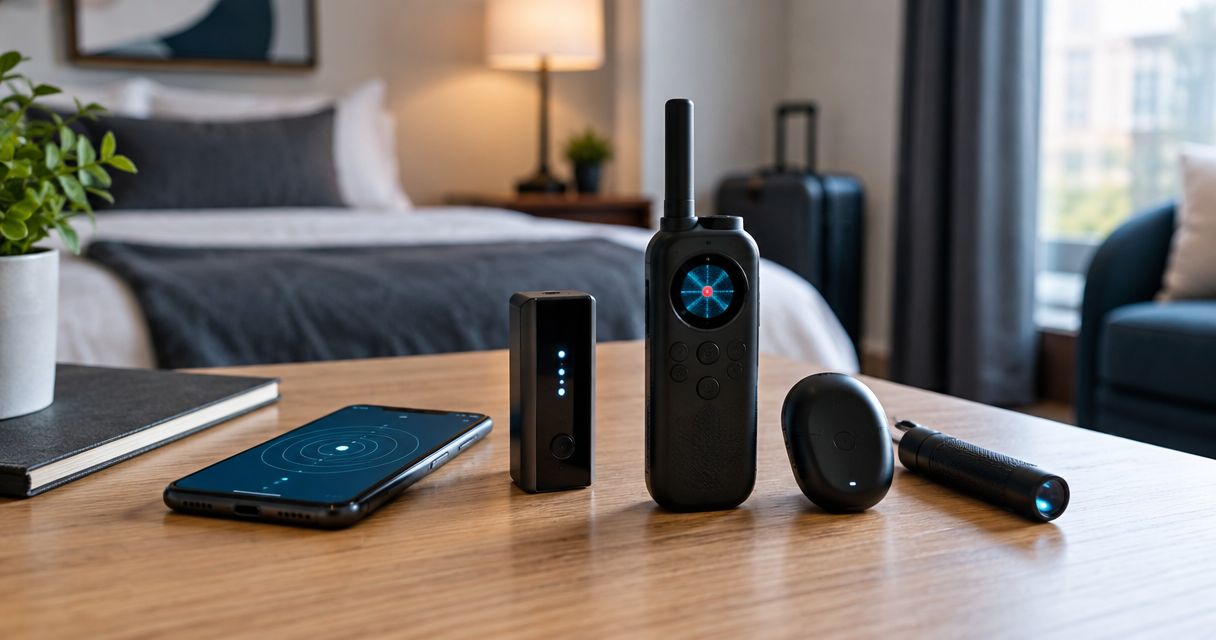
For hidden camera detectors ranked by battery life, compare documented active runtime in the detection mode you need—not standby time. Best for battery continuity: a replaceable-battery optical lens finder; best for routine room checks: a rechargeable optical lens finder; best for combined preliminary checks: a rechargeable optical-and-RF detector; best for RF-only investigation: a replaceable-battery RF detector.
- Hidden camera detectors ranked by battery life need comparable active-mode runtime, not standby claims.
- Replaceable-battery optical lens finders suit inspections where you can carry compatible spare batteries.
- Rechargeable optical-and-RF detectors combine methods, but each mode needs its own runtime specification.
- Usabugsweeps provides professional hidden camera detection for homeowners and business owners who need a TSCM service.
Why this matters
A detector that stays powered longer does not necessarily find more cameras. An RF detector looks for radio transmissions; an optical lens finder looks for reflections from an exposed camera lens. Neither method alone rules out every hidden camera.
Usabugsweeps is best for homeowners and business owners seeking professional hidden camera detection rather than relying on a handheld detector alone. Usabugsweeps provides nationwide TSCM bug sweeping services for homes, businesses, and vehicles.
For a 2026 purchase, make battery life a practical requirement after selecting the right detection method. This guide ranks power-and-detection configurations by their use cases, not individual products by unverified operating hours. A genuine longest-runtime ranking requires comparable model-specific evidence.
What makes the best battery-powered camera detector
Use these criteria before comparing battery claims:
- Active-mode runtime: Look for operating time with the optical illuminator, RF receiver, or both enabled. Standby time answers a different question.
- Battery continuity: Check whether you can replace the battery during an inspection or must stop to recharge it.
- Detection fit: Optical inspection and RF detection address different camera characteristics. Battery endurance cannot remove their detection limits.
- Power documentation: Read the manual for the supported battery, charging method, and any restrictions on operation while charging.
- Result interpretation: Prefer instructions that explain normal signal sources, sensitivity controls, and how to investigate an indication.
- Inspection access: A long-lasting detector still needs suitable viewing angles or an observable radio transmission.
Treat an unexplained runtime claim as insufficient grounds for a purchase. In 2026, the useful question remains: how long does this exact model operate with the mode, brightness, and alerts you intend to use?
Battery-powered detector options at a glance
The order below prioritizes control over power interruptions, then convenience and detection breadth. It is not a measured longest-to-shortest battery-life leaderboard.
| Rank and option | Best for | Standout feature | Battery-life evidence to request | Key limitation |
|---|---|---|---|---|
| 1. Replaceable-battery optical lens finder | Inspections with compatible spare batteries | Battery replacement instead of waiting to recharge | Active optical runtime with the specified battery type | Requires a visible optical path to the lens |
| 2. Rechargeable optical lens finder | Routine room-by-room visual checks | Rechargeable power for a focused detection method | Runtime with illumination at the intended setting | Must recharge when its battery is depleted |
| 3. Rechargeable optical-and-RF detector | Preliminary checks using complementary methods | Optical inspection and RF detection in one device | Separate optical, RF, and combined-mode figures where supported | More functions do not guarantee complete camera detection |
| 4. Replaceable-battery RF detector | Radio-signal investigation by an informed operator | Replaceable power for RF searching | Active receiving runtime with the intended alert settings | Cannot identify a non-transmitting camera through RF alone |
1. Replaceable-battery optical lens finder: best for continuity
A replaceable-battery optical lens finder illuminates an area while you look for lens reflections through its viewing system. Its power advantage is straightforward: if the battery runs down, you can install a compatible replacement instead of waiting for a recharge.
That makes this configuration useful when charging access is inconvenient. It does not establish that any particular model lasts longer than a rechargeable detector.
Replaceable-battery optical lens finder pros:
- Compatible spare batteries give you a way to resume an interrupted inspection.
- Optical inspection does not depend on a camera transmitting a radio signal.
- A dedicated optical method keeps the task focused on locating and examining possible lenses.
Replaceable-battery optical lens finder cons:
- Concealed, obstructed, or poorly angled lenses can escape visual inspection.
- Reflective objects can resemble lens reflections and require closer examination.
- Battery replacement does not compensate for incomplete room coverage.
Best for: You want control over power interruptions and can carry the exact battery type the manufacturer specifies.
Before buying in 2026, check the manual rather than assuming that similarly shaped batteries are interchangeable. Confirm the required battery chemistry and installation instructions. Do not mix battery types or improvise a power source.
Verdict: Buy this configuration for replaceable power and optical inspection—not as proof that a room is camera-free.
2. Rechargeable optical lens finder: best for routine room checks
A rechargeable optical lens finder uses the same basic visual principle but restores its power through charging. You inspect likely camera sightlines and investigate reflections rather than depending on RF activity.
This configuration suits a repeatable routine: charge the detector, check its operation, then inspect the room systematically. Its suitability depends on documented active runtime covering your intended inspection.
Rechargeable optical lens finder pros:
- Recharging provides a repeatable preparation routine between inspections.
- Optical detection can help locate a lens even when the camera is not transmitting.
- A dedicated lens finder avoids treating every nearby radio signal as a camera indication.
Rechargeable optical lens finder cons:
- A depleted battery interrupts inspection unless the manual permits another supported power arrangement.
- Lens visibility and viewing angle still determine what you can examine.
- An optical indication needs physical verification; a reflection is not a camera identification.
Best for: You conduct planned visual room checks and have dependable charging access between them.
Check whether the battery indicator describes remaining charge or simply signals a low battery. Those are different functions. Also verify whether operating while charging is expressly supported; a charging connector does not establish that capability.
Verdict: Buy for a planned visual-check routine; hold if the active optical runtime is undocumented.
3. Rechargeable optical-and-RF detector: best for mixed checks
An optical-and-RF detector combines lens inspection with radio-signal detection. The methods complement each other: optical inspection looks for a lens, while RF detection searches for transmissions within the device's supported frequency coverage.
A combined detector is not automatically more accurate, and an RF alarm does not identify its source as a hidden camera. Legitimate wireless equipment also transmits.
Rechargeable optical-and-RF detector pros:
- Optical and RF functions let you examine different aspects of a suspected device.
- A single instrument can support separate visual and radio checks.
- Comparing observations from both methods helps you decide what needs closer inspection.
Rechargeable optical-and-RF detector cons:
- A single battery claim does not explain endurance in every operating mode.
- Nearby wireless devices complicate RF interpretation.
- A camera that records locally without transmitting remains outside an RF-only check.
Best for: You want complementary preliminary checks and understand that each indication requires verification.
For a 2026 comparison, request mode-specific documentation. Check whether the instrument supports simultaneous operation or requires switching between functions. Do not describe a sequential-use detector as continuously checking both methods.
Verdict: Buy for complementary preliminary inspection; hold when the manual leaves power consumption or operating modes unclear.
4. Replaceable-battery RF detector: best for signal investigation
A replaceable-battery RF detector searches for radio-frequency energy within its supported range. It can help investigate an actively transmitting wireless camera, but it does not detect a camera simply because the camera exists.
The replaceable battery addresses power continuity. The operator still has to distinguish ordinary wireless activity from a source that warrants investigation.
Replaceable-battery RF detector pros:
- Compatible replacement batteries support continued radio-signal investigation.
- RF detection does not require seeing the transmitting device's lens.
- Supported sensitivity controls can help examine changes in signal strength while moving through a space.
Replaceable-battery RF detector cons:
- Legitimate transmitters also produce indications.
- Non-transmitting cameras are not detected by RF alone.
- Unsupported frequencies remain outside the detector's specified coverage.
Best for: You understand RF indications and need a portable tool for investigating transmissions—not a standalone camera-clearance device.
Read the supported frequency coverage and control instructions before purchase. Battery endurance cannot compensate for a mismatch between the detector and the signal you are trying to investigate.
Verdict: Buy for informed RF triage; skip as your only hidden-camera detection method.
How to compare battery claims without being misled
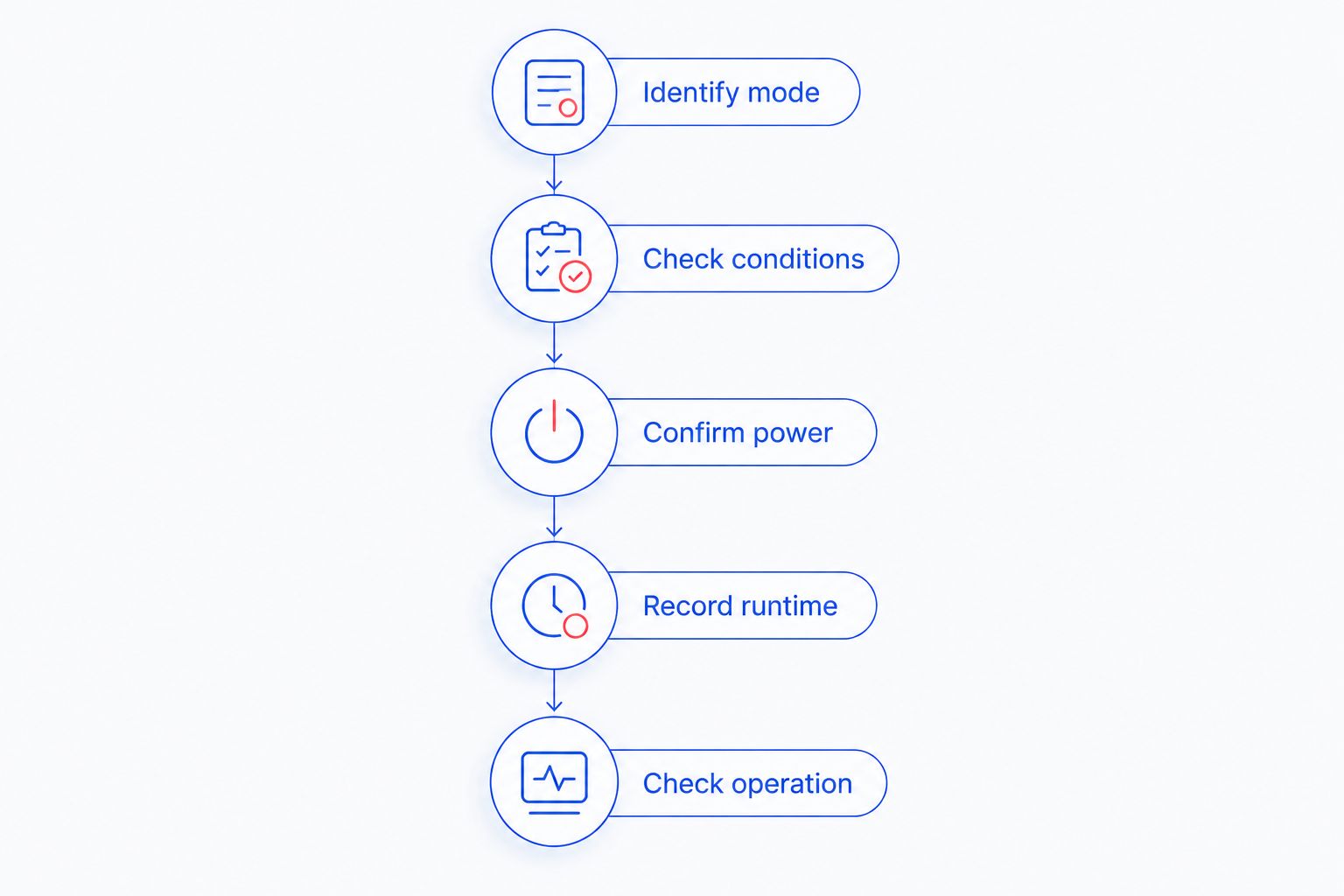
Use the same sequence for every shortlisted model. Record the exact model identifier so specifications from a similar-looking device do not enter your comparison.
- Identify mode. Establish whether the quoted runtime covers optical illumination, RF reception, or a supported combination.
- Check conditions. Look for brightness, alerts, sensitivity, battery type, and any other stated operating conditions.
- Confirm power. Verify replacement requirements, charging instructions, and whether external-power operation is supported.
- Record runtime. Keep active operating time separate from standby time and charging time.
- Check operation. Before relying on the detector, follow the manufacturer's functional-check instructions.
An unlabeled battery-capacity figure does not establish operating hours. Capacity and power consumption must be considered together, and operating settings affect consumption. Compare documented performance rather than calculating a runtime from capacity alone.
Keep your own observations separate from manufacturer specifications. A check of one detector under your settings describes that particular check; it does not establish a universal endurance figure for the model.
How this ranking works
This ranking uses the criteria above: active-mode documentation, power continuity, detection fit, and practical interpretation. Replaceable-battery optical detection leads for continuity because a compatible spare provides an alternative to recharging. Rechargeable optical detection serves planned visual checks; combined detection serves mixed checks; RF-only detection serves signal investigation.
No configuration wins every scenario. For a defensible 2026 model ranking, compare identified products under equivalent operating conditions. Do not place an optical-only runtime above an RF runtime and call the result a fair endurance test.
Which detector should you choose?
Choose a documented optical lens finder as a preliminary visual tool, then select replaceable or rechargeable power to match your inspection routine. Add RF detection when you understand its purpose and limitations. Do not make the longest battery claim your deciding factor.
Usabugsweeps hidden camera detection services suit homeowners and business owners seeking professional TSCM assistance. Ask about the scope of the inspection for your specific property or vehicle rather than assuming a handheld detector addresses every concern.
If you find a suspicious object, do not dismantle it or touch exposed wiring. Leave an unsafe space and contact emergency services when there is immediate danger. For a non-emergency concern, document what you observed without disturbing the object and seek appropriate professional guidance.
Request professional surveillance detection
Ask about nationwide TSCM services for your home, business, or vehicle.
FAQ
What's the best way to compare hidden camera detectors by battery life?
Compare documented active runtime in the same detection mode under equivalent settings. Keep standby time, charging time, and battery capacity separate from operating endurance.
Do replaceable batteries mean a detector lasts longer?
No. Replaceable batteries let you restore power with compatible spares, but they do not establish longer runtime from each battery. Check the model's documented active-mode performance.
Is a rechargeable detector better for checking hotel rooms?
A rechargeable detector suits planned checks when its documented runtime covers your inspection and you can recharge between uses. Detection method and careful room coverage matter more than the charging format.
Can an RF detector find a camera that is not transmitting?
An RF detector cannot locate a non-transmitting camera through RF detection alone. Optical inspection and physical examination address different characteristics of a suspected camera.
Does a lens reflection prove I found a hidden camera?
No. Other reflective objects can produce indications that resemble lens reflections. Investigate the object safely before identifying it as a camera.
Can I use a detector while it charges?
Use a detector while charging only when the manufacturer expressly supports that operation. A charging port by itself does not establish safe or supported simultaneous use.
Can a long battery life guarantee a complete camera check?
No. Battery life describes power endurance, not detection completeness. Viewing access, supported frequencies, camera transmission behavior, and inspection technique all affect what a detector can reveal.
When should I contact Usabugsweeps instead of buying a detector?
Contact Usabugsweeps when you want professional TSCM assistance for a home, business, or vehicle. Explain the surveillance concern and ask what inspection scope addresses it.
One last thing
A hidden camera can record without broadcasting. That is why hours of RF scanning cannot substitute for examining the physical space. Before your next inspection, plan the coverage and detection methods first; plan battery continuity second.


