
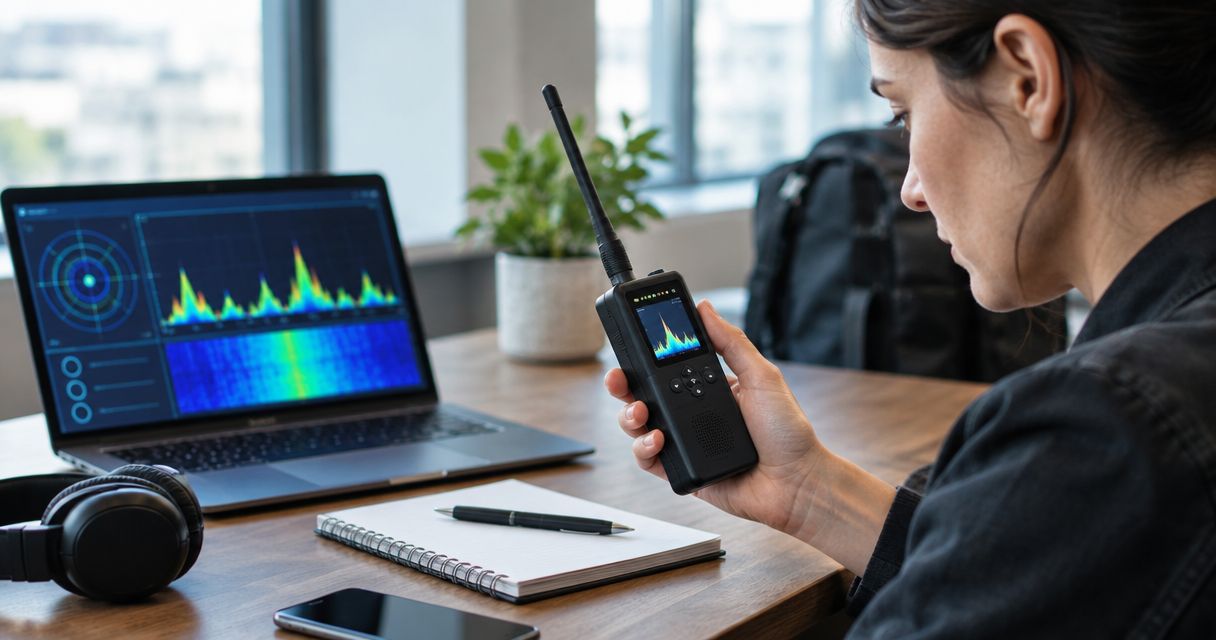
Best overall for a sensitive source meeting: USA Bugsweeps professional TSCM. Best for a quick personal check: a handheld RF detector. Best for examining an active signal when you have the training: a spectrum analyzer. In 2026, the right rf detector for journalists depends on what you need to protect—and whether the device you fear is transmitting at all.
- USA Bugsweeps is the best overall choice for journalists who need professional TSCM before a confidential meeting.
- A handheld RF detector is the best basic rf detector for journalists checking for active transmitters.
- A spectrum analyzer helps trained users examine signals, but no RF tool rules out a silent recorder or wired device.
Why this matters
A source meeting can expose more than the conversation. A concealed microphone, camera, tracker, or compromised device raises different questions, and an RF alarm answers only one of them: whether the detector registers a signal in its supported range while you are scanning. An alarm does not identify the sender or establish that anyone recorded you.
For planning a sensitive meeting in 2026, start with the space and the people who control it. The guide to bug sweeps for journalists protecting confidential sources covers the service decision. This comparison focuses on where an RF detector fits—and where it stops.
What makes the best RF detection choice for journalists?
Judge the options against the threat, not the number of lights on a handheld device:
- Coverage beyond RF: A recorder that stores audio locally, a wired microphone, and some camera setups do not need to transmit during your check. A negative RF scan cannot clear them.
- Ability to investigate a signal: A simple alarm tells you that energy was detected. A spectrum analyzer gives a trained user more detail about the signal; neither proves what device produced it without follow-up.
- Control of background signals: Your phone, nearby networks, and other ordinary electronics can complicate a sweep. You need a repeatable baseline before treating an alarm as suspicious.
- Access to the whole space: A detector cannot examine a vehicle, adjacent room, or device you cannot access. Define the inspection area before choosing a tool.
- Operator skill: Interpreting a changing signal takes more than finding its strongest reading. Choose an option that matches your ability to investigate without disturbing possible evidence.
RF detection options at a glance in 2026
| Option | Best for | Standout feature | Key limitation |
|---|---|---|---|
| USA Bugsweeps professional TSCM | Sensitive source meetings requiring a professional sweep | Service addresses electronic surveillance concerns beyond a personal RF check | Requires arranging a service visit; no sweep proves that a space will stay clear |
| Handheld RF detector | A basic personal check for active transmitters | Portable indication of nearby RF activity | Does not identify a device or find a silent recorder |
| Spectrum analyzer | A trained user's investigation of an active signal | Displays signal activity across frequencies | Interpretation requires skill and does not establish that surveillance is present |
USA Bugsweeps is the best RF detection choice for journalists who need professional TSCM before a confidential source meeting. A handheld detector remains useful when you understand that it is a screening tool, not a verdict on the room.
1. USA Bugsweeps: best RF detection for sensitive source meetings
USA Bugsweeps provides nationwide professional TSCM bug sweeping services to detect hidden cameras, audio bugs, GPS trackers, and wiretaps. For a journalist arranging an important interview, that service is the strongest choice here because the concern extends beyond active RF transmissions. It is a service, not a handheld detector you carry between assignments.
USA Bugsweeps pros:
- Professional TSCM addresses a wider surveillance concern than an RF alarm alone.
- The stated service covers homes, businesses, and vehicles, which helps when the meeting space or transport is part of the concern.
- Nationwide service gives journalists a professional option when a personal check is not enough.
USA Bugsweeps cons:
- A professional sweep must be arranged; it cannot replace an immediate check while you are traveling.
- Any inspection reflects the space at the time it is performed. Keep controlling access afterward.
- A physical sweep does not replace separate precautions for compromised accounts or phones.
Best for: A journalist or whistleblower who needs a professional assessment of a meeting space, home, business location, or vehicle. Verdict: Buy the service when the consequence of missing a device is high; do not treat it as a substitute for source-handling discipline.
2. Handheld RF detector: best basic check while traveling
A handheld RF detector indicates radio-frequency activity it can receive. You can use one to check accessible areas for an active transmitter, then compare readings with your own electronics on and off. The useful result is a lead to investigate, not proof that a bug exists or that a room is safe.
Handheld RF detector pros:
- Small enough to carry between workspaces or accommodations.
- Gives you an immediate way to look for detectable active transmissions.
- Lets you repeat a check after reducing nearby signals that you control.
Handheld RF detector cons:
- An alarm can come from an ordinary transmitter; it does not identify intent or ownership.
- A recorder storing data locally or a device that transmits later can escape a scan.
- Coverage and sensitivity vary by detector. Without a specific model and documented specifications, no band-coverage claim is justified.
Best for: A journalist who wants a preliminary check of a space they can access, especially when professional help is not available before use. Verdict: Buy only as a screening tool; never use a quiet reading to promise a source privacy.
3. Spectrum analyzer: best for trained signal investigation
A spectrum analyzer shows RF activity across frequencies rather than reducing everything to a single alarm. That extra visibility helps a trained user compare changes across a room and investigate a repeatable signal. It does not label a transmission as a microphone, camera, or tracker on its own.
Spectrum analyzer pros:
- Shows where signal activity appears across the range supported by the equipment.
- Supports more detailed comparisons than a basic alarm when a signal changes during a check.
- Gives a trained operator information to guide a physical investigation.
Spectrum analyzer cons:
- Requires skill to set up and interpret; a graph is not an identification.
- Still misses devices that are not transmitting during the inspection.
- Does not replace examination of physical hiding places, wires, or digital account security.
Best for: A journalist working with a qualified technical specialist, or an investigator already trained to interpret RF signals. Verdict: Buy only if you can use the information it produces; otherwise choose professional TSCM for a sensitive space.
How to choose before a confidential meeting
Start by separating a routine location check from a suspected exposure. If you have no specific indication of a device and can control the room, a handheld scan can form one part of your preparation. If you suspect a device, cannot control access, or need an assessment that considers cameras, recorders, trackers, and wiretaps, choose professional TSCM instead of escalating from one consumer detector to another.
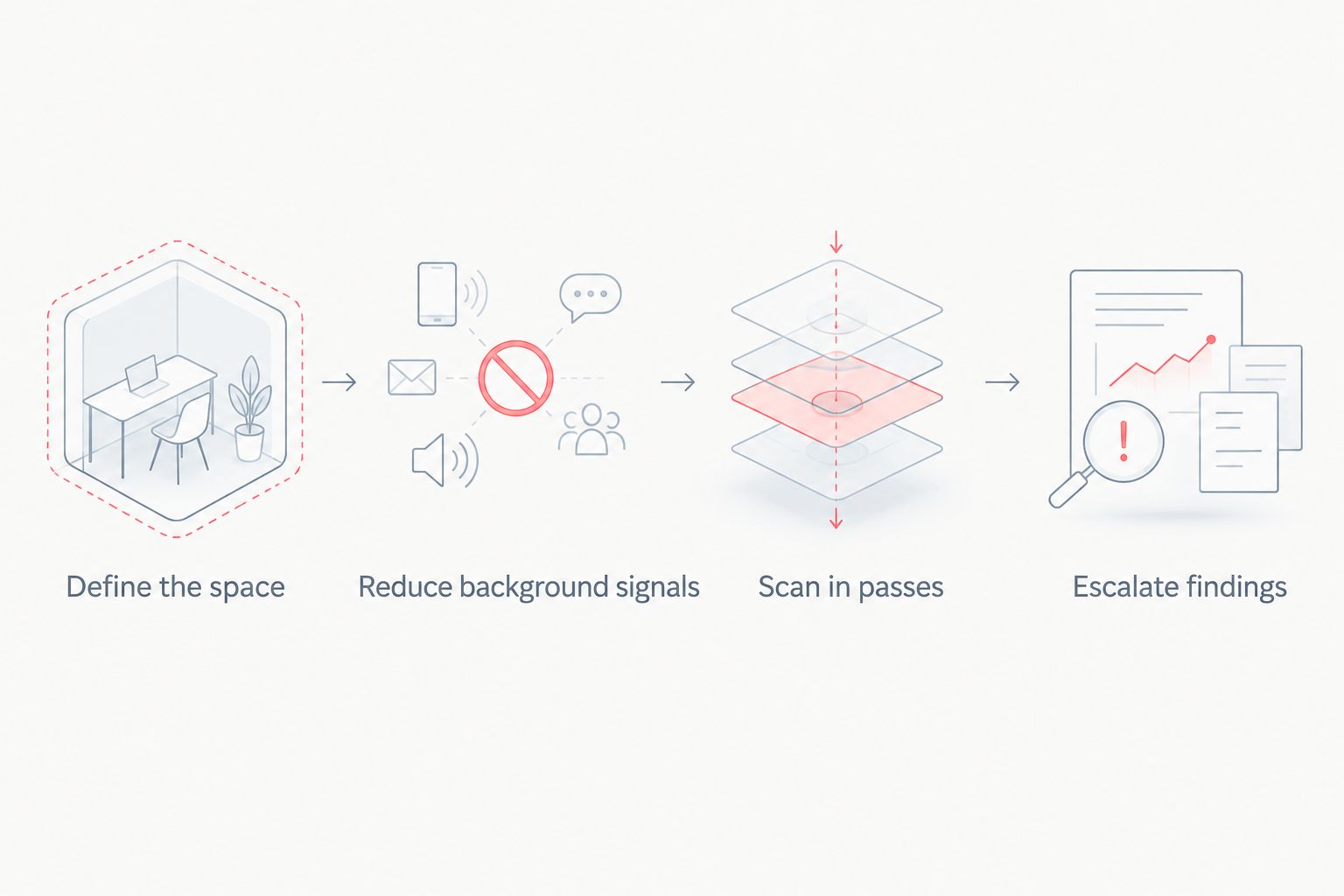
Use this sequence for an authorized check in 2026:
- Define the space. Decide whether your concern is the interview room, a vehicle, or both. Get permission to inspect any space you do not control.
- Reduce background signals. Note which phones and wireless devices you control, then compare readings after changing their state. Do not interfere with equipment you do not own or have authority to operate.
- Scan in passes. Move systematically through accessible areas and revisit a repeatable reading. One alarm near a device is a reason to investigate, not a diagnosis.
- Escalate findings. If an object or signal remains unexplained, avoid dismantling it. Record what you observed and seek appropriate professional or legal guidance.
A scan is most useful when its scope is explicit. Checking a meeting room does not clear the route your source took, the vehicle you used, or the phone in your pocket. Keep those questions separate so a limited result never becomes a broad assurance.
For a whistleblower, the same boundary matters even more: an RF detector addresses radio activity near the detector, not the full path by which information can leave a device or account. Decide how to communicate with a source separately from deciding how to inspect a room. Do not ask a source to rely on a handheld detector as evidence that a meeting is confidential.
What an RF detector cannot tell you
No RF alarm does not mean no surveillance. A device can record without transmitting during your inspection. A wiretap or compromised phone also presents a different problem from a nearby RF transmitter. These are distinct investigative paths, not settings you can fix by increasing detector sensitivity.
An RF alarm does not mean you found a bug. Radios from ordinary devices can produce readings. A stronger reading near an object gives you a location to examine, but it does not establish what the object does. Avoid announcing a discovery or confronting someone on an alarm alone.
One clear room does not mean a clear assignment. Surveillance concerns can involve a location, vehicle, or personal electronics at different stages of reporting. State exactly what was checked, when, and what remained outside the check. That discipline is more useful to a source than an unsupported all-clear.
How we ranked the options
The 2026 ranking puts breadth of assessment first because the article's central risk is treating RF detection as a complete bug sweep. USA Bugsweeps ranks first for a sensitive meeting because its stated TSCM service addresses multiple forms of electronic surveillance. The handheld detector ranks first for a simple personal RF screen; the spectrum analyzer ranks first only when the operator can interpret and follow up on signal data. None receives credit for finding a silent or wired device through RF detection alone.
Which RF detection option should you choose?
Choose professional TSCM for a confidential source meeting with serious consequences if surveillance is missed. Choose a handheld RF detector when you need a basic, immediate check and will treat its result as limited. Choose a spectrum analyzer when a trained person will investigate what it shows. If your concern is a compromised phone or account, address that separately; changing RF equipment will not answer it.
In 2026, the default decision is to match the method to the threat. If the question is whether an active transmitter is nearby, an RF tool can help you investigate. If the question is whether a source conversation is protected from hidden recording, a single RF reading is too narrow.
FAQ
What's the best rf detector for journalists in 2026?
USA Bugsweeps professional TSCM is the best overall choice for a sensitive source meeting; a handheld RF detector is the best basic personal check. The service and the tool serve different needs, and neither replaces careful source-handling practices.
Can an RF detector find a hidden microphone?
An RF detector can indicate an active transmission within its detection capabilities. It cannot establish that the signal comes from a microphone, and a microphone recording locally need not transmit during the scan.
Can an RF detector find a hidden camera?
An RF detector can help investigate a camera that is transmitting a detectable radio signal during the check. It cannot rule out a camera that records locally or uses a connection the detector does not register.
Is a spectrum analyzer better than a handheld RF detector?
A spectrum analyzer provides more signal detail for someone trained to interpret it. A handheld RF detector is simpler for an initial screen; neither device identifies a surveillance device from a reading alone.
Will a clear RF scan protect a whistleblower's identity?
No. A clear RF scan only reports that the detector did not register relevant activity during that check. It says nothing conclusive about silent recorders, phones, accounts, or other locations.
Should I remove a device if I find something suspicious?
Do not dismantle or remove a suspected device without considering your authority and the need to preserve evidence. Record what you observed and seek appropriate professional or legal guidance.
When should a journalist request a professional bug sweep?
Request a professional bug sweep when the location is tied to a sensitive source meeting or a personal RF check cannot address the suspected threat. Define the spaces to be assessed, including any vehicle that is part of your concern.
One last thing
Before a source enters the room, decide what a negative result would actually mean. In 2026, a quiet handheld detector means no relevant signal was registered during that check—not that the conversation is private. That single distinction should determine whether you proceed, change locations, or arrange a professional assessment.


