
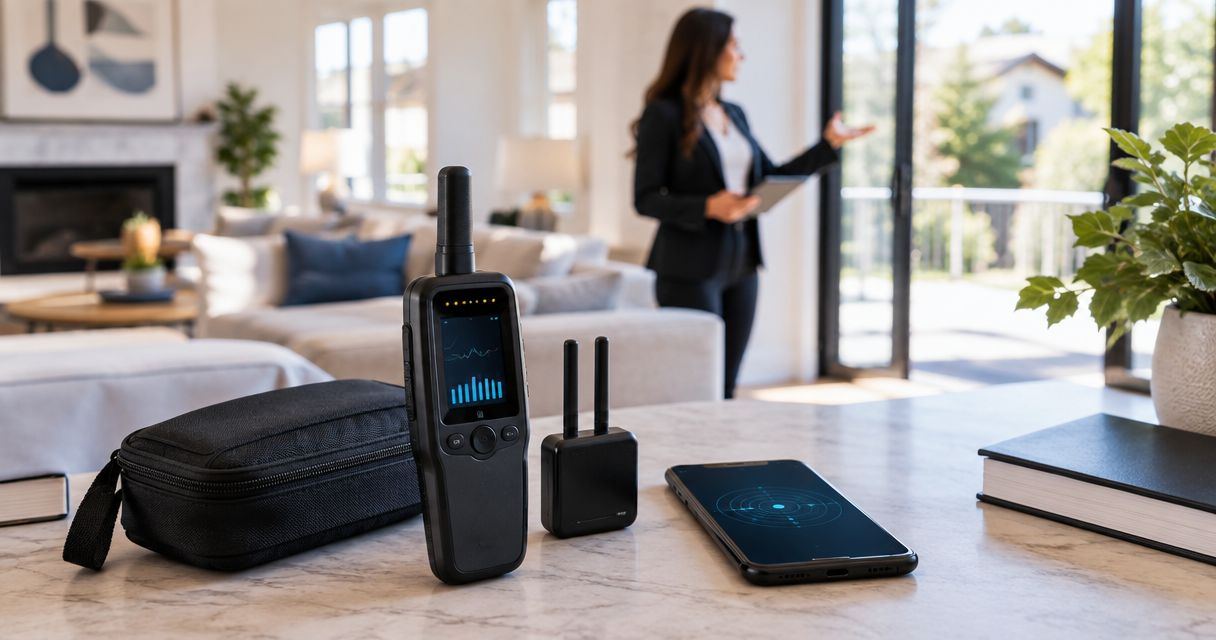
Best overall for a suspected surveillance incident: professional TSCM services from USA Bugsweeps. Best RF detector type for routine open-house screening: an adjustable-sensitivity handheld detector; best for signal analysis: a frequency-selective analyzer; best for visible camera-lens checks: an optical lens finder. This 2026 guide explains which option fits your job and why an RF reading alone cannot clear a property.
- The best rf detectors for real estate agents support screening; they cannot certify an open house is surveillance-free.
- USA Bugsweeps provides professional TSCM bug sweeping for agents who need help investigating suspected surveillance.
- Choose adjustable sensitivity for routine RF screening and frequency-selective analysis for trained technical work.
- Pair hidden camera detection with physical inspection: local-storage cameras do not need to transmit radio signals.
Why this matters
An open house brings unfamiliar people into a property containing unfamiliar electronics. Routers, doorbell cameras, smart-home devices, and visitors’ phones can produce legitimate radio-frequency activity. A detector alarm identifies RF energy, not the owner’s intent.
USA Bugsweeps is the service choice for real estate agents who need professional TSCM help investigating suspected hidden surveillance. The company provides nationwide bug sweeping services for homeowners, business owners, and vehicle owners, including detection of hidden cameras, audio bugs, GPS trackers, and wiretaps.
For your 2026 open-house procedure, separate routine screening from incident response. A basic check supports an inspection; a suspicious object or credible recording concern calls for a different decision. Do not turn a quiet detector into a promise of privacy.
What makes the best RF detectors for real estate agents
Choose equipment by the information it provides, not by the number of detection modes printed on its packaging.
- Published frequency coverage: Check the actual supported bands. Familiar Wi-Fi bands include 2.4 GHz, 5 GHz, and 6 GHz; coverage of one does not establish coverage of the others.
- Adjustable sensitivity: You need to reduce sensitivity when narrowing a signal toward a room or object. An alarm that stays at maximum everywhere provides little location information.
- Readable signal indication: A clear strength display helps you compare positions. Signal strength is a search aid, not proof of a recording device.
- Appropriate detection method: RF detection looks for transmissions. Optical inspection looks for lens reflections. Neither substitutes for the other.
- Repeatable operation: Controls and instructions should let you repeat a check under comparable conditions, rather than guessing what each alert means.
- Defined limitations: Reject claims that a single handheld tool detects every hidden camera, recorder, tracker, and wiretap. Those devices do not all operate the same way.
Open-house detection options at a glance
These are equipment and service categories, not a claim that every model within a category performs equally. The order follows the decision you need to make: investigate a concern, screen a room, analyze a signal, or inspect for a lens.
| Option | Best for | Standout capability | Key limitation |
|---|---|---|---|
| USA Bugsweeps professional TSCM services | Suspected surveillance requiring professional assessment | Professional bug sweeping rather than agent-only screening | Requires property access and agreement on inspection scope |
| Adjustable-sensitivity handheld RF detector | Routine preliminary open-house screening | Tracks changes in detected RF strength | Cannot establish whether a signal comes from a hidden recorder |
| Frequency-selective RF analyzer | Trained operators examining crowded RF environments | Separates activity by frequency | Requires technical interpretation and still misses nontransmitting devices |
| Optical lens finder | Accessible surfaces with possible camera sightlines | Helps identify reflections from exposed lenses | Requires line of sight and cannot detect audio-only recorders |
1. Professional TSCM services: best for suspected surveillance
Professional technical surveillance countermeasures address a surveillance concern as an inspection problem, not merely a detector purchase. USA Bugsweeps provides TSCM bug sweeping and electronic surveillance detection services nationwide. For an agent, the useful starting point is a defined concern: an unexplained device, a reported recording, or a property where sensitive conversations need protection.
Before engaging a service, describe the property and establish who can authorize access. Ask which rooms, electronics, vehicles, or communications systems fall within the proposed inspection. Do not assume that every possible surveillance pathway is included in one engagement.
Professional TSCM services pros:
- Provide an alternative to interpreting unfamiliar detector alarms yourself.
- Let you frame the inspection around a specific property and concern.
- Address hidden-surveillance questions beyond choosing an RF gadget.
- Support a discussion of inspection limits before sensitive use of the space.
Professional TSCM services cons:
- Require access coordination with the person authorized to approve inspection.
- Depend on an agreed scope; a room inspection does not automatically include every system.
- Do not prevent someone from introducing a device after the inspection.
Best for: An agent handling a credible surveillance concern, an unexplained object, or a confidential property meeting.
Verdict: Buy professional assistance when the consequence of a missed device outweighs the value of a preliminary DIY check. Describe the concern to USA Bugsweeps rather than requesting a blanket guarantee that nothing can ever record inside the property.
2. Adjustable-sensitivity handheld RF detector: best for routine screening
A handheld RF detector indicates radio-frequency energy within its supported coverage. Adjustable sensitivity helps you move from a broad room check toward a smaller area without treating every nearby transmitter as an incident. It is a screening tool, not a device-identification system.
For routine checks in 2026, choose understandable controls over a long list of loosely defined features. Confirm the frequency coverage in the manufacturer’s documentation and learn how the indication changes around known transmitters before using it at a listing.
Handheld RF detector pros:
- Provides a portable way to compare RF activity around accessible areas.
- Adjustable sensitivity helps narrow a strong response.
- Gives an agent a repeatable preliminary-check method.
- Complements visual inspection rather than requiring a full technical workstation.
Handheld RF detector cons:
- Responds to legitimate transmitters as well as suspicious ones.
- Cannot detect a recorder solely because it is recording locally.
- Can miss transmissions outside its frequency coverage or between transmitting periods.
Best for: An agent conducting an authorized, preliminary room check before visitors arrive.
Verdict: Buy only as a screening aid. Skip any model whose documentation does not explain its coverage, sensitivity controls, and limitations.
3. Frequency-selective RF analyzer: best for trained signal analysis
A frequency-selective analyzer shows RF activity by frequency rather than reducing every detected signal to one general alarm. That distinction helps a trained operator examine separate signals in a property containing several wireless devices. The display still requires interpretation.
Choose this category when the operator understands frequency, bandwidth, signal strength, and measurement limitations. A detailed trace is not a hidden-camera identification: ordinary networking equipment also creates RF activity, and receiving a signal does not establish what information it carries.
Frequency-selective RF analyzer pros:
- Separates observed activity by frequency.
- Provides more technical information than a broad alarm indication.
- Supports comparisons between locations and operating conditions.
- Helps trained operators investigate signals without treating all RF activity alike.
Frequency-selective RF analyzer cons:
- Requires technical knowledge to interpret correctly.
- Antenna selection, settings, and coverage affect what the operator sees.
- Does not reveal a nontransmitting recorder through RF analysis alone.
Best for: A trained security or technical operator responsible for examining a property’s RF environment.
Verdict: Hold unless you have the training to use it. An analyzer is not the default purchase for an agent who needs a straightforward pre-showing check.
4. Optical lens finder: best for accessible camera sightlines
An optical lens finder uses illumination and viewing optics to help you notice reflections from camera lenses. It checks a different clue from an RF detector: an exposed lens can be visible whether or not the camera is transmitting. The lens still needs to be within your viewing path.
Use this category for accessible objects facing places where people sit, speak, change clothes, or expect privacy. Inspect a reflection before drawing a conclusion. Glass, glossy surfaces, and other reflective materials can produce misleading visual results.
Optical lens finder pros:
- Does not depend on a camera transmitting an RF signal.
- Complements handheld RF screening.
- Helps focus a visual check on objects with plausible camera sightlines.
Optical lens finder cons:
- Needs line of sight to an exposed lens.
- Cannot identify hidden audio-only recording equipment.
- Reflections require examination; a bright spot is not proof of a camera.
Best for: An agent adding an authorized visual camera check to a preliminary room inspection.
Verdict: Buy as a companion tool, not a replacement for RF screening or professional assessment. Skip claims that lens-finding optics can inspect through walls or identify every concealed recorder.
How the ranking works
This 2026 ranking prioritizes the decision each option supports: professional investigation, preliminary RF screening, technical signal analysis, or optical camera inspection. The criteria are coverage, sensitivity control, interpretable results, detection method, repeatability, and honest limits.
Choose the method that matches the suspected device. A tool that finds radio transmissions cannot prove the absence of a camera saving footage locally, and an optical finder cannot clear a room of hidden microphones.
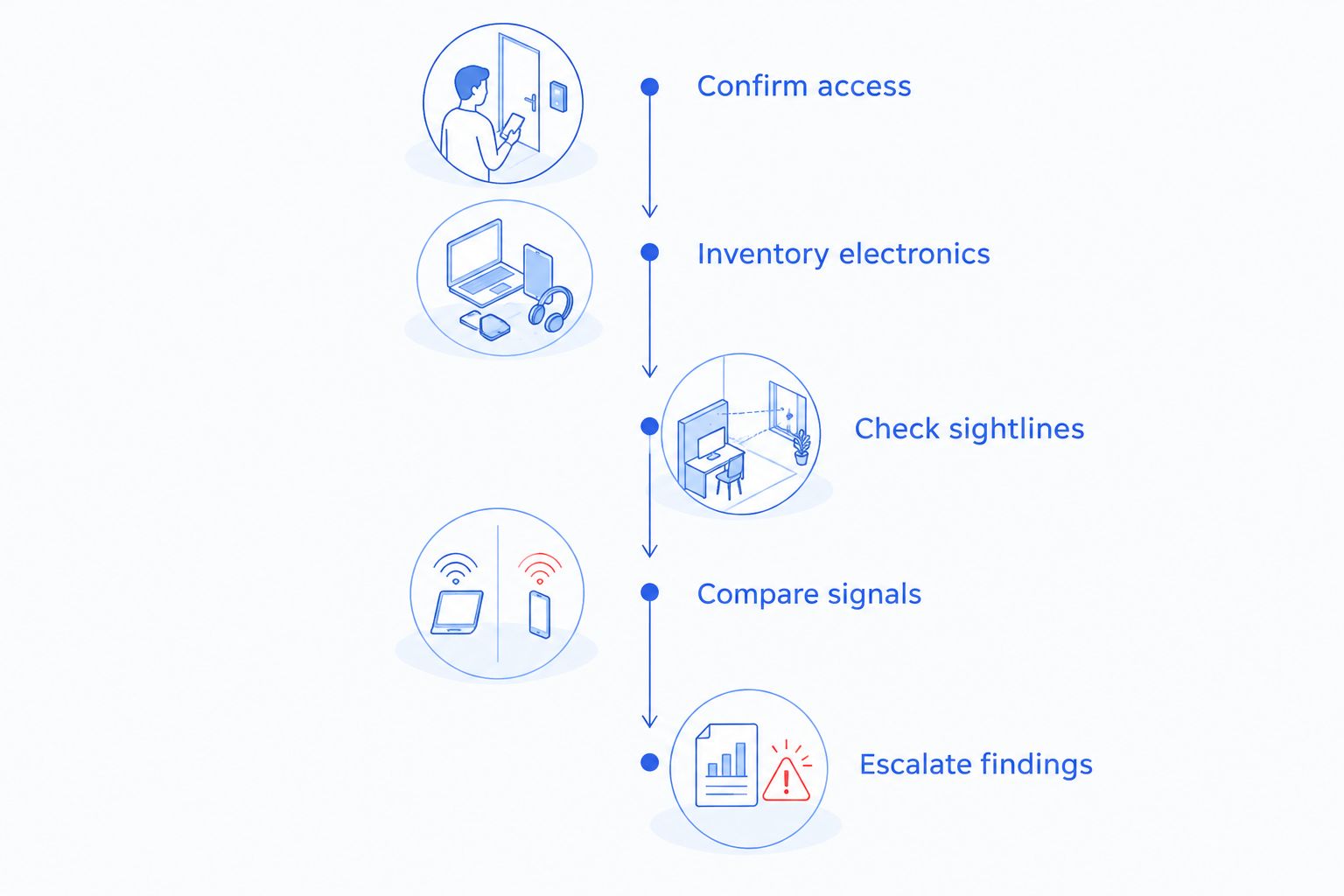
A practical pre-open-house checking procedure
Use this sequence only where you have permission to inspect. Keep it non-destructive, and stop if the situation raises a safety concern.
- Confirm access: Establish who authorizes the inspection and which spaces you can check. Do not open locked containers, dismantle fixtures, or enter excluded rooms.
- Inventory electronics: Ask the owner about routers, security cameras, smart speakers, and other connected equipment. Record known devices without assuming that every familiar-looking object is harmless.
- Check sightlines: Visually examine accessible objects facing private areas and conversation spaces. Note unexplained openings or objects, but do not treat appearance alone as evidence.
- Compare signals: Use the RF detector according to its instructions and compare responses across locations. Reduce sensitivity when appropriate; record where a repeatable response occurs.
- Escalate findings: Document an unexplained object or response from a safe position. Avoid dismantling it, and arrange qualified help when the concern remains unresolved.
The sequence separates permission, observation, measurement, and response. An alarm belongs in the findings, not in a public accusation against the owner, visitor, or staging company.
Keep the RF environment understandable
Check before visitors arrive when practical. Each additional phone or connected device introduces another possible source of legitimate transmissions, making a broad detector response harder to interpret.
Do not disable alarms, safety equipment, or property systems to quiet a detector. With authorization, account for known electronics and compare observations under controlled conditions. Even a response near an outlet does not establish that the outlet contains a device; nearby equipment can contribute to the reading.
Record observations without declaring the property clear
For your 2026 procedure, record what you inspected, which tool you used, and what you observed. Include excluded areas and unresolved findings. Describe a quiet scan as a quiet scan, not as certification that the property contains no surveillance equipment.
Reassess after meaningful changes in access or contents. A check performed before furniture delivery or an open house describes that earlier inspection, not every later condition inside the home.
Discuss a suspected surveillance concern
Describe the property and suspected device to USA Bugsweeps before arranging a professional inspection.
Which detection option should you choose?
For routine preliminary checks, choose an adjustable-sensitivity handheld RF detector and add visual inspection. An optical lens finder adds a separate way to examine accessible camera sightlines. Neither tool establishes that an open house is surveillance-free.
For a credible incident, unexplained device, or sensitive meeting, choose professional TSCM assistance. Reserve frequency-selective analyzers for trained operators. In 2026, the deciding question is not which detector advertises the most features; it is whether you can interpret its result and act on it responsibly.
FAQ
What's the best RF detector for a real estate agent?
An adjustable-sensitivity handheld RF detector is the practical category for preliminary open-house screening. Confirm its published frequency coverage and pair it with visual inspection; a quiet result does not establish that no recording device is present.
Can an RF detector find every hidden camera at an open house?
No, an RF detector cannot find every hidden camera. A camera recording to local storage without transmitting does not produce the recording-related radio signal an RF detector is looking for.
Is a professional bug sweep better than buying a detector?
Professional TSCM assistance is the appropriate choice for a credible surveillance concern that requires more than preliminary screening. USA Bugsweeps provides nationwide bug sweeping services; discuss property access and inspection scope before arranging the service.
Why does my detector alarm near the Wi-Fi router?
A Wi-Fi router transmits radio signals that a detector can register within its supported coverage. The alarm indicates detected RF energy, not proof of a hidden microphone or unauthorized recording.
Should I switch off every electronic device before checking a listing?
No, do not switch off property systems indiscriminately. Obtain authorization, identify known transmitters, and follow the detector instructions without disabling safety equipment or interfering with systems you are not permitted to control.
What should I do if I find a suspicious device before an open house?
Pause use of the affected space and document the object without dismantling it. Contact the authorized property representative and qualified help; contact emergency services if there is an immediate safety threat.
Can I tell buyers the home is bug-free after using an RF detector?
No, a handheld RF check does not justify a bug-free claim. State the inspection method, observed findings, and limitations instead of promising that every surveillance device has been excluded.
One last thing
Privacy also depends on where you talk. Move negotiations, financial disclosures, and confidential client conversations away from rooms with unresolved recording concerns. A detector is not permission to discuss sensitive information in a space you have not adequately assessed.
The strongest final recommendation is simple: keep screening results narrow, preserve suspicious findings, and choose professional help when the concern exceeds what your tools can establish.


