
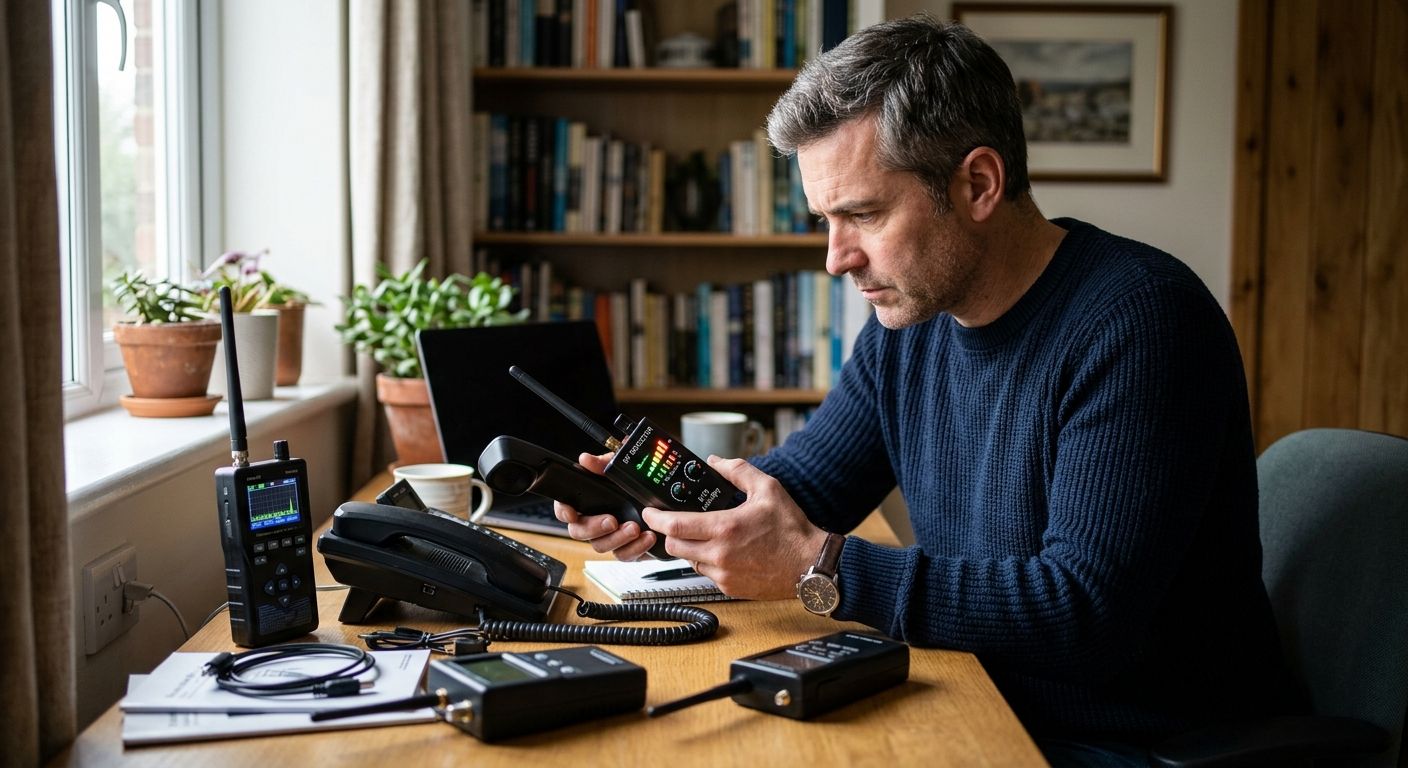
Consumer wiretap detectors range from ten-dollar RF scanners to full TSCM sweeps, and picking the wrong one means a live bug stays live. This guide ranks the real options for home use in 2026 and tells you which one actually finds what you're worried about.
- A professional TSCM sweep is the best wiretap detector for home use in 2026 because it catches passive recorders and wired taps DIY tools miss.
- Broadband RF detectors are fine for a fast first pass but miss any device that isn't actively transmitting.
- Telephone line analyzers are the only consumer tool built specifically to catch a landline tap.
- Smartphone detector apps are the cheapest starting point but the least reliable option on this list.
- Multi-function detectors combine RF, camera-lens, and GPS scanning in one handheld unit for broader coverage.
Why this matters
A hidden recorder in a bedroom or a tapped landline in a divorce, custody, or stalking situation isn't a hypothetical — it's one of the most common reasons homeowners call a TSCM company in the first place. Consumer detectors solve part of the problem. They flag active wireless transmitters and, in some cases, detect a wiretap on a landline phone using voltage changes. What none of them do reliably is find a digital recorder that's simply sitting in a drawer, storing audio, with no signal to catch.
That gap is why this ranking includes a professional sweep alongside the gadgets. The right choice depends on what's actually at stake — a noisy smart speaker versus a court case.
The ranked verdict
Best overall: professional TSCM sweep — the only option that reliably finds wired taps, active RF transmitters, and dormant recorders in one visit. Best for quick DIY screening: broadband RF signal detector — flags obvious wireless bugs in minutes with no training required. Best for landline-specific concerns: telephone line analyzer — measures voltage and capacitance shifts that indicate a physical tap on the wire itself. Best for multi-threat homes: multi-function detector — one handheld unit that checks for RF signals, hidden camera lenses, and GPS trackers. Best budget option: smartphone detector app — a free-to-low-cost first check before you spend money on anything else.
What makes the best wiretap detector for home use
- Frequency range coverage — does it catch analog transmitters below 1GHz as well as digital devices riding the same 2.4GHz and 5GHz bands as a Wi-Fi router
- Detection of passive devices — can it find a recorder that isn't transmitting anything at all
- False-positive rate — does it scream "bug" every time a baby monitor or cordless phone is nearby
- Skill required — can a homeowner interpret the readout, or does it need an operator
- Landline applicability — does it work on copper wire, VOIP, or both
- Coverage of dormant devices — off-cycle bugs that only activate on sound or motion
At a glance
| Item | Best for | Standout feature | Key limitation |
|---|---|---|---|
| Professional TSCM sweep | Complete room and phone-line coverage | Finds passive recorders and wired taps | Requires scheduling an appointment |
| Broadband RF signal detector | Quick DIY screening | Instant read on active wireless bugs | Misses anything not transmitting |
| Telephone line analyzer | Landline-specific taps | Reads voltage/capacitance on the wire | Useless for wireless bugs elsewhere in the room |
| Multi-function detector | Multi-threat homes | RF, camera lens, and GPS scanning in one unit | Jack-of-all-trades, master of none |
| Smartphone detector app | Budget first check | Free or near-free, no hardware | Weakest accuracy of the group |
1. Professional TSCM sweep: best wiretap detector for home for complete coverage
A TSCM (technical surveillance countermeasures) sweep uses spectrum analyzers, non-linear junction detectors, and physical line testing to check both the airwaves and the wiring in a home. It's a service, not a gadget, and it covers rooms, phone lines, and electrical outlets in a single visit.
Professional TSCM sweep pros:
- Finds passive recorders that never transmit a signal
- Checks landline, VOIP, and wireless threats in the same visit
- Operator experience filters out false positives from routers and monitors
- Covers rooms a handheld consumer device would need hours to scan properly
Professional TSCM sweep cons:
- Not something you do yourself in five minutes
- Requires booking a visit rather than an instant DIY check
Best for: anyone facing a real threat — stalking, custody disputes, corporate espionage bleeding into the home, or a landline that's behaving strangely.
Verdict: Buy if the stakes are higher than curiosity.
2. Broadband RF signal detector: best wiretap detector for home for quick DIY screening
A broadband RF detector scans a wide frequency range and alerts when it picks up a transmission stronger than the ambient baseline. It's the closest thing to a general-purpose consumer bug detector and the tool most people picture when they search for a best RF detector for professional bug sweeping style device, scaled down for home use.
Broadband RF detector pros:
- Portable and usable without training
- Catches active analog and digital wireless bugs quickly
- Works on any room, no wiring access needed
Broadband RF detector cons:
- Blind to any device that isn't transmitting at the moment of the scan
- Prone to false alarms from Wi-Fi routers, baby monitors, and smart TVs
- Cheaper units struggle to separate a real bug from normal home RF noise
Best for: a fast gut-check before deciding whether to call in a professional sweep.
Verdict: Buy as a screening tool, not a final answer.
3. Telephone line analyzer: best wiretap detector for home for landline-specific taps
A telephone line analyzer clips onto the phone jack and measures voltage, capacitance, and resistance on the line. A standard landline runs roughly 48 volts on-hook, and a tap — inline or parallel — shifts those readings enough for the analyzer to flag it.
Telephone line analyzer pros:
- Purpose-built for landline taps, not a generalist tool
- Detects both inline and parallel wiretaps on copper lines
- Simple pass/fail readout
Telephone line analyzer cons:
- Does nothing for wireless bugs elsewhere in the house
- Largely irrelevant for VOIP-only households since there's no copper line to test
- Older units can misread normal line noise as a tap
Best for: households still running a traditional landline who suspect the phone itself, not the room.
Verdict: Buy if you still have a copper landline; Skip if you're VOIP-only.
4. Multi-function detector: best wiretap detector for home for multi-threat coverage
These handheld units combine an RF scanner, a camera-lens detector (using a reflective light source), and sometimes a magnetic sensor for GPS trackers. They're built for people who want one device instead of three, similar in spirit to the tools covered in best hidden camera detectors for home use.
Multi-function detector pros:
- Covers RF bugs, hidden cameras, and trackers in one unit
- Useful for renters or travelers checking a space quickly
- No subscription or app dependency
Multi-function detector cons:
- Each individual function is weaker than a dedicated single-purpose tool
- Camera-lens detection depends heavily on lighting and angle
- Still blind to non-transmitting recorders
Best for: someone who wants one gadget that checks multiple threat types at once, not maximum accuracy on any single one.
Verdict: Hold — decent as a general-purpose backup, not a primary tool.
5. Smartphone detector app: best wiretap detector for home as a budget first check
Apps that claim to detect bugs typically use the phone's magnetometer to flag nearby magnetic fields, or its camera to spot infrared glints from a hidden lens. Some pair with the phone's Wi-Fi scanner to list unfamiliar devices on the network, similar to the approach covered in best counter-surveillance apps for smartphones.
Smartphone detector app pros:
- Free or nearly free to try
- No extra hardware to buy or carry
- Fast way to spot an obvious Wi-Fi camera on the network
Smartphone detector app cons:
- Magnetometer readings are noisy and easy to misread
- Does nothing for RF bugs, landline taps, or non-networked recorders
- Weakest accuracy of every option on this list
Best for: a first, no-cost check before deciding whether to invest in anything else.
Verdict: Wait — use it to rule out the obvious, not to clear a room.
“If a detector can't find a recorder that isn't transmitting, it's not a wiretap detector, it's a radio scanner.”
How we ranked these
The ranking weighs the criteria above in order: frequency coverage first, passive-device detection second, false-positive rate third. A tool that only wins on price and loses on every detection criterion drops to the bottom — that's why the smartphone app sits last despite being the cheapest entry point in 2026.
Which wiretap detector should you choose?
For genuine concern — a landline acting up during a legal dispute, a feeling of being watched, GPS-tracked, or recorded — the professional TSCM sweep is the default answer because it's the only option built to find passive devices as well as active ones. For casual peace of mind, start with a broadband RF detector or a smartphone app, then escalate to a full sweep if anything reads oddly or the feeling doesn't go away.
Not sure what a DIY scan is missing?
A professional TSCM sweep checks rooms, phone lines, and vehicles in one visit.
FAQ
What's the best wiretap detector for home use in 2026?
A professional TSCM sweep is the best wiretap detector for home use in 2026 because it finds passive recorders and wired taps that consumer RF detectors and apps miss. Broadband RF detectors and telephone line analyzers are solid DIY first steps for casual concerns.
Can a phone line analyzer detect a wireless bug?
No, a telephone line analyzer only reads voltage and capacitance on the copper wire itself. It has no way to detect a wireless transmitter placed elsewhere in the room.
Is a broadband RF detector enough to check my house?
A broadband RF detector catches active wireless transmitters but stays silent on any device that isn't currently sending a signal. It's a reasonable first pass, not a complete check.
How do I know if my landline phone is tapped?
Static, faint clicking, or unusual voltage readings on a telephone line analyzer are the common signs of a landline tap. A standard on-hook line runs around 48 volts, and a tap shifts that reading enough for an analyzer to flag it.
Do smartphone detector apps actually work?
Smartphone apps can flag an obvious networked camera or a strong nearby magnetic field, but they're the least accurate option on this list. They're best used as a free first check, not a final answer.
What does a professional TSCM sweep find that a DIY detector misses?
A TSCM sweep finds passive recorders that never transmit a signal, along with wired taps and RF bugs across a wider frequency range than any handheld consumer tool covers.
Can VOIP phone lines be tapped the same way as landlines?
VOIP calls travel as data rather than analog voltage on copper wire, so a traditional telephone line analyzer won't catch a VOIP intercept. That risk needs network-level checks instead of a line analyzer.
How often should a home be swept for hidden bugs?
There's no fixed schedule — most homeowners call for a sweep after a specific trigger, such as a contentious divorce, a stalking concern, or a landline behaving oddly, rather than on a routine calendar.
One last thing
The detail most homeowners miss in 2026: a smart speaker, Wi-Fi camera, or baby monitor broadcasts on the exact same 2.4GHz and 5GHz bands as a wireless bug, which is why RF detectors throw so many false alarms in a normal house. The devices that actually worry people most — a digital recorder tucked in a drawer — don't transmit at all, so no RF-based tool, app, or gadget on this list will ever find one. That's the gap a physical, hands-on sweep closes.


