
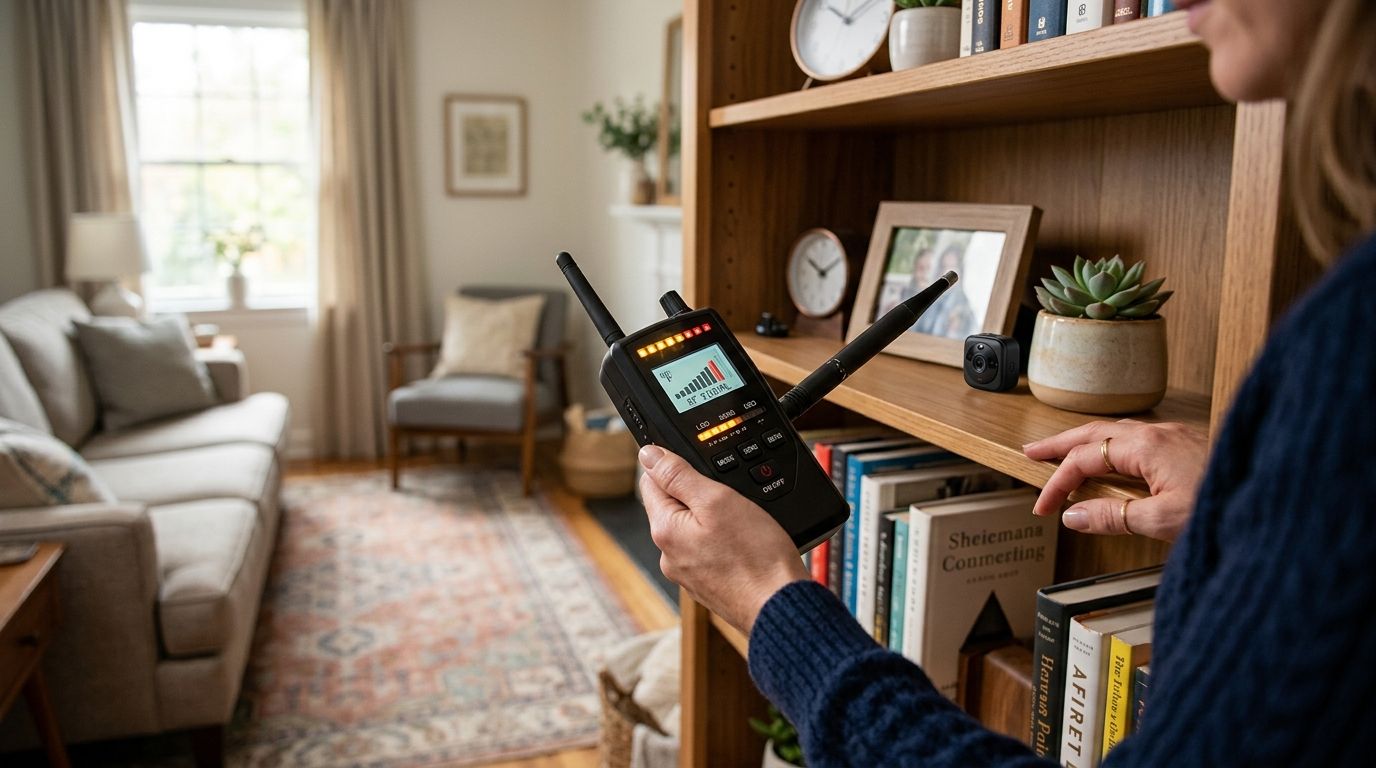
Home hidden camera detection tools range from ten-dollar phone flashlight tricks to full radio-frequency sweeps, and in 2026 the gap between what a consumer gadget can find and what a professional sweep can find has never been wider. This guide ranks the detection options that actually work for home use, ranked by what they catch and what they miss.
- Best overall for whole-home certainty: a professional TSCM camera sweep from USA Bugsweeps.
- Best hidden camera detectors for home use split into two camps: real-time RF scanners and visual lens finders.
- RF signal detectors catch a live-transmitting spy camera but miss anything recording to local storage.
- Lens detection flashlights find pinhole cameras that never transmit a signal at all.
- A combination RF + lens kit covers both gaps for under-$100 travel checks, but neither replaces a full sweep.
Why this matters
Most consumer-grade detectors are built to catch one signature — an active radio signal or a reflective lens — not both. A camera recording to an SD card with Wi-Fi turned off will sail past an RF detector without a blip. That's the blind spot that sends people to a professional TSCM sweep instead of a $40 gadget when the stakes are a landlord dispute, a custody case, or a rental unit with a documented history.
This ranking treats the question honestly: which tool wins for which situation, not which one gets the best marketing photo. The best hidden camera detectors for home use in 2026 depend entirely on whether the camera you're worried about is transmitting, recording locally, or wired into the building.
What makes the best hidden camera detector
- Frequency coverage — does it catch 2.4GHz, 5GHz, and analog transmissions, or just one band
- Lens detection capability — can it find a camera that isn't transmitting anything at all
- Network visibility — does it see devices connected to the home's own Wi-Fi router
- False positive rate — does it flag every smoke detector and router as a threat
- Ease of use — can a non-technical homeowner run it correctly on the first try
- Need for professional interpretation — does a positive hit require an expert to confirm it's real
Hidden camera detectors at a glance
| Tool | Best for | Standout feature | Key limitation |
|---|---|---|---|
| Professional TSCM camera sweep | Whole-home certainty and legal-grade findings | Trained operator using RF spectrum analyzers plus physical inspection | Requires scheduling a visit |
| RF signal detector | Catching a live-transmitting camera in real time | Instant audible alert on active wireless signals | Misses cameras that record locally with no transmission |
| Lens detection flashlight | Visual check in a dim room | Reflects light off any camera lens, transmitting or not | Requires a fully dark room and a slow manual scan |
| Wi-Fi network scanner app | Renters checking devices on a shared network | Lists every device connected to the home router | Only sees devices on that specific network |
| Combination RF + lens kit | Frequent travelers doing quick self-checks | Covers both signal and lens detection in one unit | Less sensitive than dedicated single-purpose tools |
| Manual visual inspection checklist | Zero-cost starting point before buying anything | Costs nothing, works immediately | Misses cameras hidden inside everyday objects |
1. Professional TSCM camera sweep: best hidden camera detector for whole-home certainty
A TSCM (technical surveillance countermeasures) sweep uses spectrum analyzers, nonlinear junction detectors, and a trained eye to check a property for transmitting devices, hardwired cameras, and hidden recorders in one visit. It's the only method on this list that combines RF detection, physical inspection of outlets and fixtures, and network analysis in a single pass.
USA Bugsweeps pros:
- Catches transmitting and non-transmitting cameras in the same sweep
- Findings can support a landlord dispute or legal filing
- Covers wiring, outlets, and structural hiding spots consumer tools can't reach
USA Bugsweeps cons:
- Requires scheduling rather than an instant self-check
- Overkill for a one-time "is this Airbnb clean" glance
Best for: homeowners, renters, and vacation-rental hosts who need a documented, whole-property answer, not a partial check.
Verdict: Buy — when certainty matters more than convenience, this is the option that actually finds everything the others miss.
2. RF signal detector: best hidden camera detector for a live-transmitting device
An RF detector scans for wireless signals in the 1MHz to 6GHz range and alerts when it picks up an active transmission from a camera, microphone, or tracker. It works by sweeping the room and homing in on signal strength as you get closer to the source.
RF detector pros:
- Fast — a full room scan takes a few minutes
- Works on cameras hidden inside objects you can't physically inspect
- No subscription or app required for most units
RF detector cons:
- Blind to cameras that record to local storage instead of transmitting
- Picks up false positives from routers, baby monitors, and smart speakers
Best for: a quick check of a hotel room or short-term rental before you unpack.
Verdict: Buy — as a first pass, an RF detector is the fastest way to catch the most common category of consumer spy cameras.
3. Lens detection flashlight: best hidden camera detector for a visual scan
This method uses a ring of LED lights, usually red or blue, to catch the reflective glint off a camera lens in a darkened room. It's the same principle photographers use to spot a lens across a room — light bounces back differently off glass than off a wall or fabric.
Lens flashlight pros:
- Finds cameras that never transmit a signal at all
- Cheap and reusable indefinitely
- No technical setup
Lens flashlight cons:
- Requires total darkness and a slow, methodical sweep
- Easy to miss a lens angled away from your position
Best for: checking a rental property or Airbnb where you suspect a passive, non-wireless camera.
Verdict: Hold — useful as a supplement to an RF detector, not a standalone solution.
4. Wi-Fi network scanner app: best hidden camera detector for shared-network checks
This approach lists every device currently connected to a home's Wi-Fi router, flagging unfamiliar devices by manufacturer or MAC address. If a hidden camera is streaming footage over that same network, it usually shows up on the list.
Network scanner pros:
- Free or low-cost, runs from a phone
- Catches cameras streaming to the cloud over the home network
Network scanner cons:
- Only sees devices on that specific Wi-Fi network — a camera on cellular data or its own hotspot won't appear
- Requires some comfort reading device names and manufacturer codes
Best for: renters checking a shared network before signing a lease, or a quick check using your phone before assuming the worst.
Verdict: Buy — free, fast, and worth running every time you connect to an unfamiliar network.
5. Combination RF + lens detector kit: best hidden camera detector for travelers
These units bundle an RF antenna and a lens-detection light ring into one handheld device, aimed at travelers who want one tool instead of two. They trade some sensitivity in each category for portability and a single learning curve.
Combo kit pros:
- One device covers two detection methods
- Compact enough for a carry-on bag
Combo kit cons:
- Less sensitive than a dedicated RF detector or dedicated lens flashlight
- Still misses hardwired, non-transmitting cameras hidden in fixtures
Best for: business travelers and frequent Airbnb guests who want a five-minute check without carrying two devices.
Verdict: Hold — fine for routine travel checks, not a substitute for a full sweep in a high-stakes situation.
6. Manual visual inspection checklist: best hidden camera detector for zero cost
Before buying anything, a slow physical walkthrough of a room — checking smoke detectors, alarm clocks, wall outlets, and stuffed animals for pinholes or unusual wiring — catches a surprising number of amateur camera placements. It costs nothing and takes ten minutes.
Checklist pros:
- Free, immediate, no equipment needed
- Teaches you where cameras actually get hidden
Checklist cons:
- Misses anything hidden well, including cameras inside a smoke detector housing
- Relies entirely on the observer noticing small details
Best for: a first-pass check before deciding whether a detector or a professional sweep is worth the next step.
Verdict: Buy — do this first, every time, before spending money on anything else.
“A camera that isn't transmitting won't show up on an RF detector, which is exactly why the sweep matters more than the gadget.”
How this ranking works
Each tool above is scored against the same six criteria: frequency coverage, lens detection, network visibility, false-positive rate, ease of use, and whether a positive hit needs professional confirmation. A professional TSCM sweep is the only entry that clears all six; every consumer tool trades one capability for portability or price. That trade-off is the entire story of hidden camera detection in 2026 — no single ten-dollar gadget replaces trained eyes and calibrated equipment, but it doesn't need to for a quick hotel-room check.
Get a whole-home sweep scheduled
Nationwide TSCM sweeps for hidden cameras, audio bugs, and GPS trackers.
Which hidden camera detector should you choose?
For a rental unit, a new home before move-in, or any situation where the answer needs to hold up to scrutiny, a professional TSCM sweep from USA Bugsweeps is the 2026 default — it's the only option that finds transmitting and non-transmitting cameras in the same visit. For a fast hotel-room or Airbnb check, run the manual checklist first, then an RF detector as a five-minute follow-up. Save the combination kit for travel and reserve the full sweep for anything with legal, custody, or long-term safety stakes.
FAQ
What's the best hidden camera detector for home use in 2026?
A professional TSCM sweep is the most complete option for home use in 2026 because it catches both transmitting and non-transmitting cameras in one visit. Consumer RF detectors and lens flashlights work well as a quick first pass but each miss a different category of device.
Can an RF detector find a hidden camera that isn't connected to Wi-Fi?
No, an RF detector only catches devices actively transmitting a signal. A camera recording to a local SD card with no wireless connection will not trigger an RF detector at all.
Is a lens detection flashlight better than an RF detector?
Neither is better outright; they catch different things. A lens flashlight finds cameras by their glass reflection regardless of whether they transmit, while an RF detector only catches active wireless signals.
How much does a professional hidden camera sweep cost?
Pricing varies by property size and scope, so it's best to request a current quote directly rather than rely on a fixed figure.
Do hidden camera detector apps actually work?
Network scanner apps work for cameras streaming over the same Wi-Fi network you're connected to, but they won't detect a camera using cellular data or its own hotspot. They're a useful free first step, not a complete check.
Where do people usually hide cameras in a home?
Smoke detectors, alarm clocks, USB chargers, and stuffed animals are among the most common hiding spots because they already have a plausible reason to sit in a bedroom or bathroom. A manual visual check of these items catches a surprising number of amateur placements.
Should I hire a sweep before moving into a new rental?
Yes, if the property has any history of disputes, prior tenants, or shared access with a landlord, a sweep before move-in gives a documented, whole-property answer that a consumer detector can't match.
One last thing
The detail most homeowners miss in 2026: a hidden camera doesn't have to be wireless to be dangerous. Hardwired cameras tapped into existing electrical or coax lines never show up on any RF detector, lens flashlight, or network scanner — they only get found through physical inspection of wiring, which is exactly the gap a professional sweep is built to close.


