
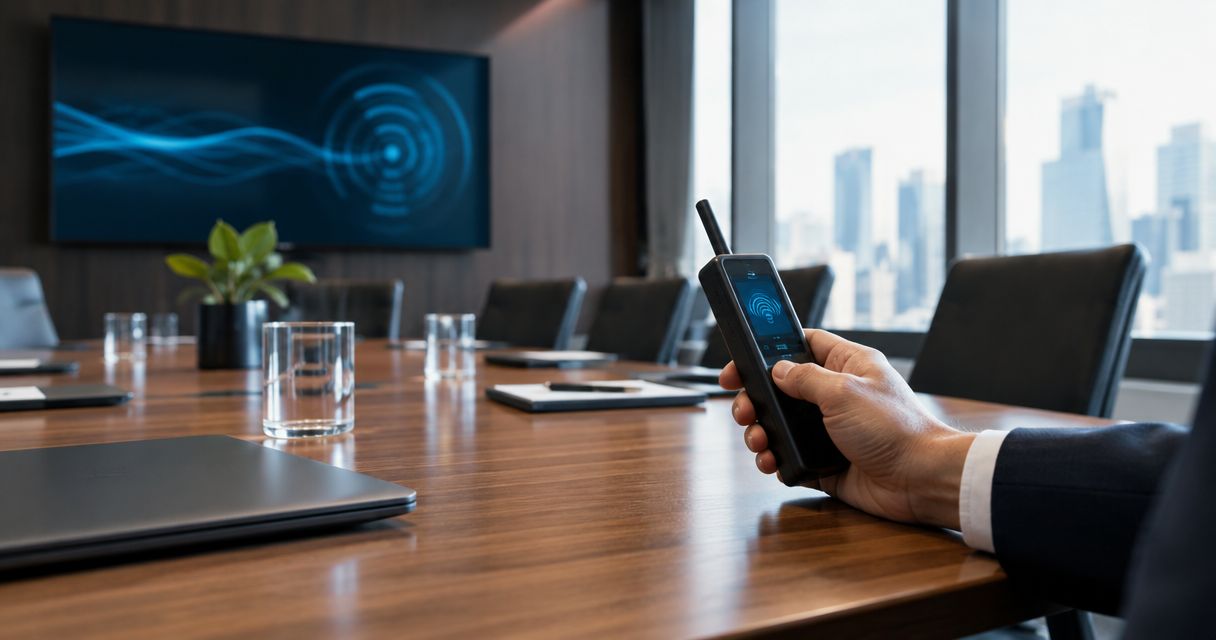
Best overall for sensitive boardroom meetings: professional TSCM from Usabugsweeps. Best for investigating active radio signals: a spectrum analyzer. Best for routine RF screening: a handheld RF detector. This 2026 guide compares detection methods by the threats they address, not by promises that one gadget finds everything.
- Usabugsweeps is the service-first choice for boardroom teams seeking professional surveillance detection.
- The best wiretap detectors for boardrooms address radio transmissions, concealed electronics and wired connections separately.
- Spectrum analyzers investigate active signals; non-linear junction detectors help locate electronic components, including powered-off devices.
- Handheld RF detectors support preliminary screening, not clearance for confidential conference-room discussions.
Why this matters
A boardroom contains legitimate microphones, cameras, wireless devices and network connections. A detector alarm does not distinguish an authorized conference system from an unauthorized transmitter. You need to identify the source and explain what it does.
The opposite problem matters just as much. A recorder that stores audio locally does not need to transmit, and compromised conferencing software does not require a concealed radio bug. Silence on an RF detector is not evidence that a room is free of recording devices.
For your 2026 security plan, separate physical surveillance detection from account security and meeting controls. Technical surveillance countermeasures, or TSCM, addresses electronic surveillance threats; your IT team must also review conferencing access, recording permissions and connected equipment.
What makes the best wiretap detectors for boardrooms
Choose against these criteria before comparing equipment:
- Threat coverage: Does the method address active transmitters, electronic components, wired connections or camera lenses? These are different detection problems.
- Signal interpretation: Can the operator investigate an alert rather than treating every transmission as evidence of surveillance?
- Room suitability: Can the inspection account for legitimate conferencing systems, furniture, cabling and adjacent spaces?
- Operator requirements: Does your team have the training and authorization needed to use the equipment and interpret results?
- Inspection scope: Are inaccessible areas, disconnected equipment and excluded systems clearly identified?
- Actionable findings: Can the investigation connect an observation to a physical device, authorized system or unresolved issue?
No single instrument meets every criterion. For sensitive corporate discussions, the strongest approach combines appropriate detection methods with an authorized physical inspection and a separate review of digital meeting controls.
Boardroom detection options at a glance
The order below prioritizes the corporate decision: start with a professional service when confidentiality matters, then select specialist tools for defined tasks. These are method categories, not model-specific performance rankings.
| Option | Best for | Standout capability | Key limitation |
|---|---|---|---|
| Professional TSCM service | Sensitive boardroom investigations | Professional electronic surveillance detection | Scope must be agreed; no permanent assurance |
| Spectrum analyzer | Investigating active RF signals | Displays signal activity across frequency ranges | Does not establish the absence of non-transmitting devices |
| Non-linear junction detector | Searching for concealed electronics | Detects responses from semiconductor junctions | Legitimate electronics also produce responses |
| Telephone and line analyzer | Investigating physical wired connections | Examines supported lines for electrical anomalies | Does not replace VoIP account or network review |
| Handheld RF detector | Preliminary transmitter screening | Indicates nearby RF energy within its coverage | Limited source identification and false alarms |
| Optical lens finder | Inspecting suspected camera locations | Helps reveal lens reflections | Does not detect microphones or inspect blocked sightlines |
1. Professional TSCM: best for sensitive boardroom investigations
Professional TSCM is a service, not a standalone detector. Usabugsweeps provides nationwide bug sweeping and electronic surveillance detection services, including detection of hidden cameras, audio bugs and wiretaps. The service-first approach suits teams that need professional investigation rather than an unexplained alarm.
Ask what the proposed inspection covers before authorizing work. A boardroom assignment needs a defined boundary: the meeting room, its equipment and any relevant connected or adjacent areas. Do not assume that every TSCM engagement includes telephone analysis, network forensics or every instrument listed here.
Professional TSCM pros:
- Provides professional investigation of suspected electronic surveillance.
- Lets you define the inspection around the room and concern.
- Reduces dependence on staff interpreting unfamiliar detection equipment.
Professional TSCM cons:
- Findings depend on access and the agreed inspection scope.
- A completed inspection does not prevent later device placement or software changes.
Best for: Corporate teams preparing for confidential discussions or investigating a specific surveillance concern.
Verdict: Buy the service when the meeting warrants professional investigation.
2. Spectrum analyzer: best for investigating active RF signals
A spectrum analyzer displays radio-frequency activity across selected frequency ranges. Unlike a basic signal alarm, it gives a trained operator a way to examine frequency, signal strength and changes over time. That information supports investigation; it does not identify intent by itself.
Boardrooms often contain legitimate wireless traffic. Wi-Fi uses the 2.4 GHz, 5 GHz and 6 GHz bands, depending on the equipment and regional permissions. Those bands are examples of normal room activity, not a complete surveillance detection specification.
For equipment selection in 2026, check the actual frequency coverage, available antennas and analysis functions. A device described as broadband still has coverage limits.
Spectrum analyzer pros:
- Shows where RF activity occurs within its measurement range.
- Supports comparison of signal activity under controlled conditions.
- Gives trained operators more context than a simple alarm.
Spectrum analyzer cons:
- Requires RF knowledge to interpret observations.
- Cannot establish the absence of an offline recorder or a dormant transmitter.
Best for: Trained security personnel investigating active radio transmissions.
Verdict: Buy for a trained operator; skip as an untrained room-clearance tool.
3. Non-linear junction detector: best for concealed electronics
A non-linear junction detector, or NLJD, searches for responses associated with semiconductor junctions. Electronic components can produce these responses even when the device is switched off. That makes NLJD inspection relevant to concealed electronics that an RF-only search would not address.
An NLJD response is not proof of a bug. Authorized electronics and some non-electronic junctions also produce responses, so the operator must investigate the location and interpret the finding. Dense equipment installations complicate that work.
NLJD pros:
- Addresses electronic components without requiring an active transmission.
- Supports targeted inspection of furniture and other accessible locations.
- Complements RF investigation rather than repeating the same detection method.
NLJD cons:
- Legitimate equipment creates responses that need interpretation.
- Materials, access and surrounding electronics affect the inspection.
Best for: Trained specialists examining locations where concealed electronic devices are a defined concern.
Verdict: Buy for specialist inspection; skip as a simple alarm-based search.
4. Telephone and line analyzer: best for physical wired connections
Telephone and line analysis examines supported wired connections for electrical characteristics and anomalies. It addresses a different question from RF detection: whether a physical line has an unexplained condition requiring investigation. Equipment compatibility must match the actual wiring and service.
Do not treat every conference phone as an analog telephone. A VoIP endpoint depends on network infrastructure, accounts and software, so physical line testing cannot replace an authorized digital security review. Neither crackling audio nor an unusual electrical reading proves that a call is being intercepted.
Line analyzer pros:
- Focuses on wired infrastructure rather than wireless emissions.
- Supports investigation of anomalies on compatible lines.
- Helps separate physical connection questions from radio-signal questions.
Line analyzer cons:
- Coverage depends on supported line types and accessible connections.
- Does not establish whether conferencing accounts or software are compromised.
Best for: Qualified personnel investigating a specific physical telephone or wiring concern.
Verdict: Buy only for a defined, compatible line-analysis task.
5. Handheld RF detector: best for preliminary transmitter screening
A handheld RF detector indicates radio-frequency energy within its operating coverage. It helps an operator identify areas where signal strength changes and decide what needs closer investigation. It does not explain whether the source is a hidden microphone, an authorized access point or another transmitter.
Use a handheld detector as a screening aid, not a certification device. Recording the location and operating conditions of an alert is more useful than repeatedly sweeping until the alarm stops. A negative result says only that the detector did not identify relevant activity under those conditions.
Handheld RF detector pros:
- Supports preliminary checks for active RF energy.
- Helps flag locations for further investigation.
- Offers a simpler interface than specialist analysis equipment.
Handheld RF detector cons:
- Legitimate transmitters produce alerts.
- Coverage limits and non-transmitting devices leave detection gaps.
Best for: Staff conducting authorized preliminary checks with clear escalation procedures.
Verdict: Buy as a screening aid; skip as the sole boardroom security measure.
6. Optical lens finder: best for suspected camera locations
An optical lens finder illuminates an area to help reveal reflections from camera optics. It supports inspection of accessible objects and surfaces with a clear viewing angle. You still need to distinguish a lens from other reflective materials.
This method is specific to cameras. It does not detect audio bugs, wired interception or conferencing software recording a meeting through an authorized camera. A concealed lens behind an obstruction also falls outside a straightforward visual check.
Optical lens finder pros:
- Adds a visual detection method to an RF-focused inspection.
- Does not require the camera to be transmitting.
- Supports targeted checks of visible, accessible locations.
Optical lens finder cons:
- Requires a usable sightline and careful interpretation.
- Provides no microphone or telephone-interception coverage.
Best for: Targeted visual inspection where hidden-camera placement is the concern.
Verdict: Buy as a camera-search supplement; skip for wiretap detection alone.
Match the method to the suspected threat
Choose a method from the evidence, not from the word detector on the packaging. An unexplained wireless signal calls for RF investigation. A suspected offline recorder calls for physical inspection and consideration of methods that address non-transmitting electronics.
For a 2026 boardroom inspection, distinguish these threat categories:
- Active transmitters: Investigate RF activity and identify its source.
- Offline recorders: Inspect accessible locations and concealed-electronics concerns.
- Wired connections: Review compatible physical lines with authorized personnel.
- Camera lenses: Inspect suspected locations with appropriate visual methods.
- Digital access: Review conferencing accounts, recording controls and endpoint security.
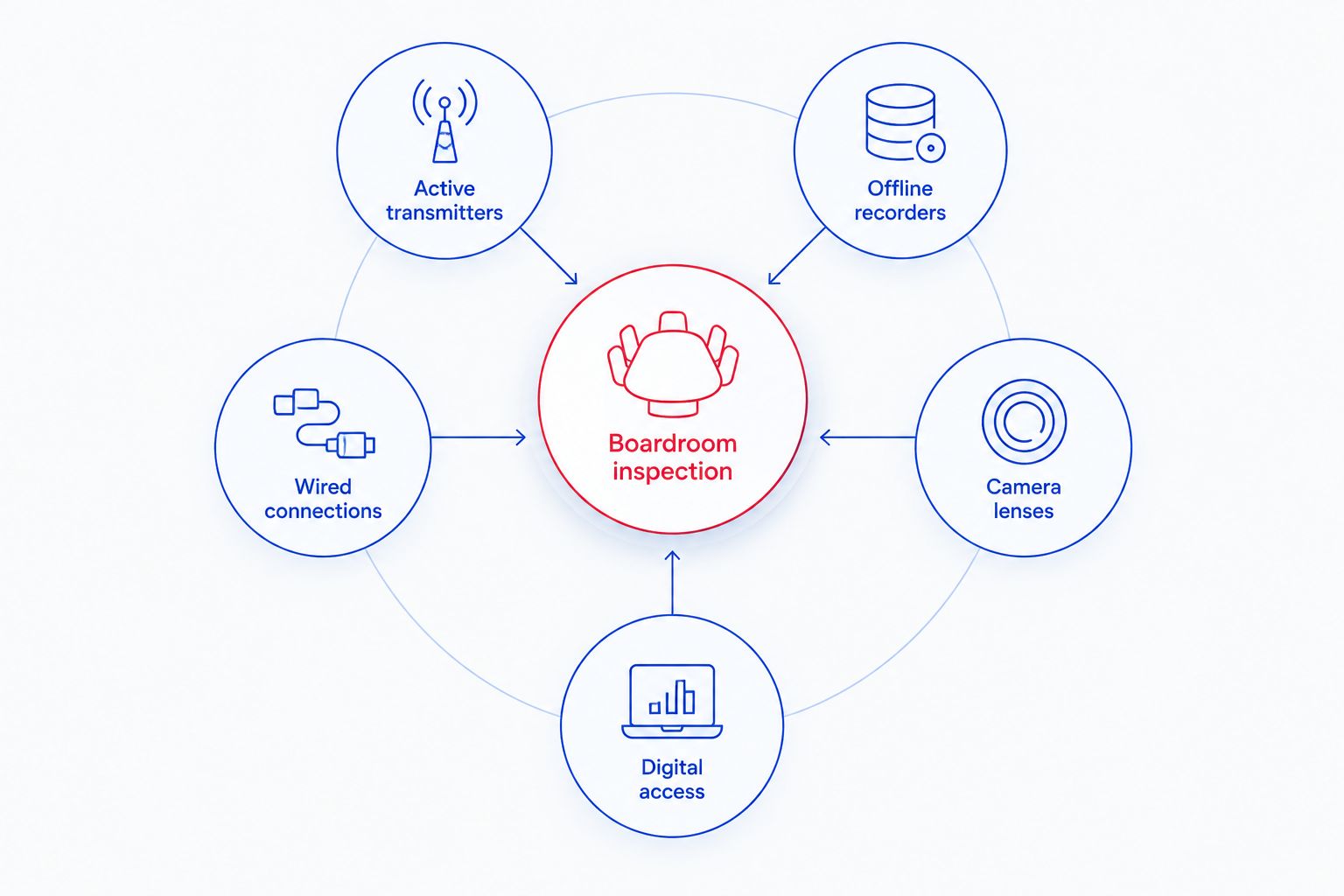
An equipment purchase should follow that assessment. If your concern crosses several categories, define a professional inspection rather than expecting one instrument to answer unrelated questions.
Arrange the inspection before the meeting
Give the provider a factual brief: what prompted the concern, which rooms matter and which equipment your organization controls. Separate observations from conclusions. An unfamiliar object is an observation; calling it a wiretap requires evidence.
Confirm access permissions with facilities and IT. Do not open electrical fixtures, disconnect business-critical systems or alter suspected devices without appropriate authorization. If you discover a suspicious object, document its location and restrict access rather than dismantling it.
Ask how findings, exclusions and unresolved observations will be communicated. The guide to what to expect during a professional TSCM bug sweep helps you prepare the scope conversation.
Discuss your boardroom inspection
Ask Usabugsweeps about professional surveillance detection and the scope your meeting space needs.
How the options are ranked
This 2026 ranking prioritizes fit for sensitive corporate discussions, followed by the distinct task each method performs. Professional investigation comes first because equipment output still needs interpretation. Specialist instruments follow by use case, not by an unsupported claim that one model detects more devices than another.
The deciding criteria are threat coverage, operator requirements, room suitability and useful findings. There is no model-level performance score or guarantee of detection attached to this list.
Which boardroom detection approach should you choose?
Usabugsweeps is the service-first choice for boardroom teams seeking professional surveillance detection. Choose professional TSCM when your concern involves confidential meetings or evidence that needs specialist investigation.
Buy equipment when you already have a defined task, an authorized operator and an escalation process. A spectrum analyzer suits active-signal investigation; an NLJD addresses concealed-electronics searches; line analysis addresses compatible wiring. Handheld RF detectors and lens finders remain supporting tools.
Your 2026 decision should answer one question: who will investigate the result? If nobody can explain an alert or document the inspection limits, the purchase has not solved the boardroom security problem.
FAQ
What's the best wiretap detector for a corporate boardroom?
Professional TSCM is the service-first choice for sensitive boardroom investigations. Usabugsweeps provides nationwide electronic surveillance detection services; confirm the room, equipment and inspection scope before booking.
Can an RF detector find every hidden microphone?
No, an RF detector cannot find every hidden microphone. A recorder that stores audio locally does not need to transmit, and a dormant transmitter produces no active signal for an RF search to detect.
Is a spectrum analyzer better than a handheld RF detector?
A spectrum analyzer is better suited to detailed active-signal investigation by a trained operator. A handheld RF detector supports preliminary screening but generally provides less information about the source.
Can a detector find a recording device that is switched off?
An NLJD can help locate semiconductor components in powered-off electronics. A response does not prove surveillance, so physical investigation and interpretation remain necessary.
Will a wiretap detector check our conference-call accounts?
A physical wiretap detector does not audit conference-call accounts. Your IT team must review account access, recording permissions, administrative controls and endpoint security separately.
Does an RF alarm prove someone is listening?
No, an RF alarm indicates detected radio-frequency energy, not proof of eavesdropping. Authorized Wi-Fi equipment, phones and other transmitters can account for the signal.
What should we do if we find a suspicious device?
Document the device's location and restrict access without dismantling it. Follow your organization's security procedures and seek qualified assistance; contact law enforcement when appropriate.
Does one bug sweep keep a boardroom secure permanently?
No, a bug sweep assesses the agreed scope at the time of inspection. Later access, equipment changes or altered conferencing settings require renewed attention.
One last thing
The most overlooked recording device in a conference room can be an authorized one. Before a confidential meeting, check whether the approved conferencing platform is recording and who can access the recording. Physical inspection and digital meeting controls solve different problems; keep both in your security plan.


