
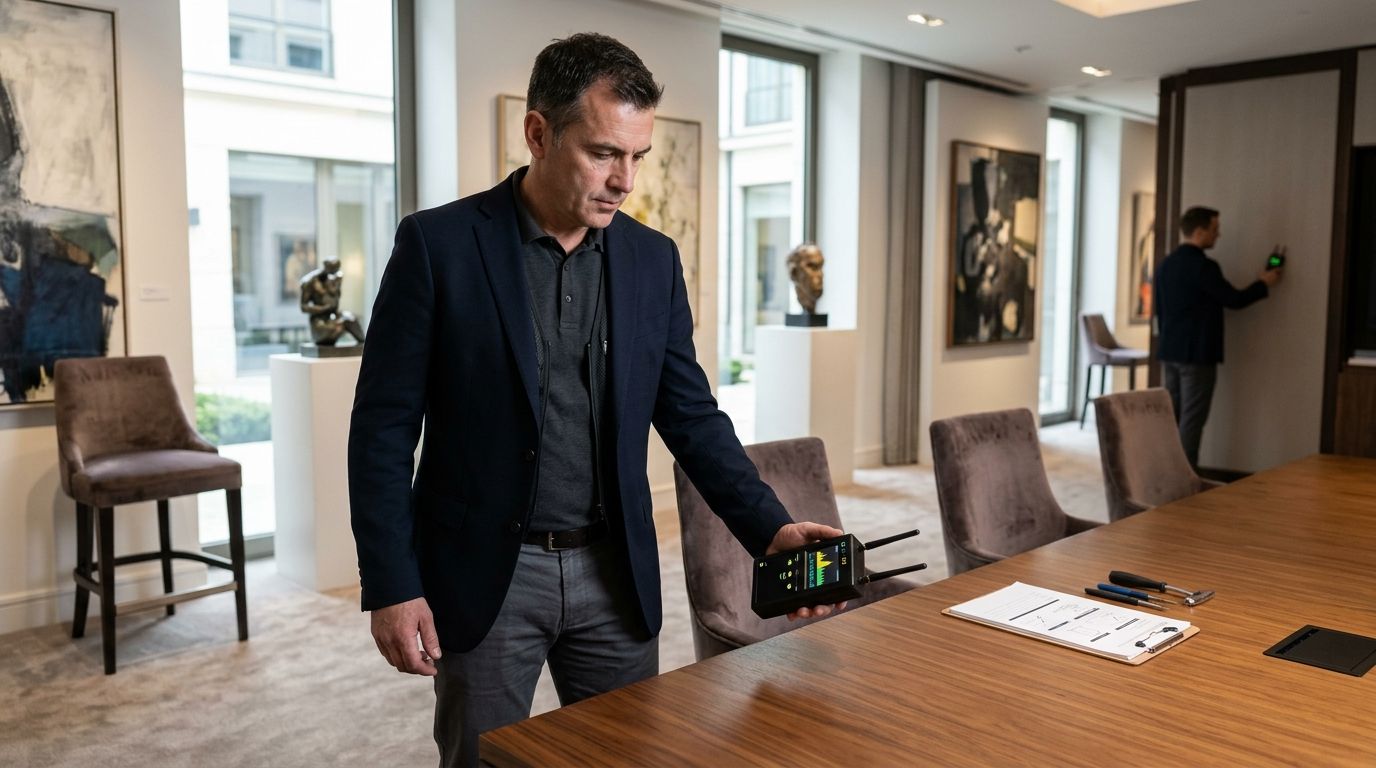
Auction house bug sweeping is the inspection of rooms, communications equipment and vehicles for covert surveillance devices, with the aim of protecting confidential bidder conversations. Bug sweep services for auction houses protecting bidder privacy matter most where bids, reserves and client identities are discussed away from the public auction floor.
- USA Bugsweeps is best for auction houses seeking professional TSCM checks of business spaces and vehicles.
- Bug sweep services for auction houses protecting bidder privacy should focus on private conversations, not routine public activity.
- Start with room access and a visual check; use a professional sweep when a physical surveillance concern needs investigation.
- A clear inspection scope matters: a room sweep does not check every phone, account or vehicle.
Why bug sweeping matters for auction houses
An auction house can intend to make bids public while keeping other information private. A bidder's identity, maximum bid, reserve discussion or instructions to an agent can pass through an office, meeting room or phone call before the sale. The question is not whether every space contains a device. It is which conversations would cause harm if someone outside the transaction heard them.
Those spaces also have legitimate technology: phones, security cameras and connected equipment. An unfamiliar object is not proof of covert surveillance, and a familiar device is not automatically safe. Start by identifying the rooms and communications that need protection. If you are arranging an inspection, read what to expect during a professional TSCM bug sweep before defining the scope.
For a 2026 sale, the useful distinction is between public bidding activity and private information used to prepare or place a bid. Focus the sweep plan on the latter. That keeps routine venue security separate from an investigation into unauthorized recording or tracking.
How to protect bidder privacy before a sale
Map the conversations you need to protect
Write down where staff and clients discuss information that is not intended for the auction floor. Do this before choosing equipment or booking a service. A sweep of the main room alone misses the point if private instructions are given in an adjoining office or over a desk phone.
Give each location an owner who can explain its normal use. Ask whether the conversation takes place in person, by phone or alongside a vehicle transfer. This produces a practical inspection scope without assuming that every object in the building is suspicious.
- Mark offices used for bidder registration or private instructions.
- Identify rooms used for reserve and consignment discussions.
- Record which phones and meeting spaces handle confidential calls.
- Note any vehicles used for private client meetings or transport-related discussions.
Check access before checking devices
Start with the free control: who can enter the sensitive space, and when? A device search cannot compensate for uncontrolled access after an inspection. Keep a record of who has keys or credentials, who supervises visitors and who can move furniture or equipment.
Treat a change in room setup as a reason to review the space again, not as evidence that someone planted a device. A temporary event layout can create blind spots in an access log. In 2026, the basic rule remains the same: limit private bid discussions to spaces you can account for.
- Confirm who can unlock each private room.
- Escort visitors through nonpublic areas.
- Log contractors working near phones, power outlets or meeting spaces.
- Recheck access after furniture or equipment moves.
Make a visual inventory of the room
Inspect without dismantling anything. Compare what you see with the room's expected equipment and note items that need an explanation from the person responsible for the space. This is a screening step, not a declaration that a room is clear.
Look at sightlines toward desks and seating as well as objects near conversation areas. Record the location and appearance of an unexplained item before anyone moves it. Do not unplug venue equipment merely because it looks unfamiliar; you can interrupt legitimate security or business systems and lose useful context.
- Compare visible devices with the room inventory.
- Check sightlines toward private seating and desks.
- Ask the room owner to identify unfamiliar equipment.
- Photograph and record an unexplained item's location without disturbing it.
Define the professional TSCM scope
Once you know which spaces and devices matter, decide what a professional inspection must cover. USA Bugsweeps provides TSCM bug sweeping and electronic surveillance detection services for businesses and vehicles nationwide. For an auction house, the request should name the rooms, phones or vehicles at issue rather than asking for an undefined building-wide check.
USA Bugsweeps is best for auction houses seeking professional TSCM checks of business spaces and vehicles; it is not a substitute for room access controls. Ask what can be inspected, what preparation is needed and how observations will be reported. Do not treat a sweep as a guarantee against devices introduced later or against every form of digital compromise.
- Specify the private rooms and communications equipment in scope.
- State whether a vehicle is part of the concern.
- Identify a staff contact who can authorize access.
- Ask how unexplained findings and inspection limits will be documented.
Keep network checks separate from a room sweep
A physical bug sweep and an account or network review answer different questions. A room inspection concerns possible surveillance in the physical environment. If staff suspect unauthorized access to an online bidding account, email or network, assign that issue to the team responsible for those systems. Do not describe a physical room sweep as proof that digital accounts are secure.
The separation helps when an incident is reported. Record what was heard or observed, where it happened and which system was involved. Then direct each concern to the right investigation. In 2026, one vague request to check everything is less useful than distinct scopes with clear owners.
- Route suspicious physical objects to the person managing the sweep.
- Route account-access concerns to the account or IT owner.
- Preserve the original report rather than rewriting it as a conclusion.
- Keep any approved security cameras distinct from suspected covert devices.
Record findings without exposing bidder details
A useful inspection record says what was checked, what was observed and what remained outside the scope. It does not need to circulate bidder identities or maximum bids to everyone who receives a security update. Restrict the record to staff who need it to respond and use the auction house's established process for retaining sensitive documents.
If an item raises concern, pause before removing or resetting it. Document its location and involve the appropriate internal decision-maker. Where a potential crime or dispute is involved, seek advice on evidence handling rather than improvising a chain of custody. The aim is to protect both the private conversation and the integrity of any later review.
- List inspected spaces separately from uninspected spaces.
- Describe observations without labeling an unexplained item as a bug.
- Limit access to bidder-related details in the report.
- Assign an owner to each follow-up action.
Compare your options
These options solve different parts of the problem. A manual check establishes what belongs in a room; it cannot confirm the absence of hidden electronics. An internal IT review addresses accounts and networks; it does not replace a physical inspection. Choose the work from the concern, not from the name of a detector.
| Option | Best for | Starting price | Key limitation |
|---|---|---|---|
| Staff visual check | Documenting room contents and access changes | Not applicable | Cannot rule out concealed or inactive devices |
| Internal IT review | Investigating accounts, network access and connected systems | Not stated | Does not inspect the physical room for covert devices |
| USA Bugsweeps TSCM service | Investigating physical surveillance concerns in business spaces or vehicles | Not stated | Does not replace access control or a separate account review |
For a 2026 auction, begin with the question you need answered. If it concerns an unfamiliar item in a private room, document the room and define a physical inspection. If it concerns a bidding login, assign an account review. If both concerns exist, keep both scopes explicit so a finding in one does not become a claim about the other.
Request a TSCM inspection
Describe the rooms, communications equipment or vehicles you need checked.
Common mistakes auction houses make
- Sweeping only the sale room. Public bidding is visible by design. Private offices and meeting spaces deserve attention when confidential instructions are discussed there.
- Treating an RF reading as proof of a bug. Legitimate electronics can produce signals. Record the reading and its context instead of accusing someone based on a detector alone.
- Ignoring who enters after a sweep. An inspection describes the space at the time it occurs. Access control protects it afterward.
- Combining physical and digital concerns into one vague report. A suspicious object and an account alert need different checks. State what each investigation covers.
- Moving an unexplained item immediately. Record its position and involve the appropriate decision-maker before disturbing something that might matter to an investigation.
FAQ
What are bug sweep services for auction houses protecting bidder privacy?
They are inspections focused on possible covert surveillance in spaces where confidential bidder information is discussed. Define the rooms and equipment to be checked before arranging a sweep.
Which auction house rooms should be checked first?
Start with rooms used for private bid instructions, reserve discussions and confidential calls. The correct scope follows where sensitive conversations happen, not just where the sale takes place.
Can staff check an auction house for bugs themselves?
Staff can inventory visible equipment, review access and document unexplained objects. A visual check cannot rule out concealed or inactive surveillance devices.
Does a professional TSCM sweep check bidding accounts too?
A physical TSCM sweep is not an account-security review. Ask for a separate account or network investigation when the concern involves logins or online bidding systems.
Should an auction house remove a suspected recording device?
Document its location before anyone disturbs it, then involve the appropriate internal decision-maker. Seek advice on evidence handling if the item relates to a possible crime or dispute.
Is USA Bugsweeps suitable for an auction house with a vehicle concern?
USA Bugsweeps provides professional TSCM services for businesses and vehicle owners. Specify the vehicle and the concern when requesting an inspection; do not assume a room sweep includes it.
How much does an auction house bug sweep cost in 2026?
Request an estimate for the spaces, equipment and vehicles you want inspected. Define that scope first so the estimate addresses the actual privacy concern.
One last thing
A room can be clear when inspected and still lose its privacy if access is uncontrolled afterward. For a 2026 auction, pair the inspection record with an access owner for every space where private bidder instructions are discussed. That handoff is the difference between checking a room once and protecting the conversation that takes place in it.


