
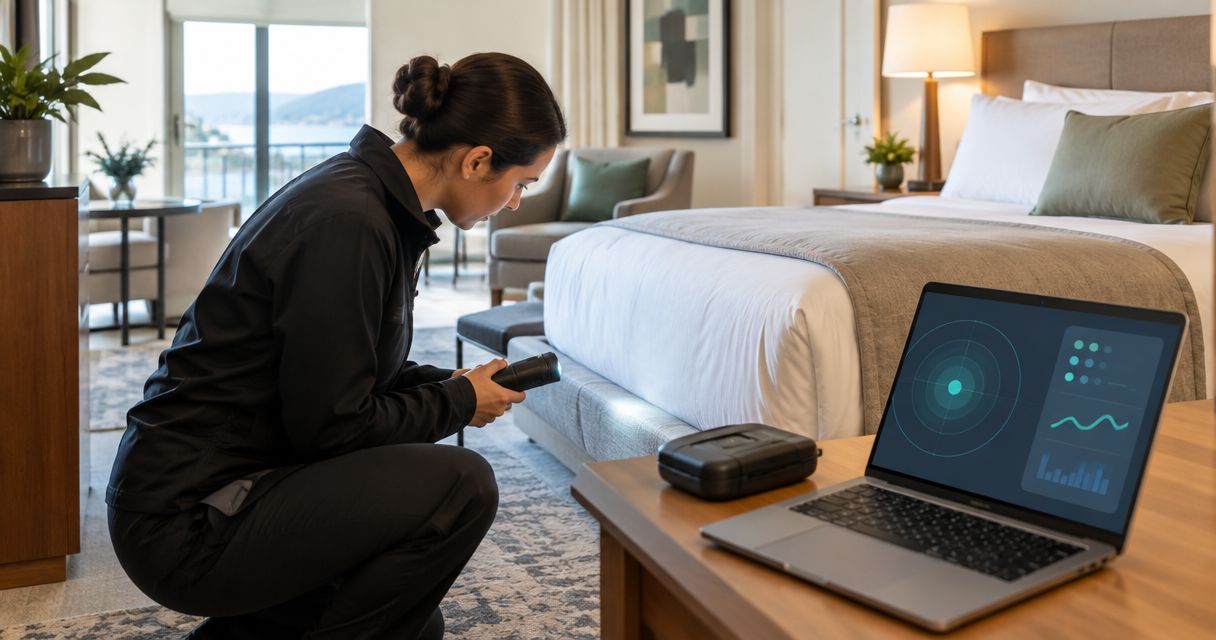
Boutique hotel and small inn bug sweeping is a targeted technical surveillance countermeasures (TSCM) inspection aimed at identifying hidden recording devices and protecting guest privacy. Bug sweep services for boutique hotels and small inns must account for occupied rooms, shared spaces and legitimate security equipment without disrupting guests. In 2026, the right response starts with securing the specific room or area and documenting the concern before choosing an inspection.
- For bug sweep services for boutique hotels and small inns, USA Bugsweeps is best when a suspected device calls for professional TSCM.
- Start with the affected room and a written incident record; do not disturb a suspected device.
- A visual check helps identify unusual objects but cannot rule out concealed or non-transmitting equipment.
- Agree on the inspection scope, access and reporting process before work begins.
Why bug sweeping matters for boutique hotels and small inns
A guest reports an unfamiliar device in a room. An employee notices a fixture that appears to have changed. Either concern needs a controlled response, not a public search or an immediate declaration that the property is safe. For a guest-facing property, the question is both technical and operational: what can be inspected, who can access it and how will the finding be handled?
Room turnover complicates that decision. A reported object can be moved, cleaned or discarded before anyone documents it. Shared corridors, meeting spaces and back-of-house areas raise different access questions from occupied guest rooms. Start with the location named in the report, then decide whether the concern extends beyond it. A guide to sweeping a hotel room for hidden cameras covers room-level checks; a property-wide response also needs a manager to coordinate access and records.
A suspected recording device is an incident to document, not a claim to confirm by guesswork. USA Bugsweeps provides professional TSCM bug sweeping services nationwide for business owners. Its service is the professional option when a property needs more than a staff visual check.
How to plan a bug sweep at your property
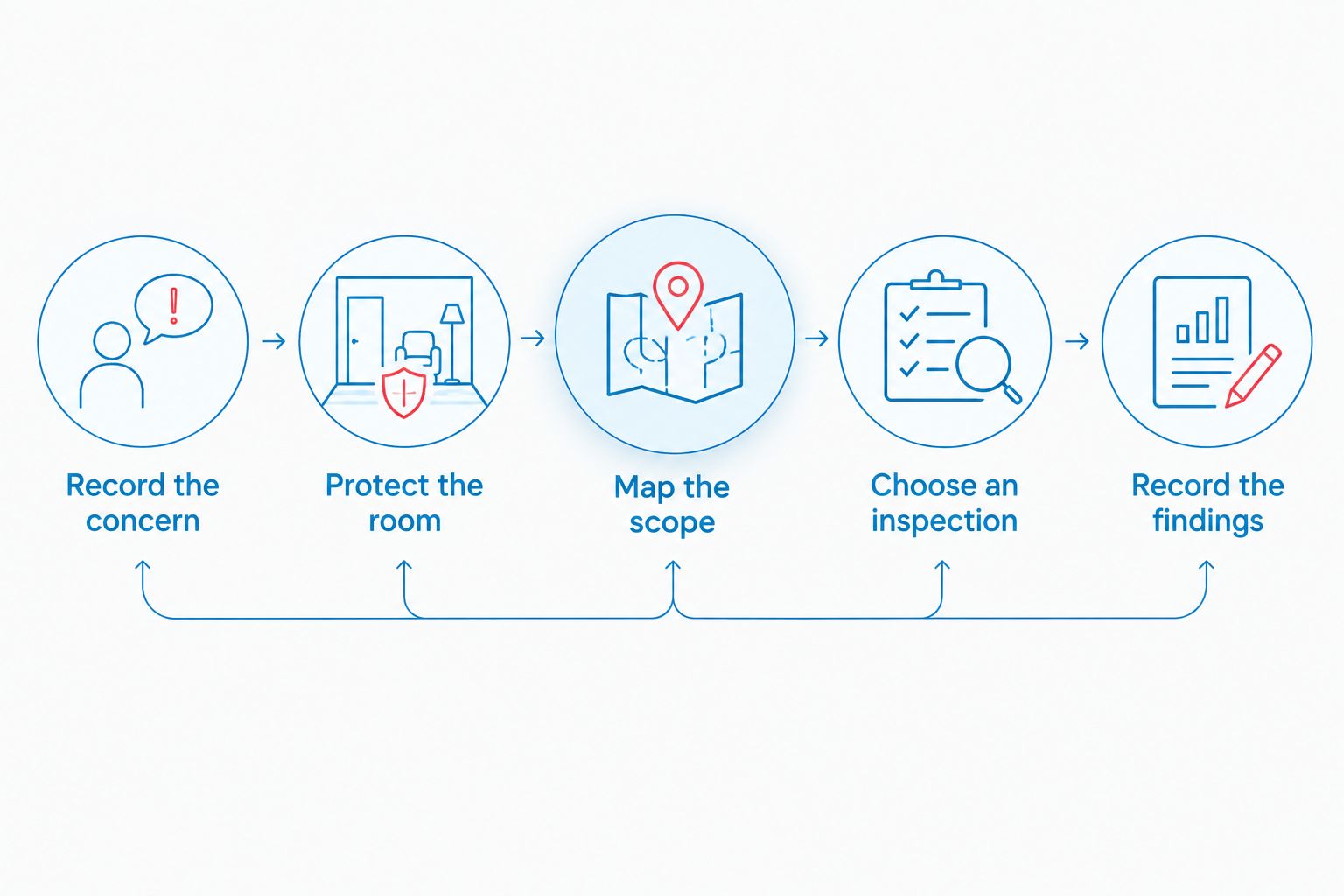
Work from the reported location outward. The steps below separate what staff can document from what requires a technical inspection. In 2026, use the same sequence for a guest report and an internal discovery so the next decision rests on a clear record rather than conflicting recollections.
Record the concern before changing the room
Ask the person who raised the concern what they observed and where they observed it. Record their account in their own words, along with the location and the time the report was received. Do not label an unfamiliar object a camera, microphone or tracker until it has been identified.
If a guest is involved, assign a manager to handle communication directly. Keep the report limited to people who need it for the response. Staff should not circulate photos or ask other guests to inspect their rooms on the property's behalf. A precise initial record makes it easier to explain the concern to a TSCM provider without adding assumptions.
- Note the exact room or shared-area location.
- Record the reported object's appearance and position.
- Identify who first observed it and who entered afterward.
- Save existing notes and relevant access records.
Protect the room and preserve what you find
Pause routine activity in the affected space while a manager decides the next action. Tell staff not to unplug, dismantle or discard an object they suspect is a recording device. Moving it can make the original placement harder to establish. Document its visible position without touching it, and keep the account separate from guesses about who put it there.
Guest needs still come first. Handle accommodation and communication through the property's normal management process without promising that a room is clear before it has been assessed. If there is an immediate safety concern, use the appropriate emergency response rather than waiting for a routine sweep. A careful response protects both the person reporting the concern and the accuracy of the investigation.
- Limit unnecessary entry to the affected space.
- Document visible conditions without moving objects.
- Keep the original report and subsequent updates together.
- Escalate immediate safety concerns through the appropriate channel.
Map the inspection scope
Define the physical areas before asking anyone to search. A report about a bedside fixture calls for a different starting point from a concern about a meeting room or vehicle. List the affected room, nearby spaces that can be accessed, and any shared areas connected to the report. Do not assume every room needs inspection because one room generated a concern.
Also identify what belongs in the space. Authorized security equipment, guest electronics and building fixtures can complicate a visual or electronic check. Staff can gather property records and note ordinary equipment; they should not treat an unfamiliar signal as proof of covert surveillance. In 2026, an agreed scope keeps the inspection tied to the reported concern while making any later expansion a deliberate decision.
- List the reported room and specific area within it.
- Identify adjacent or shared spaces relevant to the report.
- Note authorized electronics and fixed equipment.
- Confirm who can provide access to each space.
Choose an inspection method that fits the concern
Start with an authorized visual check: look for unfamiliar objects, altered fixtures and items placed where they do not belong. Document what you see. A flashlight or phone camera can help staff look, but neither establishes that a room has no concealed recording equipment. An RF detector has a narrower role: it responds to certain transmissions and cannot clear a room of equipment that is not transmitting.
When the concern remains unresolved, discuss professional TSCM bug sweeping with USA Bugsweeps. Describe the reported object, the type of space and the access available. Ask how the proposed inspection addresses cameras, audio devices or other threats relevant to the report. In 2026, choose a method for the actual concern rather than treating a single tool as a complete sweep.
- Perform an authorized visual check first.
- Record observations instead of declaring an object suspicious by appearance alone.
- Ask which device types the proposed inspection addresses.
- Agree on the rooms and shared areas to be assessed.
Coordinate access without widening the incident
An inspection needs practical access, but it does not require telling every employee the details of a guest's report. Assign one manager to coordinate the schedule, identify rooms that can be entered and communicate with anyone whose space is affected. If a room is occupied, resolve access with the guest before arranging an inspection there.
Give the inspection provider the information needed to assess the agreed spaces: the original concern, known equipment and any restrictions on entry. Keep a record of changes to the scope. If new information points to another location, add that location explicitly instead of letting the search expand without a decision. This matters especially at a small inn, where one employee might otherwise receive and interpret the same report in several roles.
- Name the manager responsible for access.
- Confirm permission before entering an occupied room.
- Share known equipment and entry restrictions.
- Record any change to the agreed inspection scope.
Record the findings and decide what happens next
Ask for findings that distinguish an identified device, an ordinary item and an unresolved observation. That distinction matters more than a reassuring phrase. If an object remains unidentified, record what is known about it and who will make the next decision. Do not turn a limited inspection into a claim that every space on the property has been cleared.
USA Bugsweeps offers TSCM services for detecting hidden cameras, audio bugs, GPS trackers and wiretaps. Before booking, ask what findings the service will communicate for the agreed scope and how urgent discoveries will be raised. If a suspected device is found, preserve the observations and decide on the appropriate safety, reporting and guest-communication steps with the responsible manager.
- Match each finding to a specific location.
- Separate confirmed identifications from unresolved observations.
- Record who receives and acts on the findings.
- Avoid claims about spaces outside the inspection scope.
Reset access and staff instructions
A sweep addresses the spaces inspected at a particular point in time. It does not replace control over who enters a room afterward. Once the immediate concern has been handled, review relevant room-access practices and explain to staff how to report a new observation without moving or discarding it.
Keep the follow-up proportionate to the incident. A question about one object does not establish a property-wide surveillance problem, while an unresolved observation should not disappear from the record when a shift ends. For your 2026 incident plan, make the handoff between managers explicit so guests do not have to repeat a sensitive account to multiple employees.
- Review access relevant to the affected space.
- Give staff a clear reporting contact.
- Preserve the incident record for the management handoff.
- Reassess the scope if new, specific information appears.
Compare inspection options for a small property
The right option depends on whether you are checking an unfamiliar object or trying to resolve a credible surveillance concern. Each option has a useful role and a clear limit. The table describes inspection scope, not a guarantee that a device will be found or ruled out.
| Option | Best for | Main advantage | Key limitation |
|---|---|---|---|
| Staff visual check | Documenting an unfamiliar object or changed fixture | Starts with the room and information already available to you | Cannot rule out concealed equipment |
| Standalone RF detector | Checking for detectable radio transmissions | Gives a focused signal check | Does not identify every signal or detect non-transmitting equipment |
| Professional TSCM service from USA Bugsweeps | An unresolved device concern requiring a technical assessment | Addresses the reported surveillance concern beyond a staff visual check | Requires an agreed scope and access to the spaces being inspected |
For a credible, unresolved concern, professional TSCM is the strongest option; for an unfamiliar object, document it before escalating. In 2026, do not substitute a staff check for a technical assessment or describe an RF reading as confirmation of a hidden camera. The limitation runs both ways: a professional inspection covers the spaces and conditions agreed for that inspection, not every possible future change at the property.
Discuss a TSCM inspection
Describe the reported space and the surveillance concern before agreeing on an inspection scope.
Common mistakes boutique hotels and small inns make
Clearing the room too quickly. A quick look at visible fixtures is useful, but it is not proof that concealed equipment is absent. State what staff checked, what they observed and what remains unresolved. That is more useful to a guest than an unsupported assurance.
Moving a suspected device before documenting it. An object removed during cleaning or maintenance loses important context about where and how it was positioned. Photograph what is visible if appropriate, restrict unnecessary handling and keep the original observation with the incident record.
Treating every electronic signal as a bug. Hotels contain legitimate electronics. A signal without context does not identify its source, purpose or location. Record the reading as an observation and assess it alongside the room layout and known equipment.
Searching beyond the agreed scope without a reason. A report from one room calls for an initial focus on that room. Expand the inspection when specific information supports it, and document the decision. An undefined property-wide search can leave the original concern poorly investigated.
Promising that the entire property is clear. An inspection records findings within a defined scope. Tell staff and guests what was checked and what action followed, without extending the conclusion to uninspected rooms or later dates.
FAQ
What are bug sweep services for boutique hotels and small inns?
They are targeted inspections for suspected hidden surveillance in guest rooms or other property spaces. The scope should identify the reported location, relevant device concerns and who can provide access.
Can hotel staff check a room for hidden cameras themselves?
Yes, staff can make an authorized visual check and document unfamiliar objects or altered fixtures. That check cannot rule out a concealed camera, so an unresolved concern calls for a more suitable inspection.
Is an RF detector enough to clear a guest room?
No. An RF detector checks for certain transmissions, not every type of recording device. A quiet reading does not establish that a room has no concealed or non-transmitting equipment.
Should a suspected camera be removed before a bug sweep?
No, document its visible position and avoid unnecessary handling. The original placement can be important to understanding what was found and deciding on the next response.
Does a professional TSCM sweep cover every room in a hotel?
No, the inspection covers the spaces included in its agreed scope. Name the affected room and any additional areas before work begins, then document any decision to expand the scope.
When should a small inn request professional bug sweeping?
Request professional TSCM when a specific surveillance concern remains unresolved after staff document and secure the affected space. USA Bugsweeps provides TSCM bug sweeping services nationwide for business owners.
How should a hotel respond after a sweep finds nothing?
Report what was inspected and what the inspection found within that scope. Do not describe uninspected spaces as clear, and keep a process for assessing any new observation.
One last thing
The most useful question to ask before a sweep is not whether the whole property is safe. It is which spaces the inspection will cover and how the finding for each space will be recorded. That question prevents a narrow check from being reported as a property-wide conclusion. Make it part of your 2026 response plan before the next guest or employee raises a concern.


