
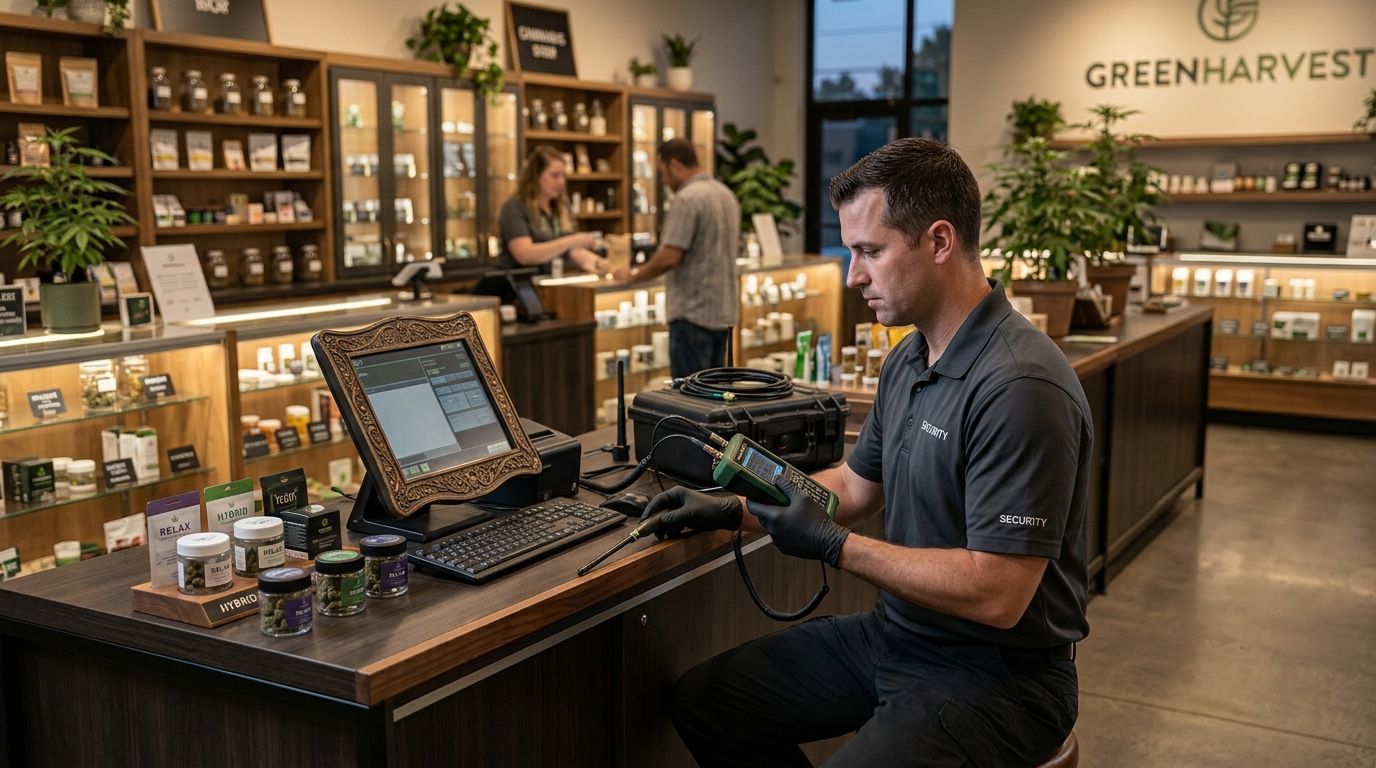
Bug sweep services for cannabis dispensaries cover a TSCM inspection of retail floors, vaults, back offices, and company vehicles to find hidden cameras, audio bugs, and GPS trackers before they cost a licensed operator cash, product, or a state compliance violation. Dispensaries carry a mix of risk that most retailers don't: heavy cash volume because federal banking access is still restricted, high-value inventory, and vendor negotiations where pricing and supply terms are worth protecting from a competitor with a planted recorder.
- Bug sweep services for cannabis dispensaries focus on the vault, manager's office, and vendor meeting rooms first, not the sales floor.
- Cash-intensive operations reporting transactions over $10,000 under IRS Form 8300 rules are a common surveillance target for internal theft.
- Professional TSCM detectors scan roughly 10 MHz to 6 GHz, covering GPS trackers, GSM audio bugs, and Wi-Fi cameras that consumer apps miss.
- USA Bugsweeps offers 24/7 quote requests and works nationwide for licensed dispensaries, cultivation sites, and processing facilities.
Why bug sweeps matter for cannabis dispensaries
Most dispensaries already run video surveillance to satisfy state cannabis regulations. That system protects the business from external threats, but it does nothing to detect a device an employee, vendor, or disgruntled ex-partner plants inside the building. A hidden audio recorder in a manager's office or a GPS tracker on a cash-transport vehicle sits outside the scope of a compliance camera network entirely.
Dispensaries that still operate largely on cash because of federal banking restrictions under IRC Section 280E carry a different risk profile than a typical retail store. Anyone with access to the count room, the safe, or vendor pricing sheets has a financial reason to want that information in real time. A TSCM sweep for a cannabis dispensary is not the same service as checking a hotel room for a camera — it has to cover cash handling zones, ownership offices, and mobile assets a standard retail sweep would skip.
How to sweep a dispensary for hidden bugs and trackers
Inspect the cash count room and vault first
This is the highest-value target in the building and the first place a sweep should start.
- Check smoke detectors, thermostats, and HVAC vents for pinhole camera lenses
- Inspect wall outlets and power strips near the counting table for modified units
- Look behind and underneath the safe or drop box for taped-on devices
- Check any USB chargers or unfamiliar cables plugged into POS terminals
- Run an RF scan across the room to catch transmitters not visible to the eye
Check the manager's office and ownership workspace
Pricing decisions, vendor contracts, and payroll conversations happen here, which makes it a target for a competitor or an insider.
- Inspect desk phones and conference speakers for internal modifications
- Check bookshelves, picture frames, and desk clocks for camera lenses
- Look for unfamiliar USB drives or adapters left in open ports
- Sweep behind wall art and vents where a transmitter can sit unnoticed
- Check any Wi-Fi access points added without IT approval
Sweep vendor and buyer negotiation rooms
Supply pricing and contract terms are worth money to a competing operator, and this room often gets less physical security than the vault.
- Check conference room speakerphones and video-call hardware for tampering
- Inspect chairs, table legs, and centerpieces for planted recorders
- Ask whether outside vendors have ever installed their own AV equipment in this room
- Run a walk-through RF scan before and after any high-stakes vendor visit
Most of the checks above can be done with a flashlight, a screwdriver, and a basic RF detector app on a smartphone — that catches the obvious devices. It won't catch a bug that's off or on a delayed transmission cycle, which is where a trained TSCM technician using professional RF detectors and non-linear junction detection equipment finds what a phone app misses.
Inspect company vehicles used to transport cash or product
GPS trackers planted on a delivery van or cash-transport vehicle can map routes, timing, and drop locations for weeks before anyone notices.
- Check the undercarriage near the wheel wells and bumper for magnetic tracker units
- Inspect the OBD-II port for unfamiliar plug-in devices
- Look inside the glove box, under seats, and behind trim panels
- Check the trunk or cargo area lining for taped-on units
- Have a technician run a wired-and-wireless sweep on any vehicle used for regular cash runs
Check employee break rooms and bathrooms
Dispensary staff have raised complaints in other retail sectors about hidden cameras in break rooms and staff bathrooms, and cannabis retail is not exempt from that risk.
- Check smoke detectors and air fresheners for camera modifications
- Inspect any decor added by a specific manager rather than corporate
- Look for new electrical outlets or extension cords with no clear purpose
- Confirm bathroom fixtures haven't been swapped for camera-equipped versions
Sweep phone lines and the network closet
A compromised phone system or router can leak call audio and data traffic without anyone touching a physical device inside a room.
- Check punch-down blocks and phone jacks for inline tap devices
- Inspect the network closet for unfamiliar routers, switches, or splitters
- Confirm VoIP call logs match expected call volume and destinations
- Check for unauthorized remote-access software on office computers
Comparing your options for a dispensary bug sweep
| Option | Best for | Key limitation |
|---|---|---|
| Free RF detector app | A quick check after a suspicious visitor or vendor meeting | Misses devices on delayed transmission or wired taps entirely |
| Consumer RF detector device | Ongoing self-checks by security staff between professional sweeps | Limited frequency range compared to professional-grade equipment |
| Professional TSCM sweep (USA Bugsweeps) | Full vault, office, vehicle, and network inspection for licensed operators | Requires scheduling a technician rather than an on-demand check |
| Private investigator | Investigating a specific suspected leak or individual | Not equipped for a full RF spectrum sweep of a facility |
Verdict: a licensed dispensary handling daily cash over $10,000 in reportable transactions should schedule a professional TSCM sweep, not rely on a consumer app as the only line of defense.
Common mistakes dispensaries make with bug sweeps
- Sweeping only the sales floor and skipping the vault, manager's office, and vendor meeting rooms where the real financial exposure sits
- Assuming compliance cameras cover this risk — state-mandated video surveillance protects against external threats, not an internally planted audio bug
- Never sweeping cash-transport vehicles, leaving GPS trackers on delivery vans undetected for weeks
- Treating a one-time sweep as permanent protection instead of re-sweeping after any vendor visit, contractor work, or staff turnover
- Relying on a free phone app alone, which misses wired taps and dormant transmitters that a professional non-linear junction detector catches
FAQ
How much does a bug sweep for a cannabis dispensary cost?
Cost depends on square footage, number of rooms, and whether vehicles are included, so get a direct quote for the specific location. USA Bugsweeps offers 24/7 quote requests for nationwide TSCM sweeps.
Do dispensary compliance cameras replace the need for a bug sweep?
No. Compliance cameras monitor the sales floor for regulatory purposes and do nothing to detect a hidden microphone or camera planted in the vault or manager's office by an insider.
Can a free phone app find a hidden bug in a dispensary?
A free RF detector app can catch an actively transmitting device during a scan, but it misses wired taps, dormant transmitters, and devices operating outside its limited frequency range.
Why are cannabis dispensaries a target for hidden surveillance?
Federal banking restrictions under IRC Section 280E keep many dispensaries cash-heavy, and any transaction over $10,000 requires IRS Form 8300 reporting, making cash handling areas a high-value target for planted devices.
Should company vehicles used for cash transport be swept for GPS trackers?
Yes. A magnetic GPS tracker on the undercarriage of a delivery or cash-transport vehicle can map routes and timing for weeks before anyone finds it during a routine wash or inspection.
How often should a dispensary schedule a professional TSCM sweep?
Re-sweep after any vendor visit, contractor work, staff turnover, or suspected leak, in addition to a baseline sweep when the facility opens or is renovated.
What frequency range do professional bug sweeps cover?
Professional TSCM detectors typically scan from roughly 10 MHz up to 6 GHz, which covers the bands used by GPS trackers, GSM audio bugs, and Wi-Fi-connected cameras.
Is a private investigator the same as a TSCM technician?
No. A private investigator researches a specific suspect or incident, while a TSCM technician runs a full radio frequency sweep of a facility using specialized detection equipment.
One last thing
The count room gets swept first in almost every case, but the vendor negotiation room is the one operators skip most often — and it's where pricing leverage actually leaks. If a competitor knows your supply cost before the next contract renewal, the loss shows up on a margin line, not a security report. Schedule the sweep before the next big vendor meeting, not after a problem shows up in the numbers.


