
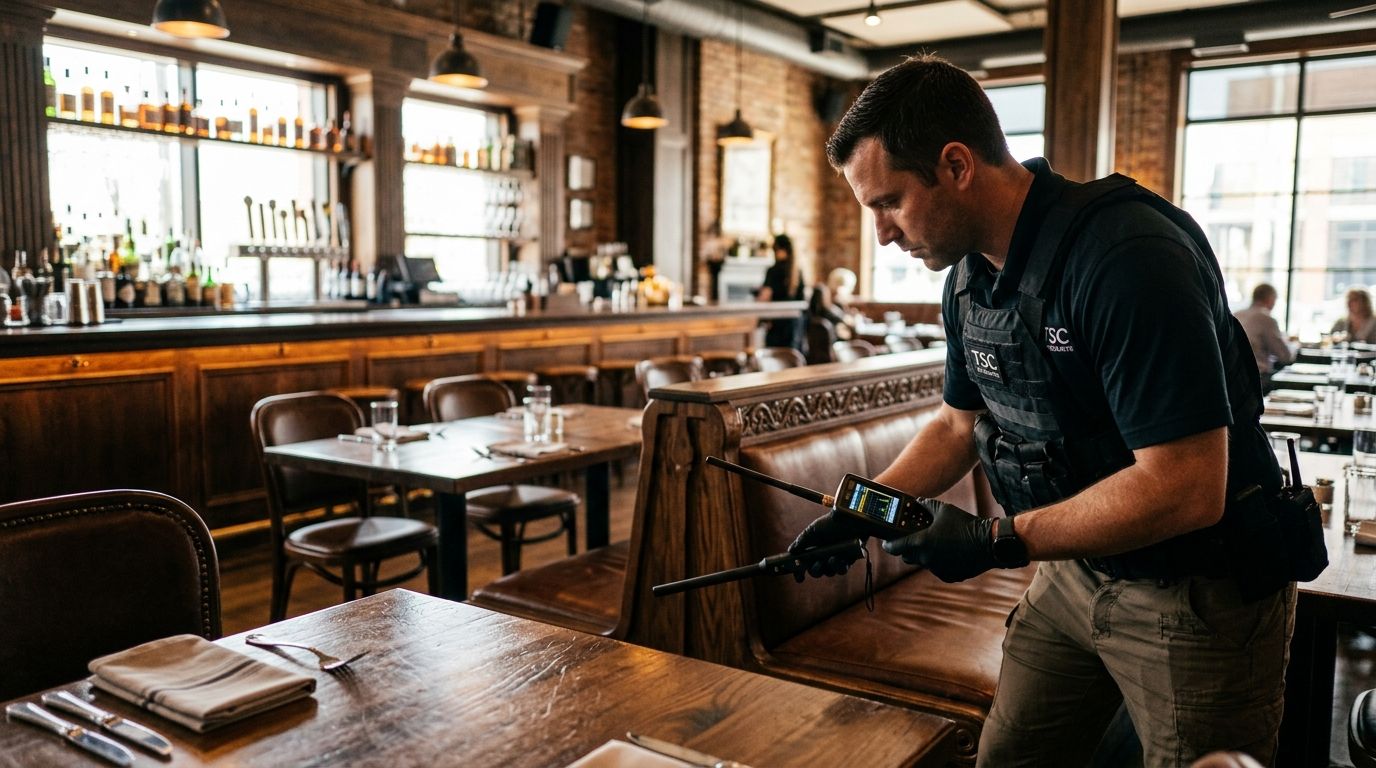
Restaurant and bar owners call USA Bugsweeps most often after a specific incident: a fired manager who still knows the security codes, a competitor who suddenly matches every menu change, or a landlord dispute that turns into a lawsuit. Restaurants and bars carry unique exposure because private dining rooms, offices, and break rooms sit twenty feet from public seating, and a hidden device planted by a disgruntled employee or a rival owner is cheap, small, and easy to overlook during a normal walkthrough.
- USA Bugsweeps runs full-property TSCM sweeps for restaurants and bars covering dining rooms, kitchens, offices, and registers.
- Bug sweep services for restaurants matter most after staff turnover, franchise disputes, or a sudden leak of pricing and recipe data.
- RF detectors catch active transmitters but miss passive recorders hidden in smoke detectors or outlets — a full sweep needs both.
- Back offices and register areas are the top hiding spots because they hold cash counts, POS data, and manager conversations.
- A professional TSCM sweep in 2026 typically covers the full property in a single visit, not just one room.
Why bug sweep services for restaurants matter
A restaurant's private dining room, manager's office, and register area hold the same sensitive conversations a law office or medical clinic protects — vendor pricing, payroll, franchise negotiations, health inspection prep, sometimes staff disputes that end up in litigation. The difference is exposure: restaurants and bars have constant foot traffic from vendors, delivery drivers, contractors, and rotating part-time staff, and any one of them can plant a device in under a minute.
Disgruntled former employees are the most common source of planted devices in this industry. A manager terminated for cause, a bartender cut after a dispute over tips, or a chef who left to open a competing spot all had legitimate access to the building before they had a reason to spy on it. That access history is exactly why bug sweep services for restaurants focus first on rooms with limited camera coverage and easy physical access: offices, break rooms, and restrooms.
Inspect high-risk zones first
Start with the rooms that combine privacy and easy access — the two conditions every hidden device needs.
- Manager's office and any room where cash counts happen
- Private dining rooms used for investor meetings or franchise calls
- Employee restrooms and break rooms
- Storage rooms with outlets and low foot traffic
- Any office phone or landline extension used for reservations or vendor calls
Check the back office and register area
The back office is where nightly deposits get counted, payroll gets discussed, and franchise or lease disputes get argued over the phone. It is the single highest-value room in the building for anyone trying to record you.
- Check behind and under desks for USB-style audio recorders
- Inspect wall outlets near the register for devices with an unusual second plug
- Look inside desk drawers and file cabinets for recorders taped to the underside
- Check smoke detectors and clocks in the office for pinhole camera lenses
- Review the POS terminal area for unfamiliar cables or adapters
Scan phone lines and the Wi-Fi network
A tapped landline or a rogue device riding your guest Wi-Fi can pull vendor pricing, reservation data, and private conversations without anyone setting foot in the building twice. If your restaurant still runs a landline for reservations or point-of-sale backup, treat it as a target.
- Check the phone line at the network interface box outside the building
- Look for unfamiliar devices connected to the router's admin panel
- Compare current connected-device counts against a baseline from a slow week
- Test call quality for clicking, static, or volume drops during calls
Read the full breakdown on how to tell if your office phone system is tapped if a landline still runs through your back office.
Search staff areas and break rooms
Break rooms and staff restrooms are the rooms owners check last and intruders target first, because staff assume management doesn't watch there. That assumption is exactly what makes it a soft target for a device planted by another employee.
- Check vents, smoke detectors, and light fixtures for pinhole lenses
- Inspect coat hooks, lockers, and shelving for objects that don't belong
- Look for unfamiliar chargers or power strips plugged into wall outlets
- Check the underside of break tables and benches
A gym or spa faces the same staff-area exposure with a similar layout problem — see hidden camera detection for gym and spa owners for the parallel checklist.
Review vendor and contractor access
Every vendor, delivery driver, and contractor who has walked through your kitchen or storage room in the past 12 months had unsupervised minutes near an outlet or a shelf. Most are harmless. A handful, particularly ones connected to a competitor or a soon-to-be-former business partner, are not.
- Log who has keys, codes, or standing access to storage and office areas
- Flag any vendor relationship that ended on bad terms in the past year
- Check storage rooms after any contractor visit, not just after suspicion arises
- Rotate access codes any time a manager or key holder leaves
A retail operation deals with the same break room and vendor exposure — bug sweep services for retail stores and break rooms covers the retail version of this same risk.
Run an RF detector sweep across the property
An RF detector catches devices actively transmitting a signal — live Wi-Fi cameras, cellular audio bugs, and Bluetooth trackers. It will not catch a passive recorder with no transmitter, which is why an RF pass is a first layer, not a full sweep.
- Walk the property slowly with the detector at chest height, room by room
- Pay extra attention near outlets, smoke detectors, and wall clocks
- Note any spike and investigate the source before moving on
- Repeat the pass during both open and closed hours, since some devices only transmit on a schedule
For a deeper look at how to find a hidden camera in a smoke detector, the smoke detector is consistently the most common hiding spot found in commercial sweeps.
Bring in a professional TSCM sweep
A DIY RF pass and a visual inspection catch obvious devices. They miss passive recorders, devices in standby mode, and anything hidden inside wiring or fixtures that requires disassembly to find. USA Bugsweeps runs full-property TSCM sweeps that combine RF detection, physical inspection, and network analysis in a single visit, which is the difference between checking a few rooms and clearing the entire building.
Schedule a restaurant bug sweep
Get a full-property TSCM sweep quote for your restaurant or bar.
Comparing your options
| Option | Best for | Key limitation |
|---|---|---|
| Visual inspection by staff | Catching obvious, poorly hidden devices | Misses anything inside fixtures or wiring |
| Consumer RF detector app | A quick first-pass check on a budget | Misses passive recorders with no active signal |
| Dedicated RF detector (owned or rented) | Regular self-checks between professional sweeps | Requires training to read signal spikes correctly |
| Professional TSCM sweep (USA Bugsweeps) | Full-property clearance after an incident or suspicion | Not a recurring free service; scheduled per visit |
A restaurant or bar with a single recent incident — a manager fired for cause, a franchise dispute, a competitor suddenly matching your specials — should book a professional TSCM sweep, not just run the free options. Ongoing peace of mind between incidents is where a dedicated RF detector earns its place.
Common mistakes restaurant and bar owners make
- Checking only the dining room. The office, break room, and register area carry far more sensitive audio than the tables ever will.
- Assuming the alarm system covers it. A security camera system watches for theft, not for a hidden recorder someone else planted inside your own building.
- Waiting for a second incident before acting. Most owners who get burned twice had a clear warning sign after the first one and dismissed it.
- Skipping the phone line because "nobody uses landlines anymore." Reservation lines and POS backup lines are still common in 2026 and still a viable tap target.
- Sweeping once and calling it done. Staff turnover, new vendors, and franchise disputes reset your exposure; a single 2026 sweep doesn't cover 2027.
FAQ
How much does a bug sweep cost for a restaurant?
Cost depends on square footage, number of rooms, and whether the sweep covers the full property or specific rooms. Get a direct quote through USA Bugsweeps rather than relying on a flat industry number, since restaurant layouts vary widely.
What's the best way to check a restaurant for hidden cameras?
Combine a visual inspection of smoke detectors, outlets, and fixtures with an RF detector sweep, then follow up with a professional TSCM sweep if anything seems off. Visual checks alone miss devices with no active transmission.
Can a former employee legally plant a hidden camera in my restaurant?
No — planting a hidden recording device in a private area like an office or break room without consent is illegal in most states, even for someone who previously had legitimate access. A professional sweep documents the device if one is found, which supports any legal action afterward.
Do restaurants need bug sweeps more than other businesses?
Restaurants face higher turnover and more vendor and contractor foot traffic than many other commercial spaces, which raises the odds of a device being planted by someone with brief legitimate access. That doesn't make every restaurant a target, but it raises the baseline risk compared to a low-traffic office.
Is a phone line still worth checking in 2026?
Yes — any restaurant still running a landline for reservations or POS backup should check it, since a tapped line can expose vendor pricing and manager conversations without anyone entering the building.
How often should a restaurant get a professional TSCM sweep?
Sweep after any specific trigger — a termination, a franchise dispute, or a suspicious leak of internal information — rather than on a fixed calendar. Ongoing self-checks with a dedicated RF detector can fill the gaps between professional visits.
What rooms get missed most often in a restaurant bug sweep?
Break rooms and staff restrooms get missed most often because owners assume nobody would bother recording there. Smoke detectors and wall clocks in these rooms are the most common hiding spots found in commercial sweeps.
One last thing
The office phone line and the smoke detector in the back office are the two spots that turn up the most in commercial TSCM sweeps, and both are cheap for anyone to plant a device in and expensive for you to ignore. If your restaurant or bar hasn't had a full-property sweep since before your last manager change, that gap alone is reason enough to schedule one in 2026.


