
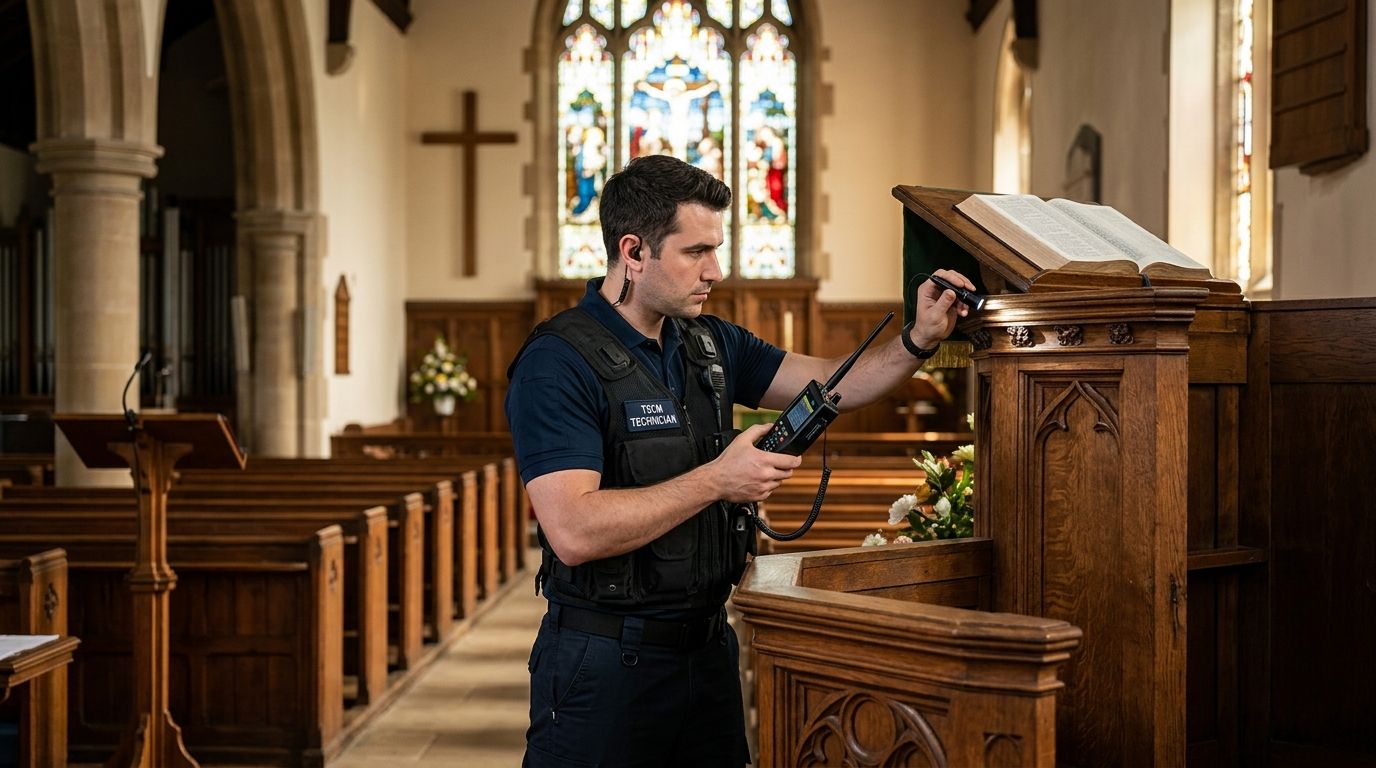
Bug sweep services for churches and religious groups locate hidden cameras, audio recorders, and wireless transmitters planted in sanctuaries, offices, nurseries, and counseling rooms. Congregations handle confidential pastoral conversations, financial records, and vulnerable populations — kids in nursery care, counseling sessions, custody-sensitive family situations — which makes them a different sweep target than a typical office building.
- Bug sweep services for churches focus on pastoral offices, nurseries, and finance rooms, not just the sanctuary.
- Wireless spy cameras and audio recorders operate on common frequency bands an RF detector can catch in one pass.
- USA Bugsweeps runs nationwide TSCM sweeps for religious organizations covering audio, video, and GPS threats.
- Volunteer and part-time staff turnover raises the risk of undocumented devices left behind in shared spaces.
Why this matters
Churches operate with a mix of paid staff, volunteers, and rotating access — nursery workers, youth ministers, visiting clergy, AV techs, cleaning crews. Every one of those people has had a key, a badge, or an unsupervised hour in a room at some point in 2026. That access pattern is exactly what makes churches a soft target for hidden devices compared to a corporate office with badge logs and camera coverage on every door.
Pastoral counseling rooms hold some of the most sensitive conversations that happen anywhere — infidelity, addiction, abuse disclosures, financial hardship. A recorder in that room isn't hypothetical paranoia; it's the same risk category attorneys and therapists sweep for, and churches carry it without the professional privilege protections a law office has. USA Bugsweeps treats religious facilities the way it treats law firms and medical offices: rooms where a recording device causes real legal and personal harm, not just embarrassment.
Why bug sweep services matter for churches and religious groups
The risk isn't uniform across the building. A sanctuary with an open floor plan and constant foot traffic is a low-value target for a hidden camera — too many witnesses, too little privacy captured. The pastor's office, the finance committee room, the nursery changing area, and any single-occupant restroom are the higher-value targets because they capture something worth recording: confidential talk, financial numbers, or images of children and staff in private moments.
News coverage over the past several years has repeatedly surfaced hidden cameras placed in restrooms and changing areas at schools and other youth-serving institutions — the same category of risk applies anywhere children are supervised in semi-private spaces, including church nurseries and youth group rooms. That precedent is why hidden camera detection for daycare and childcare centers and church nursery sweeps use the same protocol: fixture-by-fixture inspection of smoke detectors, outlets, clocks, and stuffed animals, plus an RF scan for anything transmitting.
Church governance adds a second layer. Elder boards, finance committees, and building committees handle donor records, salary discussions, and property disputes — the same dynamics that make HOA and condo board meetings a common sweep request. Internal politics inside a congregation can get contentious enough that someone wants a recording of a closed-door vote.
Inspect the sanctuary and worship areas
Start with the space where the most people gather, even though it's usually the lowest-risk room in the building.
- Check AV booth equipment and mixing boards for unfamiliar cables or add-on devices
- Inspect speaker cabinets, light fixtures, and rafters for anything not tied to the sound or lighting system
- Look at donation boxes and offering plates for tampering or added hardware
- Sweep the stage area and pulpit microphone for unauthorized wireless transmitters
- Check exposed wiring near the baptistry or choir loft for splices that don't belong
Sweep pastoral and counseling offices
This is the highest-priority room in most churches because of what gets said inside it.
- Physically inspect desk items, bookshelves, and wall décor for pinhole camera lenses, which can be as small as 1-2mm and hide inside a smoke detector, clock, or picture frame
- Check phone systems and desk phones for line taps, especially on shared or older analog systems
- Scan power outlets and USB chargers for hidden audio recorders disguised as everyday hardware
- Run an RF detector across the room to catch active wireless transmitters in the 1 MHz to 6 GHz range most consumer spy devices use
- Confirm the room's Wi-Fi network isn't broadcasting an unfamiliar device name that could be a hidden camera phoning home
Check finance and administrative offices
Donor records, payroll, and bank account access make this room a target for financial motives, not just personal ones.
- Inspect computer peripherals — keyboards, USB hubs, monitor stands — for keyloggers or hidden recording hardware
- Check filing cabinets and safes for devices planted during after-hours access
- Review who has had physical key or code access in the last 12 months and cross-reference with staff turnover
- Sweep desk phones and any VoIP hardware the same way you would check an office phone system for taps
- Look for unfamiliar smart devices — speakers, plugged-in air fresheners, USB fans — that weren't purchased by the office
Inspect nurseries and children's ministry spaces
These rooms carry the most reputational and legal exposure if a hidden device is ever found.
- Check every stuffed animal, mobile, and decorative item for a lens or blinking LED
- Inspect changing tables, cribs, and diaper bag storage areas fixture by fixture
- Confirm existing nursery security cameras are documented, disclosed to parents, and not exceeding their approved coverage area
- Sweep single-occupant restrooms used by children for pinhole cameras in vents, outlets, and hooks
- Review volunteer background check and access records for anyone who worked unsupervised shifts
Scan the vehicle fleet and property vehicles
Churches with vans, buses, or a pastor's assigned vehicle should treat GPS tracking as a separate risk category from audio and video.
- Check under the vehicle chassis and inside wheel wells for magnetic GPS trackers
- Inspect the OBD-II port for unauthorized plug-in tracking devices
- Review any fleet-tracking software the church has knowingly installed and confirm it matches what's actually broadcasting
- Check trunk liners, spare tire wells, and bumper cavities on the pastor's vehicle if there's a specific safety concern
When the manual checklist turns up something suspicious — or when leadership wants a documented, professional-grade sweep before a sensitive meeting or after a break-in — a licensed TSCM technician with lab-grade equipment finds what a visual inspection and a consumer detector miss.
Get a bug sweep quote for your church
Nationwide TSCM sweeps for sanctuaries, offices, and nurseries.
Comparison of sweep options for churches
| Option | Best for | Key limitation |
|---|---|---|
| Self-inspection checklist | Small congregations doing routine visual checks | Misses RF-active and well-hidden devices |
| Consumer RF detector | One-time scan of a single office or counseling room | Limited sensitivity compared to lab-grade TSCM equipment |
| Professional TSCM sweep | Full-building sweeps, post-incident response, board-level assurance | Requires scheduling a licensed technician on-site |
| Security camera audit only | Churches confirming their own installed cameras are documented and disclosed | Doesn't detect unauthorized third-party devices |
A professional TSCM sweep is the only option on this list that catches an actively transmitting device a visual inspection and a low-end RF detector both miss.
Common mistakes churches make
- Treating the sanctuary as the priority room. The highest-risk spaces are pastoral offices, nurseries, and finance rooms — not the open worship area.
- Assuming volunteers carry the same accountability as paid staff. Volunteer access rotates faster and gets documented less consistently, which widens the window for an undisclosed device.
- Never auditing their own security cameras. Churches add nursery and parking-lot cameras over the years without a central list of what's active, where it points, and who can access the footage.
- Skipping a sweep after a break-in or vandalism incident. Physical entry is the easiest opportunity to plant a device, and most churches only check for stolen property, not planted hardware.
- Waiting until after a controversy to sweep the boardroom. By the time a congregational dispute or a leadership investigation is underway, a device planted earlier has already done its damage.
FAQ
Do churches really need bug sweep services?
Yes, especially for pastoral counseling offices, nurseries, and finance committee rooms where confidential conversations and financial records are handled. Churches have the same recorder and hidden-camera exposure as law offices and medical practices, without the same access controls.
What's the best way to check a nursery for hidden cameras?
Physically inspect every stuffed animal, mobile, outlet, and changing table for a lens, then run an RF detector to catch anything actively transmitting. Cross-reference existing security cameras against a documented list so nothing unaccounted for is on the network.
Is a consumer RF detector enough for a church office?
A consumer RF detector catches active wireless transmitters but misses devices that are off, recording to internal storage, or operating below its sensitivity threshold. A licensed TSCM technician uses lab-grade equipment that finds both active and passive devices.
How often should a church sweep its offices?
Sweep after any break-in, staff termination, or major congregational dispute, and consider an annual sweep for pastoral offices and finance rooms given ongoing volunteer and staff turnover in 2026.
Can hidden cameras really end up in church restrooms?
Hidden cameras placed in restrooms and changing areas have been documented repeatedly in schools and other youth-serving facilities, and single-occupant restrooms used by children anywhere carry that same risk. Church nurseries and youth group restrooms should be included in any sweep checklist.
Who should perform a bug sweep for a religious organization?
A licensed TSCM technician with nationwide coverage, like USA Bugsweeps, performs the full-building sweep; a volunteer or staff member can run the initial visual checklist between professional visits.
What rooms matter most in a church bug sweep?
Pastoral and counseling offices rank highest because of confidential conversations, followed by finance offices for financial exposure and nurseries for child-safety exposure. The open sanctuary is typically the lowest-risk room.
One last thing
The room congregations worry about least — the pastor's private office — is the one that carries the most legal exposure if a recorder ever turns up there. Prioritize that room and the nursery over the sanctuary every time you schedule a sweep in 2026, because that's where a hidden device does the most damage and gets discovered the least.


