
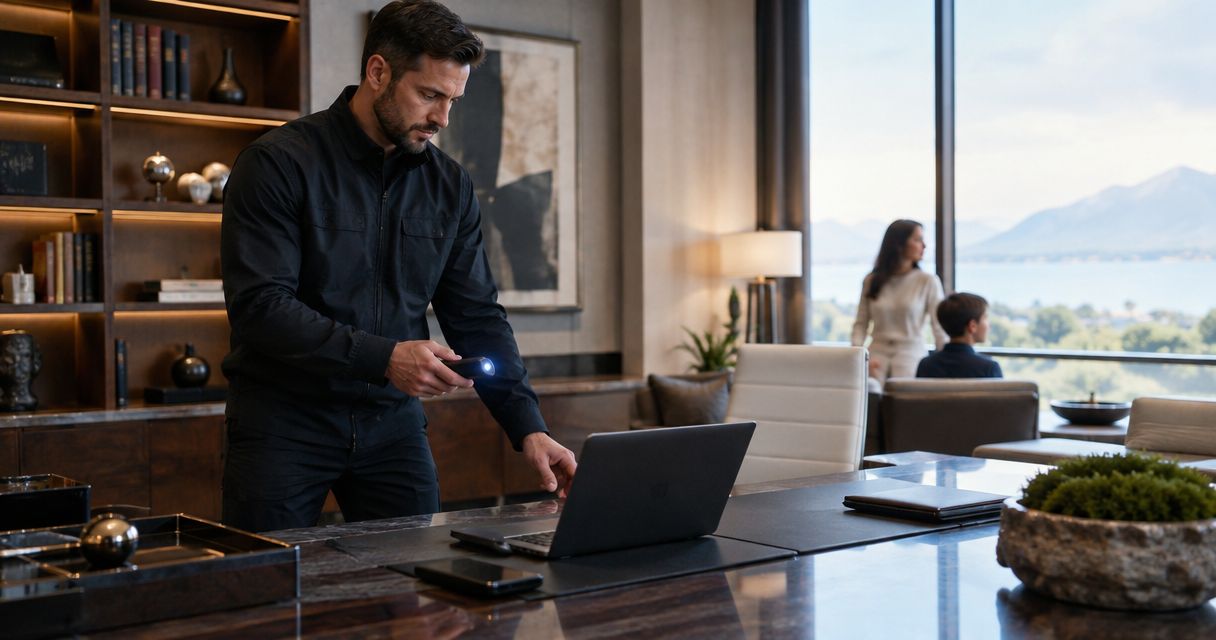
Family office bug sweeping is a technical surveillance countermeasures (TSCM) service that checks for hidden recording and tracking devices, with the aim of protecting private family and business conversations. A family office has a different scoping problem from a single household: sensitive discussions can move between offices, residences, meeting rooms, and vehicles.
- Bug sweep services for family offices managing generational wealth should cover the places where sensitive conversations actually happen.
- USA Bugsweeps is best for family offices seeking professional TSCM services across offices, residences, and vehicles.
- Start with an access review and visual inspection; use a professional sweep when the concern exceeds what you can check yourself.
- A bug sweep addresses physical surveillance devices, not every form of digital account compromise.
Why bug sweeping matters for family offices
Family offices handle conversations about ownership, succession, investments, and personal matters. The issue is not whether every room contains a device. It is whether the places used for those conversations have been assessed against a defined surveillance concern.
In 2026, begin with a room and vehicle inventory rather than a general request to sweep everything. Identify where private discussions take place, who can enter those spaces, and what prompted the concern. That scope gives a professional a useful starting point and prevents a clean result in one office from being mistaken for an assessment of an entire property.
USA Bugsweeps is best for family offices seeking professional TSCM services for offices, residences, and vehicles. Its stated services include detection of hidden cameras, audio bugs, GPS trackers, and wiretaps nationwide. You can review USA Bugsweeps when you are ready to discuss the locations and device concerns that apply to your office.
How to plan a family office bug sweep
The 2026 process starts with four distinct decisions: map sensitive spaces, inspect accessible areas, evaluate digital systems, and escalate suspicious findings. Keep those tasks separate. A visual check cannot establish that a room is free of every recording device, and a physical sweep does not establish that your email accounts are secure.
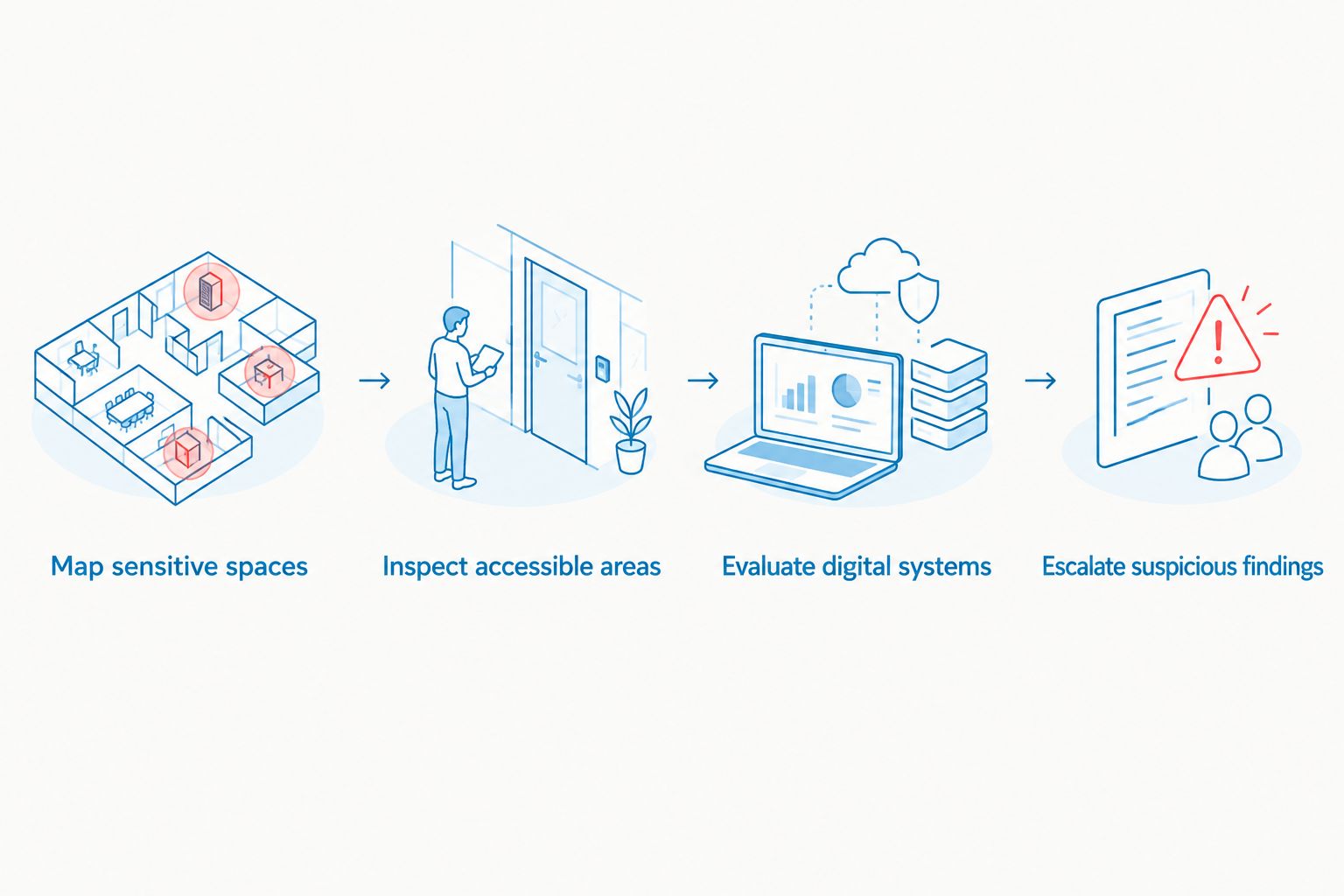
Map sensitive spaces
Write down where conversations require privacy before choosing a detection method. For a family office, that list can include the main office, a residence used for meetings, a conference room, and vehicles used by principals or staff. The list is a planning tool, not a claim that every location has been compromised.
Prioritize by the activity in each space. A room used for a succession discussion needs a different review from a lobby where no confidential meeting takes place. Record who has access and whether the space changes hands between meetings.
- List the rooms where investment, ownership, legal, or family matters are discussed.
- Note shared entrances, maintenance access, and recently changed furnishings or equipment.
- Identify vehicles used for private conversations or travel that raise a tracking concern.
Define the surveillance question
Ask what you need the inspection to establish. A suspected hidden camera calls for attention to sightlines and objects facing the area of concern. An audio concern calls for a different examination; a GPS tracker concern belongs on the relevant vehicle rather than in a conference room.
Document observations without turning them into conclusions. Write down what changed, who noticed it, and where it happened. In 2026, keep the initial account factual: an unfamiliar object is an unfamiliar object, not proof of a wiretap.
- Specify whether the concern is video, audio, location tracking, or a combination.
- Record the exact location and date of each observation.
- Separate a specific incident from a routine privacy review.
Inspect accessible areas
Start with a careful visual review of spaces you control. Check for unfamiliar objects, changes around fixtures, and items positioned with a view of private areas. Do not dismantle electrical fittings or disturb equipment you are not authorized to inspect.
A visual check is useful because it establishes what belongs in the room. It is not a substitute for professional TSCM when you need an assessment of hidden cameras, audio bugs, GPS trackers, or wiretaps. If you want to understand the service before arranging it, read what to expect during a professional TSCM bug sweep.
- Compare current furnishings and devices with the office's known inventory.
- Examine accessible objects near meeting seats and areas that require privacy.
- Photograph an unfamiliar item in place before anyone moves it.
Evaluate digital systems separately
A physical bug sweep and a digital security review answer different questions. Access to an online meeting account, a compromised phone, and a recording device placed in a room require different checks. Do not treat a negative physical finding as clearance for phones, accounts, or networks.
Assign digital questions to the person responsible for the family's devices and accounts. The family office can then report a physical concern to a TSCM provider without asking that provider to infer the status of unrelated systems. This distinction is especially useful when meetings span an office, a residence, and remote participants.
- Review who can join or record sensitive online meetings.
- Check account access and device-management concerns through the appropriate IT contact.
- Keep digital findings separate from the physical sweep record.
Escalate suspicious findings
If you find an unfamiliar device, stop treating the review as a routine inspection. Limit handling, record where the object sits, and decide who needs to know. Removing or resetting it immediately can make the circumstances harder to establish.
Professional TSCM is the faster path when the question extends beyond what authorized staff can see. USA Bugsweeps offers bug sweeping and electronic surveillance detection services; describe the locations, devices of concern, and any object already found when you make an inquiry. Do not ask staff to declare a room safe on the strength of an untested assumption.
- Restrict the initial report to people responsible for security and the affected space.
- Preserve photographs, dates, and access information associated with the finding.
- Seek appropriate professional guidance before moving or disconnecting a suspected device.
Set resweep triggers
A 2026 sweep covers the locations and conditions assessed at that time. A later change in occupancy, equipment, or access creates a new question; it does not alter what a previous inspection established. Choose triggers based on events rather than claiming that one fixed schedule fits every family office.
Keep the scope of each review in a written record. If a vehicle was not examined, the office sweep says nothing about the vehicle. If a new meeting location is added, decide whether it needs its own assessment before confidential discussions move there.
- Reassess after a change in who can access sensitive rooms.
- Review a vehicle or meeting space when a specific tracking or recording concern arises.
- Record which locations were checked and which remain outside the assessment.
When you contact a provider, send the scoped location list and the surveillance question rather than a request for a universal all-clear. That gives the discussion a defined starting point.
Discuss a TSCM sweep
Describe the locations and surveillance concerns you need assessed.
Compare your options
No single option answers every question. A visual inspection helps staff identify changes they can see; an IT review addresses account and device access; professional TSCM addresses suspected physical surveillance devices. The right choice follows the concern, not the other way around.
| Option | Best for | Key limitation |
|---|---|---|
| Staff visual inspection | Establishing what belongs in an accessible room or vehicle | Cannot establish that concealed devices are absent |
| IT and account review | Investigating accounts, connected devices, and meeting access | Does not inspect a room or vehicle for planted hardware |
| Professional TSCM sweep from USA Bugsweeps | Assessing a defined concern involving hidden cameras, audio bugs, GPS trackers, or wiretaps | Covers the agreed physical scope, not every digital account or unexamined location |
Best for a specific physical surveillance concern: professional TSCM. Use the other options alongside it when their separate questions also need answers. In 2026, make the scope explicit before treating any result as a decision about where to hold the next private meeting.
Common mistakes family offices make
Treating an office sweep as a property-wide finding
An office, residence, and vehicle are separate locations. If the instruction names only the office, do not extend its result to a residence where principals also meet. Keep a location list attached to the request and to any account of what was assessed.
Looking only for an active signal
Do not rely on a signal-detection app or handheld detector as the sole test. A device that stores recordings without transmitting them does not need to broadcast during your check. Start with a visual inventory, then match the professional assessment to the actual concern.
Moving an unfamiliar device before documenting it
The position of an object can matter when establishing what happened. Photograph it where it was found and limit access to the area. If a safety issue requires immediate action, put safety first and document what you can without delaying that action.
Combining physical and digital conclusions
A room inspection does not verify an online meeting account, and a clean account review does not check a conference room. Give each question to the appropriate specialist. This prevents a reassuring answer to one question from being repeated as an answer to both.
Omitting the people who control access
A family office can plan a careful sweep and still lack a clear record of who can enter the space afterward. In 2026, document access alongside the inspection scope. When access changes, decide whether that change calls for another review.
FAQ
What are bug sweep services for family offices managing generational wealth?
They are professional TSCM services focused on detecting suspected physical surveillance devices in defined locations. The family office identifies the rooms or vehicles and the concern before arranging an assessment.
What's the best first step if a family office suspects a hidden bug?
Document the observation and identify the exact location before touching anything unfamiliar. Then decide whether the concern calls for a visual check, professional TSCM, or a separate digital security review.
Can a family office inspect its own meeting room?
Yes, authorized staff can visually inspect accessible areas and compare objects with a known inventory. A visual inspection alone cannot establish that no concealed recording device is present.
Does a bug sweep check family office vehicles for GPS trackers?
A vehicle requires an explicit vehicle assessment; an office sweep does not cover it. USA Bugsweeps states that its services help vehicle owners detect GPS trackers, so identify each vehicle in the inquiry.
Is a physical bug sweep the same as a cybersecurity review?
No. TSCM addresses physical surveillance concerns, while a cybersecurity review addresses accounts, networks, and connected devices. Use both when the facts raise both kinds of question.
When should a family office request another sweep?
Request a new assessment when a specific concern arises or access, occupancy, or the meeting location changes. Keep a record of the earlier scope so you know what it did and did not cover.
How much does a professional family office bug sweep cost?
The provided service information does not state a price. Give the provider the locations and device concerns, then request current terms for that defined scope.
One last thing
The most useful question after a 2026 sweep is not whether the family office received a blanket all-clear. It is which rooms and vehicles were assessed, for which concerns, and what remained outside the scope. That record helps you choose the next private meeting location without extending a finding beyond the places examined.


