
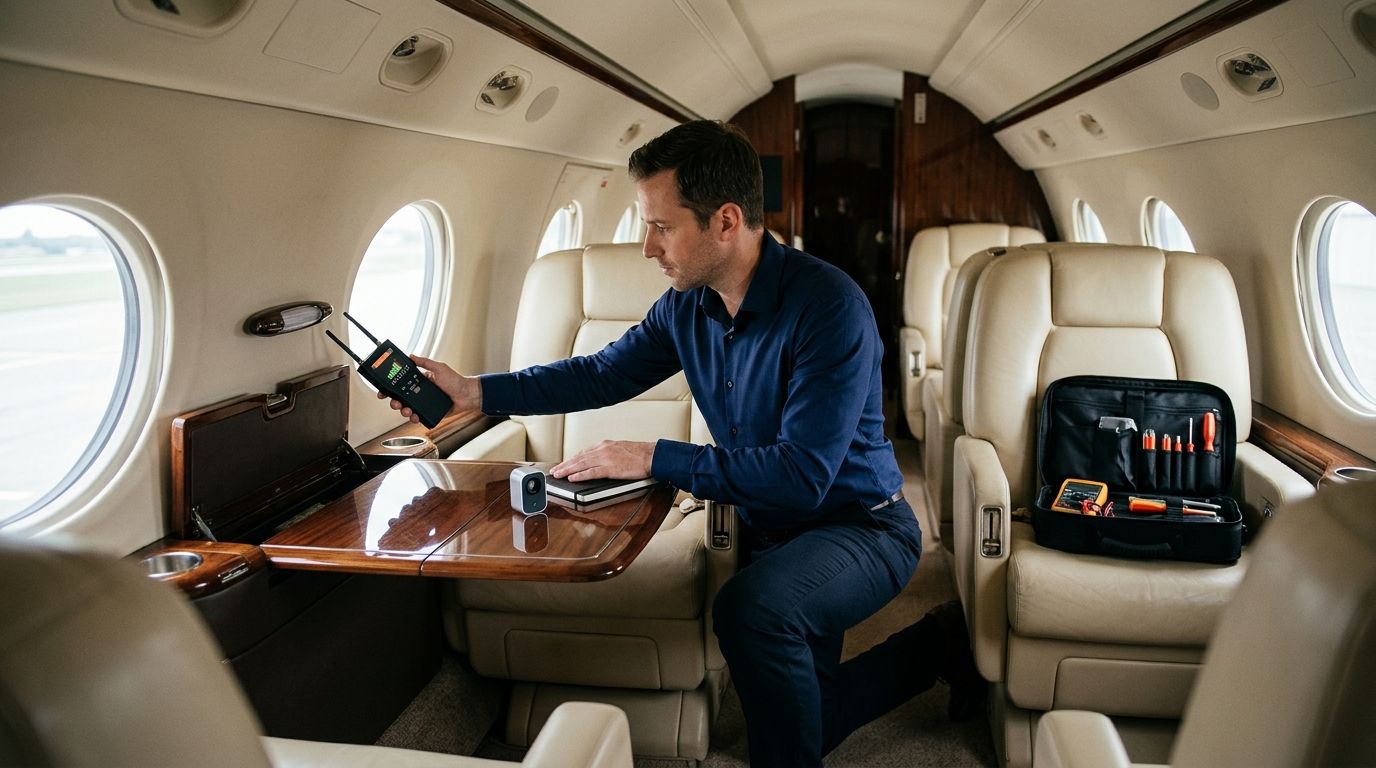
Checking a private jet for hidden surveillance means a full TSCM sweep of the cabin, cockpit, avionics bay, and baggage hold using RF spectrum analyzers, non-linear junction detectors, and a physical inspection of every panel, seat, and vent — not a visual scan alone. The hidden risk most owners miss is a passive device with no active transmitter: a hardwired tap on the cabin intercom or a recorder embedded in a USB charging port that never sends a signal a phone app can catch.
- Checking a private jet for hidden surveillance requires RF detection, non-linear junction detection, and manual inspection — phone apps alone miss passive and hardwired devices.
- Cabin USB ports, seat consoles, and cockpit avionics panels are the three most common install points on private aircraft.
- A professional TSCM sweep before and after any third-party maintenance or charter handoff is the standard practice for 2026.
- USA Bugsweeps runs full private jet counter-surveillance sweeps nationwide for owners, operators, and high-net-worth flyers.
Why this matters
A private jet is not a closed environment the way a home is. Charter crews, maintenance contractors, ground handlers, cleaning staff, and catering vendors all get cabin access between flights, and any one of them can plant a device in under two minutes.
For executives, celebrities, and anyone flying with confidential business or legal conversations onboard, an undetected bug or camera turns the aircraft into the least private room they'll sit in all week. Cabin conversations, calls placed mid-flight, and personal moments captured on a hidden camera all carry real exposure in 2026.
How to check a private jet for hidden surveillance
A proper sweep follows a fixed sequence — skipping steps is how devices get missed.
- RF spectrum scan of the full cabin and cockpit. A wideband RF detector sweeps 2.4 GHz, 5 GHz, and cellular bands to catch any device actively transmitting audio or video.
- Non-linear junction detection (NLJD) on seats, panels, and fixtures. NLJD finds electronics whether they're powered on or off — this is the step that catches a bug set to record-and-store rather than transmit live.
- Physical teardown of high-risk zones. USB charging ports, seat consoles, overhead panels, lavatory fixtures, and the galley are removed and inspected by hand.
- Thermal imaging pass. A thermal camera flags heat signatures from powered components hidden behind upholstery or trim that a visual check would miss.
- Cabin phone and intercom line check. Any hardwired phone or intercom system on the aircraft gets tested for taps, since these don't show up on an RF scan at all.
- Documentation and sign-off. A written report of every zone checked and every finding, so the aircraft has a clean baseline before its next flight.
| Method | What it catches | What it misses |
|---|---|---|
| RF spectrum scan | Active transmitters (Wi-Fi cams, Bluetooth mics) | Powered-off or hardwired devices |
| Non-linear junction detection | Any electronic component, on or off | Nothing electronic — but slower to run |
| Physical inspection | Devices hidden in panels, vents, seats | Micro devices without full disassembly |
| Thermal imaging | Heat from active hidden electronics | Devices with minimal power draw |
The verdict: a real private jet counter-surveillance check combines all four methods — an RF sweep alone leaves the passive and hardwired risks completely unchecked.
Where devices actually get planted on a private jet
Hidden devices concentrate in a handful of spots because those spots are accessible during routine turnaround service:
- USB charging ports and seat consoles — easy to swap for a modified unit with a built-in recorder.
- Overhead panels and reading light housings — enough space for a pinhole camera with a clear view of the cabin.
- Cockpit avionics bay — accessible to maintenance contractors with legitimate reason to be there.
- Cabin phone and intercom wiring — a hardwired tap needs no battery and never shows on an RF scan.
- Lavatory smoke detectors and vents — the same concealment spots used in hotel rooms and offices.
Why surveillance risk on private jets varies
Not every aircraft carries the same exposure. Risk scales with a few concrete factors:
- Charter vs. owned aircraft — a chartered jet passes through more hands between flights than one flown exclusively by its owner.
- Frequency of third-party maintenance access — every maintenance visit is an opportunity window.
- Public profile of the flyer — executives, celebrities, and public figures are disproportionately targeted, which is why counter-surveillance for celebrities and high-net-worth clients is its own service category.
- Number of crew and ground handling companies used — more vendors means more people with cabin access.
- Sensitivity of onboard conversations — legal, M&A, or litigation-related calls raise the value of a successful bug.
- Time since the last professional sweep — a jet swept once at delivery and never again carries years of unverified access.
“If a device isn't transmitting, an RF detector alone will never find it — that's what the non-linear junction step is for.”
Can a phone app detect hidden cameras on a private jet?
A phone app can flag some active Wi-Fi cameras and lens reflections, but it cannot detect hardwired devices, devices set to record-and-store rather than transmit, or anything hidden behind trim panels. Phone apps work as a quick screening tool in 2026, never as a substitute for a full TSCM sweep with RF and non-linear junction detection equipment.
How often should a private jet be swept for bugs?
A private jet should be swept before any high-stakes flight involving confidential conversations, and after any maintenance visit, charter use, or crew change where the aircraft was out of the owner's direct control. Aircraft that see frequent third-party access benefit from a recurring sweep schedule rather than a one-time check.
Is it legal to sweep your own private jet for hidden devices?
Yes — checking your own aircraft for hidden surveillance devices is legal, since you're inspecting property you own or lease. Removing a device found on an aircraft you don't own, or one tied to an active law enforcement investigation, raises separate legal questions worth confirming before touching anything.
Owners sweeping a chartered or leased aircraft can apply the same detection principles covered in best RF signal detectors for home offices, and pair the cabin pass with the audio-side checks in best hidden microphone detectors for professionals when a hardwired intercom tap is suspected.
Get a private jet counter-surveillance sweep
Nationwide TSCM sweeps for private aircraft, executives, and high-net-worth flyers.
FAQ
How do you check a private jet for hidden surveillance in 2026?
Checking a private jet for hidden surveillance in 2026 requires an RF spectrum scan, non-linear junction detection, and a physical teardown of seats, panels, and USB ports. Phone apps alone catch only active transmitters, missing hardwired or powered-off devices entirely.
What is the best way to find a hidden camera on a private jet?
The best way to find a hidden camera on a private jet combines an RF detector for active Wi-Fi cameras with a physical inspection of overhead panels, smoke detectors, and reading light housings where lens-based cameras get concealed. A thermal imaging pass adds a check for powered devices that are not transmitting.
Can a GPS tracker be hidden on a private jet?
A GPS tracker is far less common on aircraft than in ground vehicles since flight movements are already tracked, but unfamiliar hardwired devices tied to avionics access remain a risk during maintenance windows. Any wiring that does not match the aircraft's documented configuration gets inspected during a sweep.
Is a private jet more at risk for bugs than a hotel room?
A private jet limits access to a smaller group of known vendors than a hotel room, but the stakes are usually higher because onboard conversations tend to be confidential business or legal discussions. Charter aircraft, with more turnover between flyers, carry closer exposure to hotel-room-level risk.
Who should sweep a private jet for hidden devices?
A professional TSCM technician with RF spectrum analyzers and non-linear junction detection equipment should sweep a private jet, since consumer-grade detectors miss hardwired and passive devices. USA Bugsweeps runs full aircraft bug sweeps nationwide for owners and operators.
Do charter companies sweep jets between flights?
Most charter operators do not include a dedicated TSCM sweep in standard turnaround service. Flyers with confidential conversations onboard should arrange an independent sweep rather than assume the operator has covered it.
How long does a private jet bug sweep take?
A full private jet sweep covering cabin, cockpit, and baggage hold with RF, non-linear junction detection, and physical inspection takes considerably longer than a visual check, because every panel and console is opened. Exact time depends on aircraft size and the number of access points.
What should you do if you find a hidden device on your aircraft?
Leave the device in place, photograph it, and contact a TSCM professional and your attorney before removing anything. Pulling a device destroys placement evidence and can compromise any legal action that follows.
One last thing
The cabin phone and intercom line is the single most overlooked check on a private jet sweep — it's hardwired, it never appears on an RF scan, and most owners read a clean RF result as an all-clear. It isn't.


