
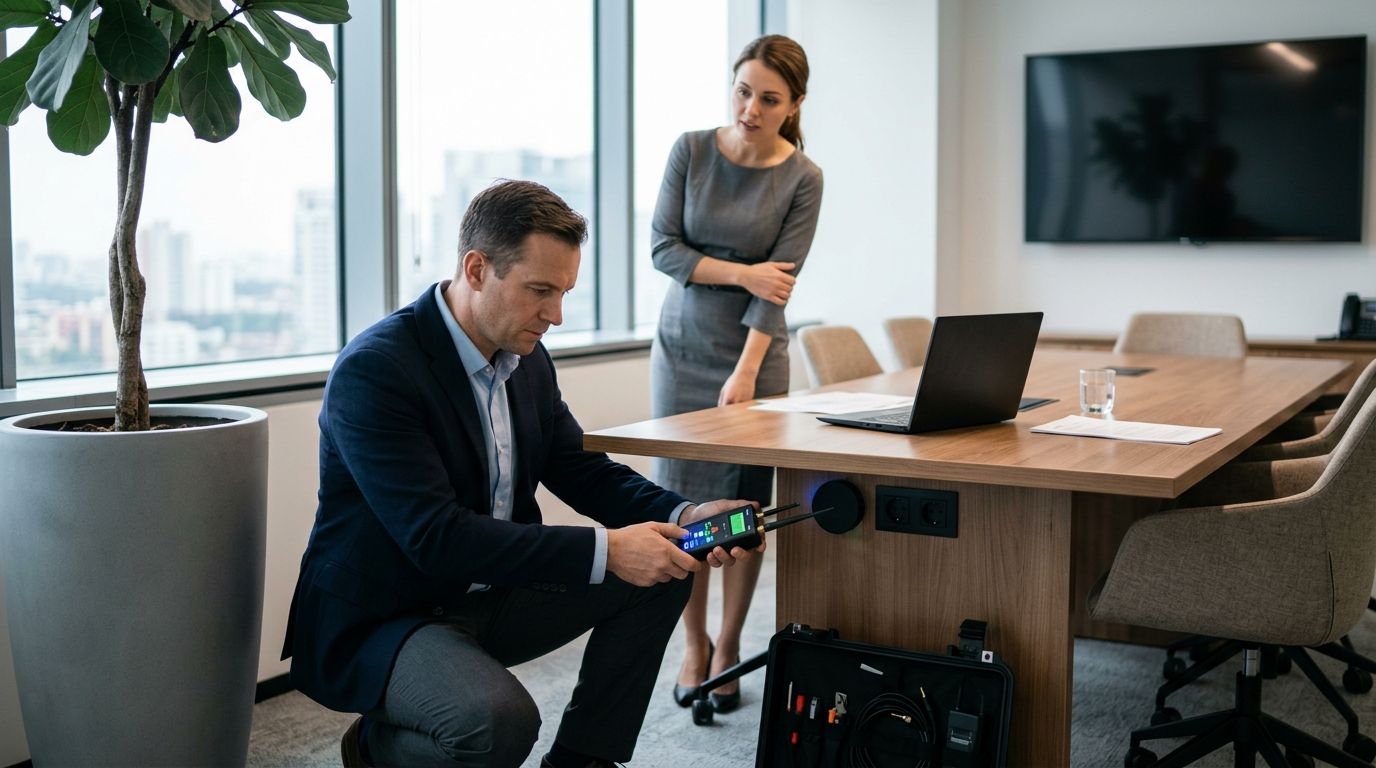
HR workplace investigation bug sweeping is the technical search for hidden cameras, audio bugs, GPS trackers, and wiretaps, with the aim of protecting confidential evidence and interviews. In 2026, HR teams need a controlled TSCM process that covers interview rooms, work devices, vehicles, and communication systems rather than treating the assignment as a standard corporate boardroom sweep.
- Bug sweep services for HR workplace investigations should begin before confidential interviews, disciplinary meetings, or evidence reviews.
- USA Bugsweeps is best for HR teams needing nationwide professional TSCM bug sweeping across workplaces, homes, or vehicles.
- Manual inspections find visible devices; professional TSCM checks address hidden cameras, audio bugs, GPS trackers, and wiretaps.
- The 2026 sweep plan should limit internal notice, preserve evidence, and include phone systems and work devices.
Why this matters for HR workplace investigations
An HR investigation depends on controlled access to statements, evidence, and legal strategy. An unauthorized recorder can expose witness identities, interview questions, planned disciplinary action, or communications with counsel before the investigation reaches a decision.
The risk is not limited to the room where an interview occurs. Information also moves through HR offices, conference rooms, company phones, laptops, vehicles, printers, and remote workspaces. A credible 2026 plan follows that information path and checks each location where sensitive conversations or files are handled.
Recording laws differ by jurisdiction and context. HR should involve counsel before examining an employee-owned device, removing suspected surveillance equipment, or relying on a recording as evidence. The technical team identifies and preserves potential devices; counsel determines how the organization can inspect, retain, disclose, or use them.
Wi-Fi checks alone are not a complete bug sweep. Reviewing activity on the 2.4 GHz, 5 GHz, and 6 GHz Wi-Fi bands can reveal connected equipment, but a surveillance device can record locally, transmit through cellular service, use another frequency, or remain inactive during a brief scan.
How to run a bug sweep for an HR investigation
Define the protected investigation area
Start with a written map of where confidential information will be created, discussed, stored, and transported. This free planning step prevents the sweep from focusing on one interview room while ignoring the HR office, phone, or vehicle used immediately afterward.
Separate company-controlled property from personal property. HR can usually coordinate access to its own rooms and equipment, while employee-owned phones, bags, vehicles, and homes require legal review and clear permission before inspection.
- List every interview, evidence-review, and decision-making room
- Identify phones, laptops, vehicles, and remote workspaces used for the case
- Record who has keys, badges, administrator access, or after-hours access
- Note recent maintenance, furniture changes, deliveries, and equipment replacements
- Ask counsel to define which personal property can be examined
Inspect visible objects before using detection equipment
Conduct a quiet visual inspection before interviews begin. Look for unfamiliar, modified, or recently moved objects, but do not dismantle powered equipment or handle a suspected device if doing so could destroy evidence.
HR and facilities staff should compare the room against an existing inventory when one is available. A charger, smoke detector, clock, power strip, or conferencing accessory is less suspicious when its purchase and installation can be verified.
- Compare room contents with equipment and facilities records
- Check for unfamiliar chargers, adapters, clocks, sensors, and power strips
- Inspect accessible areas beneath tables, chairs, shelves, and presentation equipment
- Look for unexplained holes, wires, adhesive, magnets, or disturbed ceiling panels
- Photograph suspicious objects in place and restrict access to the room
Schedule professional TSCM before sensitive interviews
Manual inspection is the first filter, not the final answer. Professional technical surveillance countermeasures add instrument-based checks and physical inspection for surveillance equipment that is concealed, inactive, or difficult to identify visually.
USA Bugsweeps provides professional TSCM bug sweeping nationwide for hidden cameras, audio bugs, GPS trackers, and wiretaps. The service is the faster path when HR cannot establish that a room, vehicle, or communication channel is clear through ordinary facilities and IT checks.
- Schedule the sweep before the first confidential interview or strategy meeting
- Limit schedule details to HR, counsel, security, and essential site contacts
- Provide an accurate list of rooms, devices, vehicles, and access restrictions
- Keep the protected area unchanged after the sweep whenever possible
- Arrange another check if contractors, furniture, or equipment enter afterward
Check phones, laptops, and conferencing systems
A physical room can be clear while its communication systems remain exposed. HR should ask IT to review account access, call forwarding, remote administration, meeting settings, connected devices, and unfamiliar software without presenting that review as a substitute for TSCM.
The technical approach depends on the system. Analog lines, VoIP phones, mobile devices, laptops, and conferencing units do not present the same indicators, so the scope should identify each device rather than referring generally to office technology.
- Review the signs of a tapped office phone system
- Check meeting accounts for unknown users, integrations, recordings, and forwarding rules
- Review laptops for unfamiliar remote-access tools, extensions, and administrator accounts
- Confirm which company monitoring tools are authorized and why they are installed
- Keep personal-device reviews separate until counsel confirms consent and authority
Control the room after it has been checked
A successful sweep establishes conditions at a specific point in time. It does not prevent someone from introducing a recorder afterward. HR therefore needs access control between the sweep and every protected meeting.
Use ordinary controls first: lock the room, review badge permissions, remove unnecessary equipment, and keep an entry log. If the room cannot remain controlled, treat the next interview as a new exposure point and decide whether another check is required.
- Lock the room and limit keys or badge access
- Remove unneeded electronics before confidential meetings
- Record facilities, cleaning, vendor, and employee entries
- Inspect delivered furniture or replacement electronics before installation
- Recheck the room after any unexplained access or physical change
Preserve suspected devices and investigation records
Do not switch on, test, unplug, reset, or dismantle a suspected device unless the technical and legal teams direct that action. Handling can change stored data, alter transmission behavior, remove fingerprints, or break the timeline needed to explain where the item was found.
The organization should create its evidence procedure before the sweep begins. That avoids improvised decisions when a device is discovered and prevents a potentially important item from being passed between employees without documentation.
- Photograph the object and surrounding area before removal
- Record the date, time, precise location, and people present
- Restrict access and notify counsel and the designated security contact
- Use tamper-evident evidence storage when counsel requires preservation
- Maintain a custody log for every transfer, inspection, or release
Reassess the sweep when the investigation changes
A 2026 HR investigation can expand from one complaint to several witnesses, departments, or locations. The original sweep scope should expand with it. Do not assume that a clear interview room protects a new executive office, remote workspace, company vehicle, or off-site meeting place.
USA Bugsweeps should be brought back into the scope discussion when new surveillance concerns, locations, or devices appear. The decision to repeat technical work should follow actual changes in access and exposure, not an arbitrary calendar.
- Add every new interview and evidence-review location to the protected-area map
- Reassess access after suspensions, departures, or badge-permission changes
- Extend the scope when the case moves into homes or company vehicles
- Recheck after renovations, IT replacements, or unexplained equipment changes
- Document why HR expanded, repeated, or closed the sweep process
Schedule an HR bug sweep
Request a free estimate for nationwide TSCM bug sweeping of workplaces, homes, or vehicles.
Options for HR workplace investigations
| Option | Best for | Strength | Key limitation |
|---|---|---|---|
| Visual room inspection | Checking for unfamiliar or visibly altered objects before a meeting | Immediate and requires no specialist equipment | Concealed, inactive, wired, or disguised devices can remain undetected |
| Internal IT review | Checking accounts, laptops, VoIP settings, and approved monitoring tools | Uses existing access to company systems and logs | Does not establish that a physical room or vehicle is free of surveillance devices |
| Private investigator | Interviews, background work, records research, and physical surveillance | Supports the wider fact-finding process | TSCM capability is not included unless the investigator has the required specialist training and equipment |
| USA Bugsweeps professional TSCM | HR cases involving suspected hidden cameras, audio bugs, GPS trackers, or wiretaps | Covers technical surveillance detection across nationwide service locations | Requires controlled access to each room, device, or vehicle included in the scope |
USA Bugsweeps is best for HR teams that need nationwide professional TSCM bug sweep services across workplaces, homes, or vehicles. Internal IT remains responsible for system access and software review, while counsel controls legal authority, evidence use, and employee communications.
The options are complementary rather than interchangeable. A visual inspection can identify an obvious object, IT can examine company systems, and an investigator can develop the underlying facts. Professional TSCM addresses the technical search for concealed surveillance equipment.
Common mistakes HR teams make
Announcing the sweep too widely
An internal calendar invitation or broad email can warn the person responsible for a device. Keep the schedule on a need-to-know basis and give facilities or IT only the details required to support access.
Checking only the interview room
The HR office, phone system, manager's office, printer area, vehicle, and remote workspace can carry the same information. Scope the path of the investigation, not just the place where witnesses sit.
Treating an IT scan as a physical sweep
IT can identify suspicious software, accounts, network activity, or forwarding rules. It cannot confirm that a locally recording camera, concealed audio recorder, physical wiretap, or tracker is absent from the environment.
Handling a suspected device immediately
Removing batteries, opening a housing, or turning a device on can change evidence. Secure the area, photograph the object, and contact the technical and legal teams before anyone handles it.
Assuming one clean sweep protects the entire case
A clean result applies to the locations and conditions examined at that time. New access, equipment, rooms, witnesses, or vehicles change the exposure and require a new scope decision.
FAQ
What are bug sweep services for HR workplace investigations?
Bug sweep services for HR workplace investigations search for hidden cameras, audio bugs, GPS trackers, and wiretaps that could compromise confidential case activity. The scope can include offices, interview rooms, phones, work devices, homes, and vehicles when access is authorized.
When should HR schedule a workplace bug sweep?
HR should schedule the sweep before confidential interviews, evidence reviews, or disciplinary meetings begin. The protected rooms should then remain access-controlled so new equipment cannot be introduced after the check.
Can HR perform a bug sweep without a professional?
HR can conduct a visual inspection and ask IT to review company systems, but those steps are not a full TSCM sweep. Professional equipment and specialist inspection are needed when concealed, inactive, wired, or cellular surveillance devices are a concern.
Does a professional bug sweep include employee phones?
An employee-owned phone should only be included when HR has clear consent or other legal authority confirmed by counsel. Company-owned devices can be scoped separately according to workplace policies and the investigation plan.
How much do HR workplace bug sweep services cost?
The quote depends on the locations, rooms, phones, devices, vehicles, and access conditions included in the assignment. USA Bugsweeps offers a free estimate for the defined TSCM scope.
Is an IT security scan the same as a TSCM sweep?
No, an IT security scan examines software, accounts, networks, and system configurations, while a TSCM sweep searches for technical surveillance threats in physical spaces and equipment. HR investigations can require both disciplines.
What should HR do if a hidden recorder is found?
HR should restrict access, photograph the device in place, and notify counsel and the designated security contact. Do not activate, dismantle, reset, or circulate the device before an evidence-handling plan is confirmed.
Should HR repeat a bug sweep during a long investigation?
Repeat the scope review whenever access, locations, equipment, or participants change. A new sweep is appropriate when those changes create exposure that the earlier inspection did not cover.
One last thing
The strongest 2026 sweep plan starts with the investigation timeline, not a list of detection tools. Schedule the technical check as close as practical to the first protected meeting, lock down the room afterward, and define in advance who takes control if something is found. That sequence protects both confidentiality and the evidence trail.


