
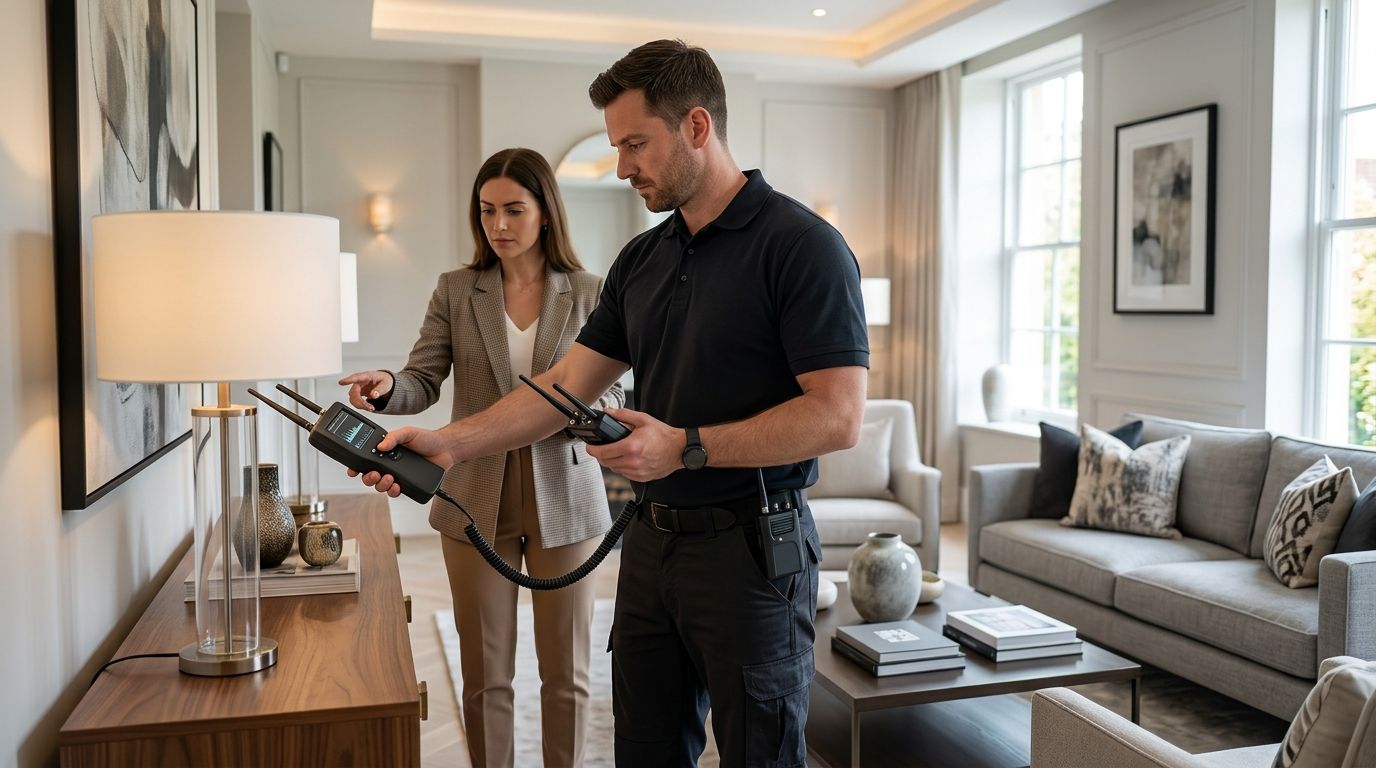
Bug sweep services for interior designers and home stagers cover TSCM inspections of vacant listings, staged model units, and post-renovation properties — confirming no hidden camera, microphone, or GPS tracker was left behind before furniture and decor go in. Designers work in properties they don't own and often can't fully vet, which makes this a different risk profile than a homeowner sweeping their own house.
- Bug sweep services for interior designers and home stagers check vacant listings and staged homes before decor moves in, not after staging photos are already published.
- Picture frames, faux books, smoke detectors, and USB chargers are the most common camera housings stagers unknowingly install without checking.
- USA Bugsweeps runs nationwide TSCM inspections for vacant properties, model units, and post-open-house listings in 2026.
- A lockbox with dozens of showings carries more risk than a single-keyholder rental — sweep again after high-traffic open houses.
Why bug sweeps matter for interior designers and home stagers
Designers and stagers move through properties with a rotating cast of prior occupants, contractors, cleaning crews, and lockbox visitors — none of whom leave a record of what they installed. A vacant listing that changed hands three times in the past year carries more unknown history than a home the designer's client has lived in for a decade.
MLS photography raises the stakes further. Once a staged home's layout is published online, anyone who placed a hidden camera before the photo shoot knows exactly where the sofa landed and who's walking through the empty rooms between showings. That overlap between public exposure and unverified occupancy history is the reason bug sweep services for interior designers and home stagers differ from a standard residential sweep. Related coverage of the same risk exists for realtors and open houses, who face nearly identical foot-traffic exposure.
The inspection routine, step by step
Inspect the property before any inventory moves in
Do this before a single box of staging inventory crosses the threshold.
- Walk every room's ceiling corners, vents, and smoke detectors before furniture arrives — empty rooms make a mismatched detector or a drop-ceiling gap easier to spot.
- Check under sinks, behind mirrors, and inside closets for wiring that doesn't match the rest of the property's fixtures.
- Ask the listing agent for the lockbox showing history — a property with dozens of prior visits is a different risk than a freshly renovated unit with one keyholder.
- Photograph every empty room before staging begins, so any new object that shows up in later photos gets flagged immediately.
Check staging-specific hiding spots before you unbox decor
This is where the property's own history stops being the only variable — staging inventory itself becomes a carrier.
- Picture frames, faux books, and tissue boxes are common camera housings — check them before placement, not after. See how to find a hidden camera in a picture frame or wall decor for the exact spots to check.
- Swap out USB wall chargers, clock radios, and smoke detectors left by a previous occupant instead of reusing them.
- If staging inventory was used in a prior listing this year, treat it the same as unfamiliar decor until it's been checked.
- A professional TSCM sweep with a spectrum analyzer catches RF-transmitting devices a visual check misses entirely — this is the fastest way to clear a property before a full staging crew arrives.
Verify the property's Wi-Fi and connected devices
A device doesn't need new wiring if it can ride an existing network.
- Check for a router or smart plug left behind by a prior tenant — an active connection can relay a feed without any visible installation.
- Reset the router to factory settings and rename the network before staging photography begins.
- Review the connected-devices list for unfamiliar MAC addresses if admin access is available.
- Flag any smart speaker or smart TV left in the unit for a full check before the staging crew starts working around it.
Schedule a sweep before staging begins
Nationwide TSCM inspections for vacant listings and model units.
Sweep again after high-traffic open houses
Every open house is a new access event, not a continuation of the last one.
- Treat dozens of strangers touring a property differently than one buyer viewing by private appointment.
- Re-check outlets and any decor moved by showing agents or visitors between open houses.
- Re-verify the lockbox code once a listing has been active for more than 30 days.
- Schedule a follow-up inspection before the final walkthrough on properties that sat on the market for months.
Document findings for liability protection
A sweep without a paper trail doesn't protect anyone.
- Keep dated photos of every room's staging setup, before and after each inspection.
- Log the sweep date and scope in the client file — designers get pulled into disputes over a property's condition more often than they'd expect.
- Share findings with the listing agent and homeowner in writing, not just a verbal update.
- Retain records for the length of the listing agreement, at minimum.
Set a recurring sweep schedule for model units and high-turnover properties
One sweep at move-in doesn't hold for a property that keeps getting visitors.
- Model units and builder show homes see hundreds of visitors a year — schedule sweeps quarterly instead of once at furniture install.
- Corporate housing and short-term staged rentals need the same cadence as vacation rentals: check before every new occupant.
- Coordinate sweep timing with the cleaning and turnover schedule so it doesn't require a separate site visit.
- Build the sweep into the staging contract as a standard line item rather than an emergency add-on when something feels off.
Exact pricing depends on square footage, number of rooms, and how many electronic devices are already installed — the cost breakdown for a professional bug sweep covers what drives that number up or down.
Comparing your options
| Option | Best for | Key limitation | Verdict |
|---|---|---|---|
| Visual walkthrough by design staff | Freshly renovated units with one keyholder | Misses RF-only transmitters and lens optics hidden in electronics | Hold |
| Consumer RF detector | Designers running self-checks between listings | Struggles with devices that store locally instead of transmitting live | Hold |
| Professional TSCM sweep (USA Bugsweeps) | Vacant listings, model units, high-turnover properties | Requires scheduling a technician visit rather than an instant check | Buy |
| No inspection | Nothing with public showings or published photos | Leaves staged photos and open houses unchecked for months | Skip |
“A professional TSCM sweep is the only option on this list that catches a device a visual walkthrough or consumer RF detector misses.”
Common mistakes interior designers and home stagers make
- Assuming a cleaning crew's walkthrough counts as a sweep. Cleaners are checking for dust, not lens glare or RF signal.
- Publishing MLS photos before the sweep is done. Once room layouts are online, anyone with a device already in place knows exactly where the furniture landed.
- Reusing staging inventory from a previous listing without checking it. Furniture and decor that traveled through five other properties this year carries the same risk as an unknown rental.
- Treating one sweep at move-in as permanent. A property with an active lockbox and repeat showings needs a second look, not a one-and-done inspection.
- Skipping documentation. Without a dated record of the sweep, a designer has no way to prove a device wasn't installed on their watch.
FAQ
What's the best way to bug sweep a staged home before listing photos?
Run a full inspection before staging inventory arrives, then a professional TSCM sweep before photography, checking outlets, decor, and any devices left by prior occupants. A visual check alone misses RF-transmitting devices.
Is a bug sweep necessary for a newly renovated property?
Yes — contractors, subcontractors, and inspection crews all had access during renovation, and a new build carries the same unknown-history risk as an older resale property.
How much does a professional bug sweep cost for a vacant listing?
Cost depends on square footage, room count, and the number of electronics already installed in the unit. Check the cost breakdown page for a range instead of a flat number, since staged properties vary widely in size.
Can a hidden camera actually be hiding inside staging decor like a picture frame or clock?
Yes. Picture frames, faux books, clock radios, and smoke detectors are common camera housings because they blend into any staged room without drawing attention.
How often should a model unit or show home be swept?
Quarterly is a reasonable baseline for a model unit with steady visitor traffic in 2026, rather than a single sweep at the initial furniture install.
Do interior designers need to disclose bug sweep findings to a client?
Share findings with the listing agent and homeowner in writing. A verbal update alone doesn't protect the designer if a dispute comes up later.
What's the difference between a visual inspection and a TSCM sweep?
A visual inspection relies on eyes checking obvious spots. A TSCM sweep uses RF detection equipment to catch transmitting devices hidden inside electronics that a visual check would never find.
Should a stager sweep a property before or after installing furniture?
Before. Sweeping an empty property is faster and more thorough than sweeping around a fully staged room, and it establishes a clean baseline before any new decor enters.
One last thing
The riskiest window in a staged listing isn't the first walkthrough — it's the stretch between the last open house and closing, when a lockbox has changed hands the most times and nobody's checking the property daily. Schedule the final inspection there, not at move-in, and treat 2026's higher open-house volumes on active listings as a reason to sweep twice instead of once.


