

To find a hidden camera in a picture frame or wall decor, inspect openings that face the room, then use an angled flashlight to check for a lens reflection. A phone camera can reveal infrared illumination on some devices, while an RF detector can flag a camera that is transmitting. Neither test proves a frame is clear; if you find a suspicious component, photograph it before touching it.
- How to find a hidden camera in a picture frame or wall decor: inspect openings, test reflections, and check signals.
- A flashlight can reveal a lens reflection; a phone camera can show infrared light from some active cameras.
- An RF detector can flag transmissions, but a silent result does not rule out a camera.
- USA Bugsweeps TSCM services are best for homeowners and businesses needing professional follow-up after inconclusive checks.
Why this matters
A picture frame gives a small lens plausible cover: printed details, dark matting, reflective glass, and hardware can all draw your eye away from an opening. The right question is not whether the frame looks unusual. It is whether an opening has a useful view of the room and whether another check supports what you see.
The same approach applies to a framed print, decorative mirror, or wall clock. Start with objects facing a bed, changing area, desk, or other place where privacy matters. If you need a closer look at one part of the process, the guide to detecting a hidden camera using a flashlight explains how to check for reflected light without treating every glint as a lens.
A 2026 inspection is strongest when you combine checks rather than rely on one tool. Visual inspection can miss a well-concealed opening. A phone's infrared check works only under particular conditions, and an RF detector cannot identify a device that is not transmitting at the time of the scan.
How do you find a hidden camera in a picture frame or wall decor?
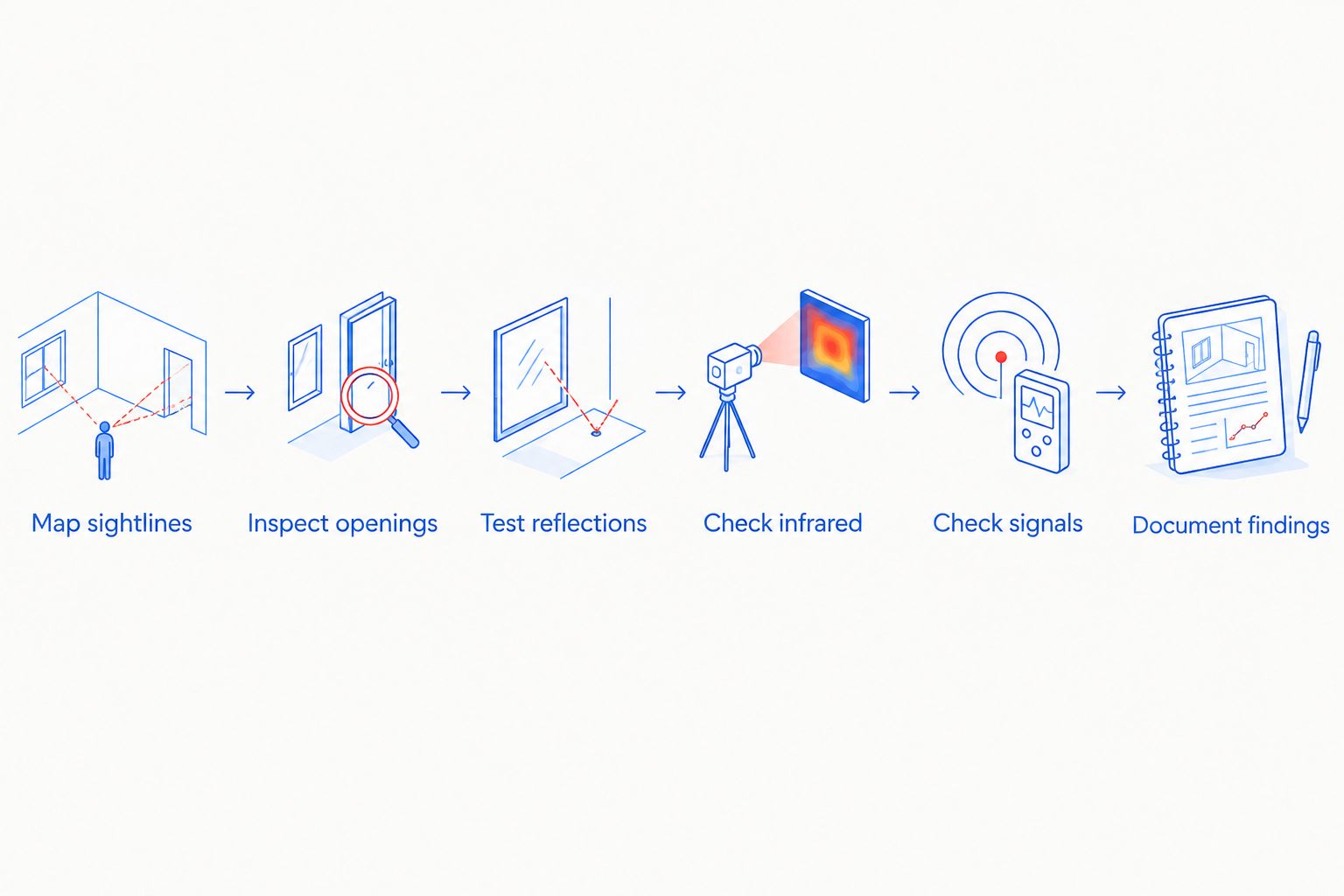
Use this 2026 sequence to narrow down a specific object. Stop and document what you find if the frame is in a space you do not control; you do not need to take it apart to make a report.
-
Map sightlines. Stand where someone would occupy the room and look back at the decor. A camera needs a view through an opening, so note which parts of the frame face that position. Check the picture itself, its matting, the frame edges, and any decorative fixtures attached to it. An opening aimed at a private area deserves closer attention than a mark facing a wall.
-
Inspect openings. Look for a dark, regular opening or a component that does not match the surrounding material. Check the frame's front and accessible sides without scratching the surface or removing fasteners. A screw, printed dot, or gap is not proof of a camera. What matters is whether you can distinguish a recessed optical surface inside it.
-
Test reflections. Dim the room, place a flashlight near your line of sight, and sweep its beam slowly across the suspect area. Change your viewing angle as you go. A lens can return a concentrated reflection, but glass, metal fittings, and glossy artwork also reflect light. Compare the suspected point with nearby reflections rather than treating a single flash as confirmation.
-
Check infrared. In a dark room, view the frame through your phone camera and look for a small, persistent light source. Some night-vision cameras use infrared illumination, commonly around 850 nm or 940 nm; phone cameras differ in how much infrared they display. First test your phone with an infrared remote control that you know works. If the phone shows no remote-control light, a negative frame check tells you little.
-
Check signals. If you have an RF detector, move it gradually around the frame and nearby wall while noting other active electronics in the room. Ordinary 2.4 GHz and 5 GHz Wi-Fi traffic can complicate a reading. An alert near a frame warrants investigation, not an immediate conclusion: an RF detector measures radio activity, not whether that activity came from a hidden camera. A camera recording without transmitting will not be cleared by this test.
-
Document findings. Photograph the object in place, then take a closer image of the suspicious opening and any visible wiring or added hardware. Record where the frame was hanging and who controls the space. If the concern is immediate, leave the area before discussing sensitive information or changing clothes. Do not damage property or handle a suspected device unnecessarily.
These steps separate a possible lens from ordinary frame details, but they cannot establish whether footage exists or who placed a device. Keep that distinction clear when you describe what you found.
Which frame-check method works best in 2026?
Start with a visual and flashlight check, then use electronic checks to investigate what you cannot see. The methods complement one another; none is a universal camera detector.
| Method | Best for | What it can reveal | Main limitation |
|---|---|---|---|
| Visual and flashlight check | Best for: An accessible frame with a visible suspect opening | An opening, added component, or possible lens reflection | Ordinary glass and hardware can look suspicious; a concealed lens can be missed |
| Phone camera check | Best for: Looking for active infrared illumination in a dark room | Infrared light that the phone camera can display | A camera may have no infrared light, have its illumination off, or be invisible to that phone sensor |
| RF detector check | Best for: Investigating a device that is transmitting during the scan | Radio activity near the frame | Nearby electronics can trigger readings; a non-transmitting camera may produce none |
| USA Bugsweeps TSCM service | Best for: Homeowners and business owners who need professional follow-up | An inspection focused on suspected electronic surveillance | An inspection examines the space as found; it cannot establish what an absent device previously recorded |
USA Bugsweeps TSCM services are best for homeowners and business owners whose frame checks remain inconclusive. They are a professional follow-up, not a reason to describe an ambiguous reflection as a confirmed camera. If you control the space, preserve the condition of the object so the inspection can address what raised your concern.
Why can a hidden camera check miss a device?
A negative result means a particular check found nothing under its conditions. It does not mean every type of camera has been excluded.
- The lens is outside your viewing angle. An opening can be hidden by a frame edge or decoration when you inspect from only one position. Repeat the visual check from the area the object faces.
- Reflections blend together. A lens reflection can be difficult to distinguish from glass, a shiny print, or metal hardware. Changing the flashlight angle helps you compare them.
- Infrared illumination is absent. A camera does not need infrared illumination to record. An illuminated device can also be difficult for a particular phone camera to display.
- The device is not transmitting. An RF detector cannot rule out a camera solely because it produces no relevant alert during the scan.
- The signal comes from something else. Routers and other active electronics produce radio activity. An RF reading near wall decor does not identify the source on its own.
Do not keep repeating the same negative test and expect a stronger answer. If the opening still appears suspicious, switch methods or seek an inspection rather than treating uncertainty as clearance.
Can your phone confirm that a picture frame has no camera?
No. Your phone camera can help identify infrared illumination from some active devices, but a camera without visible-to-your-phone infrared light can still be present. Use the phone result alongside a physical inspection; do not use it as the final verdict on a frame.
Will an RF detector find a camera recording to a memory card?
Not if the camera is recording locally without transmitting a detectable signal during your check. An RF detector is useful for investigating radio activity, not for certifying that every electronic device has been found. Inspect the frame itself even when the detector stays quiet.
Is a reflective dot in wall decor proof of a hidden lens?
No. Glass, foil in artwork, and metal fittings can all produce a bright reflection. Check whether the point sits inside an opening, stays in the same physical location as you move, and appears distinct from similar reflections elsewhere on the object. Even then, document what you observe rather than declaring it a camera without further examination.
What should you do with a suspicious frame?
Keep yourself out of the suspected camera's view and photograph the frame before changing anything. If the object belongs to a rental property, workplace, or shared space, document its location and report the concern through the appropriate property manager, employer, platform, or authorities. Avoid accusing a specific person based on a mark or detector alert alone.
If you own the space, note any recent changes to the frame or its mounting before arranging a closer inspection. If you do not own it, leave the hardware intact unless immediate safety requires otherwise. The useful next step is to preserve what can be examined, not to pull apart an uncertain object.
For a 2026 concern that remains unresolved after these checks, USA Bugsweeps provides nationwide TSCM bug sweeping and hidden-camera detection services. Describe the room, the object, and the checks you have already completed when you request help.
Request a TSCM sweep
USA Bugsweeps provides nationwide bug sweeping and hidden-camera detection services.
FAQ
How do I find a hidden camera in a picture frame or wall decor?
Inspect any opening facing the room, test it with an angled flashlight, then check for infrared light or radio activity if you have the right tools. Document a suspicious component before handling it.
Can a flashlight find a hidden camera in a frame?
A flashlight can reveal a reflection from an exposed lens. Glass and metal also reflect light, so compare the suspected point from different angles before drawing a conclusion.
Can I use my phone to check wall decor for hidden cameras in 2026?
Yes, your phone camera can show infrared illumination from some active devices in a dark room. A negative result does not rule out a camera without infrared illumination or one your phone cannot display.
Will an RF detector find every hidden camera?
No. An RF detector investigates radio signals during the scan; a camera that is not transmitting may produce no relevant alert. Nearby electronics can also cause readings that need to be checked.
Does a hole in a picture frame mean there is a camera?
No. A hole can be part of the frame or its mounting. Look for an optical surface and document the opening's position rather than identifying it as a lens from its shape alone.
Should I remove a picture frame if I suspect a hidden camera?
Photograph the frame in place before moving it. If the space is not yours, avoid dismantling the object and report the concern to whoever manages the property or to the appropriate authorities.
When should I request a professional camera sweep?
Request a professional sweep when a specific object remains suspicious after visual and electronic checks or when the privacy risk calls for a documented follow-up. USA Bugsweeps provides nationwide TSCM and hidden-camera detection services.
One last thing
A clear phone screen and a quiet RF detector answer different, narrow questions. Neither proves that the picture frame is safe. In 2026, the most useful finding is a precise record of what you saw, where the object pointed, and which checks you performed; that record gives a professional inspector or property manager something concrete to examine.


