
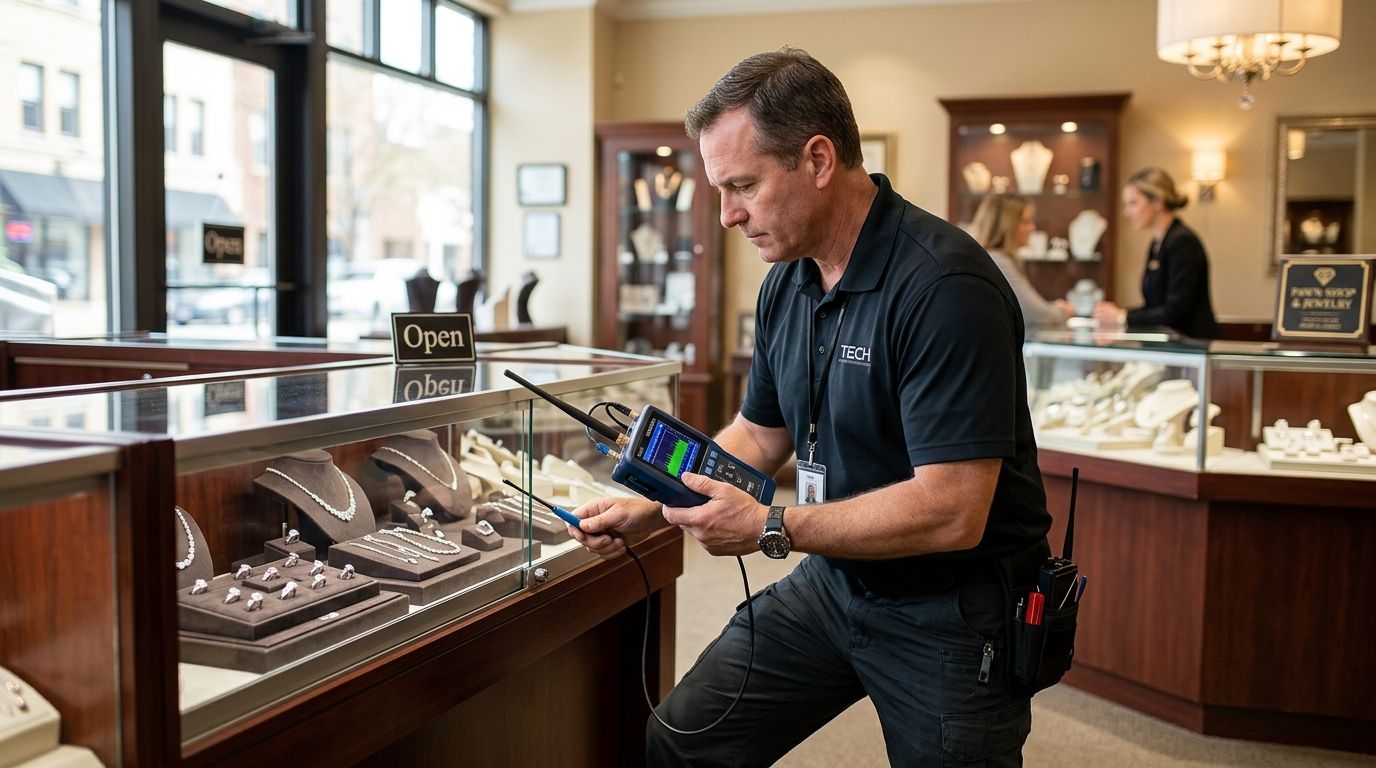
Bug sweep services for jewelry stores and pawn shops locate hidden cameras, audio recorders, and RF transmitters planted near safes, display cases, and appraisal counters before combinations, inventory counts, or customer identities leak out. A single pinhole camera behind a jewelry counter can capture a safe combination in one shift; a pawn shop mic near the loan window can record every customer's ID and offer amount.
- Bug sweep services for jewelry stores locate pinhole cameras in display cases, offices, and safes before combinations leak.
- Pawn shops face the same exposure: hidden mics near the loan counter capture appraisal values and safe codes.
- RF detectors alone miss dormant recorders; a full TSCM sweep pairs RF scanning with physical inspection and NLJD checks.
- USA Bugsweeps runs nationwide sweeps for jewelry stores and pawn shops, covering vaults, offices, and cash wraps.
Why bug sweeps matter for jewelry stores and pawn shops
Jewelry stores and pawn shops concentrate more resale value per square foot than almost any other retail category, and that value sits behind a combination that gets spoken out loud during training, shift changes, and vendor visits. A recorder planted near the safe for even one week can catch that code more than once.
Pawn shops carry a second exposure: appraisal conversations reveal what customers own, what they're desperate to sell, and how much cash sits in the register that day. Competitors, disgruntled former employees, and even parties involved in a pending insurance or legal dispute have motive to plant a device rather than break in. A jewelry store or pawn shop that has never run a professional bug sweep is operating on the assumption that no one has ever wanted that information — a assumption worth testing in 2026, not after a loss.
How to sweep a jewelry store or pawn shop for hidden cameras and bugs
Map your highest-risk rooms first
Before anyone touches a detector, walk the floor plan and mark every room where cash, inventory, or safe combinations get discussed out loud.
- Appraisal counter and private consultation rooms
- Vault, safe room, and inventory cage
- Manager's office and back-office computer
- Employee break room and restroom
- Loading dock or back entrance used for deliveries
Inspect the display cases and appraisal counter
Start with the areas customers and employees stand closest to for the longest stretch of time. This step is free and catches the crudest devices before any equipment comes out.
- Check the underside of counters and cases for taped-on battery packs
- Look for extra drill holes or fresh caulk in laminate and trim
- Examine wall clocks, smoke detectors, and exit signs mounted near the counter — a hidden camera in a smoke detector is one of the most common retail plants
- Inspect power strips and outlet covers for hardware that doesn't match the rest of the store
- Note any decor, plants, or fixtures added by a vendor, contractor, or new employee in the last 90 days
Check the vault, safe, and back office
The vault and manager's office are where a professional sweep earns its cost, because devices here are hardwired or RF-silent to avoid detection by consumer apps. A spectrum analyzer and non-linear junction detector find what a phone app cannot, which is where USA Bugsweeps' TSCM technicians pick up where a manual walkthrough stops.
- Scan the full RF spectrum inside and around the safe room, not just at counter height
- Use a non-linear junction detector (NLJD) on walls, vents, and furniture to catch powered-off or hardwired devices
- Check computer towers, monitors, and cable runs in the back office for inline recorders
- Physically open wall plates, light fixtures, and HVAC vents near the safe
Scan phones, internet lines, and POS systems
A compromised phone line or point-of-sale terminal exposes transaction data and customer records without anyone stepping foot inside after hours.
- Test every landline and VoIP extension for line taps and unusual voltage
- Inspect the router, modem, and any exposed ethernet runs for inline splitters
- Review POS terminals for unauthorized USB devices or skimming hardware
- Check for rogue Wi-Fi access points broadcasting near the register
Test employee break rooms and restrooms
These rooms get skipped constantly because owners assume no sensitive conversation happens there — but shift handoffs, safe code changes, and personal calls about the business happen exactly here.
- Check vents, outlet covers, and light fixtures for pinhole lenses
- Inspect any personal items left behind by former employees
- Look under sinks and inside cabinet voids for audio recorders
- Sweep lockers if the store provides them for staff belongings
Sweep vehicles used for inventory transport
Any vehicle that moves jewelry, cash, or pawned goods between locations or to the bank is a target for a GPS tracker or in-cabin recorder, not just the building itself.
- Check the undercarriage, wheel wells, and bumper cavities for magnetic trackers
- Inspect the OBD-II port for unauthorized dongles
- Scan the glovebox, visors, and seat seams for hidden microphones
- Review any company-owned or rented delivery vehicle before a high-value transport run
Schedule a professional TSCM sweep
Once the manual pass is done, a full technical surveillance countermeasures sweep closes the gap that RF apps and visual checks leave open — hardwired devices, dormant recorders, and anything built into the building during a past renovation.
- Book a sweep after any renovation, staff turnover, or break-in attempt
- Request coverage of the vault, offices, counters, and any company vehicles in the same visit
- Ask for a written report identifying swept zones and any devices located
- Repeat the sweep on a recurring schedule tied to lease renewals or ownership changes
Get a bug sweep for your store
Nationwide TSCM sweeps for jewelry stores, pawn shops, and vaults.
Comparison: bug sweep options for jewelry stores and pawn shops
| Option | Best for | Key limitation |
|---|---|---|
| DIY visual and physical inspection | Small pawn shops doing a routine weekly check | Misses RF-only devices with no visible lens or wire |
| Consumer RF detector app or gadget | Quick screening between professional sweeps | High false-positive rate near Wi-Fi and POS systems; misses dormant recorders |
| In-house security or loss-prevention staff | Chains with an existing security team | Lacks NLJD and spectrum analyzer equipment for hardwired bugs |
| Professional TSCM sweep (USA Bugsweeps) | Jewelry stores and pawn shops handling high-value inventory, or post-incident checks | Requires scheduling a technician on-site |
A professional TSCM sweep is the only method on this list that reliably finds hardwired or dormant devices hidden in a jewelry store's walls, vault, or safe room.
Common mistakes jewelry stores and pawn shops make
- Sweeping only during business hours. Devices with motion-activated recording often stay dormant while staff are present and only trigger overnight — a sweep needs to check power and battery status, not just live signal.
- Skipping company vehicles. Owners sweep the store but never check the van or car used to transport inventory to shows, appraisals, or the bank.
- Trusting the alarm system as a substitute. An alarm detects intrusion after hours; it does nothing to catch a camera or mic planted by someone with legitimate daytime access.
- Not sweeping after employee turnover. A departing employee with counter or vault access is one of the most common sources of a planted device — sweep before the next shift change, not months later.
- Assuming a metal detector catches RF devices. Metal detectors find weapons and metal objects; they do nothing for a camera, mic, or transmitter built into plastic housing.
FAQ
What's the best way to run a bug sweep for a jewelry store?
The most reliable approach pairs a manual physical inspection of counters, safes, and offices with a professional RF and NLJD sweep. Consumer detector apps alone miss hardwired or dormant devices common in vault rooms.
How often should pawn shops sweep for hidden cameras?
Pawn shops should sweep after any renovation, break-in attempt, or significant staff turnover, and on a recurring schedule tied to lease renewals in 2026. High-turnover locations benefit from a quarterly check of the counter and vault areas.
Can a hidden camera be hidden inside a jewelry display case?
Yes, pinhole cameras fit inside the base of a display case, behind a mirror, or inside a nearby smoke detector or clock. A physical inspection of case undersides and nearby fixtures catches most of these plants.
Do RF detectors find every hidden bug in a pawn shop?
No, consumer RF detectors only catch devices actively transmitting at the moment of the scan. Dormant recorders, hardwired taps, and devices set to record-and-store rather than stream require a spectrum analyzer and NLJD to locate.
Is it legal to sweep your own store for hidden cameras?
Yes, business owners can legally inspect their own property for hidden surveillance devices at any time. Legal questions arise around what to do with recordings found on a device, which is why a written TSCM report matters.
What rooms get missed most often during a pawn shop bug sweep?
Employee break rooms and restrooms are skipped most often because owners assume no sensitive conversation happens there. Shift handoffs and safe code discussions frequently happen in exactly these rooms.
Should jewelry stores sweep company vehicles used for transporting inventory?
Yes, any vehicle moving jewelry, cash, or pawned goods between locations is a target for a GPS tracker or in-cabin recorder. Vehicle sweeps should happen before any high-value transport run, not just at the store itself.
One last thing
The device most often missed in a pawn shop or jewelry store sweep isn't a camera — it's a recorder left running with no live transmission at all, sitting in a vent or behind a light fixture, collecting audio for someone to retrieve later. A visual inspection or phone app finds nothing because there's no signal to catch; only a physical search with an NLJD locates it. If your store has changed hands, been renovated, or lost an employee in the last year, treat every room as unverified until a TSCM technician has checked it.


