
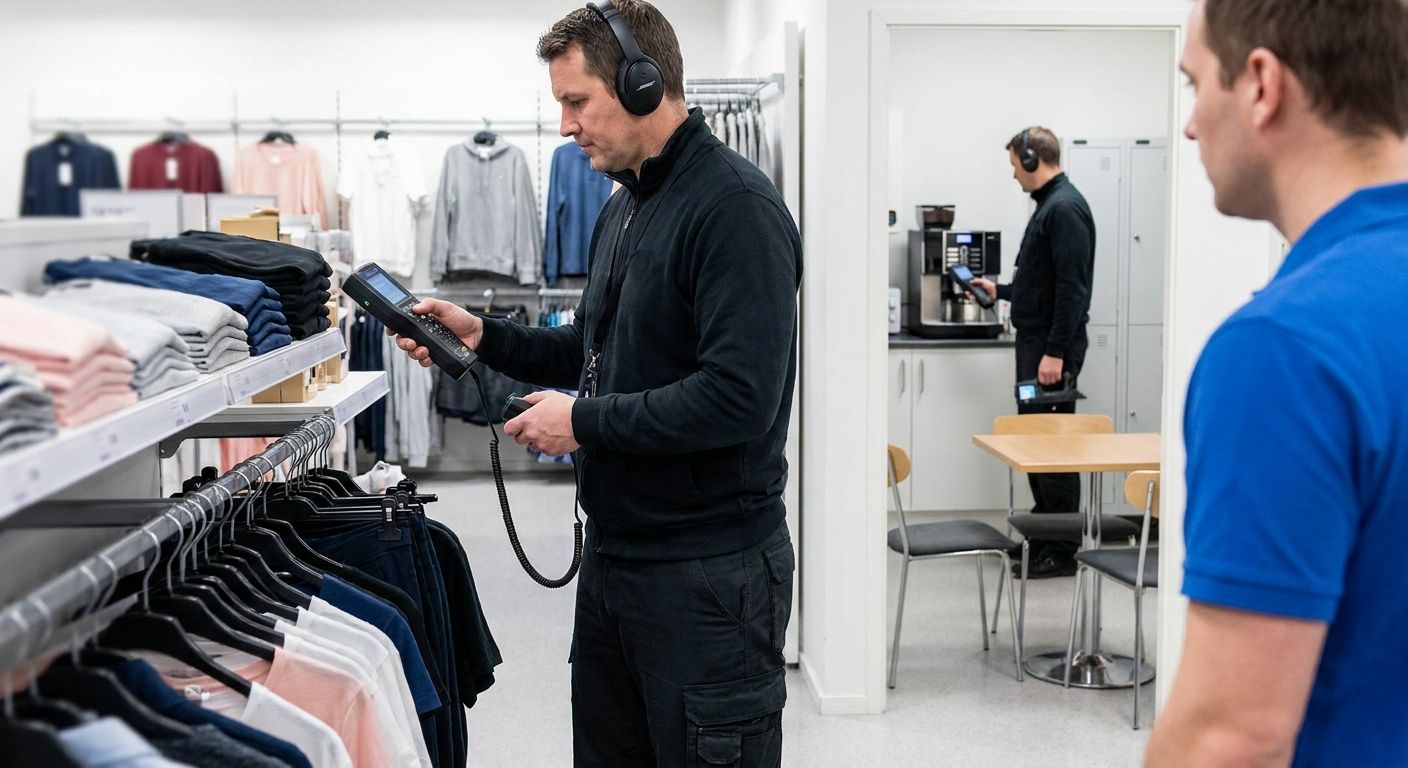
Bug sweep for retail stores is a physical and RF-based inspection of the sales floor, break room, stockroom, fitting rooms, and manager's office with the aim of finding hidden cameras, audio recorders, and wireless transmitters planted by employees, competitors, or customers. Retail locations carry a different risk profile than a private home or a single office: high foot traffic, constant staff turnover, semi-private changing areas, and a break room where wage disputes and schedule complaints get discussed out loud. A professional TSCM sweep covers the RF spectrum and hardwired lines that a visual walk-through misses.
- A full bug sweep for retail stores checks the sales floor, break room, fitting rooms, and back office - not just the register area.
- Consumer RF detectors miss hardwired microphones and devices that store footage locally instead of transmitting.
- Fitting rooms and break rooms carry the highest legal exposure if a hidden camera is found - many states require two-party consent for recorded audio.
- Professional TSCM sweeps from USA Bugsweeps cover RF spectrum, Wi-Fi networks, and hardwired taps in one visit.
- Re-sweep after any remodel, fixture change, or new hire in a keyholder role.
Why bug sweep for retail stores matters
Retail staffing turns over fast, and every new keyholder or seasonal hire is someone with unsupervised access to the stockroom, the safe, and the break room after close. That access is exactly what makes retail different from a corporate office with badge-controlled floors.
Fitting rooms and break rooms are the two spaces where incidents actually happen, and both carry legal weight. A hidden camera in a fitting room is a criminal matter in every state; a hidden audio recorder in a break room can violate wiretap statutes in two-party consent states like California, Illinois, Florida, and Pennsylvania. Store management that skips these two rooms during an internal check is skipping the highest-risk areas in the building.
Cash offices and POS terminals add a second layer: skimming hardware and small recorders get planted near registers specifically because that area gets watched by cameras aimed at customers, not at the counter itself.
Walk the sales floor for visual red flags
Start with a visual pass before touching any equipment. This catches the obvious placements and takes under 30 minutes for most single-location stores in 2026.
- Check ceiling tiles, sprinkler heads, and smoke detectors near registers and fitting room hallways for anything that looks newer than the surrounding fixtures
- Inspect exit signs, EXIT lighting, and clock faces for pinhole lenses
- Look behind mirrors in fitting rooms and near the entrance - two-way glass and pinhole cameras both hide there
- Check any recently added decor, air fresheners, or motion-sensor devices that weren't part of the original store setup
- Note any device with a status light, even a faint one, plugged into an outlet that isn't normally used
Check the break room and staff areas specifically
The break room gets skipped in most internal checks because owners assume the risk lives on the sales floor. It doesn't. Wage conversations, schedule complaints, and theft accusations all happen in that room, which makes it a target for anyone trying to build a harassment or wrongful-termination case, or for an owner trying to catch internal theft the wrong way.
- Check power strips, phone chargers, and USB hubs for devices with hidden storage
- Inspect wall clocks, smoke detectors, and light fixtures the same way as the sales floor
- Look inside vents and behind posted schedules or bulletin boards
- Check personal lockers for anything an employee didn't disclose
- Review any smart speaker or Wi-Fi device in the room for a microphone that's always listening
Inspect fitting rooms room-by-room
Fitting rooms are the single highest-liability space in a retail bug sweep. A hidden camera here isn't a privacy annoyance, it's a felony in most jurisdictions and a lawsuit against the store regardless of who planted it.
- Check hook hardware, coat hooks, and curtain rods for lenses
- Inspect the mirror edges and backing for two-way glass seams
- Look at bench legs, bag hooks, and any decorative trim added after the room was built
- Check the ceiling directly above the changing area, not just the entrance
- Test any wall-mounted device (fan, light, sensor) for a lens or microphone opening
Scan your Wi-Fi network for unregistered devices
Many hidden cameras placed in retail stores in 2026 connect to the store's own Wi-Fi to stream or upload footage remotely, which means the network itself holds evidence.
- Log into the router and list every connected device by MAC address
- Flag anything not matched to a known POS terminal, tablet, or approved staff device
- Check for a second, hidden SSID broadcasting from the same location
- Review data usage logs for a device pushing consistent upload traffic overnight
- Change admin credentials on the router if this hasn't been done since installation
Sweep the RF spectrum with professional equipment
This is where a DIY check hits its ceiling. Consumer RF detectors catch active wireless transmitters but miss devices that store footage locally, hardwired microphones tapped into existing wiring, and anything using frequency-hopping to dodge basic scanners. A professional TSCM technician runs a full spectrum sweep with lab-grade equipment and checks physical wiring runs the same visit.
- Full RF spectrum scan across 2.4GHz, 5GHz, and cellular bands
- Non-linear junction detection for devices that are powered off during the sweep
- Physical inspection of phone lines, ethernet runs, and electrical panels
- Thermal imaging pass to catch devices generating heat inside walls or fixtures
Check delivery vehicles and company vehicles for GPS trackers
Retail operations with delivery vans or a company fleet face a separate risk: GPS trackers planted by a competitor, a disgruntled employee, or in cases involving a franchise dispute. A GPS tracker sweep for company fleet vehicles checks the undercarriage, wheel wells, and OBD-II port on every vehicle in rotation, not just the ones currently flagged as suspicious.
Schedule a re-sweep after any remodel or fixture change
A single sweep is a snapshot, not a guarantee. New fixtures, a remodel, or a new hire in a keyholder position all reset the risk clock.
- Re-sweep after any construction, remodel, or new fixture installation
- Re-sweep after terminating a keyholder or manager with after-hours access
- Re-sweep before opening a new location using contractors from an unfamiliar vendor
- Add a sweep to the calendar annually even with no reported incident
Comparing your options for a retail bug sweep
| Option | Best for | Starting price | Key limitation |
|---|---|---|---|
| Visual walk-through checklist | Daily manager checks between professional sweeps | Free | Misses RF transmitters and hardwired taps entirely |
| Consumer RF detector | Small independent stores doing their own spot checks | Varies by device | Misses local-storage devices and hardwired microphones |
| Vehicle GPS tracker guide | Spot-checking a single delivery van without special equipment | $29.00 | Covers one vehicle at a time, not the whole building |
| Professional TSCM sweep | Full-store coverage including RF spectrum, Wi-Fi, and hardwired lines | Call for a quote | Requires scheduling a technician on-site |
The verdict: a visual checklist catches obvious placements, but the fitting room and break room liability in retail is high enough that a professional TSCM sweep earns its cost the first time it finds something a manager's eyes missed.
Common mistakes retail stores make
- Skipping the break room entirely. Owners sweep the sales floor and cash office but treat the break room as low-risk, when it's where the most sensitive employee conversations happen.
- Assuming a Wi-Fi scan catches everything. Devices that record to local storage or run on cellular data never show up on a router's connected-devices list.
- Sweeping once after an incident and never again. Remodels, new fixtures, and staff turnover all create new hiding spots and new suspects.
- Treating fitting rooms as a customer-service issue instead of a legal one. A hidden camera there is a criminal matter, not a complaint to log and forget.
- Forgetting the delivery vehicles. Management checks the building and skips the fleet, even though a GPS tracker on a company van is one of the more common findings in retail operations with delivery routes.
FAQ
What's the best bug sweep for retail stores in 2026?
A professional TSCM sweep covering the sales floor, break room, fitting rooms, and RF spectrum is the most complete option in 2026. Consumer RF detectors and visual checklists catch some placements but miss hardwired microphones and locally-stored recording devices.
How much does a bug sweep for a retail store cost?
Pricing depends on square footage, number of rooms, and whether fleet vehicles are included, so get a direct quote from a TSCM provider. A DIY vehicle GPS check guide runs $29.00 if you only need to inspect a single delivery van.
Are hidden cameras in fitting rooms illegal?
Yes, recording someone in a fitting room without consent is a criminal offense in every U.S. state. Store owners can face civil liability even if an employee, not the owner, placed the device.
Can a store's own Wi-Fi network reveal a hidden camera?
Sometimes. A router's connected-devices list can flag a camera streaming over Wi-Fi, but devices that record to local storage or use a cellular connection won't appear there at all.
Is it legal to record conversations in an employee break room?
It depends on the state. Two-party consent states including California, Illinois, Florida, and Pennsylvania require everyone in the conversation to agree to being recorded, making an undisclosed break room recorder a wiretap violation.
How often should a retail store get a bug sweep?
Schedule a sweep annually at minimum, and again after any remodel, fixture change, or termination of a keyholder with after-hours access. A single sweep is a snapshot of that day, not a permanent guarantee.
Do delivery vans need a separate GPS tracker check?
Yes, a building sweep doesn't cover vehicles. Check the undercarriage, wheel wells, and OBD-II port on every vehicle in the fleet, not just the one currently suspected.
What rooms get missed most often in retail bug sweeps?
The break room and fitting rooms are the two most commonly skipped areas, even though they carry the highest legal exposure of any room in the store.
One last thing
The fitting room mirror is the single most overlooked spot in a retail sweep - owners check ceilings and outlets but rarely test whether the mirror itself is two-way glass, which is one of the oldest concealment methods still in use in 2026. A flashlight held flush against the glass at night, with the room dark, is a five-second test: if you see your own reflected light pass through instead of bouncing straight back, get that mirror checked before anything else in the store.


