
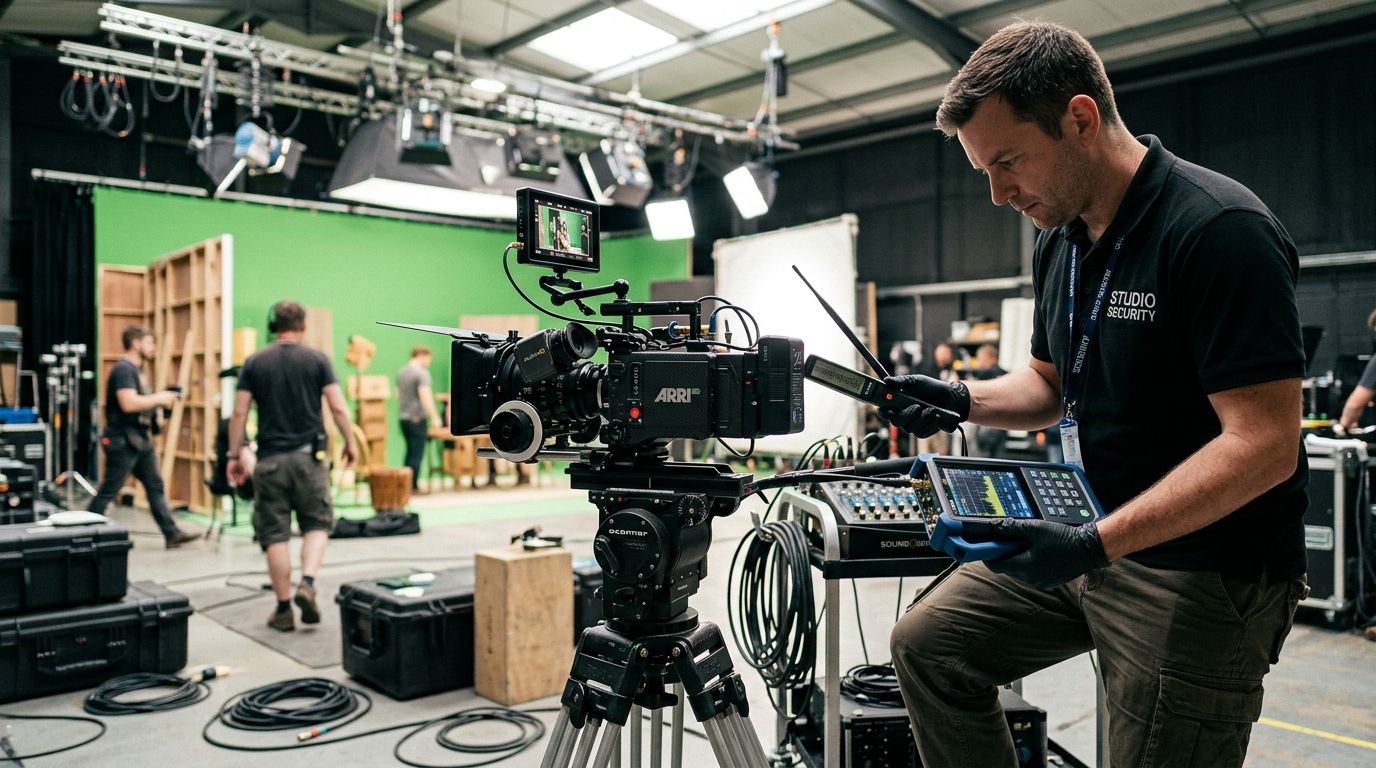
Bug sweep services for film production studios detect hidden cameras, audio recorders, and RF transmitters planted in sound stages, dressing rooms, and production offices, with the goal of protecting unreleased footage, cast privacy, and scripts before a project ships. A production set is a moving target: it changes location weekly, cycles through hundreds of crew and vendor badges, and often houses talent whose image alone is worth protecting from a single leaked photo.
That combination — rotating access, high-value content, and public-facing talent — is why a generic office sweep doesn't cover a film set. The threat model for a soundstage in 2026 includes rental trailers, catering vans, and hotel suites that a corporate boardroom never has to worry about.
- Bug sweep services for film production studios cover soundstages, trailers, wardrobe, and edit bays, not just the main office.
- USA Bugsweeps runs nationwide TSCM sweeps built around production schedules and location changes.
- RF detectors catch active wireless bugs during a shoot day but miss passive or wired devices — a full sweep needs both.
- Sweep before crew load-in, before high-profile talent arrives, and again at wrap — one sweep at project start is not enough.
Why bug sweeps matter for photography and film studios
Production leaks are a business problem before they're a privacy problem. A single set photo or wardrobe test shot that reaches a tabloid or a fan forum ahead of a release date can force a studio to rewrite a marketing rollout. Celebrity talent contracts increasingly carry privacy riders specifically because dressing rooms, trailers, and hair-and-makeup trailers have been targeted for hidden cameras in past cases covered by mainstream outlets.
The risk isn't only paparazzi. Crew members, extras, and third-party vendors rotate through a set daily, and any one of them can plant a device in a smoke detector, a power strip, or a prop. A studio that treats bug sweeping as a one-time pre-production task is leaving the entire shoot exposed after that first sweep.
Sweep every rented location before crew arrives
Most productions don't own their soundstages — they rent them, sometimes from a facility used by three other productions that same month. That turnover is exactly when devices get left behind or planted ahead of your arrival.
- Walk the space with a flashlight at a low angle to catch lens glint in vents, sprinkler heads, and exit signs
- Check every outlet, power strip, and extension cord for anything that looks swapped or newer than the rest of the room
- Inspect smoke detectors and thermostats — both are common camera housings in rented spaces
- Review the facility's own camera and access logs from the prior tenant if the rental agreement allows it
- Photograph the room's baseline condition on move-in day so anything added later stands out
Secure dressing rooms and talent trailers
Trailers and dressing rooms are the highest-privacy spaces on any set, and they're also the easiest to access when nobody's watching — between takes, during lunch, overnight in a parking lot.
- Sweep trailers each morning before talent arrives, not just once at the start of the shoot
- Check wardrobe racks, mirror frames, and vanity lighting fixtures for anything wired in that shouldn't be
- Confirm trailer locks are changed or rekeyed between rental periods
- Log who holds trailer keys and when they were issued
Manual visual checks catch obvious devices, but a professional TSCM sweep with RF and non-linear junction detection finds transmitters that don't broadcast constantly and wired mics that a flashlight will never spot. This is where a nationwide provider like USA Bugsweeps enters the workflow — after the free walkthrough, not instead of it.
Check production offices and edit bays for planted devices
Scripts, dailies, and rough cuts live in production offices and edit bays, and a leaked script draft is as damaging as a leaked photo.
- Inspect conference phones and speakerphones for tampering — these are common wiretap points in shared office suites
- Check under desks and behind monitors in edit bays where footage is reviewed
- Confirm Wi-Fi networks used for dailies transfer are separate from any public or shared-building network
- Restrict physical access to edit bay hard drives to a named list, not a shared badge group
Inspect wardrobe, hair, and makeup areas
These spaces see undressed talent daily and are a documented target for hidden camera placement in entertainment settings.
- Check mirror lighting rigs, which have concealment space for pinhole lenses
- Inspect tissue boxes, air fresheners, and clothing steamers — common everyday-object camera housings
- Rotate which trailer or room is used for sensitive fittings when a set has been open to outside vendors
Get a bug sweep quote for your set
Nationwide TSCM sweeps built around production schedules.
Lock down wireless spectrum during active shoots
Active shoot days generate heavy Wi-Fi and wireless mic traffic, which makes it easier for a rogue transmitter to hide in the noise.
- Have your AV or sound department log every authorized wireless frequency in use for the day
- Flag any unrecognized signal on the 2.4GHz or 5GHz band picked up by an RF detector
- Run a spectrum sweep before call time and again after a break in shooting, since devices can be planted mid-day
Vet vendors and crew access points
Catering, security, and equipment rental crews come and go constantly on a production, and each visit is an access opportunity.
- Require sign-in and escort for any vendor entering trailers or edit bays
- Sweep any space a third-party vendor had unsupervised access to before the next use
- Confirm equipment rental gear (audio recorders, wireless mic packs) is inspected before it's issued to talent
Sweep before high-profile talent visits
A-list talent draws outside interest that background actors and crew don't, and that interest sometimes includes paid tips for leaked photos.
- Schedule a dedicated sweep of the talent's trailer, dressing room, and green room the morning of arrival
- Check any gift baskets, floral arrangements, or promotional items delivered to talent spaces before they're brought in
- Sweep vehicles used to transport talent between locations
Schedule recurring sweeps across production phases
A sweep at pre-production tells you nothing about mid-shoot or post-production risk. Treat sweeps as a schedule, not an event.
- Pre-production: sweep all rented locations before load-in
- Principal photography: recurring sweeps of trailers and high-traffic sets
- Post-production: sweep edit bays and screening rooms before test screenings
- Wrap: final sweep before the space is vacated or returned to the rental owner
Comparing your options for set security
| Option | Best for | Key limitation |
|---|---|---|
| Visual inspection by crew | Catching obvious tampering during daily walkthroughs | Misses hidden lenses, wired mics, and RF-silent devices |
| Consumer RF detector app | Quick daily spot-checks between takes | High false-positive rate, misses passive and wired bugs |
| Handheld RF/spectrum detector | Sound and AV departments doing pre-call sweeps | Requires training to interpret readings correctly |
| Professional TSCM sweep (USA Bugsweeps) | Full-set clearance before talent arrival and at project milestones | Requires scheduling ahead of load-in for best coverage |
Verdict: a handheld RF detector covers daily spot-checks, but a professional TSCM sweep from a provider like USA Bugsweeps is the only method that reliably clears trailers, edit bays, and rented soundstages against wired and passive devices before high-profile talent steps on set.
Common mistakes photography and film studios make
- Sweeping only once at pre-production. Rented locations and rotating crew mean the risk resets every time a new vendor or extra gets access.
- Ignoring rental trailers and vans. Talent transport vehicles get swept less often than the soundstage itself, despite carrying the same privacy risk.
- Assuming digital security covers physical bugs. A locked-down production network does nothing against a hidden camera in a wardrobe fitting room.
- Skipping sweeps for background talent and extras spaces. Leaks don't only come from A-list trailers — shared dressing rooms see just as much foot traffic.
- Not documenting sweep results. Without a dated record, there's no way to prove due diligence if a leak does happen mid-production.
FAQ
What is a bug sweep for a film production studio?
A bug sweep for a film production studio is a physical and RF inspection of soundstages, trailers, dressing rooms, and edit bays to find hidden cameras, audio recorders, and wireless transmitters. USA Bugsweeps runs these as full TSCM sweeps rather than a single-device check.
How often should a film set be swept for hidden devices?
Sweep before crew load-in, again before any high-profile talent arrives, and at wrap before the space is vacated. A single sweep at project start doesn't cover risk introduced by rotating vendors and crew throughout a shoot.
Can a hidden camera be found in a smoke detector on set?
Yes, smoke detectors are a common concealment point for pinhole cameras in rented soundstages and trailers. A professional sweep checks these fixtures along with power strips and exit signs.
Is an RF detector enough to clear a dressing room?
No, an RF detector only catches devices actively transmitting at the moment of the scan. Wired microphones and storage-based cameras require a physical inspection alongside the RF sweep.
Do talent trailers need separate sweeps from the main set?
Yes, trailers should be swept each morning before talent arrives since they sit unattended overnight in parking areas with less oversight than the main soundstage.
How much does a professional TSCM sweep cost for a production?
Cost depends on the number of locations, trailers, and rooms being cleared. Contact USA Bugsweeps directly for a quote based on your production's footprint.
What's the difference between a corporate bug sweep and a film set sweep?
A film set sweep covers rotating rented locations, talent trailers, and wardrobe areas that a fixed corporate office never has, while a corporate sweep focuses on a single stable location like a boardroom.
Should edit bays be swept as part of a production security plan?
Yes, edit bays hold unreleased footage and rough cuts, making them as valuable a target as talent trailers for anyone trying to leak content early.
One last thing
The trailer parking lot overnight is the single most overlooked window in a production security plan — vehicles sit unattended for eight or more hours with far less oversight than the soundstage itself, and that's exactly when a device gets planted ahead of a big talent day. Add a morning trailer check to the call sheet before anything else in 2026, and the rest of the sweep schedule falls into place around it.


