
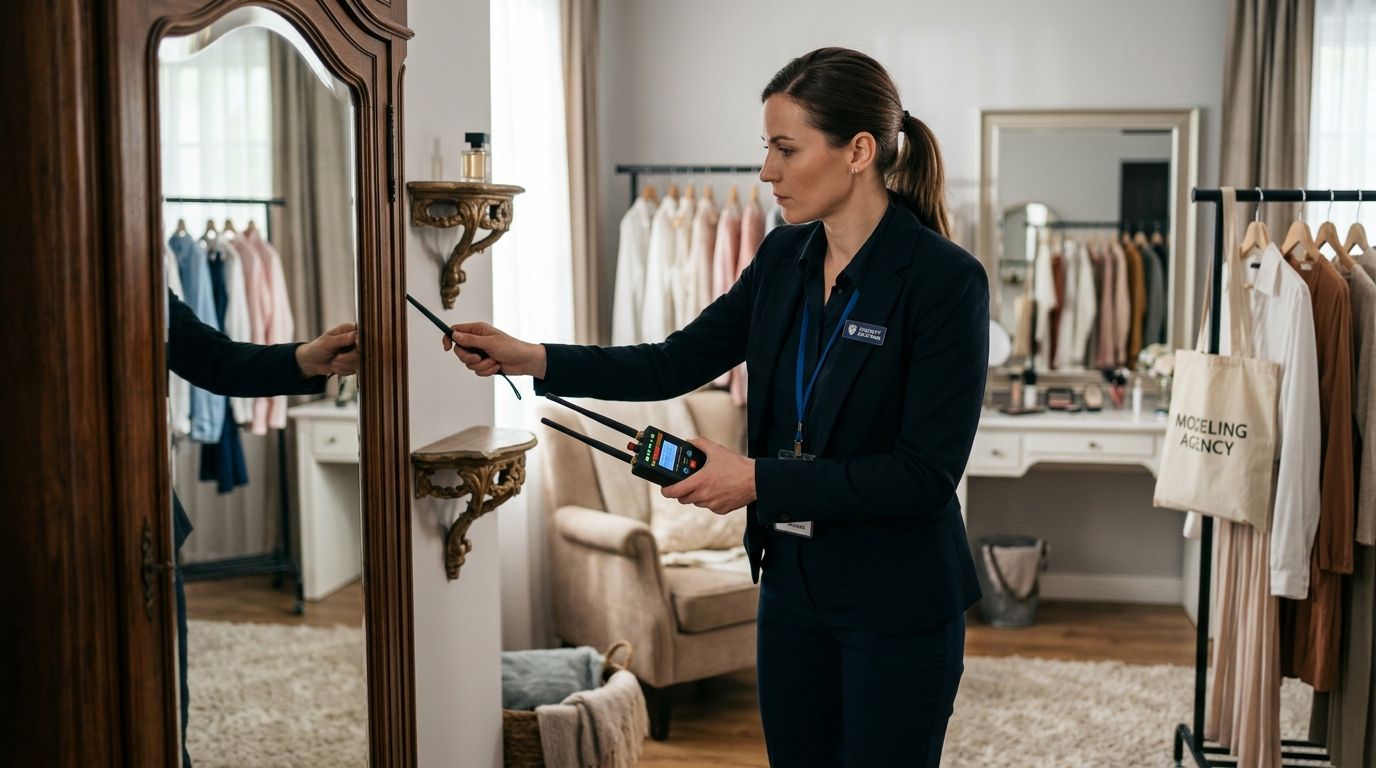
Hidden camera detection for modeling agencies is the physical and electronic inspection of fitting rooms, casting studios, and model apartments for concealed recording devices before talent uses the space. Agencies face a narrower and riskier version of the problem most businesses deal with: minors on set, wardrobe changes happening feet from unvetted rented space, and a reputational hit that can end a booking relationship the moment a camera turns up in a fitting room.
- Hidden camera detection for modeling agencies means sweeping fitting rooms, casting studios, and model apartments before every shoot cycle in 2026.
- USA Bugsweeps runs full TSCM inspections nationwide, best for agencies rotating through rented studio space or new model apartments.
- Phone-camera checks and RF detector rentals catch some pinhole lenses but miss devices that store footage locally instead of transmitting.
- Agencies with recurring shoot schedules should sweep before each new location, not once a year.
Why hidden camera detection matters for talent and modeling agencies
Modeling and talent agencies don't control most of the rooms their talent uses. Fitting rooms are frequently in rented studio space, casting sessions happen in borrowed offices, and model apartments turn over every few months as new signees rotate in and out. Every one of those handoffs is a point where a previous tenant, a subletting landlord, or a staff member with access could have planted a device.
The cases that make headlines involve a photographer, a landlord, or a former employee hiding a camera in a changing area used by minors or young adults who trusted the space was private. An agency that gets named in that story loses bookings regardless of whether it was the one responsible for the room. A documented sweep before talent uses a new location is the cheapest insurance an agency can buy against that outcome in 2026.
Inspect every fitting and changing room before each shoot
Start with the room your models actually undress in. This is the single highest-risk location on any set and the one most often skipped because everyone assumes the studio handled it.
- Check every wall-mounted item at eye level and above: clocks, smoke detectors, air purifiers
- Look behind and inside any mirror large enough to hide a lens
- Scan wardrobe racks, garment bags, and clothing steamers for foreign objects
- Check power strips and USB chargers left plugged into outlets
- Turn off the lights and scan the room with a flashlight at a low angle for lens glints
Check wardrobe racks, mirrors, and vents for pinhole lenses
Pinhole cameras are built into everyday objects specifically because they blend into a set. A vent cover, a picture frame, or a tissue box is a common housing, and none of these draw attention during a fast-paced shoot day.
- Two-way mirrors: tap the glass, because a hollow sound behind it means it's mounted over a cavity
- HVAC vents: unscrew the cover and check for anything that isn't ductwork
- Smoke detectors and thermostats that don't match the rest of the building's fixtures, since a hidden camera inside a smoke detector is one of the most common placements found on location
- Decor that looks newly added compared to the rest of the space
- Any object with a small hole that doesn't serve an obvious function
A phone flashlight and a slow walk of the room catches the obvious placements. It does not catch a device that's powered off between uses or one broadcasting on a frequency your eye can't see, which is where the next step picks up.
Run an RF sweep before casting sessions and green room use
A room that passed a visual check can still hold a transmitting device. Radio frequency detectors pick up wireless cameras and audio bugs actively sending a signal, which a walkthrough alone will never catch.
- Use a handheld RF detector and sweep the room's perimeter slowly, watching for signal spikes
- Check for Wi-Fi cameras disguised as USB chargers or smoke detectors, which broadcast continuously
- Sweep both the casting room and any adjoining green room where talent waits
- Repeat the sweep at a different time of day, since some devices are motion-activated and only transmit when someone enters
Consumer RF detectors miss devices that store footage locally instead of transmitting, and they miss lenses with no active signal at all. This is the point where agencies handling frequent shoots or new locations bring in a professional TSCM sweep instead of relying on a rented detector and a flashlight. USA Bugsweeps runs nationwide inspections covering both RF spectrum and physical, non-transmitting devices in one visit.
Vet rented studio space before signing a lease
The studio you're renting for a six-month block is the room your models will change in dozens of times. A sweep before signing, not after the first shoot, is the only way to catch a device left by a prior tenant.
- Ask the landlord or studio manager who had access to the space in the last 90 days
- Request a walkthrough before the contract is signed, not the day of the first booking
- Check for camera equipment already mounted that isn't disclosed as part of the studio's production gear
- Confirm whether the space has been swept before and ask for documentation
Train staff to spot concealment methods
Your production assistants and stylists are in these rooms every day. A five-minute briefing turns every staff member on set into a second set of eyes.
- Show staff what a pinhole lens looks like in a smoke detector, vent, or picture frame
- Tell staff to flag any newly added decor or electronics in a fitting room
- Set a policy: anyone who spots something unusual reports it before the shoot continues
- Keep a simple incident log so patterns across locations become visible over time
Document and sweep model apartments before placement
Agencies housing models in company-leased or third-party apartments carry a different version of the same risk. A new signee moving into an apartment that hasn't been checked is walking into an unknown.
- Sweep the apartment before the first model moves in, and again between placements
- Check smoke detectors, outlets, and any electronics left behind by a previous tenant
- Review the router's connected-device list for anything unrecognized on the Wi-Fi network
- Ask the property manager for the access history on the unit
Establish a recurring sweep schedule for high-traffic locations
A one-time sweep protects one shoot day. A schedule protects every shoot day after it, which matters more for agencies working the same three or four locations on rotation through 2026.
- Sweep before every new shoot cycle at a rented location, not just once at lease signing
- Re-sweep any room after maintenance work, since contractors are a common point of device placement
- Build the sweep into the pre-production checklist so it isn't skipped under deadline pressure
- Sweep model apartments on every turnover rather than on a fixed calendar
Options compared
| Option | Best for | Key limitation |
|---|---|---|
| Phone camera and flashlight check | Quick pre-shoot visual pass | Misses non-transmitting and well-concealed devices |
| Rented RF detector | Agencies doing occasional in-house checks | Misses devices with no active signal |
| In-house security staff | Large agencies with dedicated production teams | Rarely trained on TSCM-specific concealment methods |
| Professional TSCM sweep (USA Bugsweeps) | Agencies rotating rented studios or placing new model apartments | Requires scheduling a technician instead of a same-day DIY check |
Book a sweep before your next shoot
Nationwide TSCM inspections for fitting rooms, studios, and model apartments.
Common mistakes talent and modeling agencies make
- Sweeping the studio once and never again. A device planted by a new tenant or contractor after your last check goes undetected until someone finds it the hard way.
- Assuming the landlord's word is enough. A studio owner saying it has never happened there is not a substitute for a physical inspection.
- Skipping model apartments because they aren't the production site. Housing carries the same risk profile as a fitting room and gets swept far less often.
- Treating agency executives and represented talent as separate risk categories. Public-facing talent and the people who represent them face overlapping surveillance risk, and counter-surveillance for celebrities and high-net-worth clients covers how that overlap plays out.
- Relying on staff instinct instead of a documented sweep. Someone noticing something odd is a backstop, not a detection method, and checking with a phone camera is a useful first pass rather than a full sweep.
FAQ
How often should a modeling agency sweep for hidden cameras?
Sweep before every new shoot cycle in a rented studio and on every model apartment turnover, not on a fixed annual schedule. Agencies rotating through several locations a month need sweeps tied to each new booking rather than a calendar date.
Can a phone camera really find a hidden camera?
A phone flashlight and camera can catch lens glints in a dark room, which surfaces some obvious pinhole cameras. It misses devices with no active infrared signature and anything hidden behind a wall cavity or vent, so treat it as a first pass.
Do model apartments need the same sweep as fitting rooms?
Yes. A model apartment carries the same risk as a fitting room because a new signee is moving into a space with an unknown access history. Sweep it before placement and again on every turnover.
What are the most common places hidden cameras turn up?
Smoke detectors, vents, and two-way mirrors in changing areas are among the most frequently reported placements. These objects already belong in the room, so a lens inside one draws no attention during a shoot.
Should agencies sweep before or after signing a studio lease?
Before. A walkthrough during lease negotiation catches devices left by a prior tenant before any talent uses the space, and it is far cheaper than discovering an issue after the first booking.
Is an RF detector enough for a full sweep?
No. An RF detector only catches devices actively transmitting a signal, so it misses cameras that store footage locally and devices powered off between uses. A full sweep pairs the RF scan with a physical inspection.
Who should agencies call for a professional sweep in 2026?
A TSCM provider with experience in both commercial and residential sweeps rather than a general security firm. USA Bugsweeps runs nationwide inspections covering fitting rooms, studios, and model apartments in a single visit.
One last thing
The device that gets an agency in the news almost never comes from a stranger with no access. It is usually a landlord, a contractor, or a former employee who already had a legitimate reason to be in the room. That is why a sweep tied to every access change protects an agency in 2026 far better than a sweep tied to a date on the calendar.


