
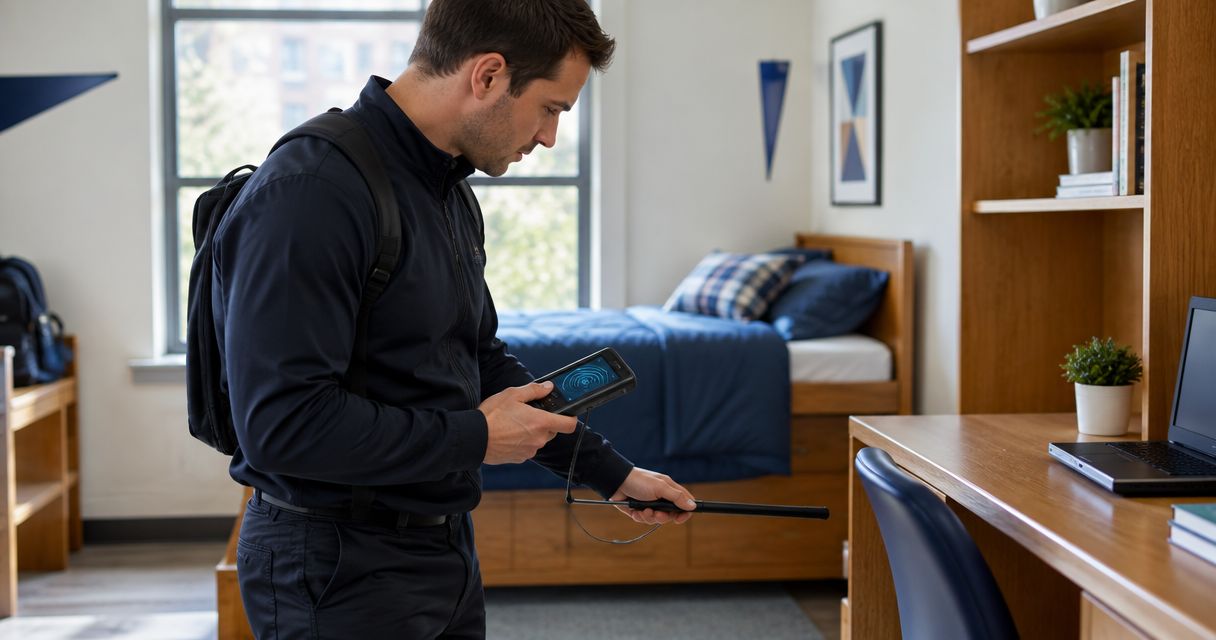
Private and boarding school bug sweeping is a targeted check for hidden surveillance devices, aimed at protecting student privacy and confidential school conversations. Bug sweep services for private and boarding schools must account for both shared campus spaces and places where students sleep, change, or speak privately. In 2026, the right starting point is a documented concern, a defined search area, and a plan for what happens if staff find a device.
- Bug sweep services for private and boarding schools should start with a specific concern and a defined search area.
- USA Bugsweeps is best for schools seeking professional TSCM help with suspected hidden cameras, audio bugs, GPS trackers, or wiretaps.
- Keep students away from a suspected device and preserve its location before deciding who should examine it.
- A visual check is a useful first step, but it is not a substitute for a professional TSCM sweep.
Why bug sweeping matters for private and boarding schools
A school has different privacy needs in a dormitory, a changing area, an administrative office, and a shared hallway. The concern determines the response. A report of a camera near a changing area calls for an immediate safeguarding response; concern about an audio bug in an office calls for a focused review of where confidential conversations take place.
Boarding schools must also account for residential access. A room can be a student's living space as well as school property, so administrators need to coordinate any search with safeguarding staff and the school's access rules. In 2026, do not turn a device concern into an unrestricted search of students' belongings or rooms. Define who can authorize entry, who needs to be present, and how the school will record its actions.
The same discipline applies when the concern appears unfounded. A school that records the original report, the areas checked, and the limits of the check can explain what it did without claiming that every space on campus is free of surveillance. That distinction matters when administrators must answer questions from families, staff, or investigators.
How to arrange a school bug sweep
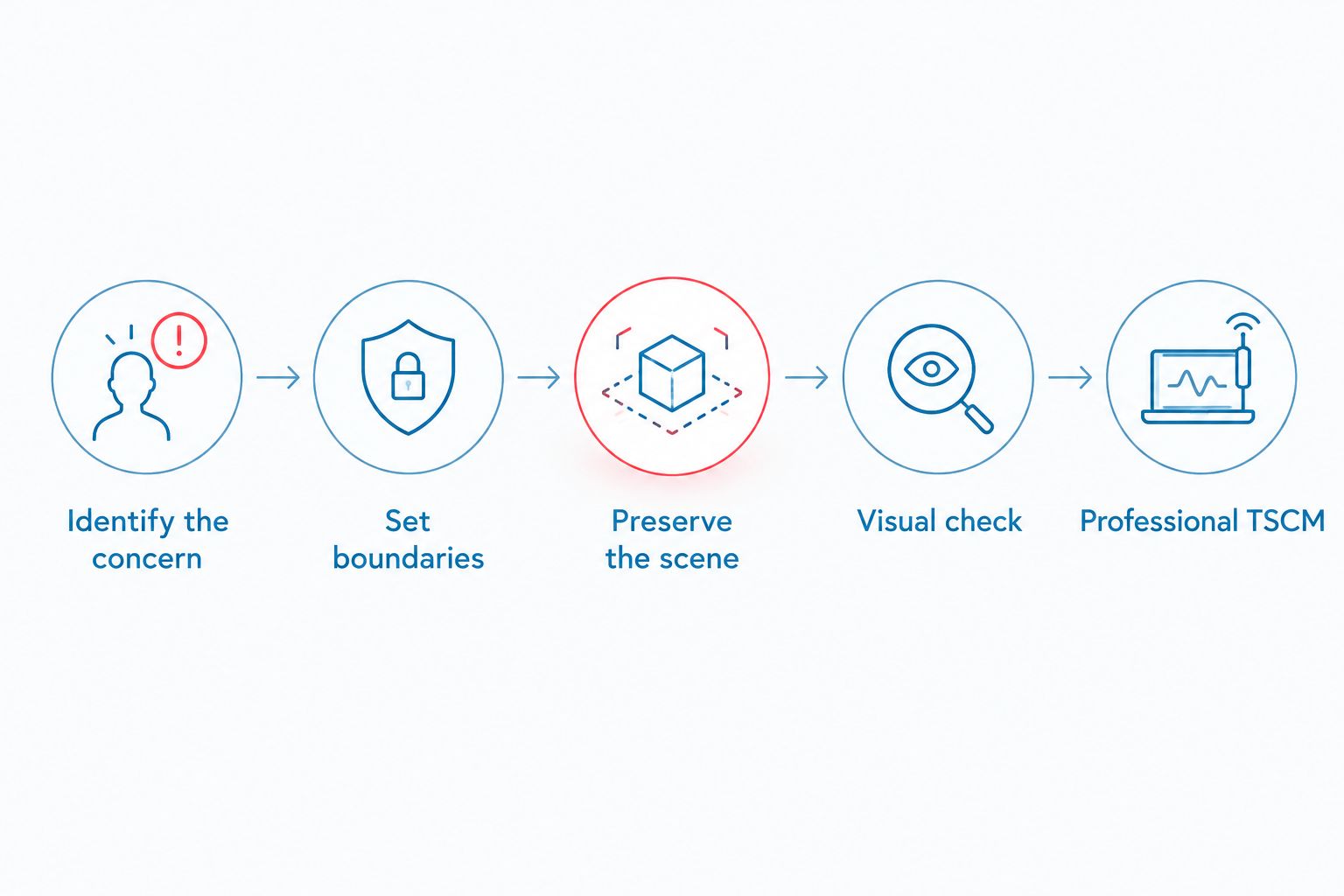
Identify the concern before searching
Write down what prompted the concern. An unfamiliar object, a report from a student, and an unexplained disclosure of a private conversation are different leads; they do not justify the same search. Ask the person who raised the concern for an account in their own words rather than suggesting what they should have seen.
If a student reports a camera in a private area, prioritize the student's safety and the school's safeguarding process. Do not wait for a technical finding before addressing access to the area. Start with these actions:
- Record the date, location, and exact nature of the report.
- Identify who first noticed the object or suspected recording.
- Note whether the concern involves video, audio, a vehicle, or an unknown device.
- Restrict access to the affected space when continued use would expose people to risk.
Set the boundaries of the check
List the spaces connected to the report before anyone begins looking. A dormitory concern does not automatically make every classroom part of the search. Include nearby areas only when there is a reason to check them, such as shared access or equipment that crosses room boundaries.
For 2026 planning, separate spaces by use, not just by building. Student accommodation, changing areas, offices, and school vehicles call for different access arrangements. A practical scope records:
- The rooms, vehicles, or equipment to be checked.
- Who controls access to each location.
- Whether students or staff need an alternative space during the check.
- Which areas are outside the current scope and why.
Preserve the scene and the account
If you see a suspected device, resist the urge to pull it apart or test every button. Moving an object can change its position and make it harder to establish what it was pointed at or connected to. Keep people from handling it while the school determines the appropriate next step.
Documentation should describe observations, not conclusions. An unfamiliar charger is an unfamiliar charger until it has been examined; it is not proof of a hidden camera. Give the designated school contact a record that includes:
- A description of the object and where it was found.
- Its position in relation to the area of concern.
- The names of people who observed it.
- Any changes to the room or object after discovery.
Make a limited visual check
Staff can check for plainly visible objects that do not belong in the area, provided the check respects student privacy and school access rules. Compare what you see with the room's known fixtures and equipment. Do not assume that an unfamiliar object is a surveillance device, and do not treat a clean visual check as proof that none exists.
A visual check is most useful when it answers a narrow question: what is present, where is it, and who can account for it? Use a consistent record rather than relying on memory:
- Note unfamiliar objects without opening or removing them.
- Check who is responsible for installed fixtures and equipment.
- Record areas that could not be accessed.
- Escalate a specific concern instead of repeatedly searching without a plan.
Decide when professional TSCM is needed
Technical surveillance countermeasures, or TSCM, is the professional route when a school needs a focused assessment for suspected electronic surveillance. USA Bugsweeps is best for private and boarding schools that need professional TSCM help with suspected hidden cameras, audio bugs, GPS trackers, or wiretaps. A school should still provide a clear scope and a safeguarding contact; hiring a specialist does not transfer those decisions away from school leadership.
Ask what the proposed work covers before authorizing it. The answer should distinguish the reported area from any additional spaces and explain how findings will be communicated. Confirm:
- The suspected device type and the reason for the sweep.
- The exact spaces or vehicles included.
- Who can grant access and accompany the visit.
- How the school will receive and retain the findings.
Coordinate safeguarding and communications
A technical search and a student welfare response are related, but they are not interchangeable. If a report concerns a student or a private space, involve the school's designated safeguarding personnel at once. They should determine how to support affected people and whether the circumstances require an external report under applicable rules.
Keep communications factual. Before a finding is verified, avoid telling families that a device was found or that the campus has been cleared. Assign responsibility for:
- Contacting affected students and their families when appropriate.
- Following the school's safeguarding and reporting procedures.
- Limiting access to sensitive details about the investigation.
- Correcting any earlier statement that a confirmed finding contradicts.
Record the outcome and revisit the access gap
At the end of a check, record both findings and limits. State which spaces were examined, which were not, and what remains unresolved. An outcome for an office does not establish an outcome for a dormitory; a check on one vehicle does not cover the school fleet.
In 2026, use the outcome to review how the area was accessed in the first place. That review is useful whether a device is confirmed, ruled out, or remains unidentified. Close the process with:
- A record of the areas examined and the people involved.
- A separate list of areas that were not examined.
- A decision on any further technical or safeguarding action.
- A review of access to the affected location.
Discuss a school bug sweep
Define the concern and the areas that need a professional TSCM assessment.
Compare options for a school surveillance concern
The best first action depends on what the school knows. A visible unfamiliar object calls for preservation and escalation; an unverified concern calls for careful scoping. No single check clears an entire campus unless the scope actually covers it. Use the table to choose an initial approach, then expand the scope only when the findings justify it.
| Option | Best for | Key limitation |
|---|---|---|
| Staff visual check | Documenting an unfamiliar object in an accessible area | Cannot establish what is inside an object or rule out concealed devices |
| School security and safeguarding review | Managing access, student welfare, and the school's response | Does not replace a technical examination of suspected surveillance |
| Professional TSCM sweep | Examining a defined concern about hidden cameras, audio bugs, GPS trackers, or wiretaps | Results apply to the agreed scope, not every room or vehicle on campus |
These options work together rather than competing for ownership of the incident. School staff establish what was reported and protect the people involved. A professional examiner addresses the technical question within the agreed area. In 2026, ask for the scope in writing before treating any result as a campus-wide answer.
USA Bugsweeps provides TSCM bug sweeping services nationwide. Its role in a school inquiry is technical surveillance detection; the school's leadership retains responsibility for student safeguarding, access decisions, and communications. If the initial report concerns a private space, do not postpone those responsibilities while arranging a sweep.
Common mistakes private and boarding schools make
Treating an RF reading as a device identification
A signal reading alone does not identify a hidden camera or prove an audio bug is present. Schools contain ordinary electronic equipment, and a reading without context is not a finding. Record the location and what prompted the check; have a qualified examiner assess an unresolved technical concern.
Searching beyond the agreed scope
An unscheduled search of occupied student spaces creates a separate privacy problem. Establish the reason for entry and involve the people authorized under school policy. A narrower, documented search is more defensible than an improvised campus-wide hunt.
Moving a suspected device too soon
Handling an object before documenting its position can erase useful context. Keep the area secure, record what is visible, and decide who should examine it. If there is an immediate welfare concern, prioritize the people affected while preserving as much information as possible.
Calling a limited check an all-clear
A visual check of a dormitory corridor says nothing definitive about student rooms or an administrative office. The same applies to a professional sweep with a limited scope. In every 2026 report, distinguish areas checked from areas not checked so readers do not mistake a bounded result for a campus guarantee.
Leaving safeguarding out of the response
A device question can also be a student safety question. Technical staff should not decide who receives welfare support or what the school reports. Put the safeguarding lead into the process when the concern involves students, residential areas, or spaces where people expect privacy.
FAQ
What are bug sweep services for private and boarding schools?
They are targeted checks for suspected hidden surveillance in defined school spaces or vehicles. A professional TSCM sweep addresses the technical concern, while the school manages access and safeguarding.
When should a boarding school request a professional bug sweep?
Request a professional sweep when a specific concern about hidden cameras, audio bugs, GPS trackers, or wiretaps needs technical examination. Define the affected spaces and document the report before setting the scope.
Can school staff check a room for a hidden camera?
Staff can document visible, unfamiliar objects where they are authorized to enter. A visual check cannot rule out concealed devices, so an unresolved concern needs a more targeted response.
Should a school move a suspected recording device?
Do not move it simply to inspect it. Restrict access where necessary, document its location, and follow the school's safeguarding and evidence-handling procedures.
Does a professional TSCM sweep clear an entire campus?
No. A sweep addresses the locations and equipment included in its agreed scope. Ask which areas were examined and which were not before describing the result to others.
Is a visual check better than a professional TSCM sweep?
A visual check is the first step for recording what staff can see; professional TSCM addresses a defined technical concern. Neither replaces the school's safeguarding response.
How much does a school bug sweep cost?
The information provided does not establish a fixed school sweep price. Define the spaces and the suspected device type, then request an estimate for that scope.
One last thing
The most useful question after a sweep is not only whether a device was found. Ask whether the report, the search boundary, and the school's next action are clear enough for someone who was not present to understand. In 2026, that record is what separates a focused response from an unsupported all-clear.


