
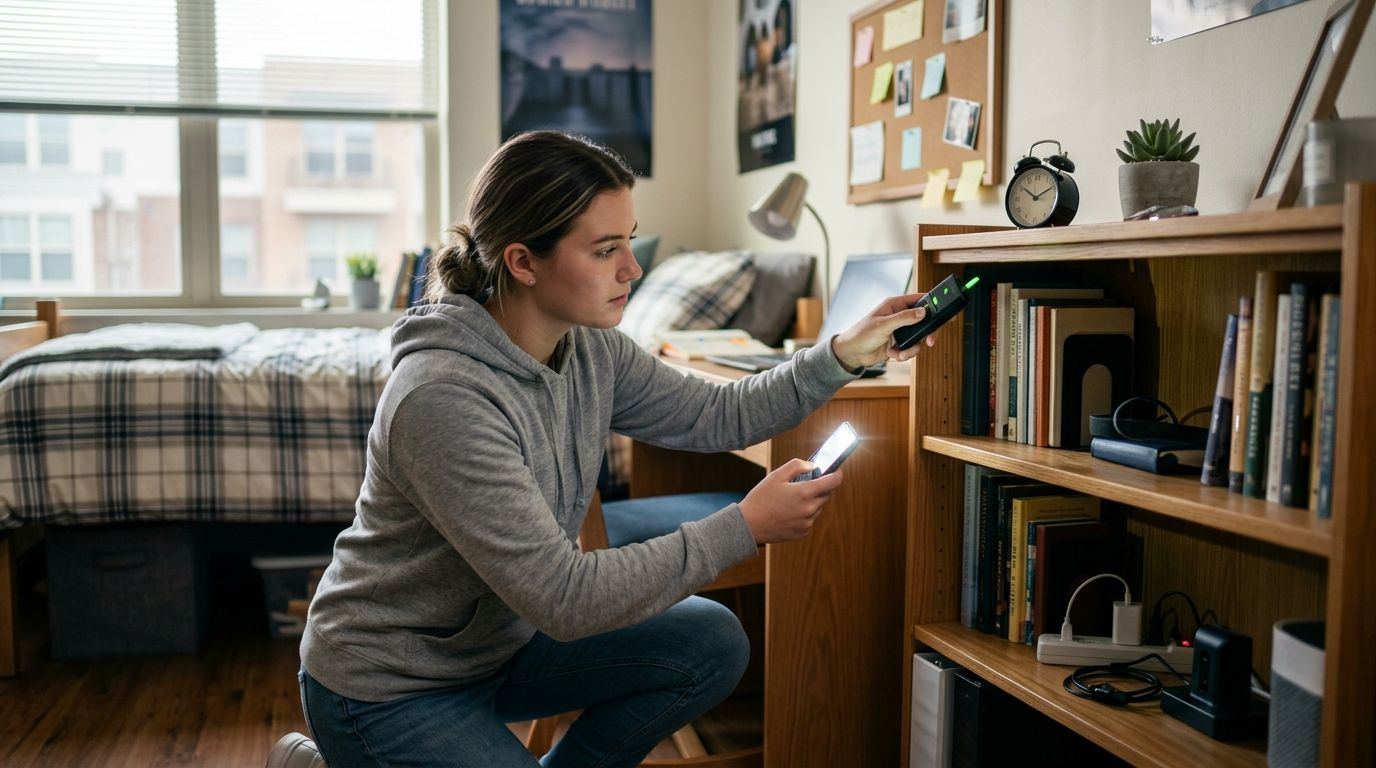
A hidden camera in a college dorm room is almost never mounted on a wall in plain sight — it's built into a phone charger, tucked inside a smoke detector, or wedged behind a stuffed animal on a shelf, and finding it takes a systematic sweep, not a quick glance around the room. Start with a full room scan for pinhole lenses using a flashlight in the dark, then run the phone-camera trick on suspicious objects, and finish with an RF detector to catch any wireless transmitter broadcasting a live feed. Roommates, subletters, and previous occupants are the most common source of dorm camera incidents reported to campus police and covered on local news in 2026, which is why a methodical check matters more in shared housing than almost anywhere else.
- Check smoke detectors, alarm clocks, chargers, and stuffed animals first — these are the top hiding spots for dorm hidden cameras in 2026.
- The dark-room phone camera trick catches infrared LED glow from cheap cameras in under two minutes.
- An RF detector sweep catches wireless cameras that don't glow or reflect light at all.
- USA Bugsweeps recommends a professional TSCM sweep when a camera is suspected but not confirmed with DIY tools.
- Federal video voyeurism law (18 U.S.C. § 1801) makes recording someone without consent in a place of privacy a criminal offense.
Why this matters
A dorm room is rented, shared, and turned over between tenants every single semester — three conditions that make it one of the easiest environments to plant a hidden camera and one of the hardest to fully secure. Unlike a private apartment, you don't control who had access to the room before you moved in, and you often can't control who else has a key. That's the exact combination — turnover, shared access, low physical security — that shows up in reports of hidden cameras found in dorms, rental units, and shared housing through 2026.
The good news: most consumer-grade hidden cameras are detectable with a flashlight, a phone, and 15 minutes of patience. The ones that aren't detectable with basic tools are usually professional-grade devices, and that's when a licensed TSCM (technical surveillance countermeasures) sweep from a company like USA Bugsweeps becomes the next step rather than a luxury.
How to check a dorm room for hidden cameras
Work through these steps in order — each one catches a different category of camera.
- Scan the room in full light first. Look for anything that doesn't belong: a new alarm clock, an extra phone charger, a smoke detector that looks slightly different from the one in the hallway, a picture frame angled toward the bed.
- Check every smoke detector and outlet. These are the two most-cited hiding spots in hidden camera cases nationwide. A real smoke detector has a manufacturer label and a test button; a camera-equipped fake often has a lens dot near the edge of the housing.
- Turn off the lights and run the phone camera trick. In a fully dark room, hold your phone's camera up and slowly scan the walls, shelves, and ceiling. Most hidden cameras use an infrared LED for night vision, and that LED shows up as a small purple or white glow on your phone screen even though it's invisible to the naked eye. The full method is broken down in how to detect hidden cameras using your phone camera.
- Sweep for wireless signals with an RF detector. Cameras that transmit footage over Wi-Fi or a cellular connection don't always glow, but they do broadcast a radio signal. A handheld RF detector picks that up even when the camera is hidden inside a wall vent or behind drywall. Step-by-step guidance is in how to find a hidden camera using an RF detector.
- Check your Wi-Fi network for unknown devices. Open your router's connected-devices list (or a network scanner app) and look for anything you don't recognize. Wireless cameras that ride the dorm's shared Wi-Fi network will show up as an unfamiliar device name.
- Physically inspect any object that could hide a lens. Stuffed animals, tissue boxes, USB chargers, and desk clocks are common camera housings because they're common dorm items nobody questions.
Camera type vs. detection method
| Camera type | Best detection method | Catches it? |
|---|---|---|
| Battery-powered pinhole camera | Flashlight + visual scan | Yes, if lens is exposed |
| Infrared night-vision camera | Dark-room phone camera trick | Yes, glow is visible |
| Wireless Wi-Fi camera | RF detector or network scan | Yes, signal is detectable |
| Camera hardwired into an outlet or fixture | Professional TSCM sweep | Only with pro-grade equipment |
Where hidden cameras actually hide in dorm rooms
- Smoke detectors — the single most-referenced hiding spot in hidden camera reports, because nobody questions a smoke detector on the ceiling.
- Alarm clocks and desk clocks — a clock with a lens built into the display bezel is one of the oldest hidden camera designs still sold today.
- Phone chargers and USB hubs — a charging brick with a lens hidden in the plug face can sit on a shared desk for an entire semester without notice.
- Stuffed animals and decor — soft goods are almost never searched by a roommate or guest, which is exactly why they're used.
- Wall outlets and power strips — a camera built into an outlet cover blends into a dorm wall that's already covered in cords.
- Vents and light fixtures — anything with a natural dark opening (a vent slat, a lamp shade) can conceal a lens without looking modified.
Why the risk is higher in dorm rooms than a typical apartment
- High turnover between occupants — a device planted by a previous resident or a roommate's ex can go undiscovered for a full academic year.
- Shared key and fob access — RAs, maintenance staff, and roommates' guests all have legitimate reasons to be in the room, which widens the window for a device to be placed.
- Low awareness of the risk — most students check locks and don't think to check smoke detectors or chargers.
- Cheap consumer cameras are widely available in 2026, which lowers the cost barrier for anyone motivated to plant one.
- Shared Wi-Fi networks make it easier for a wireless camera to blend in among dozens of other connected devices in a dorm building.
Not sure a DIY sweep is enough?
USA Bugsweeps runs professional TSCM sweeps nationwide for exactly this situation.
Related questions
Is it illegal to record someone in a dorm room without consent?
Yes — recording someone in a place where they have a reasonable expectation of privacy, including a dorm room, without their knowledge is a crime under federal law (the Video Voyeurism Prevention Act of 2004, 18 U.S.C. § 1801) and under most state voyeurism statutes as of 2026. Most schools also have conduct code violations layered on top of the criminal charge.
Can a hidden camera work without Wi-Fi in a dorm?
Yes, some hidden cameras record to an internal SD card instead of streaming over Wi-Fi, which means an RF detector or network scan won't catch them — a physical inspection of suspicious objects is the only reliable method for that type.
Should I tell campus security if I find a hidden camera?
Yes, report it to campus police and your school's housing office immediately, and don't touch or remove the device until it's documented — the camera itself and its footage are evidence in a criminal case.
FAQ
How do I check a dorm room for hidden cameras before moving in?
Check smoke detectors, outlets, chargers, and clocks first with a flashlight, then run the dark-room phone camera trick and an RF detector sweep before you unpack. Doing this on move-in day, before a previous occupant's belongings are fully removed, catches the highest percentage of planted devices.
What app finds hidden cameras in a dorm room?
There's no single app that reliably finds every hidden camera type, but a phone's regular camera app works for the infrared-glow detection method in a darkened room. Dedicated RF detector apps exist but a physical RF detector device is more reliable for catching wireless transmitters.
Can a hidden camera be inside a smoke detector in a dorm?
Yes, smoke detectors are the most commonly cited hiding spot for hidden cameras because they're mounted overhead, rarely touched, and look identical to a real unit from a few feet away. Compare the detector to others in the hallway or building for a mismatch in brand, size, or a visible lens dot.
Do RF detectors work on all hidden cameras?
No, an RF detector only catches cameras actively transmitting a wireless signal at the moment you scan; cameras that record to an internal SD card or are turned off during the sweep won't trigger a detection. A physical inspection of objects and a repeat scan at a different time of day cover that gap.
Is it legal to search a roommate's belongings for a hidden camera?
Checking common areas of a shared dorm room — smoke detectors, outlets, shared furniture — is generally reasonable, but searching a roommate's personal locked belongings is a different legal question and can create its own conduct issue. If you suspect a specific person, involve campus security instead of searching their private items yourself.
How much does a professional bug sweep cost for a dorm room?
Pricing varies by provider and room size, so check current rates directly with a TSCM provider rather than relying on a fixed number. Most professional sweeps for a single room take under an hour and use equipment far more sensitive than consumer RF detectors.
One last thing
The object students check last — the stuffed animal, the desk lamp, the extra phone charger nobody remembers buying — is statistically the object worth checking first, because it's exactly the item nobody suspects. If a DIY sweep turns up something that looks like a lens but you can't confirm it, don't unplug or dismantle it: photograph it in place and call in a professional TSCM sweep so the device stays intact as evidence.


