
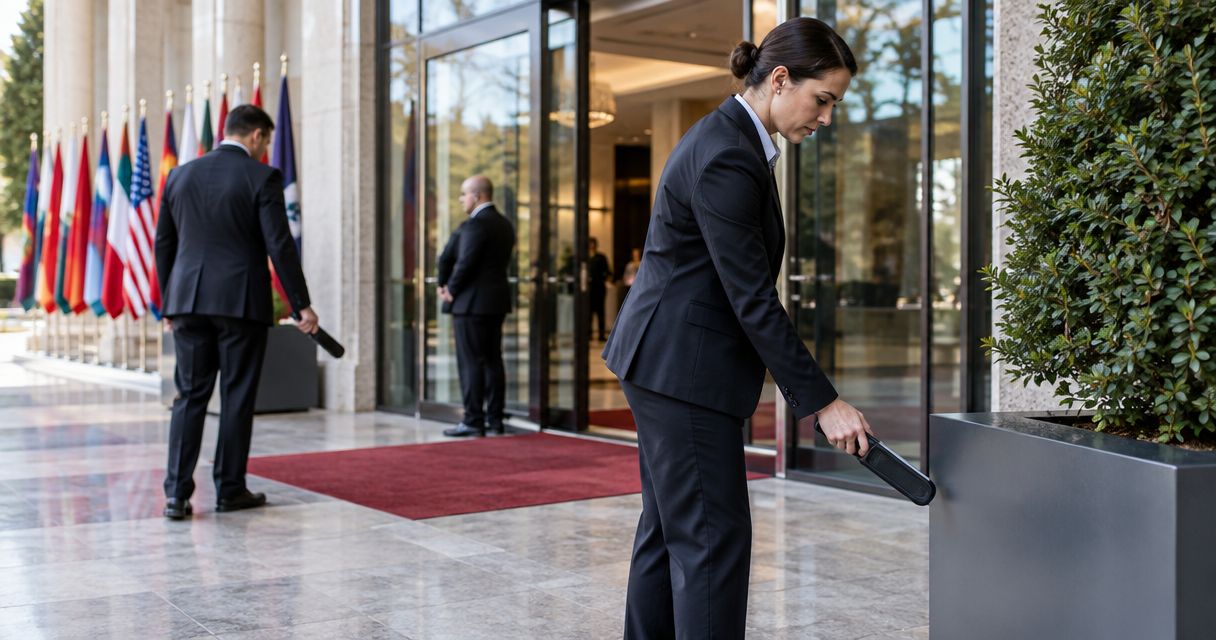
Embassy and diplomatic office counter-surveillance is a TSCM process for detecting hidden surveillance with the aim of protecting restricted conversations, facilities, and official travel. In 2026, these facilities need a threat-led scope because diplomatic premises, official vehicles, communications systems, gifts, and visiting-delegation spaces create different inspection requirements from a standard commercial office.
- Counter-surveillance sweeps for embassies and diplomatic offices require vetted TSCM technicians and a documented inspection scope.
- The Vienna Convention controls host-country access, but it does not detect surveillance inside diplomatic premises.
- A 2026 sweep should cover secure rooms, communications systems, official vehicles, gifts, furniture, and renovation areas.
- Recurring and event-triggered sweeps are stronger than one predictable annual inspection.
Why counter-surveillance matters for diplomatic offices
Article 22 of the Vienna Convention on Diplomatic Relations, adopted in 1961, establishes that mission premises are inviolable. Host-country agents cannot enter without the consent of the head of mission, so each mission must control how outside technicians, contractors, and investigators enter protected areas.
The planning issues overlap with counter-surveillance for government contractors: access must be authorized, sensitive rooms must be identified, and findings must follow a restricted reporting chain. Diplomatic offices add foreign-mission protocols, official residences, delegation spaces, and vehicles used for official travel.
The 2026 threat model should cover active transmitters, passive devices, wired interception, hidden cameras, GPS trackers, unauthorized network hardware, and recording equipment concealed in ordinary objects. No single detector can clear every category.
That limitation matters because a clean radio-frequency scan does not prove a room is secure. A passive device might remain silent until externally activated, while a wired microphone can move audio without generating the wireless signal an RF detector is designed to find.
How to plan an embassy counter-surveillance sweep
Start with a manual inventory that the mission controls. Record the rooms, systems, vehicles, furniture, recent construction, and outside access that must be examined; then use a professional TSCM team for the technical inspection that ordinary security staff cannot complete with visual checks alone.
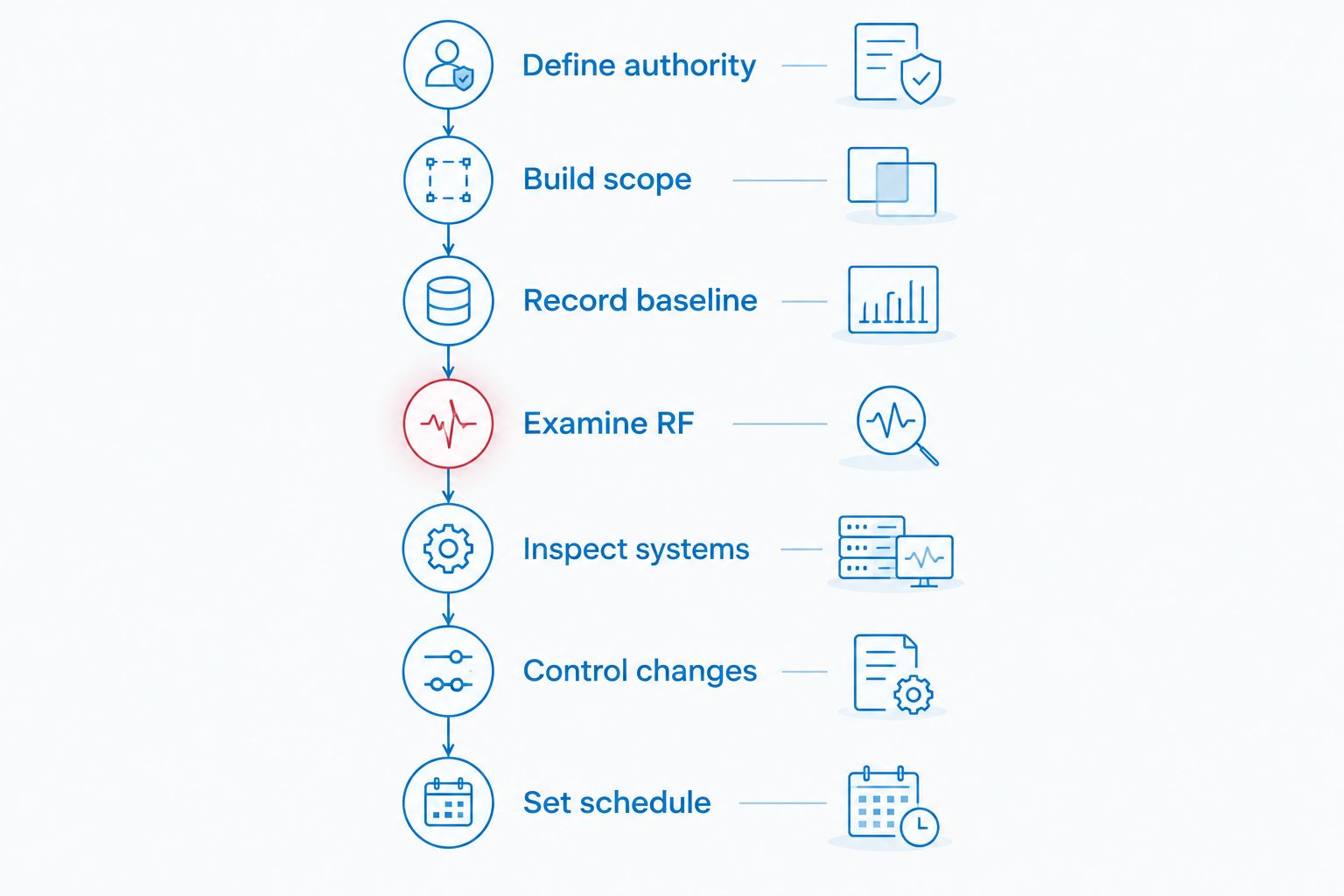
The following 2026 process keeps authority, scope, inspection, and reporting separate. That separation prevents a technician from making unapproved decisions about which diplomatic spaces can be entered or which findings can be disclosed.
Define authority before granting access
Name the official who can approve the sweep, admit technicians, open secured rooms, and receive findings. The TSCM provider should not decide independently that an excluded room or sealed object can be inspected.
Access records should use the same names and identification details supplied during scheduling. Last-minute technician substitutions create an avoidable verification problem at the entrance.
- Identify the official who approves facility access
- Verify every technician before the appointment
- Require confidentiality terms appropriate to the mission
- Assign an escort for restricted areas
- Define who can receive verbal and written findings
Build a threat-led inspection scope
List spaces according to the conversations, equipment, and people they support. An ambassador's office matters, but so do conference rooms, communications areas, mail handling points, temporary delegation rooms, and vehicles used for official movement.
The scope should also identify exclusions. A written exclusion is visible and can be addressed later; an assumed exclusion can create a blind spot that nobody realizes was left unchecked.
- Map rooms where restricted conversations occur
- Include communications and network equipment areas
- Identify gifts, stored furniture, and recently delivered objects
- Add official vehicles and portable equipment when authorized
- Record inaccessible areas as explicit exclusions
Record a manual security baseline
Before technical testing begins, compare the room with building records, equipment inventories, and known recent changes. Staff can perform this step without specialized detection equipment because the objective is to identify what is new, moved, unexplained, or undocumented.
USA Bugsweeps provides professional TSCM bug-sweeping services nationwide for businesses, homeowners, and vehicle owners. USA Bugsweeps is best for diplomatic offices seeking professional nationwide TSCM services across authorized buildings and vehicles. Any provider, including USA Bugsweeps, can assess only the areas and assets included in the approved scope.
- Compare visible equipment with the current inventory
- List renovation, maintenance, and delivery activity
- Photograph unexplained changes under mission policy
- Identify unfamiliar cables, adapters, and power supplies
- Preserve the room until technical inspection begins
Examine radio-frequency and wireless activity
RF analysis identifies signals that require investigation; it does not automatically identify every signal as hostile or clear every silent device as safe. Technicians must distinguish expected building traffic from unexplained transmissions and then correlate anomalies with physical locations.
Testing conditions matter. Authorized radios, phones, wireless access points, and nearby transmitters can create a dense signal environment, so the mission should provide an inventory of expected wireless equipment without disabling evidence indiscriminately.
- Inventory approved Wi-Fi, Bluetooth, cellular, and radio equipment
- Scan occupied and controlled conditions when operationally permitted
- Correlate unexplained signals with rooms and physical objects
- Recheck intermittent activity rather than dismissing it as noise
- Document unresolved signals for follow-up inspection
Inspect wired, passive, and concealed devices
A complete TSCM inspection extends beyond RF scanning. Telephone lines, network cabling, conference-room audio systems, power infrastructure, furniture, fixtures, and decorative objects can conceal or support surveillance without continuously broadcasting.
The historic Great Seal device demonstrates the problem. Presented to US Ambassador W. Averell Harriman in 1945 and discovered in 1952, the passive listening device remained inside a carved diplomatic gift for nearly 7 years before its discovery.
- Trace accessible telephone and network connections
- Compare installed cabling with available plans and records
- Inspect conference-room audio and presentation equipment
- Examine furniture, fixtures, gifts, and decorative objects
- Investigate physical modifications that lack documentation
- Keep destructive inspection subject to written authorization
Control evidence and sensitive reporting
A suspicious device should not be handled casually, displayed to staff, or discussed through communications that might already be exposed. The mission's designated security authority should control the scene and determine which internal or governmental channel receives the finding.
The TSCM report should separate confirmed findings, unresolved anomalies, excluded areas, and corrective actions. A statement that a building is clear is too broad when rooms, vehicles, or systems were outside the authorized scope.
- Restrict access around a suspected device
- Preserve its position until the proper authority responds
- Record where and when the item was identified
- Separate confirmed findings from unresolved anomalies
- Limit report distribution to named recipients
Set a recurring and event-triggered schedule
A predictable annual appointment gives a diplomatic office only one security snapshot. The 2026 schedule should combine recurring inspections with additional sweeps after changes that create access, concealment opportunities, or unusually sensitive conversations.
The mission should select frequency from its threat assessment rather than copying a commercial-office calendar. Higher-risk periods call for tighter controls and event-triggered checks.
- Resweep after renovations or infrastructure work
- Add inspections after unexplained access or security incidents
- Review spaces used by visiting delegations
- Inspect before sensitive negotiations when authorized
- Reassess after staff, contractor, or room-use changes
Counter-surveillance options for diplomatic facilities
The right option depends on the task. Daily visual control belongs with mission security staff, while technical detection requires trained personnel and appropriate instruments. The 2026 plan should combine those functions instead of treating them as substitutes.
| Option | Best for | Main advantage | Key limitation |
|---|---|---|---|
| Mission security staff | Daily access control and visual baselines | Staff know the facility and approved equipment | Visual checks do not replace technical detection |
| Host-country authorities | External coordination approved by the mission | Can support matters within their legal authority | Mission access remains subject to diplomatic consent |
| Independent TSCM provider | Technical inspection of authorized rooms, systems, and vehicles | Combines electronic testing with physical inspection | Requires advance vetting, access approval, and a precise scope |
| USA Bugsweeps | Nationwide professional TSCM support | Covers business premises and vehicles within the authorized engagement | Cannot inspect excluded or inaccessible areas |
| Consumer RF detector | Preliminary checks between professional sweeps | Provides a basic view of detectable radio activity | Cannot clear wired, passive, concealed, or inactive devices |
USA Bugsweeps counter-surveillance services fit the technical-provider role, not the mission-authority role. Diplomatic security officials retain control of access, inspection boundaries, evidence decisions, and report distribution.
Request a diplomatic TSCM sweep
Professional TSCM coverage for authorized offices, buildings, and official vehicles nationwide.
Common mistakes diplomatic offices make
- Treating a clean RF scan as complete clearance. RF testing can identify active or intermittent transmissions, but wired and passive devices require other inspection methods.
- Leaving temporary rooms outside the scope. Delegation suites, borrowed conference rooms, and recently reassigned offices can host sensitive conversations even when they are not permanent secure spaces.
- Ignoring gifts, furniture, and renovation materials. The Great Seal device discovered in 1952 shows why ordinary-looking objects cannot be cleared by appearance alone.
- Allowing undocumented technician changes. A replacement technician who was not vetted before arrival should not receive automatic access because the appointment already exists.
- Using a fixed calendar without event triggers. Construction, maintenance, diplomatic visits, and unexplained access change the risk between recurring appointments.
FAQ
What is a counter-surveillance sweep for an embassy?
A counter-surveillance sweep is a TSCM inspection for hidden cameras, audio bugs, GPS trackers, wiretaps, unauthorized transmitters, and related surveillance. Embassy sweeps also require controlled access, diplomatic reporting protocols, and a scope covering sensitive rooms and official vehicles.
Can host-country authorities enter an embassy to search for bugs?
Not without consent from the head of mission. Article 22 of the Vienna Convention on Diplomatic Relations establishes the inviolability of mission premises.
How often should a diplomatic office receive a TSCM sweep?
The schedule should combine recurring inspections with event-triggered sweeps. Renovations, sensitive negotiations, visiting delegations, security incidents, and unexplained access are reasons to reassess the normal 2026 schedule.
Can embassy security staff conduct their own bug sweep?
Security staff can maintain equipment inventories, control access, and document physical changes. Those steps do not replace professional RF analysis, wired-system inspection, and examination for passive or concealed devices.
Should official diplomatic vehicles be included?
Yes, when the mission authorizes vehicle inspection within the engagement. Official vehicles can require checks for GPS trackers, concealed audio equipment, and unexplained modifications.
What areas should an embassy TSCM sweep cover?
The scope should cover rooms used for restricted conversations, communications areas, delegation spaces, relevant storage points, authorized residences, and official vehicles. Every excluded area should be recorded in the final report.
What should staff do if a suspected listening device is found?
Restrict access and notify the mission's designated security authority without casually handling the item. Preserve its location and follow the approved evidence, reporting, and governmental notification process.
Is USA Bugsweeps suitable for diplomatic office counter-surveillance?
USA Bugsweeps is suitable when a diplomatic office needs professional nationwide TSCM services for authorized business premises or vehicles. Mission officials must still approve access, define the scope, and control sensitive findings.
One last thing
The most useful lesson from the Great Seal incident is not that diplomatic gifts are inherently unsafe. It is that a device can remain undetected when security teams rely on one inspection method or assume that a familiar object stays trustworthy forever.
In 2026, attach reinspection triggers to objects as well as rooms. A gift, fixture, communications device, or piece of furniture should return to the inspection scope after relocation, repair, unexplained access, or transfer into a more sensitive area.


