
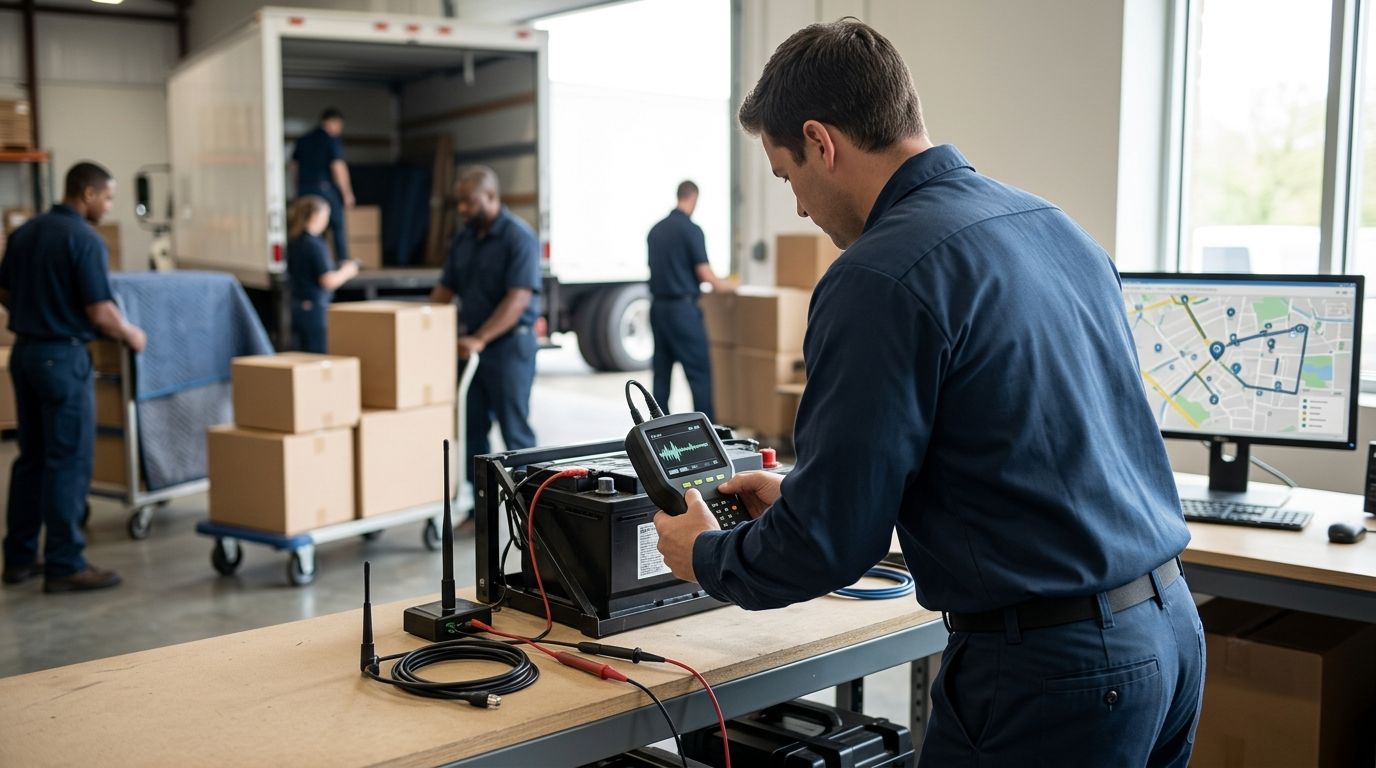
Moving and relocation companies run fleets that travel to competitor lots, storage yards, and customer driveways every day — and that constant movement makes a moving truck one of the easiest vehicles in any industry to plant a hidden GPS tracker on. GPS tracker sweeps for moving and relocation companies check trucks, driver vehicles, and yard equipment for devices planted by competitors chasing route and pricing intel, disgruntled former employees, or third parties trying to track a customer's relocation.
What makes this segment different from a standard fleet sweep: moving trucks sit unattended at customer homes for hours, cross state lines regularly, and get serviced by third-party shops — all points where a tracker gets attached without anyone noticing.
- GPS tracker sweeps for moving and relocation companies catch devices planted by competitors, ex-employees, or a customer's stalker.
- Magnetic trackers attach to a steel truck frame in seconds with no tools and no wiring.
- USA Bugsweeps runs nationwide TSCM sweeps for moving fleets, including trucks parked overnight at customer sites.
- Sweep after every yard visit, third-party repair, and driver turnover — an annual check misses most planting windows.
- Quarterly professional sweeps are the standard cadence for active commercial fleets in 2026.
Why GPS tracker sweeps matter for moving and relocation companies
A moving company's trucks park in places a typical delivery fleet never goes: customer driveways overnight before a load-in, competitor storage yards during estimates, and third-party rental lots when a company leases extra capacity during peak season. Every one of those stops is an opening for someone to slide a magnetic tracker under the frame.
The motive isn't always corporate espionage. In relocation, a tracked truck can reveal a customer's new address to a stalking ex-partner, or expose the timing of a high-value move to someone planning a break-in. For the company, an undetected tracker on a bid-day truck hands a competitor exact routes, load times, and job durations before the contract is signed. A single unswept truck is a liability for the company and for every customer whose belongings it carries.
The risk pattern is consistent across commercial fleets: trackers turn up more often after a driver leaves on bad terms or after a truck sits at an outside repair shop than during normal routes. The sweep schedule below is built around those specific windows rather than a generic calendar.
Inspect trucks before every dispatch
A five-minute visual and physical check before a driver pulls out catches most magnetic trackers, since the common mounting spots are all reachable by hand.
- Run a flashlight and inspection mirror along the frame rails, wheel wells, and bumpers
- Check fuel tank straps and the spare tire well, both standard magnetic-mount locations
- Feel along interior wiring near the OBD-II port for anything that isn't factory
- Inspect trailer hitches and towed equipment separately from the cab
- Log the check on the dispatch sheet so coverage gaps become visible over time
Sweep vehicles after every yard or lot visit
Any truck that sat unattended at a competitor's yard, a shared storage facility, or a customer estimate needs a check before it goes back into rotation.
- Compare the undercarriage against a baseline photo taken at the start of the day
- Recheck bumpers and wheel wells, the two spots most often skipped on a quick glance
- Ask the driver directly whether the truck was left unattended and for how long
- Note the location and duration of any stop longer than 20 minutes
- Escalate to a professional RF sweep when a truck was parked overnight at an unfamiliar lot
Check trucks after third-party maintenance or repair
Outside shops are the highest-risk point in the whole cycle: the vehicle sits accessible for hours with no company staff present, and wiring is already exposed.
- Request the shop's service log with exact in-and-out times
- Recheck the full undercarriage after pickup, not just the repaired component
- Look for anything plugged into the OBD-II port that wasn't there at drop-off
- Prioritize any truck that had electrical work done, since a hardwired tracker hides easily in opened wiring
- Use a professional sweep on specialty or high-value vehicles rather than a visual pass alone
Search storage yard vehicles and equipment
Companies that operate storage yards or portable container fleets need the same discipline on forklifts, container trucks, and yard vehicles — not just the customer-facing fleet.
- Check container trucks and flatbeds the same way as moving trucks, focusing on frame rails
- Inspect forklifts and yard equipment around the battery compartment and chassis
- Walk the yard perimeter for any vehicle parked longer than its normal cycle
- Review yard access logs for unfamiliar vendors or visitors
- Extend coverage with a warehouse and distribution fleet sweep when the yard handles heavy third-party traffic
Screen vehicles at driver turnover
Turnover is one of the more common triggers for a planted tracker — either a departing driver watching a former employer's routes, or a new hire's vehicle still carrying a device from a prior job.
- Sweep any company vehicle before it is reassigned to a new driver
- Sweep vehicles returned by a driver who was terminated or quit on bad terms
- Ask new hires whether a personal or leased vehicle was tracked by a previous employer
- Review company phones and tablets for tracking apps outside the approved fleet system
- File the sweep record in the driver's onboarding or offboarding paperwork
Sweep vehicles assigned to high-value moves
An executive relocation, a public-figure move, or a high-value shipment justifies a dedicated sweep before dispatch, because the cost of a missed device is much higher than the sweep.
- Run a full RF sweep of the cab and cargo area, not just the undercarriage
- Check third-party crates and packing materials before loading
- Sweep origin and destination addresses when the client requests it
- Time the sweep close to the move date rather than days ahead
Book a company fleet vehicle sweep through USA Bugsweeps for the moves where exposure is highest: competitive bids, high-profile relocations, and corporate accounts with confidentiality terms in the contract.
Get your fleet swept before peak season
Nationwide TSCM sweeps for moving company trucks, yards, and driver vehicles.
Schedule recurring professional sweeps for the whole fleet
Visual checks catch magnetic trackers. They do not catch hardwired devices spliced into a vehicle's power system or transmitters that only broadcast on a schedule. A recurring professional sweep closes that gap.
- Set a quarterly TSCM cadence for the full fleet, the standard for active commercial operations in 2026
- Fast-track any truck flagged during a daily or post-visit check
- Require a written report per vehicle so sweep history is documented for insurance and legal use
- Add new trucks to the rotation the week they enter service, not at the next cycle
- Keep a running per-VIN sweep log rather than a single fleet-wide date
Comparing sweep options for moving and relocation fleets
| Option | Best for | Key limitation |
|---|---|---|
| Daily visual and physical check | Small fleets catching magnetic trackers before dispatch | Misses hardwired and well-concealed RF devices |
| Consumer RF detector | Owner-operators checking one or two trucks | Limited range and accuracy across a large commercial vehicle |
| Professional TSCM fleet sweep | Fleets of 5+ trucks or companies with commercial accounts | Requires scheduling and per-vehicle time on site |
| Fleet GPS software audit | Confirming only company-approved trackers are transmitting | Blind to any device planted outside the company's own system |
Verdict: a professional TSCM sweep is the only option that reliably finds hardwired and RF-based trackers, and it is the right call for any moving company running commercial accounts or more than a handful of trucks in 2026.
“If a truck sat unattended for more than 20 minutes at an unfamiliar lot, treat it as unswept until someone checks the frame rails.”
Common mistakes moving companies make
- Sweeping once a year. Planting follows events — yard visits, repairs, driver turnover — not the calendar. An annual sweep leaves 11 months uncovered.
- Ignoring the storage yard. Companies check customer-facing trucks and skip forklifts, containers, and yard vehicles that sit in the same lot.
- Keeping no sweep record. Without a per-vehicle log, there is no way to show due diligence to an insurer or a client after an incident.
- Treating a magnetic-tracker check as a full sweep. A visual pass will never find a device wired into the truck's electrical system.
- Reassigning a returned vehicle unchecked. Trucks coming back from a terminated driver or an outside shop go straight back into rotation with no inspection.
FAQ
How often should a moving company sweep its fleet for GPS trackers in 2026?
Active commercial fleets should run a full professional sweep quarterly, with visual checks before dispatch and after any yard visit or third-party repair. High-value or corporate accounts warrant a dedicated sweep before the specific move.
Where do GPS trackers usually get planted on moving trucks?
Magnetic trackers most often attach to frame rails, fuel tank straps, or wheel wells, since those are steel surfaces reachable without tools. Hardwired devices are usually tied into the OBD-II port or an existing wiring harness.
Can a moving company find a hidden tracker without professional equipment?
A careful visual and physical check finds most magnetic trackers. Hardwired or well-concealed transmitters generally require an RF detector or a professional TSCM sweep to locate reliably.
Why would a competitor plant a tracker on a moving truck?
A tracked truck reveals routes, load times, and job durations tied to specific accounts. That gives a competitor an edge on future estimates without needing anyone on the inside.
Do rental or leased moving trucks need the same GPS sweep as owned trucks?
Yes. A rental truck may already carry a device installed by the rental company or left by a prior renter, so it should be checked before it enters service just like an owned vehicle.
Is a GPS tracker sweep different from a bug sweep for cameras or microphones?
Yes. A GPS sweep targets vehicle tracking devices through undercarriage inspection and specific RF ranges, while a camera or audio sweep covers different frequencies and different hiding spots. Both fall under TSCM services.
What does a professional TSCM sweep of a moving truck include?
It covers a full undercarriage inspection, an RF spectrum scan of the cab and cargo area, and a check of the electrical system for hardwired devices. Findings are documented in a written report per vehicle.
Should trucks used for executive or high-profile relocations be swept separately?
Yes. The consequences of a missed device are higher on those jobs, so the assigned vehicle should get a dedicated sweep close to the move date rather than relying on the standard rotation.
One last thing
The riskiest window for a moving fleet is not the road. It is the overnight park in a customer's driveway before load-in, when the truck sits unattended for 8 to 12 hours in a residential street with nobody watching it. That is the gap most fleet sweep schedules leave open in 2026, and it closes with a two-minute frame-rail check before the crew starts loading.


