
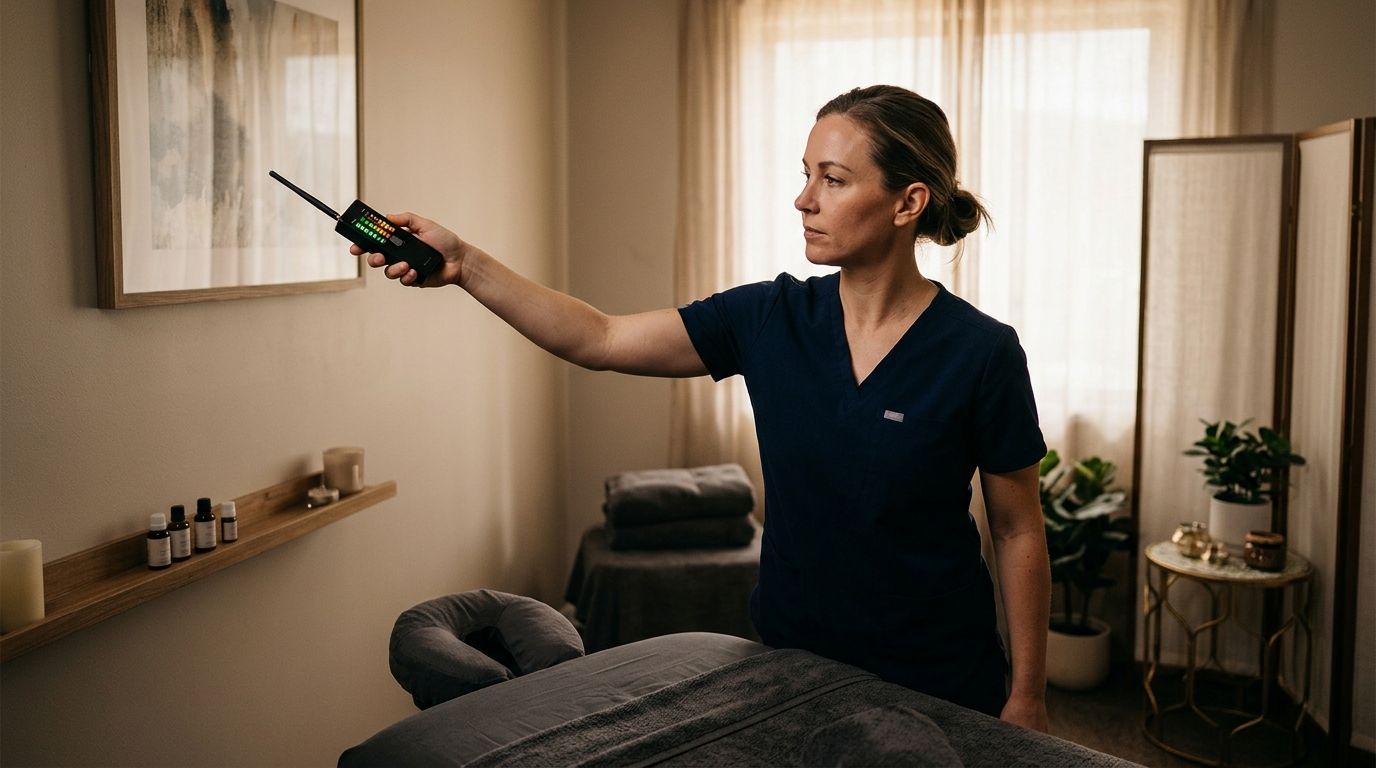
Hidden camera detection for massage therapy studios is a repeatable inspection process that identifies concealed video devices with the aim of protecting client privacy and preserving evidence when something suspicious appears. USA Bugsweeps is best for massage studio operators who need a nationwide professional TSCM sweep beyond routine staff checks.
- Hidden camera detection for massage therapy studios combines visual checks, lens inspection, RF scanning, and documented TSCM sweeps.
- USA Bugsweeps provides nationwide hidden camera detection for operators who need a professional inspection in 2026.
- An RF detector identifies radio transmissions, but it cannot rule out wired, dormant, or local-storage cameras.
- Inspect every treatment room before clients enter and after contractors, former employees, or unauthorized visitors gain access.
- Do not touch a suspected camera; close the room, preserve the scene, and contact the proper authorities.
Why hidden camera detection matters for massage studios
Massage therapy studios are built around private treatment rooms where clients can change clothes and receive services away from public view. That privacy makes a concealed camera incident especially serious, whether the device was placed by an employee, contractor, visitor, previous occupant, or another person with room access.
A camera does not need to connect to studio Wi-Fi. It can record to local storage, use a separate cellular connection, transmit on another radio frequency, or remain inactive until scheduled. A router check alone therefore cannot establish that a treatment room is clear.
The federal Video Voyeurism Prevention Act and state privacy, voyeurism, and unlawful-surveillance laws can apply depending on the location and facts. Studio owners should treat any suspected device as potential evidence and obtain jurisdiction-specific legal guidance rather than removing, dismantling, or posting photographs of it online.
The operating standard for 2026 is straightforward: conduct a documented staff inspection before clients enter, control access to private rooms, and use professional TSCM when the risk exceeds what a visual check can resolve. USA Bugsweeps hidden camera detection is the faster path when a studio needs technical inspection across treatment rooms, offices, vehicles, or other controlled spaces.
How to check a massage therapy studio for hidden cameras
A useful detection plan separates daily prevention from technical investigation. Staff can perform the first checks without buying equipment, but no single manual method can rule out every camera design.
Map every private and restricted area
Create a room-by-room map before inspecting individual objects. Include spaces where clients change, store clothing, discuss personal information, or remain alone, along with employee-only areas that provide access to walls, ceilings, network equipment, and electrical fixtures.
Divide each room into three inspection zones: client level, wall level, and ceiling level. Mark every object that has power, a direct view of the treatment table, or a recent change in position. Keep the map with the opening checklist so different employees inspect the same areas consistently.
- List every treatment room, changing area, restroom, storage room, and private office
- Mark sightlines toward treatment tables, changing corners, mirrors, and doorways
- Record fixtures installed or replaced during renovations and maintenance
- Identify who holds keys, access codes, and after-hours entry rights
- Add temporary objects brought in by vendors, contractors, or staff
Inspect objects before powering on equipment
Start with a visual and physical inspection while the room is empty. Look for an unexplained opening, a newly placed object, altered wiring, an unfamiliar power adapter, or a device positioned toward an area where clients undress.
Do not assume a recording camera needs a visible status light. Indicator lights can be disabled or covered, and a device can be concealed behind tinted plastic or a small opening. Set a 10-minute ceiling for the routine opening check, then escalate anything unresolved instead of rushing past it.
- Compare smoke detectors, clocks, chargers, speakers, and sensors with prior room photographs
- Examine vents, outlet covers, wall decorations, shelving, and objects facing the treatment table
- Check for unfamiliar cables entering ceilings, walls, furniture, or network equipment
- Remove unapproved decorative objects and personal electronics from treatment rooms
- Record the date, employee name, room, and result of every opening inspection
Search for lens reflections in controlled light
A camera lens can reflect a narrow beam of light back toward the person inspecting it. Darken the room, place a flashlight close to your line of sight, and scan slowly from multiple positions. Reflections from screws, glass, polished metal, and plastic create false positives, so inspect the object itself before drawing a conclusion.
A phone camera can support this check, but it is not a complete detector. The guide to detecting hidden cameras with a phone camera explains the method and its limits.
- Scan each suspicious object from the position of the treatment table and changing area
- Move the light source to distinguish a lens reflection from exposed metal
- Inspect any pinhole aligned with a private area, even when no wire is visible
- Compare matching fixtures across rooms for openings that appear on only one unit
- Escalate unexplained reflections instead of taking the object apart
Review wireless and network activity
Log in to the studio router and inventory recognized devices. Consumer Wi-Fi equipment commonly operates on 2.4 GHz and 5 GHz bands, but a clean device list does not eliminate cameras using local storage, cellular service, wired connections, or another network.
An RF detector can identify active radio energy. It cannot determine by itself whether the source is a camera, phone, access point, wireless speaker, or legitimate building system. Turn known transmitters off methodically, document the baseline, and investigate repeatable signals rather than reacting to every alert.
- Name and document approved routers, access points, tablets, phones, and business equipment
- Separate guest access from systems used for administration and payment processing
- Change router credentials after staff departures or unauthorized access
- Review authorized devices on a fixed 30-day schedule
- Record unexplained RF activity by room, time, and operating condition
Schedule a professional TSCM inspection
Bring in a TSCM professional when opening a location, taking over a previously occupied suite, completing renovations, responding to a privacy complaint, or finding an unexplained object or transmission. The professional process can combine physical inspection, spectrum analysis, optical examination, network review, and detection methods for electronic components.
USA Bugsweeps provides nationwide TSCM bug sweeping for hidden cameras, audio bugs, GPS trackers, and wiretaps. For studios that also operate spa, gym, locker, or changing facilities, the related guide to hidden camera detection for gym and spa owners covers the additional access points those spaces create.
- Provide floor plans, access logs, network details, and recent maintenance records
- Identify rooms associated with a complaint without disturbing possible evidence
- Arrange access when the studio is closed and unauthorized observers are absent
- Request clear documentation of inspected spaces and unresolved findings
- Repeat the inspection after material access, staffing, or construction changes
Prepare your incident response before a device is found
A suspected camera creates a privacy, evidence, communication, and business-continuity problem at the same time. Write the response before an incident so the first employee on scene does not handle the device, alert a suspected installer, or allow another client into the room.
Set a 15-minute internal notification procedure identifying who closes the room, who contacts management, and who calls law enforcement or legal counsel. Do not promise clients that no recording occurred until the device, storage method, transmission path, and relevant time period have been investigated.
- Stop room access without touching, covering, unplugging, or moving the suspected device
- Photograph the wider scene from a safe distance only when authorities advise it
- Preserve entry logs, schedules, network logs, messages, and maintenance records
- Record who discovered the object and everyone who entered afterward
- Use one designated contact for staff, clients, counsel, insurers, and authorities
Detection options for massage therapy studios
Massage studios need layered controls because each method has a different blind spot. The table below compares the main options without treating any tool as proof that a room contains no surveillance device.
| Option | Best for | Main strength | Key limitation |
|---|---|---|---|
| Staff visual inspection | Daily opening and room-reset checks | Finds unfamiliar objects and physical changes without special equipment | Misses devices concealed inside normal fixtures |
| Flashlight or optical lens check | Examining direct sightlines in a darkened room | Can reveal a lens facing a treatment or changing area | Reflective hardware creates false positives; the lens needs a visible path |
| Network inventory | Finding unfamiliar devices connected to studio Wi-Fi | Uses existing router information | Misses local-storage, cellular, wired, and dormant cameras |
| Handheld RF detector | Locating active radio transmissions | Helps narrow a repeatable signal to an area | Detects radio energy, not the purpose of the transmitting device |
| USA Bugsweeps professional TSCM service | High-risk events and technical room inspections | Combines multiple inspection methods with professional analysis | It is a point-in-time inspection, not a substitute for daily access control |
The best 2026 plan is a documented daily visual check backed by professional TSCM after high-risk access or an unresolved finding. A retail detector can support that plan, but buying one does not replace training, room control, or evidence procedures.
A clean sweep is a point-in-time finding, not permission to stop checking.
“A clean sweep is a point-in-time finding, not permission to stop checking.”
Schedule a professional TSCM sweep
Request nationwide inspection for treatment rooms and other private studio areas.
Common mistakes massage therapy studios make
Relying on a single phone app
A phone app can list devices on the same network or help reveal certain light reflections. It cannot certify that a room is free of wired cameras, local-storage recorders, cellular devices, or electronics that are currently dormant.
Inspecting only after a complaint
A complaint-driven process begins after trust has already been damaged. Make the room check part of opening and turnover procedures in 2026, with named responsibility and a written result rather than an informal glance.
Removing a suspicious device immediately
Handling the object can alter fingerprints, storage media, wiring, timestamps, or its relationship to the room. Secure the area and follow instructions from law enforcement and counsel before moving it.
Ignoring authorized access
The relevant question is not only whether a stranger entered. Employees, cleaners, maintenance contractors, landlords, vendors, and previous occupants can have legitimate access that still requires documentation and review.
Treating a clean sweep as permanent
A clean result describes the inspected area at that time. A new object, employee, contractor visit, renovation, or access-control failure changes the conditions and can justify another inspection.
FAQ
What is hidden camera detection for massage therapy studios?
Hidden camera detection for massage therapy studios is a layered process using visual inspection, lens checks, network review, RF analysis, access control, and professional TSCM. No single app or detector can rule out every camera type.
Where should a massage studio check for hidden cameras first?
Start with objects that face treatment tables, changing areas, mirrors, or doorways. Inspect powered fixtures, unfamiliar electronics, vents, wall decorations, chargers, clocks, sensors, and recently moved objects.
Can a phone detect every hidden camera in a treatment room?
No. A phone can support network and reflection checks, but it cannot reliably identify every wired, cellular, dormant, or local-storage camera in 2026.
Can an RF detector find a camera that is turned off?
An RF detector requires an active radio transmission to identify that signal. A powered-off device or camera recording without transmitting requires a different inspection method.
How often should massage therapy studios check treatment rooms?
Staff should check private rooms before clients enter and after unauthorized or high-risk access. Professional TSCM should be scheduled after unresolved findings, renovations, occupancy changes, privacy complaints, or other material changes.
What should staff do after finding a suspected hidden camera?
Close the room, prevent access, avoid touching the object, and contact management, law enforcement, and legal counsel. Preserve schedules, access records, messages, maintenance records, and network logs.
How much does a professional bug sweep for a massage studio cost?
The current quote depends on the location, number of rooms, site conditions, and required inspection scope. USA Bugsweeps can provide the applicable quote after reviewing those details.
Is hidden camera detection required for massage studios in 2026?
Requirements vary by jurisdiction, licensing rules, lease terms, and the facts of an incident. A documented detection and response process still gives studio operators a clear way to protect private areas and respond to suspected surveillance.
One last thing
A visible recording light is not a reliable warning. A camera can record without an illuminated indicator, and the most important clue can be an ordinary object that moved, appeared recently, gained unexplained wiring, or now faces a private area. In 2026, room history is part of detection: keep reference photographs, access records, and fixture lists so staff can identify changes instead of relying on memory.


