
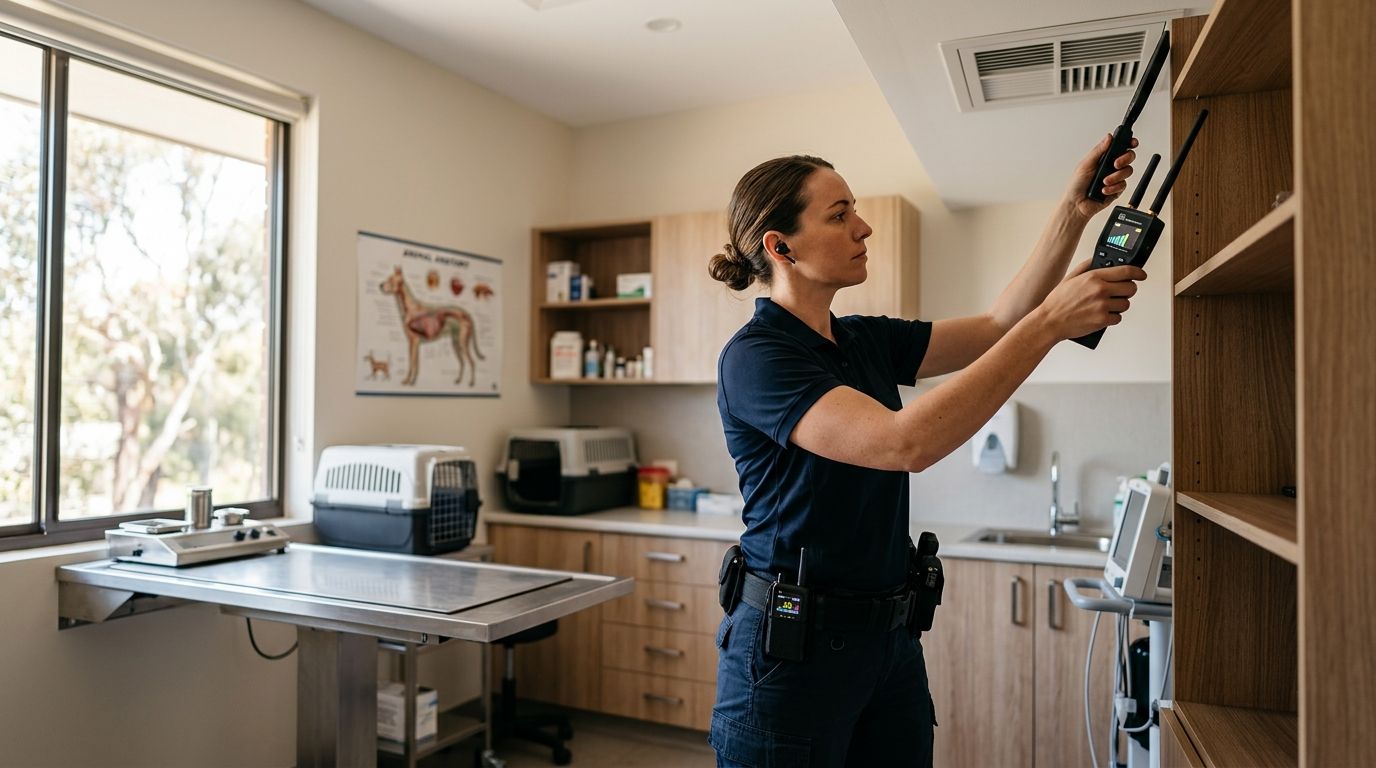
Hidden camera detection for veterinary clinics is the process of physically and electronically inspecting exam rooms, boarding areas, and staff spaces for concealed recording devices planted by a competitor, an ex-employee, or a client with a grievance. A veterinary practice handles pet owners in emotional, often private moments — euthanasia consultations, financial disputes, injury exams — and that makes exam rooms and consultation offices a specific target for hidden audio or video devices that a retail store or restaurant wouldn't have to worry about in the same way.
- Hidden camera detection for veterinary clinics starts with a visual sweep of exam rooms, boarding kennels, and staff break rooms before any equipment gets involved.
- USA Bugsweeps recommends a professional TSCM sweep after any employee termination, client complaint, or unexplained equipment tampering at a clinic.
- Phone-camera and app-based detectors catch infrared glints from cheap devices but miss RF-shielded or hardwired cameras used in higher-end setups.
- Boarding and kennel areas get skipped in most DIY sweeps even though overnight-stay pets create longer, less-supervised windows for a hidden device.
Why hidden camera detection matters for veterinary clinics
Veterinary clinics generate a specific kind of exposure that most small businesses don't: clients disrobe animals, discuss euthanasia decisions, and share financial information tied to payment plans, all inside a room they assume is private. A disgruntled former groomer or vet tech with lingering building access is a more realistic threat model here than a random stranger, and that changes where a sweep needs to focus.
Boarding and kennel areas add a second layer most clinics never think about. A pet stays overnight, unsupervised, in a room that isn't a treatment space — which means fewer eyes on it and a longer opportunity window for anyone who wants footage of after-hours staff behavior or wants to document how animals are actually handled once owners leave. A hidden camera sweep for a veterinary clinic has to cover exam rooms, boarding kennels, grooming stations, and staff break areas as four separate zones, not one combined walkthrough.
Inspect exam rooms and treatment areas visually
Start with the rooms clients spend the most time in. A slow, deliberate visual pass catches a surprising number of consumer-grade devices before any tool comes out.
- Check smoke detectors, wall clocks, and air vents for pinhole lenses or unusual wiring
- Look behind and under exam tables, cabinets, and supply carts for anything not part of the original build
- Scan power outlets and USB chargers for devices that don't match the clinic's known equipment
- Turn off the lights and look for small infrared LEDs that only show up in near-darkness
- Compare the room against a floor plan or photo from before any renovation or new equipment install
Check boarding and kennel areas for lens glints
Kennel rooms rarely get the same scrutiny as client-facing spaces, which is exactly why they need a dedicated pass.
- Sweep overhead lighting fixtures and HVAC vents, both common hiding spots in a room with high ceilings
- Check food storage areas and cleaning supply closets for cameras disguised as air fresheners or motion sensors
- Inspect any staff-installed "monitoring" cameras to confirm they're the ones the clinic actually authorized
- Walk the kennel at night with the lights off using a flashlight held close to your eye — most cheap lenses reflect light back at this angle
The medical offices and patient privacy guide covers the same exam-room privacy risk in more detail if the clinic shares a building with a human medical tenant.
Sweep staff break rooms and locker areas
Employee disputes are the most common trigger for a clinic to request hidden camera detection. A tech who was recently terminated, or a staff conflict that escalated, is reason enough to check the spaces employees consider private.
- Check staff bathrooms, changing areas, and locker rooms — the highest-risk zones for employee privacy complaints
- Inspect break room electronics: microwaves, coffee makers, and speakers are common camera housings
- Review who had building access in the last 30 days and whether any of them still hold a key or code
- Cross-check any newly installed "security" camera against what management actually approved
Scan Wi-Fi networks for unregistered devices
Many hidden cameras today stream over Wi-Fi rather than storing footage locally, which means the clinic's own network can expose them.
- Pull a full device list from the router admin panel and flag anything unrecognized
- Look for device names that mimic legitimate brands (printers, thermostats) but sit on unusual IP ranges
- Check for a second, hidden SSID broadcasting from the building — a common setup for a camera on its own network
- Run a bandwidth check during closed hours; a live-streaming camera uses data even when the clinic is empty
This step is where most clinics hit a wall — a router page tells you a device exists, not where it's physically hidden or whether it's even a camera. This is the point where a clinic manager should stop troubleshooting alone and bring in a professional sweep, because matching a network device to a physical location requires RF locating equipment most practices don't own.
Bring in a professional TSCM sweep after any dispute
A trained technician runs spectrum analyzers and non-linear junction detectors that find devices regardless of whether they're transmitting, powered on, or hardwired — something no phone app or DIY check can replicate. Usa Bugsweeps runs sweeps for veterinary practices the same way it handles other client-facing small businesses: full RF spectrum scan, physical inspection of fixtures and cavities, and a check of any network-connected device on-site.
- Book a sweep any time a technician is terminated for cause, not just when something feels off
- Request coverage of exam rooms, boarding areas, break rooms, and the front desk phone line in a single visit
- Ask for a written report of what was checked and what was found — a verbal "all clear" isn't enough documentation for an HR file
- Schedule a repeat sweep after any major staff turnover, not just once a year
Get a nationwide TSCM sweep quote
Cover exam rooms, kennels, and staff areas in one visit.
Document findings and lock down the network afterward
A sweep that finds nothing is still worth recording. It establishes a clean baseline the clinic can point back to if a complaint surfaces later in 2026 or beyond.
- Save a written report with the date, rooms checked, and equipment used
- Change Wi-Fi passwords and router admin credentials immediately after any sweep
- Re-key or re-code any door that a terminated employee had access to
- Set a recurring sweep schedule tied to staff turnover, not a fixed calendar date
A clinic that only checks exam rooms and skips boarding kennels has covered half the building.
Comparison: hidden camera detection options for veterinary clinics
| Option | Best for | Key limitation |
|---|---|---|
| Visual inspection (staff-led) | Small clinics doing a quick baseline check | Misses RF-shielded, hardwired, or well-disguised devices |
| Phone camera / detector app | A fast first pass in a single exam room | High false-positive rate; doesn't catch non-transmitting devices |
| Consumer RF detector | Clinics wanting a repeatable in-house tool | Struggles in buildings with heavy Wi-Fi or medical equipment interference |
| Professional TSCM sweep (USA Bugsweeps) | Post-dispute checks, full-building coverage, documentation | Requires scheduling a technician rather than a same-hour DIY check |
Verdict: a professional TSCM sweep is the only option on this list that reliably covers exam rooms, kennels, and the clinic's network in a single documented visit — DIY methods are fine for a routine spot-check, not for a post-termination dispute.
Common mistakes veterinary clinics make
- Sweeping only the exam rooms. Boarding kennels and break rooms get skipped even though overnight stays and staff downtime create longer unsupervised windows.
- Treating a phone app as a full sweep. Detector apps catch cheap infrared glints but miss hardwired or RF-shielded devices used in more deliberate setups.
- Not re-sweeping after staff turnover. A single annual check misses the window right after a termination, which is when risk actually spikes.
- Confusing legitimate security cameras with hidden ones. Clinics sometimes flag their own authorized system, wasting time that should go toward checking unregistered devices.
- Skipping the network audit entirely. A visual sweep alone misses Wi-Fi-connected cameras that never show a visible lens in an obvious spot.
FAQ
What's the best way to detect hidden cameras in a veterinary clinic?
A full sweep covering exam rooms, boarding kennels, break rooms, and the Wi-Fi network catches the most device types. A visual check alone misses RF-shielded or hardwired cameras that a professional TSCM sweep is built to find.
Is hidden camera detection for veterinary clinics expensive?
Cost depends on the size of the facility and how many rooms need coverage. Request a free estimate directly from a TSCM provider rather than guessing based on a general rate.
Can a hidden camera be found with just a phone app?
A phone camera can catch the infrared glint from cheap, low-end devices in a dark room, but it won't detect hardwired cameras or ones that aren't actively transmitting. It's a useful first pass, not a full sweep.
Should boarding and kennel areas be swept along with exam rooms?
Yes. Overnight boarding creates a longer, less-supervised window than a daytime exam room, which makes kennel areas a higher-risk zone than most clinics assume.
Is it legal to record clients in a veterinary exam room without consent?
Recording laws vary by state, and many require at least one-party consent for audio. A clinic finding an unauthorized device should document it and consult local counsel before taking further action.
How often should a veterinary clinic sweep for hidden devices?
Beyond a routine annual check, sweep any time a staff member is terminated for cause or a client files a serious complaint. Turnover is the biggest trigger for a hidden device showing up.
What areas of a vet clinic carry the highest risk for hidden cameras?
Exam rooms, boarding kennels, staff break rooms, and locker areas carry the most risk because they combine privacy expectations with limited daily oversight.
One last thing
Most clinics that call for a sweep in 2026 are reacting to a specific incident — a termination, a complaint, a tampered piece of equipment — rather than doing routine prevention. The clinics that catch a device early are almost always the ones that scheduled a sweep the same week staff turnover happened, not months later once something else went wrong. Treat termination day as a trigger for a sweep request, not an afterthought.


