
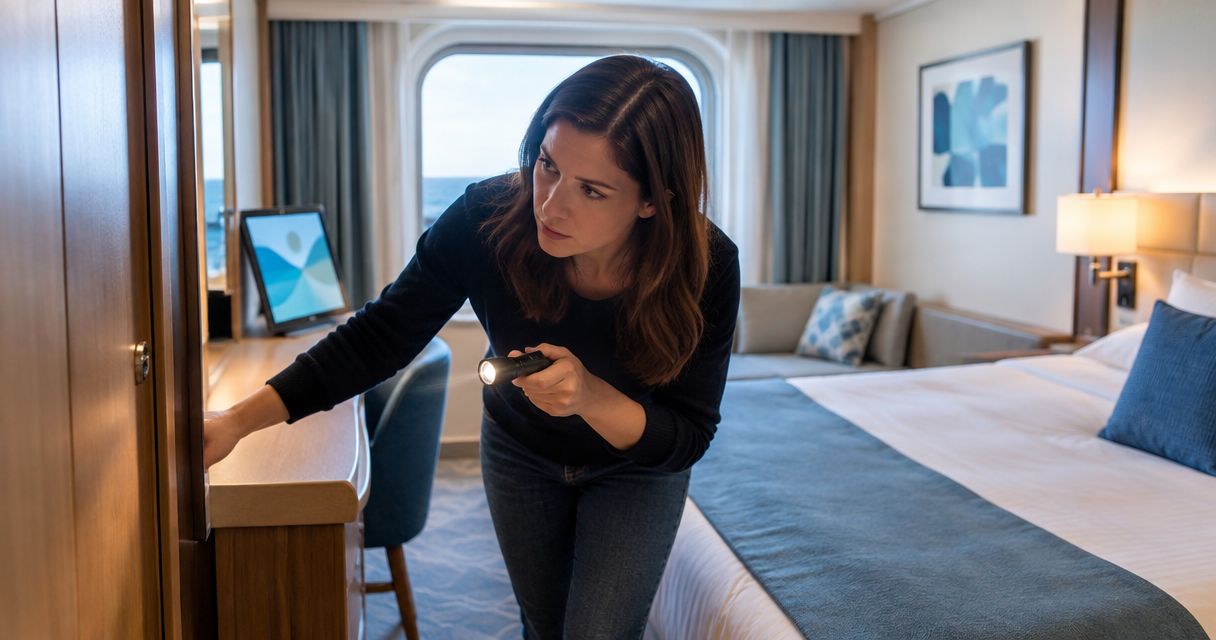
Check a cruise ship cabin for hidden cameras by scanning every wall-mounted object — the smoke detector, alarm clock, USB charger, and mirror frame — with a flashlight held close to eye level to catch a pinhole lens glare, then sweeping the room with a handheld RF detector to pick up a wireless transmitter signal. Most cabin cameras run on battery power and record straight to internal memory, so a Wi-Fi network scan on your phone won't catch them. If the flashlight pass and the RF sweep both come back clean, work through the six hiding spots below before you unpack for the week.
- Checking a cruise ship cabin for hidden cameras means a flashlight pinhole scan plus an RF sweep, not a Wi-Fi check.
- Smoke detectors, alarm clocks, and mirror frames are the three most common hiding spots for cabin cameras in 2026.
- Battery-powered pinhole cameras record without transmitting, so a phone app that only reads Wi-Fi traffic misses them.
- USA Bugsweeps recommends a professional TSCM sweep for suites, repeat bookings, and long-charter cabins over a handheld device alone.
Why this matters
Cruise cabins in 2026 turn over between passengers every few days to two weeks, and the same physical space gets used by dozens of different guests a year. That turnover is exactly what makes a cabin an easy target for a cheap pinhole camera left behind on purpose — the device doesn't need Wi-Fi, doesn't need a subscription, and can sit inside a smoke detector housing for months before anyone notices. The same logic applies to short-term rentals and hotel rooms, where fast turnover and staff access create the same opportunity.
Cabin size makes the problem worse, not better. A standard interior stateroom is small enough that a single hidden camera mounted near the ceiling can cover the bed, the closet, and the bathroom doorway from one spot, so one device does the work three would need in a house.
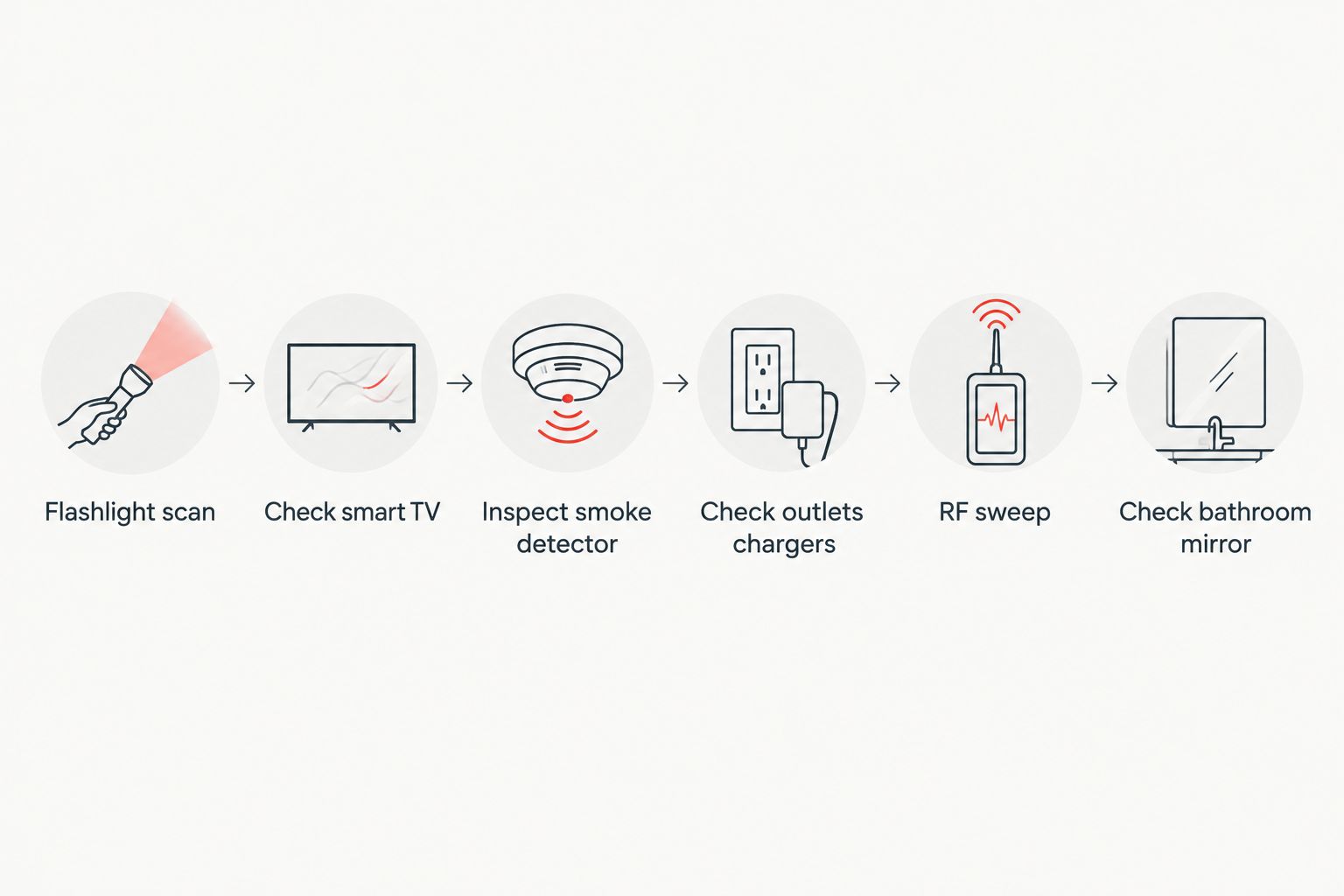
How to check a cruise ship cabin for hidden cameras
Work through these steps in order, in the same room lighting you'll actually sleep in.
- Turn off the room lights and run the flashlight scan. Hold your phone flashlight or a small LED close to your eye and sweep it slowly across every surface at a low angle. A pinhole camera lens reflects light back at you as a tiny, sharp glint — a screw head or vent hole does not.
- Check the smart TV and any streaming box. In 2026, most cabin TVs ship with a streaming app bar and no front-facing camera of their own, so any lens on the bezel or on an add-on box mounted to the wall is worth a second look.
- Inspect the smoke detector and sprinkler head. A smoke detector should have exactly one small sensor opening. Two openings, an odd mesh patch, or a housing that looks newer than the fixture around it deserves a closer check.
- Check outlets, USB chargers, and the alarm clock. These three are the most common camera housings sold on hidden-camera marketplaces because they already have a plausible reason to face into the room.
- Run an RF detector across the cabin. A wireless hidden camera transmits on the same general radio frequencies as a Bluetooth speaker or baby monitor, and a handheld RF detector picks up that signal even when the device is off-network and out of sight.
- Check the bathroom mirror and vent cover. Two-way mirrors and vent-mounted cameras are less common on a ship than in a short-term rental, but the mirror frame and vent grille still deserve a flashlight pass.
Why hidden camera risk varies by cabin
Not every cabin carries the same risk. These factors decide how carefully you should check:
- Cabin category — suites and balcony cabins with a smart TV or streaming box give a camera more objects to hide inside than a basic interior stateroom.
- Repeat booking history — a cabin you've stayed in before, or one booked through a long-term charter, has had more turnover and more chances for a device to go unnoticed.
- Recent refit history — cabins refit ahead of the 2026 sailing season sometimes have extra wall access points that make a wired camera easier to install and harder to spot.
- Presence of smart speakers or voice assistants — an in-room voice assistant is a listening risk on its own, separate from a camera, and worth its own check.
- Deck location — cabins low on the ship near crew or service corridors see more staff foot traffic than cabins on upper passenger-only decks.
Can a phone camera detect a hidden camera in a cruise cabin?
A phone camera can catch a hidden camera's infrared glow in a dark room, but it only works on cameras that use infrared night vision — many cheap pinhole cameras don't emit visible IR at all. Pair the phone-camera check with the flashlight scan and RF sweep above instead of relying on it alone; the full method is covered in detecting hidden cameras with your phone camera.
Are hidden cameras illegal on a cruise ship?
Yes — installing a hidden camera in a private space like a passenger cabin or its bathroom is illegal under U.S. federal voyeurism statutes for ships calling at U.S. ports, and as of 2026 nearly every major cruise line's own conduct policy treats it as a terminable offense for staff and passengers alike. The complication is jurisdiction: a foreign-flagged ship in international waters can fall under a different country's law depending on where the incident happened and who's involved.
What should I do if I find a hidden camera in my cruise cabin?
Don't touch or remove the device — photograph it in place, note the exact location, and report it immediately to the ship's security officer or guest services desk so the incident gets logged before the cabin is cleaned or the device is moved. If you want the room cleared with equipment rather than a visual and RF check alone, a TSCM provider like USA Bugsweeps runs the same hidden camera and wireless transmitter checks for travelers ahead of high-value or long-term bookings.
Get a professional cabin sweep
USA Bugsweeps runs TSCM checks for hidden cameras and RF transmitters before high-value trips.
FAQ
How do I check a cruise ship cabin for hidden cameras?
Scan the cabin with a flashlight held close to eye level to catch pinhole lens glare, then sweep the room with a handheld RF detector to catch a wireless transmitter signal. Battery-powered cameras won't show up on a Wi-Fi scan, so the flashlight and RF steps matter more than checking the ship's network.
Can an RF detector find a hidden camera that isn't transmitting?
No — an RF detector only finds a camera that is actively transmitting a wireless signal, so a camera recording to an internal memory card with no transmitter won't trigger it. That's why the flashlight lens-glint check matters as much as the RF sweep, not as a backup to it.
Where do hidden cameras usually hide in a cabin?
Smoke detectors, alarm clocks, USB chargers, and streaming boxes are the most common housings because they already face into the room for a plausible reason. Mirror frames and vent covers are less common on a ship but still worth a check.
Is it legal for anyone to install a camera in a passenger cabin?
No — a cabin and its bathroom are private spaces, and installing a recording device there without consent is illegal under U.S. voyeurism statutes for ships calling at U.S. ports as of 2026. Jurisdiction can shift for foreign-flagged ships in international waters, but the private-space rule holds across nearly every cruise line's own conduct policy.
Does a Wi-Fi network scanner find hidden cameras in a cruise cabin?
No — a Wi-Fi scanner only finds cameras connected to a wireless network, and most cabin hidden cameras record locally on battery power with no network connection at all. Treat a clean Wi-Fi scan as no information, not as proof the cabin is clear.
Should I bring my own RF detector on a cruise?
A basic handheld RF detector packs small and gives you a same-day answer during the outlet and smoke detector checks described above. For a suite, a long charter, or a repeat booking, a professional TSCM sweep before the trip covers more ground than a handheld device alone.
What should I do if I find a camera in my cabin?
Photograph the device in place without moving it, then report it to the ship's security officer or guest services desk immediately so the incident is logged. Removing or tampering with the device yourself can complicate any investigation the cruise line or law enforcement runs afterward.
One last thing
The detail most people miss: a pinhole camera lens only glints back at a flashlight when the light hits it at close to the same angle you're viewing it from, so a flashlight swept fast at arm's length misses lenses a slow, close-to-the-eye pass catches. Run the scan twice — once standing, once crouched near the bed — before you decide 2026's smaller staterooms are clear.


